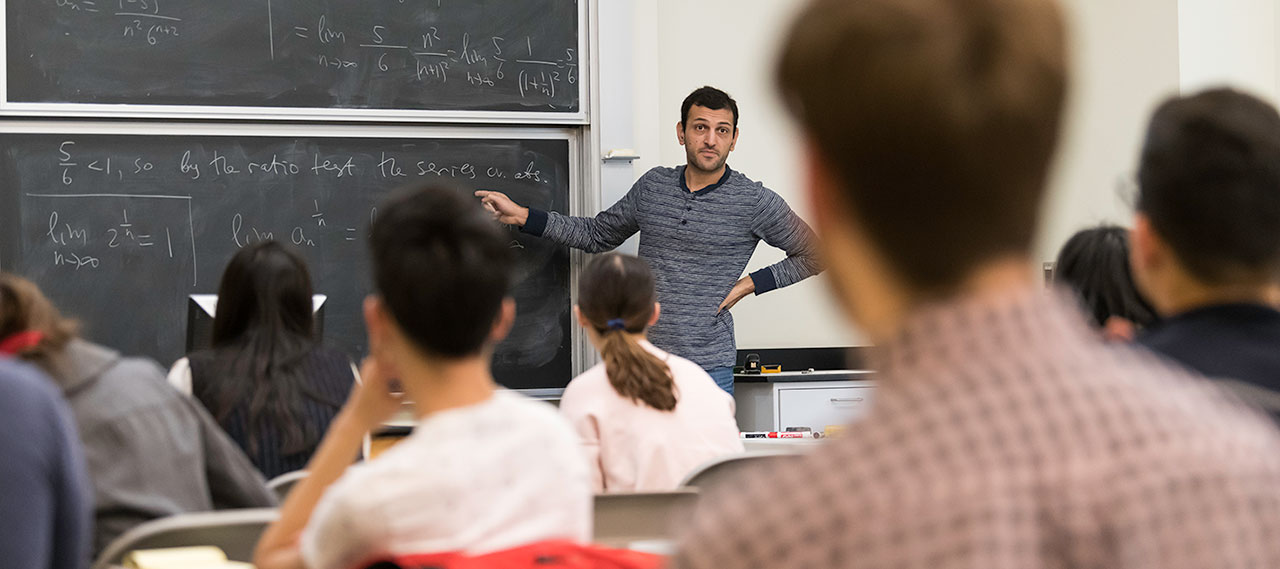
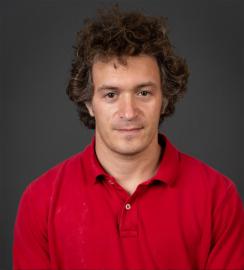
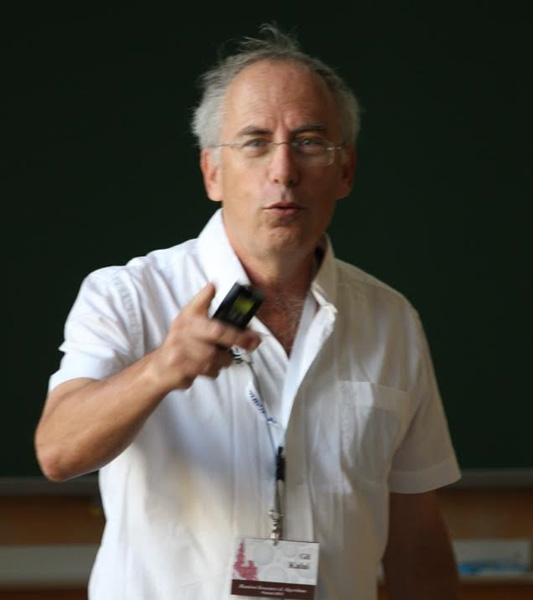
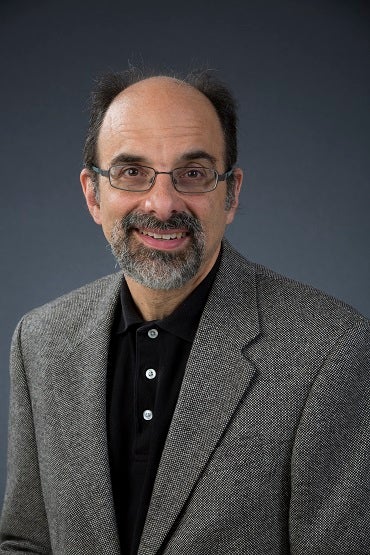
Yang P. Liu is an Assistant Professor at Carnegie Mellon University 's Department of Computer Science . He received his PhD from Stanford University under the supervision of Aaron Sidford and previously studied at MIT . Fields of Interest : Graph Algorithms, Optimization, High-Dimensional Geometry, Additive Combinatorics, Theoretical Computer Science. His research focuses on algorithmic design and analysis for graph problems, optimization, and combinatorics, with applications in machine learning and complexity theory. Recent work includes advancements in parallel repetition games , combinatorial lines , and dynamic graph algorithms . In 2024, his research spanned FOCS , STOC , and RANDOM conferences, addressing problems in k-CSPs , min-cost flow , and hypergraph sparsification . Earlier contributions (2023) included deterministic flow algorithms and spectral hypergraph techniques. Scientific Awards : NDSEG Fellowship (2018-2021), Google PhD Fellowship (2022-2023), FOCS Best Paper (2022), STOC Best Student Paper (2022), FOCS Best Student Paper (2021). He teaches CS 15-759 , a graduate course on convex optimization theory and applications, covering gradient descent, interior point methods, and algorithmic sparsification techniques.
Andrew Childs is a Professor at the University of Maryland, affiliated with the Department of Computer Science and the Institute for Advanced Computer Studies (UMIACS). He serves as Director of the NSF Quantum Leap Challenge Institute for Robust Quantum Simulation (RQS) and is a Fellow at the Joint Center for Quantum Information and Computer Science (QuICS). His research focuses on quantum algorithms for simulating physical systems, algebraic problems, and quantum walk protocols, with applications in quantum computing and computational complexity. University of Maryland Institute for Advanced Computer Studies (UMIACS) Joint Center for Quantum Information and Computer Science (QuICS) NSF Quantum Leap Challenge Institute for Robust Quantum Simulation Childs' research spans quantum simulation, quantum Fourier transform, phase estimation, and Hamiltonian dynamics. He has developed techniques to reduce quantum computational resources for simulating quantum systems and explored limitations of quantum computers through hidden subgroup problems and non-unitary dynamics. His publications cover diverse areas including quantum walk optimization, Hamiltonian simulation methods, and applications to cryptography and condensed matter physics. Recent works address spatial search algorithms, product formulas for commutators, and quantum routing protocols. As an educator, Childs has taught courses on quantum algorithms and information processing at both the University of Maryland and University of Waterloo, with lecture notes and materials spanning multiple years. Contact: amchilds@umd.edu | Office: ATL 3359 | Affiliated with University of Maryland's quantum research institutes.
Professor Dinesh S. Thakur holds the position of Professor in the Department of Mathematics at the University of Rochester. He earned his PhD from Harvard University and has made significant contributions to number theory, arithmetic geometry, and function field arithmetic. His research focuses on developing theories related to zeta functions, Drinfeld modules, and p-adic analysis in finite characteristic environments. Education: PhD in Mathematics, Harvard University Research Interests: Thakur’s work integrates advanced topics such as elliptic curves, modular forms, Diophantine equations, and the arithmetic of function fields. He has pioneered studies on multizeta values, p-adic continued fractions, and the distribution of Diophantine exponents in finite characteristic. His research bridges classical number theory with modern algebraic geometry and p-adic analysis. Teaching & Mentorship: Thakur has taught a wide range of courses, including graduate-level topics in function field arithmetic, algebraic geometry, and number theory. He has advised 11 PhD students and several master’s students, whose theses span themes like elliptic Carmichael numbers, Drinfeld modular forms, and multizeta relations. Notable advisees include Javier Diaz-Vargas (1996), George Todd (2015), and Yao-Rui Yeo (2021). Outreach & Contributions: Thakur participates in initiatives like the Arizona Winter School and Olympiad training programs in India. He maintains an active seminar series at UR on topics such as L-values, Fermat’s Last Theorem, and automatic sequences. His work is accessible through his personal page and MathSciNet.
Professor Imre Leader is a distinguished mathematician at the University of Cambridge, where he serves as Professor of Pure Mathematics in the Department of Pure Mathematics and Mathematical Statistics (DPMMS), which is part of the Faculty of Mathematics. His office is located in room C2.02 at the DPMMS building. Professor Leader's research primarily focuses on Extremal Combinatorics and Ramsey Theory , two fundamental areas of discrete mathematics. His work explores deep connections between combinatorial structures, set theory, and algebraic properties. He has made significant contributions to understanding partition regularity, monochromatic structures, extremal set theory, and combinatorial geometry. His research often bridges the gap between pure combinatorics and applications in computer science and theoretical mathematics. Over his prolific career, Professor Leader has published numerous influential papers in top mathematical journals, collaborating with leading mathematicians worldwide. His work spans various aspects of combinatorics including hypergraph theory, geometric combinatorics, additive number theory, and combinatorial game theory. He has been particularly active in advancing our understanding of Ramsey-type phenomena in infinite structures and developing new techniques in extremal combinatorics. Research Group: Combinatorics Email: I.Leader@dpmms.cam.ac.uk Telephone: 01223 765902 Personal homepage: https://www.dpmms.cam.ac.uk/~ibl10
Peter Selinger is a Professor in the Department of Mathematics and Statistics at Dalhousie University , with a cross-appointment in Computer Science. He specializes in mathematical methods in computer science, particularly quantum computing and combinatorial game theory . His work on quantum programming languages like Quipper and foundational research in category theory has garnered international recognition. Education : Ph.D. in Mathematics (University of Pennsylvania, 1997), undergraduate studies in Mathematics (Technische Universität Darmstadt). Research Interests span quantum computing, category theory, and combinatorial game theory. He has pioneered formalisms for quantum programming languages, developed categorical models for quantum mechanics, and analyzed game-theoretic structures in games like Hex. His recent work includes linear dependent type theory , quantum circuit synthesis , and combinatorial game classification . Publications demonstrate expertise in quantum programming languages, categorical semantics, and game theory. Key trends include Hamiltonian simulation , Clifford+T circuits , and monotone game realization . Scientific Honors include the Killam Professorship (2017–2022), Faculty of Science Award for Excellence in Teaching (2023), and fellowships from the Alfred P. Sloan Foundation and German National Scholarship Foundation . Students he has supervised include PhD graduates Xiaoning Bian , Francisco Rios , and Neil J. Ross , along with MSc students like Fahimeh Bayeh and Seth Greylyn . He has advised 16 postdoctoral researchers.
Illya V. Hicks is a Professor in the Computational and Applied Mathematics Department at Rice University. He holds a PhD from Rice University (2000) and a BS from Texas State University (1995). His research focuses on combinatorial optimization, integer programming, graph theory, and matroid theory, with applications in social networks, cancer treatment, and network design. He has advised numerous doctoral, post-doctoral, and masters students. Education: PhD and MA in Computational and Applied Mathematics, Rice University, 2000 BS in Mathematics, Texas State University, 1995 Research Interests: Utilizing graph decomposition techniques to solve NP-complete problems, including branch decompositions and matroid circuit problems. Applications include sensor network design, healthcare logistics, and algorithmic graph theory. Awards: Recognized with the 2015 Presidential Mentoring Award (Rice University), 2010 Forum Moving Spirit Award (INFORMS), and the 2005 Optimization Prize for Young Researchers. Grants and Projects: Includes NSF-funded research on branch decomposition techniques, submodular optimization, and healthcare service distribution. Active in promoting minority participation in operations research through travel grants and mentoring initiatives. Labs/Teams: Engaged in collaborative research on graph algorithms, combinatorial optimization, and interdisciplinary applications in healthcare and engineering.
Paul Larson is a Professor of Mathematics at Miami University. His research focuses on set theory, topology, and model theory, with particular expertise in forcing axioms, descriptive set theory, and infinitary logic. He holds a Ph.D. in Mathematics from the University of California, Berkeley. His work bridges foundational mathematical logic with applications in topology and combinatorics. Key contributions include studies on canonical models under fragments of the Axiom of Choice, polar forcings, and cardinal characteristics. Larson has collaborated extensively with leading researchers such as Saharon Shelah and Jindřich Zapletal. His publications span prestigious journals like the Annals of Pure and Applied Logic and Transactions of the American Mathematical Society. Beyond research, he contributes to the academic community through editorial work and expository writings on historical developments in determinacy theory. Education: Ph.D., Mathematics, University of California, Berkeley Research interests emphasize foundational questions in set theory with applications to topology and model theory. His recent work explores advanced forcing techniques, square principles in Pmax extensions, and combinatorial properties of cardinal invariants. Publications reflect interdisciplinary engagement, including crystal structure prediction in high-pressure chemistry and operator theory in functional analysis. Despite an extensive publication record, no specific scientific awards are documented here. His advising and grant activities remain unspecified in the provided texts. Collaborations span international institutions, reflecting his role as a central figure in contemporary set theory research.
Daniel M. Kane is a Professor at the University of California, San Diego (UCSD), holding a joint appointment in the Department of Mathematics and the Department of Computer Science and Engineering (CSE). His research spans mathematics and theoretical computer science, with a focus on number theory, combinatorics, complexity theory, and computational statistics. He earned a Ph.D. in Mathematics from Harvard University (2011) and dual BS degrees in Mathematics with Computer Science and Physics from MIT (2007). Prior to UCSD, he was a postdoctoral researcher at Stanford University (2011–2014) on an NSF fellowship. His research interests include robust statistics, machine learning, polynomial threshold functions, and algorithmic methods for high-dimensional data. Notable achievements include co-authoring the book Algorithmic High-Dimensional Robust Statistics (Cambridge University Press, 2023) and receiving the Best Paper Award at the Conference on Computational Complexity (2013), as well as gold medals at the International Mathematical Olympiad (2002 and 2003). Current teaching includes courses such as Math 96 (Putnam Seminar), Math 154 (Graph Theory), CSE 101 (Algorithms), and CSE 203A (Randomized Algorithms). He has consulted for companies like CASPER Labs and AIble, and his work extends to cryptographic protocols, including quantum money schemes based on quaternion algebras. Key contributions include breakthroughs in robust mean estimation, list-decodable learning, and the development of efficient algorithms for statistical problems. His research often bridges foundational theory with practical applications in machine learning and data analysis.
Daniel A. Spielman is a Sterling Professor of Computer Science, Statistics & Data Science, and Mathematics at Yale University. He serves as the inaugural James A. Attwood Director of the Institute for Foundations of Data Science (FDS) and was previously co-Director of the Yale Institute for Network Science (YINS). He is also a member of TILOS, the NSF Institute for Learning-Enabled Optimization at Scale. His research interests span Spectral Graph Theory, Algebraic Graph Theory, Laplacian Matrices, Expander Graphs, and Random Walks on Graphs. Spielman has made fundamental contributions to understanding the mathematical foundations of data science, including work on smoothed analysis of algorithms, spectral sparsification, and solutions to the Kadison-Singer problem. Spielman's publications demonstrate a consistent focus on developing efficient algorithms with strong theoretical foundations. His work bridges pure mathematics, theoretical computer science, and practical applications in network analysis and machine learning. His research has evolved from foundational work on smoothed analysis to recent contributions in experimental design using discrepancy theory. His scientific honors include: Nevanlinna Prize for contributions to mathematical aspects of computer science Two Gödel Prizes (2008 and 2015) for outstanding papers in theoretical computer science MacArthur Fellowship ('Genius Grant') Simons Investigator award Membership in the National Academy of Sciences and American Academy of Arts and Sciences Spielman has advised numerous PhD students who have gone on to prominent positions in academia and industry. His teaching includes advanced courses in Spectral Graph Theory and Computation and Optimization. He has developed important software packages like Laplacians.jl for solving Laplacian linear equations and related problems.
Laura Anderson is an Associate Professor in the Department of Mathematics at Binghamton University. She holds a Ph.D. from MIT (1994) and has been affiliated with Binghamton since 2001. Her research focuses on Combinatorics and Topology, with a specialization in matroid theory, hyperplane transversals, and topological combinatorics. She teaches advanced courses such as Introduction to Combinatorics (Math 511) and Discrete Mathematics (Math 314). Her academic contributions include groundbreaking work on oriented matroids, combinatorial Grassmannians, and hyperfield applications. Anderson has advised multiple Ph.D. students, including Olakunle Abawonse, Ulysses Alvarez, and Leandro Junes, whose theses explore topics like matroid extensions and tropical phased matroids. She actively participates in academic conferences, co-organizing the Binghamton University Graduate Conference in Algebra and Topology (BUGCAT). Anderson’s research integrates algebraic topology with discrete mathematics, addressing geometric realizations, hyperfield structures, and topological invariants. Her pedagogical innovations include experimenting with flipped classroom methods in calculus education. She maintains an active presence in academic service, contributing to journal reviews and editorial work in combinatorial geometry.
David Perkinson is a Professor of Mathematics at Reed College, where he holds a position in the Department of Mathematics. His research focuses on combinatorics, algebraic geometry, and discrete mathematics, with a particular emphasis on sandpile models, graph theory, and matroid theory. He is the author of the textbook *Divisors and Sandpiles: An Introduction to Chip-Firing*, which explores the combinatorial theory of chip-firing on graphs. Perkinson has also developed software tools like the Sandpile Java App, which visualizes and analyzes the Abelian Sandpile Model. He organizes the Cascade Lectures in Combinatorics (CALICO), a series of conferences funded by the National Science Foundation, aimed at fostering collaboration among researchers in combinatorics. His work bridges discrete mathematics with algebraic geometry, emphasizing connections between graph theory and geometric structures. Perkinson teaches advanced courses in analysis and contributes to the academic community through his research on topics such as divisor theory on graphs, sandpile groups, and combinatorial game theory. His recent publications (2015–2024) address matroid theory, sandpile dynamics, and applications of algebraic methods to discrete systems.
John MacLaren Walsh is a Professor in the Department of Electrical and Computer Engineering at Drexel University, where he leads the Adaptive Signal Processing and Information Theory Research Group. He holds BS, MS, and PhD degrees from Cornell University, all completed under Dr. C. Richard Johnson, Jr. His research spans information theory, network coding, distributed computing, and machine learning applications in patent analysis. His work focuses on: Bounding entropic vectors and their impact on communication networks Rate region computation for network coding and distributed storage Information theory for distributed function computation Machine learning-enhanced patent processing systems Publications emphasize entropy geometry, network coding complexity, distributed algorithms, and patent analysis, with consistent themes of optimization and combinatorial methods. Recent work (2016-2019) shows increased focus on probabilistic supports and computational efficiency in network coding. Awards: 2011 NSF CAREER Award for 'Entropy Geometry in Variational Inference Signal Processing' He has advised PhD students on topics like entropy region mapping, network coding, and distributed control. Key grants include NSF CAREER and AFOSR funding for wireless network overhead control. He directs the Adaptive Signal Processing and Information Theory Research Group, which develops algorithms for network coding, distributed storage, and patent analysis systems.
Gil Kalai is a Professor of Mathematics at the Hebrew University of Jerusalem since 1992, where he holds the Henry and Manya Noskwith Chair. He also serves as an Adjunct Professor of Mathematics and Computer Science at Yale University since 2004 in a long-term part-time visiting position. His academic career includes visiting positions at prestigious institutions including MIT, Cornell, IAS Princeton, Berkeley, Bell-labs, IBM, and Microsoft. Professor Kalai's research spans multiple areas within mathematics and theoretical computer science. His work in combinatorics encompasses geometric, probabilistic, and topological approaches. He has made significant contributions to the study of convex sets and polytopes, linear programming, and theoretical computer science. His influential 1988 paper with Kahn and Linial on Boolean functions pioneered applications of Fourier analysis in theoretical computer science. Kalai's research has evolved to include the application of Fourier analysis to thresholds, influences, symmetries, noise, percolation, and social choice. He has developed theories in algebraic shifting and studied face-numbers and other combinatorial invariants of polytopes. His work on the diameter of polytopes and randomized simplex algorithms has been influential in optimization theory. In 1993, his collaboration with Kahn produced a groundbreaking counterexample to Borsuk's Conjecture in 1325 dimensions. Professor Kalai's publications reveal a consistent focus on the intersection of combinatorics, geometry, and theoretical computer science. His work shows a progression from foundational combinatorial geometry to increasingly sophisticated applications of harmonic analysis in discrete mathematics. The recurring themes across his 30+ year career include Boolean functions, polytope theory, and probabilistic methods in combinatorics, demonstrating remarkable coherence in his research trajectory. 2016 European congress of Mathematics, plenary speaker 2013 ERC advanced grant 2012 Rothschild Prize 1994 International Congress of Mathematicians invited section talk, Zurich 1994 Fulkerson Prize 1993 Erdos Prize 1992 Polya Prize Though specific details of his advising are not provided in the source material, Kalai has written over 70 scientific papers and maintains an active research blog entitled "Combinatorics and More." His 2013 ERC advanced grant indicates significant research funding for his work. His extensive collaborations with researchers across multiple institutions suggest a robust research program with numerous PhD students and postdoctoral researchers, though specific names are not mentioned in the provided texts. Professor Kalai maintains active research connections across multiple institutions including Hebrew University, Yale, and various research centers worldwide. His work bridges pure mathematics and theoretical computer science, creating a unique interdisciplinary research environment that influences both fields.
Stephen A. Vavasis is a Professor in the Department of Combinatorics and Optimization at the University of Waterloo, part of the Faculty of Mathematics. He holds a PhD in Computer Science from Stanford University (1989) and has held academic positions at Cornell University (1989–2006) before joining Waterloo. His research focuses on continuous optimization, data science, first-order methods, scientific computing, and computational mechanics. Current teaching includes courses on convex optimization and portfolio optimization methods. He has served as Associate Dean of Computing (2017–2020) and Interim Director of Data Science graduate programs. His work is supported by NSERC grants. Notable awards include the Hertz Fellowship, Churchill Scholarship, and Guggenheim Fellowship. Vavasis's research emphasizes applications of optimization to clustering, machine learning, and fracture mechanics. His publications span convex optimization frameworks, algorithmic analysis of gradient methods, and numerical methods in mechanics. Recent work explores unifying analyses of first-order optimization algorithms and robust optimization techniques for high-dimensional data problems.
Vadim Lozin is a Professor of Mathematics at the University of Warwick, affiliated with the Department of Mathematics within the School of Mathematics. His research interests span graph theory, combinatorics, and discrete mathematics, focusing on areas such as clique-width, Ramsey numbers, and structural graph theory. He has held visiting positions at institutions including the Université Paris-Dauphine, EPFL, and KAUST. Lozin has received several accolades, including the Best Paper Award for 'Linear Ramsey numbers' in 2018 and a 2024 award at the International Symposium on Algorithms and Computation. His work involves collaborations with global researchers and contributions to conferences like IWOCA and WG. Lozin serves on editorial boards for journals such as Discrete Applied Mathematics and Electronic Notes in Discrete Mathematics . His research explores foundational problems in graph theory, with applications in algorithm design and complexity analysis. Lozin’s publications include studies on union-closed sets, functional graph properties, and algorithmic approaches to graph parameters. He has also contributed to books like Words and Graphs , bridging formal language theory with graph structures. His grants focus on clique-width and stability in graphs, reflecting his commitment to advancing theoretical and applied discrete mathematics.