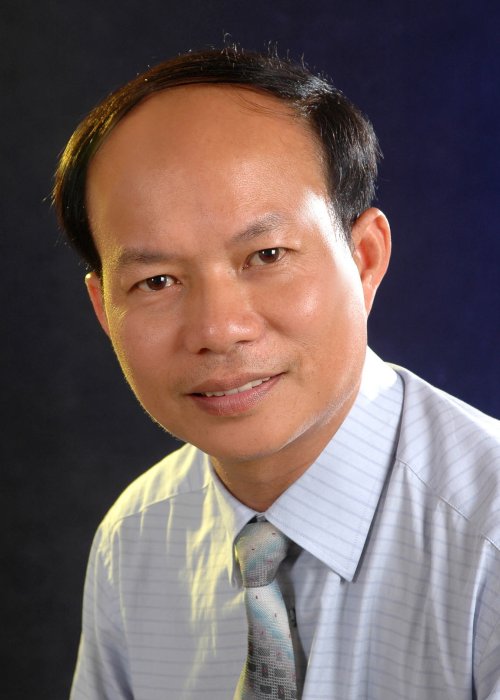
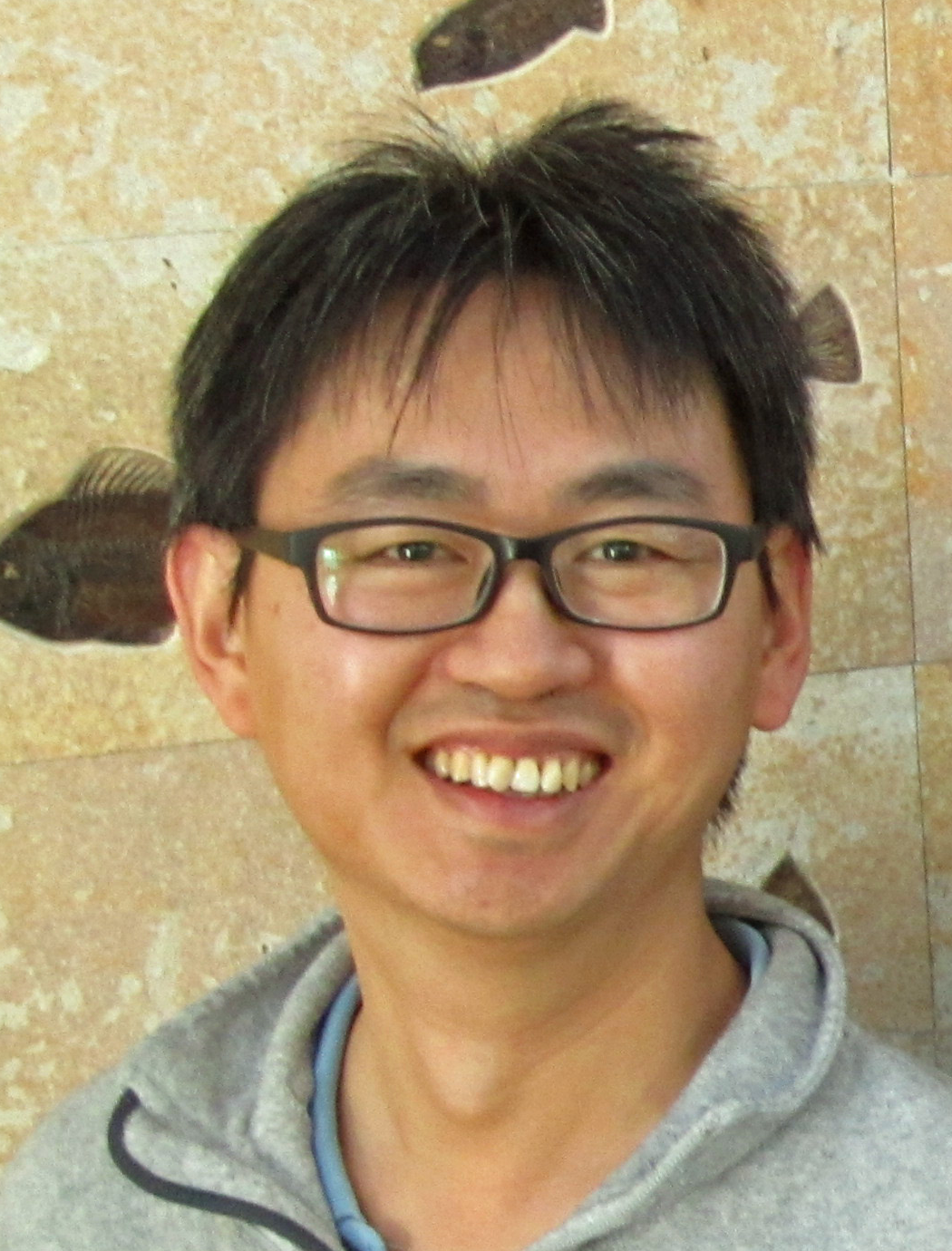
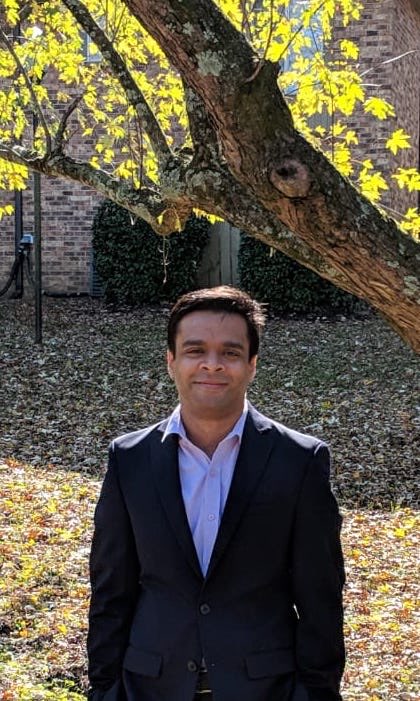
Professor Hoang Xuan Phu is a renowned mathematician affiliated with the Institute of Mathematics , Vietnam Academy of Science and Technology , where he has served since 1984 (Researcher), 1992 (Associate Professor), and 1996 (Professor). He is an elected member of multiple prestigious academies: the Heidelberg Academy of Sciences and Humanities (2004), Bavarian Academy of Sciences and Humanities (2010), TWAS - The World Academy of Sciences (2013), and acatech - National Academy of Science and Engineering, Germany (2019). His email contact is hxphu@math.ac.vn and phu@iwr.uni-heidelberg.de . Education : University of Leipzig (Diploma 1979, PhD 1983, Habilitation 1987) Research Areas : Optimization, Optimal Control, Functional Analysis, Numerical Analysis, Rough Analysis Applications : Inventory Problems, Hydroelectric Power Plant Control, Robotics, Open Channel Hydraulics Editorial Roles : Editor-in-Chief of Vietnam Journal of Mathematics (2011-2022), Honorary Editor-in-Chief (2023-present), Associate Editor for multiple journals His recent publications focus on convex hull algorithms, optimal path planning, and function perturbation analysis, reflecting his expertise in mathematical optimization and computational methods. He has organized numerous international conferences on High Performance Scientific Computing in Hanoi (2000-2024) and Optimization & Scientific Computing (2003-2024).
Oliver G. Ernst is a Professor of Numerical Analysis at Technische Universität Chemnitz . His research focuses on Numerical Analysis , Uncertainty Quantification , and Inverse Problems , with applications in Thermo-Hydro-Mechanical (THM) processes , Electromagnetics , and Stochastic Partial Differential Equations . He is associated with the Numerical Analysis group at TU Chemnitz. Key Research Areas : Efficient numerical methods for PDEs Krylov subspace techniques Stochastic finite element methods Multi-physics modeling Geoscientific applications Recent Publications (2025-2010): THM simulations under uncertainty Neural network PDE solvers Bayesian inversion frameworks Rational Krylov algorithms Deflated restarting strategies Collaborations : TU Bergakademie Freiberg University of Manchester Technical University of Munich University of Maryland University of Geneva Software Development : Contributor to OpenGeoSys platform Developer of FEMALY MATLAB library Academic Recognition : h-index 32, i10-index 66, with over 4423 citations since 2020.
Roie Levin is an Assistant Professor at Rutgers University's Department of Computer Science. He received his PhD in Algorithms, Combinatorics and Optimization from Carnegie Mellon University in 2022, advised by Anupam Gupta. Prior to that, he worked at the Allen Institute for Artificial Intelligence (2015-2017) and earned dual BSc degrees in Computer Science/Applied Mathematics and Mathematics from Brown University (2015). Before joining Rutgers, he was a Fulbright Postdoctoral Fellow at Tel Aviv University under Niv Buchbinder. Current Role: Assistant Professor in Computer Science Academic Training: PhD (2022) CMU, BSc (2015) Brown University Postdoctoral: Fulbright Fellow at Tel Aviv University Levin's research focuses on approximation algorithms for uncertain environments (online/dynamic/streaming models) and submodular function optimization. His work spans theoretical foundations and practical implementations across distributed systems, geometric constraints, and reinforcement learning paradigms. Teaching includes graduate and undergraduate algorithms courses (CS 344, CS 513) with emphasis on problem-solving techniques, computational complexity, and modern algorithmic trends. His publications showcase expertise in online algorithms, submodular optimization, and approximation theory with applications in clustering, caching, and machine learning. The 2025 articles demonstrate continued exploration of online consistency and contention resolution, while 2023-2024 works focus on submodular optimization under uncertainty and dynamic environments. Earlier publications (2015-2017) cover semantic parsing, geometric approximation, and planar graph optimization. Fulbright Postdoctoral Fellow Levin's research connects theoretical guarantees with practical implementations, bridging classical algorithm design with modern machine learning applications. His recent work explores primal-dual methods in online settings and robust subspace approximation techniques for streaming data environments.
Fan-Chi Lin is an Associate Professor in the Department of Geology and Geophysics at the University of Utah. With expertise in seismic methods and earth structure analysis, Dr. Lin leads research in seismic interferometry and tomography to understand Earth's structure from shallow to deep. Dr. Lin earned a Ph.D. in Geophysics from the University of Colorado Boulder in 2009. Since then, they have established themselves as a leading researcher in seismic methods development and application. Dr. Lin's research focuses primarily on seismic interferometry and seismic tomography. Seismic interferometry is a method that extracts useful information from diffusive wavefields (like ambient noise and coda wavefields) that were traditionally considered unusable noise. Their work has demonstrated that signals extracted through seismic interferometry provide important new constraints on Earth structure across various scales. This research has applications in studying 3D sedimentary basin structure, regional/continental crust and upper mantle structure, volcano magma bodies, and deeper mantle and core structure. As a member of the University of Utah, Dr. Lin also applies these techniques to model the 3D structure of the Salt Lake Valley and the geometry of the Wasatch fault system to better understand seismic hazards in the area. Analysis of Dr. Lin's recent publications (2021-2025) reveals a strong focus on applying dense seismic arrays and advanced processing techniques to study geological structures. Their work spans multiple geographical areas including Yellowstone National Park, the Wasatch fault system, Taiwan, Hispaniola Island, and the Wyoming Craton. The research demonstrates expertise in Rayleigh wave analysis, ambient noise tomography, and joint inversion techniques. A notable trend is the increasing use of dense linear arrays and double beamforming techniques to achieve higher resolution imaging of subsurface structures. Dr. Lin maintains an active research program with numerous collaborations across institutions. Their work has been featured in high-impact journals including Nature, Science, and Geophysical Research Letters, with several papers receiving media attention from outlets like BBC Science Focus, Discover Magazine, and Phys.org. Dr. Lin leads the "noise.earth.utah.edu" research group, which focuses on developing and applying seismic noise-based methods for Earth structure imaging. The lab utilizes both permanent and temporary seismic arrays to study various geological settings, with particular emphasis on geothermal systems, fault zones, and volcanic regions.
Yoshinori Gongyo is a Professor at the Graduate School of Mathematical Sciences, University of Tokyo . His research focuses on Birational Geometry within Algebraic Geometry , particularly on the Abundance Conjecture , Minimal Model Program , and Log Fano Varieties . He has worked extensively on vanishing theorems, extension theorems, and the geometry of algebraic varieties in positive characteristic, including Globally F-regular and F-split Varieties . His research also explores Polarized Endomorphisms and their applications to complex geometry. Selected awards include the MSJ Takebe Katahiro Prize (2011), JSPS Ikushi Prize (2012), and the University of Tokyo President's Prize (2012). He was also awarded the MSJ Algebra Prize (2023) and the MEXT Young Scientists' Prize (2023). He has held positions at the University of Tokyo since 2011, progressing from Assistant Professor to Professor. He has collaborated internationally, including at Imperial College London and Johns Hopkins University , and serves on the Public Relations Committee of the Mathematical Society of Japan (2018–2023).
Dr. Ayan Mukhopadhyay serves as a Senior Research Scientist in the Department of Electrical Engineering and Computer Science at Vanderbilt University's School of Engineering. Previously, he was a Post-Doctoral Research Fellow at Stanford Intelligent Systems Lab where he received the 2019 CARS post-doctoral fellowship. His academic journey includes a Ph.D. from Vanderbilt University's Computational Economics Research Lab with a doctoral thesis nominated for the Victor Lesser Distinguished Dissertation Award 2020. His research spans critical domains in smart infrastructure systems with particular focus on: Developing robust decision-making frameworks for cyber-physical systems under uncertainty Creating multi-agent solutions for emergency response optimization Designing machine learning approaches for urban mobility and energy management Building proactive incident detection pipelines using heterogeneous data sources Analysis of his recent publications reveals strong thematic continuity in applying artificial intelligence to real-world infrastructure challenges, particularly in transportation systems, emergency response, and energy management. His work consistently bridges theoretical AI advances with practical implementation in smart city contexts, demonstrating expertise in both algorithmic innovation and systems integration. Award highlights include: CARS Post-Doctoral Fellowship (2019) Best Paper Award at ICLR's AI for Social Good Workshop Victor Lesser Distinguished Dissertation Award Nomination (2020) Dr. Mukhopadhyay leads significant research initiatives through ScopeLab, focusing on creating deployable solutions for public transit, emergency response, and energy systems. His work on vehicle-to-building charging, traffic incident localization, and equitable transit network design demonstrates commitment to solving high-impact urban challenges through rigorous computational methods. Current projects involve developing simulation environments for non-stationary environments (NS-Gym) and explainable planning frameworks integrating formal logic with large language models.
Timm Oertel is a Professor in the Department of Data Science at Friedrich Alexander University Erlangen-Nuremberg (FAU), holding the Chair of Analytics & Mixed-Integer Optimization. His office is located in Room 03.344 at Cauerstraße 11, Erlangen, and he can be contacted via email at timm.oertel@fau.de or phone at +49 9131 85-67313. His research focuses on mixed-integer optimization, combinatorial optimization, and discrete mathematics, with significant contributions to sparse solutions in lattices and semigroups, integer Carathéodory rank, knapsack polyhedra, and parametric integer optimization. His work bridges theoretical computer science, operations research, and discrete geometry, emphasizing structural properties of integer solutions and algorithmic efficiency. Professor Oertel's publication record (2013-2025) reveals consistent trends in theoretical integer programming, with recent work (2020-2025) concentrating on sparsity patterns, approximation in algebraic structures, and complexity bounds. He frequently collaborates with leading researchers including Iskander Aliev, Robert Weismantel, and Joseph Paat, publishing in top venues like Mathematical Programming and SIAM Journal on Optimization. His research demonstrates deep connections between combinatorial geometry and optimization theory.
Zinovy Reichstein is a Professor in the Department of Mathematics at the University of British Columbia, Faculty of Science. His research focuses on algebra, algebraic geometry, and algebraic groups. He serves on the editorial board for Transformation Groups and supervises graduate students in Mathematics (MSc and PhD programs). His research interests span various areas of pure mathematics, particularly focusing on: Algebraic groups and their representations Essential dimension theory and its applications Galois cohomology and field theory Invariant theory and geometric invariant theory Algebraic geometry, particularly related to moduli spaces Reichstein's recent publications (2022-2025) demonstrate a strong focus on essential dimension theory, algebraic groups, and related areas in algebra and geometry. His work often connects abstract algebra with geometric methods, exploring problems related to Hilbert's 13th problem, Brauer groups, and specialization phenomena. Many of his papers investigate the interplay between group actions, field extensions, and algebraic structures, with particular attention to problems in prime characteristic. His professional activities include: Member of the editorial board for Transformation Groups Supervision of graduate students in Mathematics Extensive publication record in top mathematics journals Reichstein teaches undergraduate courses including Math 300 (Introduction to complex variables) during Term 2 (January-April 2024).
Aravindan Vijayaraghavan is an Associate Professor in the Department of Computer Science at Northwestern University (affiliated with McCormick School of Engineering). He also holds courtesy appointments in the Industrial Engineering and Management Sciences (IEMS) department. Research interests include theoretical computer science , machine learning algorithms , quantum information , and combinatorial optimization under non-worst-case paradigms. He leads IDEAL (Institute for Data, Economics, Algorithms and Learning) as Site Director at Northwestern and former Institute Director (2023-24). Academic Background : PhD in Computer Science from Princeton University (advisor: Moses Charikar ) Bachelor's Degree in Computer Science from Indian Institute of Technology Madras Postdoctoral work at Courant Institute (NYU) and Carnegie Mellon University via Simons Collaboration grants Research Contributions : Developed smoothed analysis frameworks for random matrices with dependent entries Created sum-of-squares certificates for anti-concentration beyond Gaussian distributions Advanced quantum entanglement certification algorithms for subspaces Improved weak-to-strong generalization theory with data distribution expansion properties Designed error-tolerant e-discovery protocols for legal document classification Scientific Recognition : NSF CAREER Award NSF AITF Award (CCF-1637585, CCF-2154100) Google Research Scholar Program grant Amazon Research Awards program support Simons Postdoctoral Fellowship Academic Leadership : General Chair for FOCS 2024 Co-organizer of Junior Theory Workshop and Northwestern QTW series Active in program committees for COLT , ICML , NeurIPS , and STOC conferences Teaching Portfolio : CS262: Mathematical Foundations of CS (Continuous Mathematics for Computer Science) CS212: Mathematical Foundations of Computer Science (multiple offerings since 2015) CS496: Graduate Algorithms (since 2016) CS396/496: Quantum Computation & Information (co-taught with S. Rao) CS497: Machine Learning Theory (Spring 2025 offering)
Spyros Reveliotis is a Professor at the Stewart School of Industrial & Systems Engineering within the College of Engineering at Georgia Institute of Technology. His work bridges theoretical advancements with practical applications in automation and control systems. Education : PhD in Industrial Engineering (University of Illinois at Urbana-Champaign), B.Sc. in Electrical Engineering (National Technical University of Athens), M.Sc. in Computer Systems Engineering (Northeastern University) Reveliotis focuses on discrete event systems theory , emphasizing control of flexible automation and traffic management for multi-agent systems. His research integrates machine learning and Markov decision processes to optimize scheduling and coordination in complex environments like robotics and manufacturing systems. Recent trends in his publications address deadlock avoidance , min-time coverage in constrained spaces, and liveness enforcement for transport systems. These works often leverage combinatorial optimization and graph theory for scalable solutions. Scientific Awards : IEEE Fellow As a core faculty member of the Institute for Robotics and Intelligent Machines (IRI) , Reveliotis contributes to interdisciplinary robotics research. His affiliations with professional societies like INFORMS reflect his impact on operations research and automation fields.
Chigo Okonkwo is Full Professor and Chair of Secured Ultra High Capacity Transmission at the Department of Electrical Engineering , Eindhoven University of Technology. He leads the high-capacity optical transmission laboratory at the Institute for Photonics Integration and contributes to the Center for Quantum Materials and Technology Eindhoven (QT/e) . Academic Qualifications: MSc in Telecommunications and Information Systems, University of Essex (2002) PhD in Optical Signal Processing, University of Essex (2010) Research Interests: Professor Okonkwo focuses on: Maximizing capacity of single-mode fiber systems through advanced-coded modulation and Probabilistic/Geometrically shaped signals Developing Space Division Multiplexing (SDM) systems for Petabit/s transmission using multi-mode/multi-core fibers Quantum secure communications and cryptographic protocol development Optical vector network analyzer (OVNA) technology for SDM fiber characterization Free-space optical link deployment in urban environments Low-complexity digital signal processing algorithms Recent Publications Trends: His 15 most recent articles (2023-2025) demonstrate active research in: Quantum-classical network integration Extreme capacity fiber transmission (Petabit/s systems) Machine learning for optical diagnostics SDM fiber measurement technologies Hybrid QKD-PQC security frameworks Free-space optical urban communication Scientific Awards: Asia Communications and Photonics Conference (ACP) 2018 Best Paper Award European Conference on Optical Communications (ECOC) 2018 Student Paper Award Optica Student Paper Awards (2022) Corning Outstanding Student Paper Competition Finalist (2025) Advisory & Collaborations: Advisor to 8+ researchers including Menno van den Hout, Vincent van Vliet, and Thomas Bradley Technical Program Committee Member, European Conference on Optical Communications (ECOC) since 2014 Sub Committee Chair for Digital Signal Processing track at ECOC 2018 General Chair for OSA Advanced Photonics Congress on Signal Processing for Photonics Collaborates with EU projects (HOMTech, PhotonDelta) and industrial partners Co-founder and Chief Technology Officer of CUbIQ Technologies Laboratory & Infrastructure: Maintains the world-class High Capacity Optical Transmission Lab at TU/e, featuring: Advanced SDM fiber testing equipment Quantum communication research infrastructure Free-space optical link experimental setups Multi-core fiber amplification systems Coherent transmission testbeds Machine learning-enabled diagnostic tools
Prof. Dr.-Ing. Holger Blume serves as Vice President for Research and Transfer at Leibniz University Hannover while maintaining his academic position as Professor in the Architectures and Systems Section within the Faculty of Electrical Engineering and Computer Science. He holds multiple leadership positions including Chairperson of the Research Commission and Central Ethics Committee, Executive Board member of eNIFE (Leibniz Research Initiative for Neurosciences), and membership in both the Laboratory of Nano and Quantum Engineering and L3S Research Centre. His research interests span computer architecture, hardware design, signal processing, AI accelerators, hearing aid technology, and biomedical engineering. His work bridges theoretical computer science with practical applications in automotive systems, medical devices, and quantum engineering. Professor Blume's research demonstrates strong interdisciplinary connections between electrical engineering, computer science, and biomedical applications, with particular emphasis on hardware-oriented solutions for real-world problems. Analysis of his recent publications (2023-2025) reveals a strong focus on hardware acceleration for AI and signal processing applications, particularly in automotive radar/LiDAR systems and hearing aid technology. His work shows consistent innovation in RISC-V processor design, specialized hardware for mathematical functions, and biomedical applications of engineering principles. The research demonstrates a clear trajectory toward energy-efficient, specialized computing architectures for specific application domains. As Vice President for Research and Transfer, Professor Blume oversees significant research initiatives at Leibniz University Hannover, which hosts multiple Clusters of Excellence including PhoenixD (Photonics, Optics, and Engineering), QuantumFrontiers, and Hearing4all. The university participates in numerous collaborative research centers and junior research groups funded by DFG, BMBF, and EU programs. Professor Blume is actively involved in multiple research facilities including the Laboratory of Nano and Quantum Engineering and the L3S Research Centre. His work connects with Leibniz University's research focuses on optical technologies, quantum optics and gravitational physics, and biomedical research and technology. His leadership positions indicate strong involvement in shaping the research strategy and ethical framework of the university's scientific endeavors.
Ruta Mehta is an Associate Professor in the Department of Computer Science at the University of Illinois at Urbana-Champaign . Since 2016 she has led a vibrant research program in algorithmic game theory, market design, and fair division, while actively shaping the community through service roles such as Program Co-Chair of WINE 2020 and Area Chair of EC 2021. Education Ph.D. in Computer Science & Engineering, Indian Institute of Technology Bombay, 2012. (Advisors: Prof. Milind Sohoni & Prof. Bharat Adsul; ACM India Doctoral Dissertation Award 2012) M.Tech. in Computer Science & Engineering, Indian Institute of Technology Bombay, 2005 B.E. in Computer Engineering, Maharaja Sayajirao University (MSU) Baroda, 2003 Research Interests Mehta’s work lies at the intersection of theoretical computer science , mathematical economics , and social choice theory . She investigates the computability and complexity of equilibria—both market and Nash—under a variety of utility models, and designs provably efficient algorithms that are practical for real-world resource-allocation tasks. Current themes include: Algorithmic Game Theory: equilibrium computation, smoothed analysis, learning in games Fair Division: envy-freeness up to any good (EFX), mixed manna, competitive equilibrium with chores Interdisciplinary Applications: genetic evolution, machine-learning markets, climate-aware allocation Publication Trends Her 15 most recent works (2017–2025) span Operations Research , Mathematics of Operations Research , STOC, SODA, EC, ITCS, AAMAS, and NeurIPS. The articles cluster around three thrusts: (i) rigorous hardness and approximation results for market equilibrium in Leontief and PLC exchange economies, (ii) algorithmic advances toward guaranteed EFX allocations and competitive equilibrium with mixed manna, and (iii) novel game-theoretic analyses of genetic diversity and strategic resource allocation under budget constraints. Scientific Awards & Honors NSF CAREER Award (2018) Outstanding Post-Doctoral Researcher Award, Georgia Tech (2014) Rising Stars in EECS (2013) ACM India Doctoral Dissertation Award (2012) Google India Anita Borg Memorial Scholarship (2012) IBM PhD Award (2010) IBM PhD Fellowship (2009–2010) Grants, Advising, and Community Leadership Mehta currently mentors a growing group of graduate students and post-docs. She is PI on an NSF CAREER grant and has served on federal panels reviewing NSF CISE proposals. Beyond research, she founded the EC (AGT) Mentoring Workshop , co-located with the ACM Economics & Computation conference, to broaden participation of women and under-represented minorities in algorithmic game theory. Labs & Teams Her research group operates within the Theory & Algorithms cluster at UIUC, leveraging ties with the Decision & Control group and the Social & Algorithmic Thinking initiative. She is an active member of ACM SIGecom and regularly organizes reading groups on algorithmic game theory and fair division.
Michael M. Zavlanos is the Yoh Family Professor in the Thomas Lord Department of Mechanical Engineering and Materials Science at Duke University's Pratt School of Engineering. He also holds secondary appointments in the Department of Computer Science and the Department of Electrical and Computer Engineering. Currently serving as the Director of the Healthcare Systems Optimization program with Duke AI Health and as an Amazon Scholar with Amazon Robotics, his academic career spans control theory, optimization, and artificial intelligence with applications across multiple domains. Dr. Zavlanos received his educational foundation from prestigious institutions: Diploma in Mechanical Engineering from the National Technical University of Athens (NTUA), Greece (2002) M.S.E. in Electrical and Systems Engineering from the University of Pennsylvania (2005) Ph.D. in Electrical and Systems Engineering from the University of Pennsylvania (2008) His research program spans multiple interconnected domains, with a strong foundation in control theory, optimization, and learning methodologies . This theoretical work directly enables applications in robotics and autonomous systems , where his team develops algorithms for multi-robot coordination, motion planning under complex constraints, and network connectivity maintenance. A significant portion of his work addresses networked and distributed control systems , focusing on how multiple agents can coordinate effectively with limited communication. More recently, he has expanded his research into cyber-physical systems with healthcare applications, leveraging his expertise to optimize healthcare delivery systems through the Duke AI Health initiative. Dr. Zavlanos' work demonstrates a consistent trajectory from theoretical foundations to real-world applications. His early work established fundamental principles for maintaining connectivity in mobile robot networks, which evolved into more sophisticated approaches for temporal task planning and risk-averse decision making in uncertain environments. The most recent phase of his research integrates machine learning with traditional control theory to address complex healthcare system optimization problems. His significant contributions to the field have been recognized through prestigious awards: Office of Naval Research Young Investigator Program (YIP) Award (2014) National Science Foundation Faculty Early Career Development (CAREER) Award (2012) National Science Foundation Faculty Early Career Development (CAREER) Award (2011) Duke University Distinguished Faculty Rank (2019) Duke University Distinguished Professor designation (2018) As an educator, Dr. Zavlanos has taught courses including ME 627: Linear System Theory, ME 592: Research Independent Study, ECE 391/291: Projects in Electrical and Computer Engineering, and CEE 627: Linear System Theory. His research program has been supported by multiple grants from the National Science Foundation and the Office of Naval Research, enabling him to mentor numerous graduate students and postdoctoral researchers in the development of cutting-edge control and optimization algorithms. Dr. Zavlanos leads research efforts at the intersection of control theory, optimization, and artificial intelligence, with particular focus on translating theoretical advances into practical applications. His recent work with Duke AI Health represents a strategic expansion of his research portfolio into healthcare systems optimization, where he applies his expertise in algorithmic decision making to improve patient scheduling, resource allocation, and operational efficiency in medical settings. Through his Amazon Scholar role, he also contributes to advancing robotics technologies for real-world applications.
Clive Baldwin is a Professor in Social Work at St Thomas University and holds the Canada Research Chair in Narrative Studies. He has degrees from the University of Cambridge, Leicester, and Sheffield, and is a qualified social worker with expertise in mental health, dementia care, and not-for-profit sector development. BA, MA (Cambridge, UK) MA, Certificate of Qualification in Social Work (Leicester, UK) PhD (Sheffield, UK) Postgraduate Certificate in Management and Leadership in Higher Education (Bradford, UK) His research focuses on narrative studies applied to social care institutions, professional education, and ethics. Current projects include storytelling in health care systems, narrative literacy development, and narrative ethics evaluation. He explores intersections between narrative theory and practical concerns such as Munchausen syndrome by proxy, transableism, and the philosophical concept of the Self. Recent publications address spirituality in social work, identity formation in Muslim youth, other-than-human identities, and ethical implications of narrative dominance. His work bridges social work practice with theoretical explorations of rhizomatic selfhood and postcolonial NGO critiques. Canada Research Chair in Narrative Studies Baldwin teaches courses on narrative theory for social work practitioners and previously coordinated graduate programs at the University of Bradford. His scholarly output spans over 25 years, with consistent attention to narrative ethics, dementia studies, and human rights in child protection.