Jürgen Dölz is a Professor at the Institut für Numerische Simulation (University of Bonn), specializing in uncertainty quantification, computational electromagnetism, and numerical methods for partial differential equations. His research bridges theoretical mathematics with engineering applications, focusing on efficient simulation techniques and data-driven modeling. Current research: Shape uncertainty in Maxwell eigenproblems, fast kernel methods, quantum computing algorithms Teaching: Advanced topics in scientific computing, randomized sketching, numerical simulation Projects: DFG-funded data-driven electromagnetic resonator modeling, CRC 1639 NuMeriQS (projects B04 and A03) Recent publications address Bayesian inverse problems, spectral clustering under uncertainty, and isogeometric boundary element methods for acoustic and electromagnetic wave scattering. He leads the development of Bembel (Boundary Element Based Engineering Library) and contributes to H-matrix acceleration techniques for rough random fields.
Dr. Cleophas Kweyu is a researcher at the Max Planck Institute for Dynamics of Complex Technical Systems in Magdeburg, Germany, affiliated with the Computational Methods in Systems and Control Theory group, where he develops advanced computational techniques for complex scientific problems. His research expertise spans: Model Order Reduction via the Reduced Basis Method for efficient parametric simulations Numerical solutions of the Poisson-Boltzmann Equation in computational electrostatics Range-separated tensor decompositions for high-dimensional data compression His work bridges numerical linear algebra, computational chemistry, and systems theory to accelerate simulations of physical phenomena. As part of the Computational Methods team, he contributes to foundational algorithms for scientific computing with applications in molecular dynamics and control systems engineering.
Matthew Willsey, PhD, is an Assistant Professor jointly appointed in the Department of Neurosurgery and the Department of Biomedical Engineering at the University of Michigan, Ann Arbor. He leads the Willsey Laboratory, a multidisciplinary team dedicated to developing high-performance intracortical brain-computer interfaces (iBCIs) that restore communication and fine motor control for individuals with severe paralysis. Research Focus Real-time decoding of finger and wrist movements from cortical neural signals Non-linear machine-learning algorithms (artificial neural networks, RNNs) for robust neural decoding Clinical translation of iBCIs, including first-in-human trials with high-capacity implants Computational neuroscience of motor control and neural dynamics Low-power, wireless neural interfaces for long-term implantation Dr. Willsey’s recent publications converge on three major themes: (1) achieving naturalistic, multi-effector control through advanced decoding algorithms; (2) translating these technologies into safe, effective clinical systems for paralyzed users; and (3) understanding the underlying neural computations that enable dexterous movement. His work increasingly integrates explainable AI techniques to balance performance with interpretability, ensuring clinical adoption and regulatory approval. Clinical & Translational Leadership Principal Investigator, Paradromics Connexus BCI national clinical trial site at Michigan Director, University of Michigan arm of the Investigational Brain-Computer Interface for Motor/Speech Restoration study Leads participant recruitment and longitudinal testing for 13-month iBCI trials Laboratory & Mentorship The Willsey Lab currently hosts MD/PhD students, neurosurgery residents, and post-doctoral researchers. Recent trainees include Prateek Pinchi (MD/PhD candidate focusing on human BCI algorithms) and collaborations across the University of Michigan Neurosurgery and Biointerfaces communities. The lab also maintains active partnerships with industry (Paradromics) and national consortia to accelerate translation from bench to bedside.
Dr. Stefan Bartzsch is a Researcher at the Institute of Radiation Medicine (IRM) under Technical University of Munich , leading the Experimental Medical Physics group. His work focuses on microbeam radiation therapy , FLASH radiation therapy , and high-dose rate technologies to improve cancer treatments. Diploma in Physics, University of Jena PhD, German Cancer Research Centre (DKFZ) in Heidelberg (2011-2014) His research integrates radiobiology , dosimetry , and engineering to develop compact radiation devices. Key projects include designing a line-focus X-ray tube and proton minibeam collimation systems , enabling novel therapies for lung and brain tumors. Recent publications highlight advancements in ultra-high dose rate irradiation and spatially fractionated radiotherapy , leveraging Monte Carlo simulations and scintillation dosimetry . Collaborations span Europe, Australia, and America. 2016 Cancer Research UK Pioneer Award 2019 Emmy Noether Fellowship (DFG) 2023 DEGRO Innovation Award 2024 Klee-Preis des VDE DGBMT 2024 Medical Valley Award His team at IRM combines engineers, physicists, physicians, and biologists to model biological effects, analyze preclinical data, and implement clinical treatment planning studies.
Aarti Gupta is a Professor in the Department of Computer Science at Princeton University, where she conducts research in formal verification, program analysis, and automated decision procedures. She has made significant contributions to the field of system analysis and verification, with her work being applied in industrial settings. Before joining Princeton, she led research in systems analysis and verification at NEC Labs America. Dr. Gupta received her PhD in Computer Science from Carnegie Mellon University. Her academic journey has positioned her as a leading figure in formal methods and verification techniques. Her research focuses on two main areas: theoretical foundations and practical applications. Foundations include formal methods, model checking, program analysis, automated synthesis, and SAT/SMT solvers. Applications span verification of software, hardware, networks, and distributed systems. Gupta's work bridges the gap between theoretical advances and real-world implementation, with particular emphasis on developing techniques that scale to handle complex industrial systems. Gupta's recent publications demonstrate a clear trajectory toward more modular, scalable, and practical verification techniques. She has increasingly focused on network verification, with several papers addressing the challenges of verifying distributed network control planes. Her work also shows growing interest in hardware verification, particularly for Systems-on-Chip (SoCs), and the intersection of formal methods with neural networks. A notable trend is the development of techniques that combine symbolic reasoning with learning approaches to improve verification scalability. Dr. Gupta has received numerous prestigious awards for her contributions: ACM Fellow (2017) - for contributions to system analysis and verification techniques and their transfer to industrial practice PLDI 2023 Distinguished Paper Award for "Synthesizing MILP Constraints for Efficient and Robust Optimization" IEEE ICNP 2022 Best Paper Award DATE 2021 Best Paper Award (Track D) ACM TODAES 2020 Best Paper Award IEEE Micro Top Pick 2018 Honorable Mention Dr. Gupta has advised numerous graduate students and postdoctoral researchers, including current PhD candidates Divya Raghunathan, Akash Gaonkar, Deyuan He, and Dexin Zhang. Among her former students are Timothy Alberdingk Thijm and Lauren Pick. She has also mentored postdoctoral fellow Grigory Fedyukovich and visiting student Yueling Zhang. Her research has been supported by significant grants that have enabled her to lead projects such as SyLVer (Synthesis, Learning, and Verification) and network verification initiatives in collaboration with researchers like Dave Walker and Ryan Beckett. Dr. Gupta leads the SyLVer research group at Princeton, which focuses on developing techniques that improve the scalability of algorithmic verification by combining deductive learning with learning on data and examples. Her group collaborates extensively on network verification projects, particularly through the Minesweeper initiative with Dave Walker and Ryan Beckett, and on Instruction Level Abstraction (ILA) for System-on-Chip verification in collaboration with Sharad Malik's group.
Mark Stefan Oude Alink is an Associate Professor at the University of Twente , specializing in Integrated Circuit Design . His work bridges Artificial Intelligence Hardware , Radio Frequency Engineering , and Optical Characterization of semiconductor devices. Research Interests : Focus on silicon-on-insulator (FDSOI) technologies, intermodulation effects in RF systems, and energy-efficient circuit architectures. Key Contributions : Pioneered low-power direct-conversion receivers, advanced PIN-diode responsivity, and linearizer systems for power amplifiers. Scientific Awards include the Else Kooi Prize (2013) , Master Thesis Prize (2009) , and CIVI Propedeuseprijs (2002) , reflecting early and mid-career excellence. Publications highlight trends in 850 nm optical characterization , low-power RF design , and SOI device optimization , with recent work extending to 2025. Collaborations span intermodulation analysis , AI hardware acceleration , and spectrum sensing in cognitive radio systems.
Yan Zhu is a faculty member at the University of Macau , affiliated with the Analog and Mixed Signal VLSI Laboratory within the Faculty of Science and Technology. She has a strong research focus on high-performance analog and mixed-signal integrated circuits, particularly in data conversion and low-power design. Her research interests include: Analog and Mixed-Signal VLSI Design High-Speed Data Converters (ADCs) Noise-Shaping and Time-Domain Circuits PVT-Robust and Low-Power Circuit Techniques Compute-in-Memory and AI Hardware Acceleration The recent publications of Yan Zhu demonstrate a clear trend toward advanced ADC architectures such as time-interleaved, pipelined-SAR, and time-domain converters, with a strong emphasis on calibration, linearity, and energy efficiency. Her work frequently appears in top-tier journals like IEEE JSSC and conferences like ISSCC and CICC, indicating leadership in the field of analog circuit design. There is also a growing focus on machine learning hardware, particularly analog compute-in-memory systems for edge AI applications. No scientific awards or honors are mentioned in the provided text. Yan Zhu has made significant contributions through collaborative research, particularly with Chi-Hang Chan and Rui Paulo Martins , and has been involved in numerous projects related to ADC calibration, metastability, and high-speed sampling. While specific grant details are not listed, the volume and quality of publications suggest active funding support. She has not listed any advisees in the provided data. She is a core contributor to the Analog and Mixed Signal VLSI Laboratory at the University of Macau, where her team focuses on cutting-edge IC design for communication, sensing, and artificial intelligence applications.
Sasanka Potluri serves as Professor of General Computer Science and Medical Informatics at Karlshochschule (Karlsruhe University of Education) since September 2025. He is actively engaged in teaching and research within the Department of Computer Science and Medical Informatics, focusing on the intersection of artificial intelligence and healthcare applications. His academic leadership spans multiple research projects aimed at transforming healthcare delivery through technological innovation. His educational background includes: Dr.-Ing. in Electrical Engineering and Information Technology from Otto-von-Guericke University Magdeburg (Germany) Dipl.-Ing. in Information Technology from Alpen-Adria University Klagenfurt (Austria) B. Tech in Electronics and Communication Engineering from Jawaharlal Nehru Technological University, Kakinada (India) Professor Potluri's research spans the cutting edge of artificial intelligence applications in healthcare, with particular expertise in machine learning, deep learning, and generative AI. His work bridges technical innovation with practical healthcare solutions, focusing on clinical decision support systems, biomedical statistics, and digital signal processing. He has developed novel approaches for healthcare logistics optimization, synthetic health data generation, and addressing digital health equity issues. His research methodology combines theoretical rigor with practical implementation, often working at the intersection of computer science, medical informatics, and systems engineering. His publication record reveals a consistent trajectory from industrial control systems security toward healthcare applications of AI. Early work focused on intrusion detection in industrial control systems using deep learning techniques, while recent publications demonstrate a strategic shift toward healthcare logistics, patient transportation optimization, and blood product management. This evolution reflects both his technical expertise in AI and his commitment to addressing critical challenges in healthcare delivery systems. His research increasingly incorporates generative AI approaches to solve complex healthcare resource allocation problems. Professional service includes: Member and Reviewer at GMDS (German Society for Medical Informatics, Biometry and Epidemiology) since 2024 Reviewer for European Federation for Medical Informatics since 2024 Reviewer for IEEE Transactions on Network and Service Management since 2020 Reviewer for Elsevier Journals including Engineering Applications of Artificial Intelligence since 2017 Professor Potluri actively supervises B.Sc, M.Sc, and PhD students in medical informatics, AI applications, generative AI, clinical decision support systems, and healthcare logistics. His current research projects focus on hospital resource and process optimization, synthetic health data generation, digital health equity studies, and generative AI in healthcare. He previously held research positions as Junior Research Group Leader at University Hospital Jena, Project Leader at Otto von Guericke University Magdeburg, and Research Assistant for EU Projects, building a strong foundation for his current interdisciplinary work.
Mariusz Matuszek serves as an Assistant Professor at Gdańsk University of Technology within the Department of Computer Systems Architecture, Faculty of Electronics, Telecommunications and Informatics. His research focuses on energy-efficient computing systems and high-performance parallel architectures. His primary research interests span High-Performance Computing , GPU Acceleration , and Energy Efficiency in Computing Systems . Current work examines power-capped optimization for deep neural network training, hardware/software energy measurement methodologies for CPU+GPU systems, and resource-aware problem formulations using ILP, greedy algorithms, and evolutionary approaches. His research bridges theoretical optimization with practical implementation in multi-GPU environments. Analysis of his 2022-2025 publications reveals strong emphasis on measuring and optimizing energy consumption in parallel computing systems, with particular focus on deep learning workloads. Key methodologies include professional hardware metering (Yokogawa WT-310E), Intel RAPL, and NVIDIA NVML interfaces across multi-GPU architectures. His work demonstrates significant performance-energy improvements through strategic power capping. Matuszek actively contributes to computer science education through curriculum development in parallel programming using MPI, OpenMP, and CUDA frameworks. His teaching case studies address the growing demand for HPC expertise in modern machine learning infrastructure development.
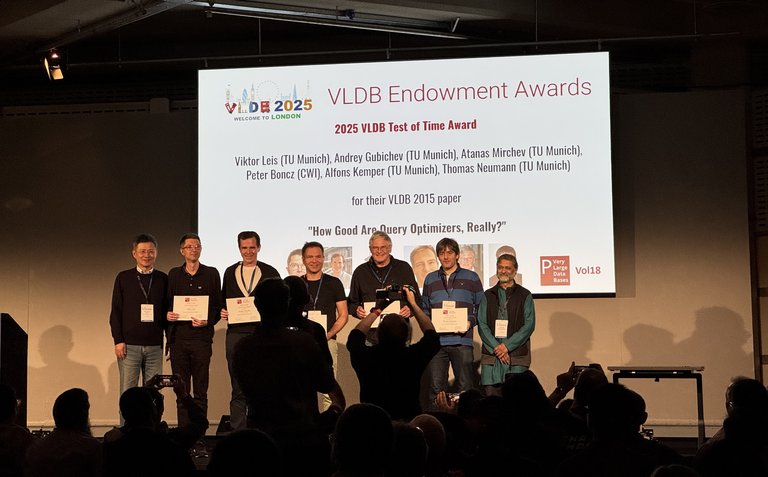
Peter Boncz is a Professor in the special chair of Large Scale Analytical Database Systems at Vrije Universiteit Amsterdam and leads the Database Architectures (DA) research group at CWI (Centrum Wiskunde & Informatica), the Netherlands' national research institute for mathematics and computer science. He serves on the CWI management team and is actively involved in multiple research initiatives and industry collaborations. Professor Boncz is internationally recognized as a pioneer of column-store databases, introduced through his PhD project MonetDB. His research spans database architecture, query processing optimization, and analytical database systems. His work on vectorized query processing with his first PhD student Marcin Zukowski has become foundational in modern analytical databases including BigQuery, Databricks, Snowflake, and DuckDB, which has millions of monthly downloads. Current research focuses include GPU data processing, vector search optimization, confidential computing, and graph data management. Boncz's recent publications reveal strong trends toward optimizing database systems for modern hardware architectures, particularly GPUs and cloud CPUs. His work bridges theoretical database concepts with practical implementation, focusing on performance optimization through innovative data layouts, compression techniques, and hardware-aware processing. The research shows a clear trajectory from foundational database concepts toward specialized optimization for emerging hardware and application requirements. VLDB Test of Time Award 2025 (second time, previously won in 2009) CIDR Test of Time Award 2024 ACM Fellow (2022) Humboldt Research Award (2013) ICTRegie Award (2006) Boncz has co-founded six spin-off companies in data systems, including MonetDB BV, and serves as an advisor to ventures like Databricks Corp. His research is supported by multiple external funding projects including Actian Research Grants, Databricks research agreements, and Motherduck Service Agreements. He has advised numerous students, with Marcin Zukowski being notably mentioned as his first PhD student who co-developed vectorized query processing. As leader of the Database Architectures research group at CWI, Boncz oversees a team focused on pushing the boundaries of database technology. The group maintains close ties with industry through projects with Databricks, Motherduck, and RelationalAI, while continuing to develop open-source technologies like DuckDB. The team is particularly active in GPU acceleration, confidential computing, and graph data management through the Linked Data Benchmark Council (LDBC), which Boncz founded.
Dr. Andreas Artemiou serves as Professor, Vice Rector for Academic Affairs and Quality Assurance, and Dean of the Technology and Innovation School at the University of Larnaca's Department of Information Technologies. His leadership spans academic administration and cutting-edge statistical research with global collaborations. His academic foundation includes: BSc in Mathematics and Statistics from University of Cyprus (2005) MSc and PhD in Statistics from Pennsylvania State University (2008, 2010) Artemiou's research pioneers statistical methods for high-dimensional datasets, specializing in dimension reduction, kernel techniques, and machine learning applications. His work bridges theoretical innovation with practical implementations across engineering, computer science, and medical sciences, particularly evident in pandemic-related mortality analysis and cytometry data processing. Recent publications (2021-2024) reveal accelerating focus on SVM-based dimension reduction, sparse modeling, and medical applications. The trajectory shows increasing interdisciplinary impact, with 2024 works emphasizing matrix data analysis and time-series dimension reduction for real-world health crises. His professional recognition includes: New Researcher Fellow at Statistics and Applied Mathematical Sciences Institute Artemiou actively contributes to major collaborative initiatives without explicit grant details. His editorial role at Computational Statistics and Data Analytics journal and board membership in the European Statistical Computing Association highlight academic leadership. Current projects drive innovation in cytometry analysis and pandemic mortality modeling. He directs CytoPy - an autonomous cytometry analysis framework - and leads pandemic mortality research through the international CMOR consortium, demonstrating commitment to translating statistical theory into public health solutions.
Alexander Vladimirovich Gasnikov is a Leading Researcher at the National Research University Higher School of Economics (HSE), specifically within the Faculty of Computer Science, the Institute of Artificial Intelligence and Digital Sciences, and the International Laboratory of Stochastic Algorithms and Multidimensional Data Analysis. He has been working at HSE since 2015 and has accumulated 17 years of scientific and teaching experience. Gasnikov received his academic credentials from the Moscow Institute of Physics and Technology (State University). He earned his Bachelor's degree in Applied Mathematics and Physics in 2004, followed by a Master's degree in the same specialty in 2006. He completed postgraduate studies at MIPT from 2006-2007, earned his Candidate of Physical and Mathematical Sciences degree in 2007, was awarded the academic title of Associate Professor in 2011, and ultimately received his Doctor of Physical and Mathematical Sciences degree in 2016 with a dissertation on 'Efficient Numerical Methods for Finding Equilibria in Large Transport Networks.' Gasnikov's research focuses on convex optimization, mathematical modeling of traffic flows, and Markov processes. His work bridges theoretical mathematics with practical applications in optimization algorithms and transportation science. He has made significant contributions to developing efficient numerical methods for optimization problems, particularly in the context of large-scale networks and stochastic settings. His research has evolved from traditional optimization methods to more advanced techniques involving stochasticity, decentralization, and applications to machine learning problems. His publications demonstrate expertise in both theoretical analysis (establishing convergence rates, lower bounds) and practical algorithm development across multiple prestigious venues including Journal of Optimization Theory and Applications, SIAM Journal on Optimization, and top machine learning conferences like NeurIPS. Gasnikov has received recognition including a bonus for publication in international peer-reviewed journals (2019-2021) and has served as a member of the editorial board of the 'Siberian Journal of Computational Mathematics' since 2017. As a supervisor, Gasnikov has guided multiple doctoral candidates, including Alexander Ogaltsov, Titov A. A. (2023), and Tyurin A. I. (2020) for Candidate of Sciences degrees, and Dvurechensky P. E. (2020) for a Doctor of Science degree. His research has been supported by grants from the President of Russia (MD-1320.2018.1) and the Russian Foundation for Basic Research (18-31-20005 mol_a_ved). Gasnikov's work contributes significantly to the theoretical foundations of optimization algorithms that power modern artificial intelligence systems. His leadership in the International Laboratory of Stochastic Algorithms and Multidimensional Data Analysis positions him at the forefront of research connecting mathematical optimization with practical applications in machine learning and data science.
François Dubeau serves as an Associate Professor in the Department of Mathematics at the University of Sherbrooke, where he maintains an active research program bridging theoretical mathematics with practical applications across diverse scientific domains. Education: B. Sc. A. Génie physique, École Polytechnique de Montréal (1971) M. Sc. A. Génie industriel, École Polytechnique de Montréal (1973) B. Sc. Mathématiques, Université de Montréal (1975) Ph. D. Mathématiques, Université de Montréal (1981) Postdoctoral Fellowship, Université de Montréal (1981-1982) Research Interests: Professor Dubeau's work centers on mathematical modeling with emphasis on optimization, numerical analysis, functional analysis, and geometric methods. His current investigations span computational geometry, quantum mechanics applications, and analytical modeling of shapes. Recent publications demonstrate innovative approaches to rotation theory, reflection methods, and numerical differentiation, often revealing unexpected connections between classical mathematics and modern computational challenges. Publication Trends: Analysis of his 2014-2025 publications reveals three dominant thematic clusters: geometric transformations (rotations/reflections for π and ln(2) computation), quantum information frameworks (qubit operations and unitary operators), and optimization techniques (multi-criteria linear programming and convergence acceleration). His work consistently demonstrates how fundamental geometric and algebraic principles solve contemporary problems in physics, epidemiology, and materials science. Scientific Awards: No specific awards documented in available sources Advising and Grants: While formal student lists aren't provided, his methodological publications suggest extensive mentorship in numerical analysis and mathematical modeling. Current research directions indicate ongoing grant activity in geometric computation and quantum applications, though specific funding sources aren't detailed in the source material. Research Environment: Professor Dubeau's work appears conducted within the Department of Mathematics' theoretical research ecosystem, with evident cross-disciplinary collaborations in physics (quantum mechanics) and engineering (metallurgy applications), though no dedicated laboratory or formal research team is specified.
Professor Sergiy A. Vorobyov serves as a faculty member in the Department of Information and Communications Engineering at Aalto University's School of Electrical Engineering, Finland. His active research and teaching profile includes delivering tutorials at major conferences like EUSIPCO'2025 and supervising doctoral candidates through 2025. His research spans critical signal processing domains with emphasis on: Optimization and Linear Algebra Methods in Signal Processing, Communications, and Machine Learning Statistical and Array Signal Processing Sparse Signal Processing techniques Estimation and Detection Theory frameworks Sampling Theory advancements Large-Scale, Cooperative and Cognitive Systems design Recent work demonstrates strong integration of machine learning with array processing, exemplified by his top 3% ICASSP 2023 paper on tensor decomposition for 2D direction-of-arrival estimation. Major recognitions include: IEEE Fellow elevation (2018) for contributions to robust signal processing optimization NSERC Discovery Accelerator Award (2012) Carl Zeiss Award (2011) Alberta Ingenuity New Faculty Award (2007) IEEE Signal Processing Society Best Paper Award (2004) He has successfully mentored over 10 graduate students to completion, including recent PhD recipients working on massive MIMO systems and big data optimization. His research group maintains active projects in optimization frameworks for communications and machine learning applications. The Vorobyov research group operates within Aalto's KIDE facility, focusing on next-generation signal processing solutions for radar, communications, and large-scale data systems.
Sonal Shreya is a Tenure Track Assistant Professor at the Department of Electrical and Computer Engineering, Aarhus University, within the Faculty of Engineering. Her research focuses on spintronics, neuromorphic engineering, and energy-efficient computing architectures. She explores applications in magnetic memory technologies, spintronic devices, and reservoir computing systems. Her work emphasizes developing novel circuits for in-memory computing, leveraging spintronic components like magnetic tunnel junctions (MTJs), STT-RAM, and spin-torque nano-oscillators. Key areas include energy-efficient data encryption, low-power pattern recognition, and multi-state memristor-based neuromorphic systems. She also investigates design thinking applications in engineering innovation, such as Tesla technology advancements. Recent studies highlight contributions to skyrmion dynamics for racetrack memory, vortex-based security solutions (PUF/TRNG), and thermal-induced memristor behaviors. Her publications span from 2014 to 2025, demonstrating a progression toward advanced spintronic applications in computing and sensing. Dr. Shreya collaborates on compact device modeling for circuit simulations and explores granular materials for reservoir computing. Her research bridges fundamental spintronics physics with practical applications in low-power electronics and hardware security.