James Hays is affiliated with Brown University . His research spans Computer Vision , Robotics , 3D Reconstruction , and Image Synthesis . His recent work focuses on 3D Object Detection (e.g., CoRL 2024 ), Semantic Scene Flow (e.g., ICLR 2024 ), and Multimodal Image Generation (e.g., CVPR 2024 ). He has contributed to datasets like ContactDB and ContactPose for robotic grasp analysis. Key trends in his publications include 3D Perception , Efficient Neural Architectures , and Cross-modal Learning for autonomous systems. While no explicit scientific awards are listed, his work is frequently published in top-tier venues like CVPR , ECCV , and CoRR .
UnivProf. Dr. Alexander Ecker is a full Professor at the Institute of Computer Science, University of Göttingen. He holds leadership roles including Head of the Neural Data Science group and Board membership in the Campus Institute Data Science (CIDAS). His work bridges computer science and neuroscience, focusing on machine learning, computational neuroscience, and data-driven modeling of biological systems. Research interests include: Machine learning applications in vision science and neuroimaging Neural data science: analyzing large-scale neural population activity Deep learning techniques for environmental sensing and microscopy Computational models of primate visual systems and behavior Recent articles emphasize: Pioneering transformer-based approaches for tree detection in satellite imagery Unsupervised neuronal clustering and functional connectivity analysis Development of state-of-the-art tracking models for primates in natural habitats Advances in holographic imaging and microparticle analysis via CNNs Teaching responsibilities include courses like Machine Learning (lecture & exercises), Scientific Writing, and Advanced Seminar in Neural Data Science. Laboratory affiliations include the Neural Data Science group and CIDAS, driving interdisciplinary projects in data science and computational neuroscience.
Prof. Dr. Volker Ahlers is a Professor in the Department of Computer Science at Hochschule Hannover – University of Applied Sciences and Arts . He serves as the International Coordinator for the department and is a member of the Senate Commission for Research . His academic career spans over two decades, with prior appointments at Goethe University Hospital, WiSenT GmbH, and the University of Potsdam. Education : PhD in Physics (University of Potsdam, 2001), M.Sc. in Physics (Georg August University Göttingen, 1998) Research Interests : Focus on Computer Graphics , Machine Learning , Data Analysis , Information Visualization , and Urban Logistics . His work bridges network security and smart city applications. Grants : Led projects funded by BMBF (EKiKo-KI, GLACIER, USEfUL), BMDV (5GAPS), and DAAD collaborations. Professional Roles : Conference chair (IDAACS 2023, ASIM 2018), reviewer for journals like PLOS ONE and Bioinformatics , and member of accreditation agencies.
Prof. Bastian Leibe serves as a University Professor at RWTH Aachen University, leading the Computer Vision Group within the Chair of Computer Sciences 8 (Computer Graphics, Computer Vision, and Multimedia). His research focuses on developing computer vision applications for mobile devices, robotic systems, and autonomous vehicles, with strong institutional ties to the Cluster of Excellence "UMIC - Ultra High-Speed Mobile Information and Communication". His core research spans visual object recognition, tracking, self-localization, and 3D reconstruction, with increasing emphasis on integrated solutions for real-world deployment. Recent work demonstrates deep specialization in autonomous driving perception systems, human-robot interaction interfaces, and foundational computer vision methodologies that bridge theoretical advances with practical engineering constraints. Analysis of recent publications reveals dominant trends in LiDAR-based anomaly detection for autonomous systems, efficient 3D scene understanding frameworks, and novel applications of foundation models in robotics. The group consistently contributes to top-tier conferences with innovations in diffusion models, vision transformers, and interactive segmentation techniques that push the boundaries of real-time mobile vision. The Computer Vision Group maintains active educational engagement through specialized lectures and seminars in computer vision and machine learning, while operating from the UMIC Research Centre facility in Aachen with direct industry and academic collaborations in mobile information systems.
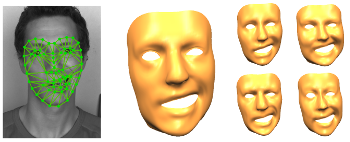
Dr. Dominik Sibbing is affiliated with the Department of Computer Science at RWTH Aachen University , Germany. His research focuses on 3D reconstruction , computer vision , and medical imaging . Developed markerless 3D face tracking systems using deformation models and smoothness priors Created volume-based fiber tracking techniques for diffusion MRI data Contributed to quad meshing methods for vascular structures Proposed SIFT-realistic rendering for laser-scanned point clouds His work combines statistical modeling with interactive GPU-based visualization . Notable award: VMV 2015 Honorable Mention . Collaborated with Leif Kobbelt and others on applications spanning facial animation, medical imaging, and physics-based simulations. Scientific Awards: VMV 2015 Honorable Mention Key Collaborations: Leif Kobbelt (RWTH Aachen) Martin Habbecke Robin Tomcin
Shilin Zhu is an Assistant Professor in the Department of Computer Science and Engineering at the University of California, San Diego's Jacobs School of Engineering. Having completed their PhD at UCSD in 2021 with a dissertation titled 'Computing Images with Diverse Illumination Effects,' Zhu has established a prolific research career spanning computer graphics, computer vision, and machine learning. Zhu's research interests center around advanced rendering techniques, autonomous driving perception systems, privacy-preserving technologies, and wireless localization. Their work bridges theoretical computer science with practical applications, particularly in developing robust systems for challenging environments like foggy weather for autonomous vehicles and creating privacy-preserving solutions using smart LED technology. Zhu has made significant contributions to neural rendering, particularly in photon mapping and denoising techniques that improve the efficiency and quality of computer-generated imagery. Analysis of Zhu's publication record shows a clear progression from foundational work in rendering and computer vision during their PhD studies to increasingly applied research in autonomous systems and privacy technologies. Their most recent work demonstrates a growing interest in interdisciplinary applications, including agricultural technology and bioinformatics, while maintaining technical depth in core computer science areas. The research consistently features innovative applications of deep learning to traditional computer graphics and vision problems. Zhu has collaborated extensively with leading researchers in the field, including Zexiang Xu, Hao Su, Ravi Ramamoorthi, and Henrik Wann Jensen, reflecting strong integration within the computer graphics and vision research communities. Their work has appeared in top-tier venues including SIGGRAPH, CVPR, and ACM Transactions on Graphics.
Riccardo Spezialetti is a researcher at the University of Bologna's Department of Computer Science and Engineering, specializing in advanced 3D vision and deep learning. He earned his PhD in 2020 with a thesis titled 'Learning to understand the world in 3D,' focusing on geometric deep learning and 3D object representation. His work bridges computer vision, machine learning, and neural representations, with notable contributions to unsupervised domain adaptation, LiDAR processing, and neural field-based 3D reconstruction. Key research interests include equivariant descriptors, implicit neural representations, and self-supervised learning for 3D data. He collaborates frequently with Samuele Salti and Luigi Di Stefano, co-authoring over 25 publications in top venues like CVPR, ICCV, and IEEE PAMI. His research has practical applications in autonomous systems, robotics, and photorealistic 3D reconstruction.
Lukas Luft is a postdoctoral researcher at the Autonomous Intelligent Systems group within the Department of Computer Science at the University of Freiburg. His work spans robotics and quantum physics, focusing on probabilistic methods for robot localization, multi-robot systems, and causal inference. Post Doc (2020–present) PhD in Computer Science, University of Freiburg (2020) Master and Bachelor in Physics, RWTH Aachen and University of Freiburg His research in Robot Localization and Mapping includes advanced probabilistic techniques like Bayes filters, decentralized algorithms for multi-robot systems, and change detection in environments using full posterior distributions. He also explores Causality and Foundations of Quantum Physics , applying entropic inequalities and information theory to causal discovery and non-locality. The articles highlight his contributions to robotics, particularly in sensor modeling for Lidar, simultaneous localization and mapping (SLAM), and efficient probabilistic methods. In quantum physics, his work addresses causal structures and entropic information, bridging AI with foundational physics. Luft has collaborated with leading researchers, including Prof. Wolfram Burgard and Bernhard Schölkopf, and contributed to key conferences like Robotics: Science and Systems (RSS) and IEEE IROS.