Dr. Jeewanie Jayasinghe Arachchige is a Lecturer in the Department of Computer Science at Vrije Universiteit Amsterdam, Faculty of Science. She teaches undergraduate courses including Bachelor Project Computer Science, Professional Development, and Software Engineering Processes for the academic year 2024–2025. Her research focuses on process mining , healthcare informatics , and data security . She applies process mining to analyze healthcare pathways and subpopulation treatment variations, develops explainable AI frameworks for predictive analytics, and examines data governance in emerging architectures like Data Lakehouses. Her work intersects legal informatics, particularly formalizing Sri Lankan civil court processes using ontology engineering. Recent publications highlight trends in balancing simplicity and complexity in process modeling, Industry 4.0 healthcare applications, and cybersecurity in model-driven web development. She has contributed to over 20 peer-reviewed articles since 2006, spanning topics from service-oriented architectures to value network analysis. Her teaching and research emphasize practical applications of IT in healthcare, legal systems, and enterprise environments. No ancillary activities are currently recorded.
Güneş Acar is a tenured Assistant Professor in the Digital Security group at Radboud University's Faculty of Science. He is also affiliated with iHub, Radboud's interdisciplinary research hub on digitalization and society. His research focuses on security and privacy threats from websites, mobile apps, and IoT devices, with special emphasis on online tracking mechanisms, anonymous communication networks like Tor, and deceptive design patterns. Dr. Acar completed his PhD at KU Leuven under the supervision of Claudia Diaz and Bart Preneel. Prior to joining Radboud University, he was a Postdoctoral Research Fellow at KU Leuven's COSIC group and a Postdoctoral Research Associate at Princeton University's Center for Information Technology Policy. His research spans web security, privacy, online tracking, IoT security, Tor network analysis, and dark patterns. He investigates how websites, mobile apps, and IoT devices compromise user privacy through various tracking mechanisms and deceptive interface designs. His work combines large-scale measurements with user studies to understand both technical vulnerabilities and their real-world impact on users. Dr. Acar's publications reveal an evolving research trajectory from foundational web tracking mechanisms to increasingly sophisticated privacy threats. His work has expanded from browser fingerprinting to IoT privacy, children's online safety, and manipulative design patterns in subscription interfaces. A consistent theme across his research is the examination of how third-party trackers operate and circumvent privacy protections. 2022 CNIL-Inria Award for Privacy Protection (for Leaky Forms paper) Top Reviewer Award, Privacy Enhancing Technologies Symposium (2022) Future of Privacy Forum's Annual Privacy Papers for Policymakers Award (2020) Runner-up for multiple Caspar Bowden Awards for Outstanding Research in Privacy Enhancing Technologies Dutch Research Council (NWO) Vidi Grant (2025-2030) for "A Web Security and Privacy Observatory" Dr. Acar actively supervises PhD students including Zahra Moti, Tim Vlummens, and Luqman Zagi, with Asuman Senol recently completing her PhD in 2024. He has secured significant research funding including the NWO Vidi Grant and a project grant from armasuisse for the Mobile Web Inspector project. His research has influenced policy discussions with organizations including the OECD, US Federal Trade Commission, and European consumer protection authorities. As part of the Digital Security group at Radboud University, Dr. Acar contributes to a vibrant research ecosystem focused on practical security and privacy solutions. His work bridges technical security research with human-centered perspectives, often collaborating across disciplines to address complex privacy challenges in real-world contexts.
Anuj Pathania serves as an Assistant Professor in the Parallel Computing Systems (PCS) group within the Informatics Institute at the University of Amsterdam's Faculty of Science. His research pioneers sustainable computing systems operating under severe power, thermal, and reliability constraints, with significant contributions to energy-efficient hardware design and embedded systems. Education: PhD in Computer Science (2018), Karlsruhe Institute of Technology MSc in Computer Science (2012), National University of Singapore B.Tech in Computer Science (2009), Maharaja Agrasen Institute of Technology Pathania's research centers on low-power design and sustainable systems for constrained environments, with particular expertise in thermal management of 3D-stacked architectures and energy-efficient machine learning inference . His work bridges electronic design automation with real-world reliability challenges, developing novel power budgeting techniques like T-TSP that incorporate transient temperature effects ignored by conventional methods. Current projects include EU-funded initiatives on energy labeling for digital services, addressing ecological impacts through technological, behavioral, and legal frameworks. His publication trajectory reveals a strategic evolution toward zero-waste computing , with recent work (2023-2025) focusing on hardware-software co-design for edge AI, energy modeling across computing continua, and parameter-efficient neural adaptation. Key themes include thermal-aware scheduling for S-NUCA many-cores, cooperative processor utilization in heterogeneous systems, and sustainability metrics for digital services. Scientific Recognition: Best Paper Award Nomination at IEEE Computer Society Annual Symposium on VLSI 2023 for 3D-TTP power budgeting technique Pathania actively mentors 4 PhD students (Ehsan Aghapour, Saeedeh Baneshi, Sudam Wasala, Yixian Shen) and has successfully supervised 5 Master's theses (including Cum Laude defenses by Joris op ten Berg and Jurre Wolff). His research is supported by major grants including Energy Labels for Ecologically Sustainable Digital Services (2023-2024) and Towards Zero-Waste Computing (2021-2025), developing simulation frameworks like HotSniper and CoMeT for thermal analysis. The PCS group maintains strong industry collaborations with ARM and NVIDIA, particularly through tools like ARM-CO-UP for heterogeneous processor utilization.
Anna Wilbik is a Professor in Data Fusion and Intelligent Interaction at the Department of Advanced Computing Sciences, Faculty of Science and Engineering, Maastricht University (The Netherlands). Her research bridges data understanding and human-machine synergy in complex systems, focusing on multi-criteria decision making, explainable AI, and data fusion techniques. PhD in Computer Science (with honors), Systems Research Institute, Polish Academy of Science (2010) Postdoctoral Fellow, University of Missouri (2011) Stanford University TOP500 Innovators Program Alumnus Research Pillars: Intelligent human-machine interaction for joint decision making Data fusion methods for heterogeneous data integration Contextualized multi-criteria decision frameworks Fuzzy logic and linguistic summaries for explainability Federated learning systems Article Trends: Recent work focuses on intuitionistic fuzzy sets for knowledge-intensive processes, federated learning with uncertainty handling, and linguistic summarization techniques for interpretable AI. She actively explores explainability , collaborative business models , and driver behavior analysis through attention-based models. Professional Leadership: Vice-chair of IEEE Fuzzy Systems Technical Committee Organizer of IEEE World Congress on Computational Intelligence (2024)
Kate Mancey is an Assistant Professor of Music and Media at Utrecht University's Department of Media and Culture Studies , affiliated with the Institute for Cultural Inquiry . Originally from the UK, she holds a BA and MA in Music from the University of Liverpool and a PhD in Music Theory from Harvard University. Research Interests: Her work explores intersections of music, technology, and society, combining computer-aided analysis with traditional musicology. Key projects include analyzing human-technology relationships through everyday sounds (smartphones, appliances), virtual reality music dynamics, and digital humanities datasets like CoSoD for popular music collaborations. Publications Trends: Recent work spans interdisciplinary topics from emergency medicine (music interventions for pain relief) to virtual reality audiovisual analysis and historical sound studies in commerce. Scientific Awards: Kennedy Memorial Trust Fellowship Harry and Majorie Ann Slim Memorial Fellowship Sandra Ohrn Dissertation Fellowship Funding & Collaboration: Supported by multiple fellowships for research in Tokyo, Osaka, and the Smithsonian Institute. Collaborator on projects like Boston Rock City (linked data) and music-related legal consultancy.
Dr. Bart Jaski is a Researcher at the Utrecht University Library , specializing in Special Collections and Research Data Support . His work bridges Medieval History , Celtic Studies , and Digital Humanities , with a focus on digitized heritage and manuscript analysis. He has contributed to projects like Annotating History: Managing Digitized Heritage Interactively and The Miracle of St. Martin - The Happy City (2022), which celebrated Utrecht’s 900th anniversary through medieval music and historical exhibitions. His recent publications, including co-edited works on A.G. van Hamel and Adriaan Reland, highlight intersections of Celtic scholarship , oriental studies , and digitization . While no scientific awards are explicitly mentioned, he has secured grants from the Netherlands Organization for Scientific Research (NWO) for collaborative projects involving Brill Publishers , Museum Huis Doorn , and other heritage institutions. Bart Jaski teaches Medieval Palaeography and serves on the editorial board of the journal Kelten: Proceedings of the AG van Hamel Foundation for Celtic Studies . His research emphasizes historical annotation tools , manuscript fragment recovery , and Celtic cultural narratives , reflecting a dedication to both academic scholarship and public engagement with medieval heritage.
National Research Institute for Mathematics and Computer ScienceNetherlands
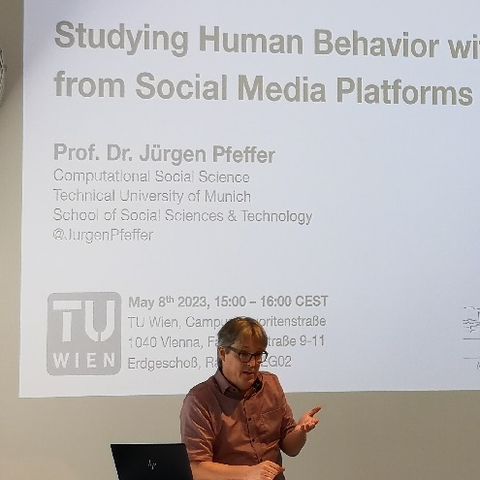
Jürgen Pfeffer is a Professor of Computational Social Science & Big Data at the Technical University of Munich's School of Social Sciences and Technology, with an additional appointment as Adjunct Professor at Carnegie Mellon University's Institute for Software Research. His interdisciplinary work bridges computer science and social science with a focus on analyzing large-scale socio-technical systems. His research expertise spans computational social science, network analysis, and big data methodologies. Pfeffer's work examines methodological, algorithmic, and theoretical challenges in analyzing dynamic social systems, with current projects focusing on modeling and detecting negative dynamics from social media, particularly online firestorms and hate speech against politically active women. His research combines network science approaches with computational methods to understand complex social phenomena. Pfeffer's publication record demonstrates significant contributions to the field since his 2010 doctorate, with high-impact papers in journals like Science and EPJ Data Science. His work on social media analysis, particularly the influential 2014 Science paper 'Social Media for Large Studies of Behavior' co-authored with Derek Ruths, has shaped methodological approaches in the field. His research shows consistent evolution from foundational network analysis to contemporary applications in political discourse, hate speech detection, and multi-layer network analysis. Hennig, M., Brandes, U., Pfeffer, J., & Mergel, I. (2012). Studying Social Networks. A Guide to Empirical Research Ruths, D., & Pfeffer, J. (2014). Social Media for Large Studies of Behavior Pfeffer, J., Morstatter, F., & Mayer, K. (2018). Tampering with Twitter's Sample API As an advisor and collaborator, Pfeffer has worked extensively with researchers including Raji Ghawi, Mirco Schönfeld, Momin Malik, and Kathleen Carley. His work demonstrates strong connections between theoretical network science and practical applications in social media analysis. His current research continues to address pressing issues in online discourse, with recent work focusing on hate speech classification, lexical change in negative word-of-mouth, and polarization dynamics in social media environments. Pfeffer leads the Pfeffer Lab, which focuses on developing methodological approaches for analyzing complex social systems through computational methods. His work has implications for understanding political legitimacy, social influence, and community dynamics in both online and offline contexts.
Nathan Edward Clark is an Assistant Professor in the Department of Organization Sciences at Vrije University Amsterdam. He holds affiliations with the Network Institute and the Organization & Processes of Organizing in Society (OPOS) group. His research focuses on disaster risk management, societal resilience, crisis governance, and humanitarian data ethics. Education: PhD in International Governance for Satellite Earth Observation in Disaster Response (University of Copenhagen, 2018), MSc in International Relations (Aalborg University), and a Bachelor's in Satellite Communications. Research Interests: Clark investigates disaster resilience through competency-building frameworks, crisis communication improvement, and legal/ethical dimensions of technology use in disasters. He coordinates EU projects like LINKS (enhancing disaster resilience via tech-society links) and SYNERGIES (cascading risk preparedness). His work aligns with UN SDGs for sustainable communities and climate action. Grants & Awards: Secured €2M+ in grants, including a 2023 Disaster Reconstruction Support Framework grant and leading the EU Horizon 2020 LINKS project (€6M+). Projects: Active in Innovating Preparedness via SYNERGIES (2023-2026) and Engaged Scholarship against Climate Change (2023-2027). Previously directed Copenhagen Center for Disaster Research (COPE). Labs/Teams: Collaborates with interdisciplinary teams on crisis informatics, space law applications, and multi-stakeholder governance models in disaster contexts.
Giovanni Sileno is an academic specializing in Artificial Intelligence, Logic Programming, and Knowledge Representation, with teaching appointments at the University of Amsterdam, EPITA Paris, and Université Pierre et Marie Curie. His primary affiliation is with the Informatics Institute at the University of Amsterdam where he serves as a Lecturer. His research interests span multiple domains within computer science, focusing particularly on formal methods for normative systems, agent-based programming, and logic-based knowledge representation. His work bridges theoretical computer science with practical applications in policy modeling, forensic science, and business information systems. Dr. Sileno has developed several notable software projects including AgentScriptCC for single-threaded intentional agents, DCPLschema for normative policy specifications, and libraries for normative primitives in Answer Set Programming. His GitHub activity shows consistent contributions from 2012 through 2025, indicating active engagement in both research and development. His publications reflect a strong focus on formal methods applied to practical problems, with particular emphasis on normative systems, agent architectures, and logic programming applications. The research trajectory shows evolution from foundational topics in logic and numeral systems toward increasingly sophisticated applications in policy modeling and agent-based systems. As an educator, he has taught across multiple institutions and disciplines, covering topics from basic programming paradigms to advanced knowledge representation and formal modeling techniques. His teaching spans undergraduate to master's level courses in information studies, cognitive science, data science, and forensic science.
Liv Malin Andreasson serves as an Assistant Professor at the University of Groningen's Faculty of Law within the Business Law, European Law and Tax Law department, specializing in Energy and Sustainability Law. She is affiliated with the Groningen Centre of Energy Law and Sustainability and actively contributes to the university's LLM programme in Energy and Climate Law. Dr. Andreasson holds dual LL.M degrees with cum laude distinction - International and European Law from University of Gothenburg (2017) and Energy and Climate Law from University of Groningen (2018). Her research primarily focuses on legal aspects of large-scale offshore wind energy developments and new energy storage and transport alternatives in the North Sea, with particular expertise in offshore energy system integration. Her scholarly work reveals a consistent focus on legal frameworks for renewable energy transition in the North Sea region, with emphasis on hydrogen production and transport, offshore wind integration, and cross-border energy cooperation. Recent publications demonstrate increasing interdisciplinary collaboration and practical policy relevance, particularly addressing the legal challenges of innovative offshore energy technologies. Dr. Andreasson actively supervises master theses and teaches across multiple programs including Energy Law and Policy, Climate Law, and Energy Investment and Trade Law. She has led significant research projects funded by NWO, including the DOSTA project (Developing Offshore Storage and Transport Alternatives) examining legal frameworks for offshore energy technologies in the Dutch North Sea. Her professional activities include numerous academic presentations at international conferences and participation in major collaborative projects such as the North Sea Wind Power Hub consortium with Energinet, Gasunie and TenneT, where she provided legal assessments of the hub-and-spoke concept across multiple European jurisdictions.
Anna Fensel is a Full Professor in Artificial Intelligence and Data Science at Wageningen University, Netherlands. Previously held positions include Associate Professor at Wageningen University and Senior Researcher roles at STI Innsbruck, FTW Vienna, University of Surrey, and DERI Innsbruck. Habilitation and Doctoral Degrees in Computer Science (University of Innsbruck, 2018/2006) Diploma in Mathematics and Computer Science (Novosibirsk State University, Russia, 2003) Her research spans Knowledge Graphs, Semantic Web, GDPR Compliance, IoT Data Governance, and FAIR Data Principles . Current projects include EU Horizon SoilWise, with past work on H2020 OntoCommons, smashHit, and Eurostars WordLiftNG. Recent publications focus on: Automated compliance verification using SHACL Privacy-aware IoT data sharing GDPR implementation frameworks Knowledge graph applications in healthcare and climate analysis Professional roles: Editorial Board Member - Engineering Applications of Artificial Intelligence (Elsevier) Associate Editor - Frontiers in Energy Efficiency Advisory Board - SEMANTiCS conference series
Amsterdam University of Applied SciencesNetherlands
Pablo Allendes is a Lecturer/Researcher in Corporate Governance & Leadership at the Faculty of Business and Economics (FBE), specializing in Development Finance and Financial Inclusion. His research focuses on microfinance, open banking, and social investing across Sub-Saharan Africa and South Asia. Education: Master in Law from Vrije Universiteit Amsterdam (2018), J.D. (Juris Doctor) from Universidad de los Andes (2011). Professional Experience: Compliance roles at Rabobank, legal advisory at Citco Group, and product development at Oikocredit International. Research interests include leveraging technology for financial inclusion, climate-resilient agriculture financing, and circular economy strategies. His work bridges legal frameworks with sustainable development goals, particularly in emerging markets. Key Awards: 2016 IBA Young Lawyers' Scholarship. Recent Activities: Supervised student theses on CSRD compliance and digital lending, organized conferences on international law and sustainable development.
Tommaso Caselli is an Assistant Professor in the Faculty of Arts at the University of Groningen, specializing in Computational Linguistics. His work focuses on advanced NLP techniques including event extraction, storyline analysis, sentiment detection, and generative AI applications. He leads the 'AI and Language' theme at the Jantina Tammes School of Digital Society and contributes to initiatives like the Dutch Abusive Language Corpus (DALC) and the Event Storyline Corpus (ESC). His research addresses societal challenges such as climate communication, misinformation detection, and ethical AI use. Caselli has received awards for his contributions to NLP, including the Outstanding Area Chair (2023) and Best Paper Awards at COLING 2022. His recent projects explore generative AI's potentials and risks in healthcare and social media contexts. Affiliations: Faculty of Arts, Computational Linguistics Department, University of Groningen External Roles: Theme Coordinator (Jantina Tammes School), Former Board Member (Senso Comune) Research Interests: Event processing, temporal reasoning, causal relation extraction, abusive language detection, and the societal impact of NLP technologies. His work intersects with UN Sustainable Development Goals related to climate action and responsible innovation. Key Contributions: Developed benchmark corpora like EXCEPTIUS for legal texts analysis and TEXT-CAKE for evaluating language models. Active in CLEF labs (CheckThat!) addressing misinformation and check-worthiness detection. Supervised datasets such as the Dutch Abusive Language Corpus and the Content Type Dataset. Awards & Recognition: Recipient of multiple academic accolades including Outstanding Paper Awards (2022-2023), Best Student Paper (2022), and leadership in organizing NLP workshops (e.g., CLEF, CASE).
Prof. J.E. Stoter is a leading academic in Urbanism at Delft University of Technology's School of Architecture and the Built Environment. His work focuses on 3D city modeling, geospatial integration, and digital twins. He has contributed to over 378 research outputs and pioneered projects like the nationwide 3D BAG dataset and BIM Legal standards for cadastral registration. Key affiliations: TU Delft, EuroSDR, ISPRS Research interests: Urban data infrastructure, BIM-GIS integration, digital twin applications Notable achievements include the Geospatial World Excellence Award (2021) and foundational work in CityGML standards. His research spans energy modeling, solar simulation, and urban policy frameworks, with significant contributions to automated building reconstruction from LiDAR data. Recent articles explore solar simulation tools, lane mapping benchmarks, and urban digital twin challenges. His work bridges geospatial science with practical urban planning applications, emphasizing interoperability and sustainability.
Dr. Enrique Santamaria Echeverria is an Assistant Professor at the Erasmus School of Law, Erasmus University Rotterdam, specializing in the intersection of law, digital technologies, and healthcare governance. As project coordinator in the Dutch Sector Plan for Law and member of the SSH breed Sector Plan on Digitalisation, his work focuses on health data commons, AI ethics, and EU legal frameworks. Education: PhD in Law (2020), University of Groningen (thesis: EU law limits on human tissue contracts) LL.M. (specialization in legal theory) His research explores the legal, ethical, and political dimensions of health data ecosystems, emphasizing AI's impact on healthcare systems and environmental sustainability in data governance. Recent publications analyze the European Health Data Space proposal, biocompatible material regulations, and the socio-legal implications of predictive technologies. Scientific Awards: Dynamics of Inclusive Prosperity Small Grant (2024) ESKAS Swiss Government Excellence Scholarship (2022)