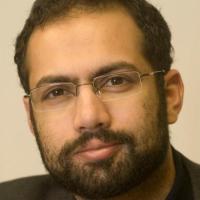
Qiudong WangView profile
Professor
Qiudong Wang is a Professor in the Department of Mathematics at the University of Arizona, where he conducts research and teaches in the field of dynamical systems and differential equations. His work spans theoretical and applied aspects of nonlinear dynamics, celestial mechanics, and chaotic systems. Education: Ph.D., University of Cincinnati, 1994 B.S., Nanjing University, China, 1982 His research focuses on homoclinic tangles, Melnikov methods, rank one attractors, twist maps, and the N-body problem . He has made significant contributions to the understanding of chaotic behavior in both deterministic and stochastically perturbed systems. His work often involves deep analytical techniques and has been published in premier journals such as Annals of Mathematics , CPAM , and JDE . He has also contributed expository works on rank one chaos and homoclinic tangles, including a Scholarpedia article. The trends in his recent publications emphasize nonautonomous and stochastic perturbations, geometric methods in dynamical systems, and the statistical properties of chaotic attractors . His research bridges pure mathematics with applications in physics and engineering, particularly in celestial mechanics and circuit systems. Scientific Contributions: Development of high-order Melnikov methods Theory of rank one attractors with Lai-Sang Young Analysis of homoclinic tangles and their chaotic dynamics Study of the N-body problem and integral manifolds Investigations into twist maps and variational methods Wang advises students in mathematics and has mentored work in dynamical systems, though specific names are not listed. He has received recognition through publications in top journals, though formal awards are not mentioned. He teaches undergraduate courses such as Math 254 and maintains comprehensive lecture notes on dynamical systems, homoclinic tangles, and rank one chaos. He is actively involved in research and continues to publish preprints and expository works, indicating ongoing scholarly activity. He leads a research group focused on nonlinear dynamics and chaos theory, with a strong emphasis on rigorous mathematical analysis. His team explores theoretical frameworks for understanding complex dynamical behavior in both finite and infinite-dimensional systems.