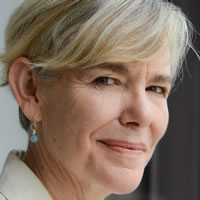
Dr. Rebecca Connolly is an Adjunct Professor at the Sydney Law School, University of Sydney, specializing in International Space Law, Technology Law, and Biotechnology Regulation. Her research addresses global governance challenges in outer space militarization, commercialization, and sustainability, while contributing to agricultural biotechnology policy frameworks. She is affiliated with the Space Law Council of Australia and New Zealand and the International Law Association. Education: LL.B (Hons), LL.M, Ph.D. (Sydney University). Teaching focuses on International Space Law and Technology Law. Recent publications (2023) emphasize regulatory gaps in near-space military activities and outer-space advertising, reflecting her expertise in emerging legal frontiers. Publications span over two decades, with early work addressing WTO disputes over genetically modified foods and AUSFTA environmental cooperation. No scientific awards listed, though her contributions to space law are notable. She supervises in space law and technology law domains, contributing to interdisciplinary legal scholarship.
Professor Douglas Guilfoyle is a Professor at UNSW Canberra within the School of Humanities & Social Sciences, where he joined in 2018. He is a 2022-2025 Australian Research Council Future Fellow working on "Small States' use of law of the sea litigation against greater powers" (FT210100186). He is also a non-resident fellow at the Sea Power Centre - Australia and was a Visiting Legal Fellow at the Department of Foreign Affairs and Trade (2018-2019). Professor Guilfoyle's educational background includes: Doctor of Philosophy (International Law), University of Cambridge, 2007 Master of Laws (International Law), University of Cambridge, 2004 Bachelor of Arts (Hons I) and Bachelor of Laws (Hons I) Australian National University, 2000 Professor Guilfoyle's research focuses on maritime security, the international law of the sea, and international and transnational criminal law. His particular areas of specialism include maritime law-enforcement, the law of naval warfare, international courts and tribunals, and the history of international law. His work examines how small States use UN Convention on the Law of the Sea (UNCLOS) dispute settlement mechanisms to gain political advantages in conflicts with greater powers. His research crosses over from the maritime domain to international criminal law generally, including questions of the effectiveness of international criminal tribunals and the law of superior responsibility. He has made significant contributions to understanding counter-piracy efforts, maritime interdiction operations, and the protection of submarine cables in the context of modern security challenges. Professor Guilfoyle's recent publications demonstrate a clear trend toward examining the intersection of emerging technologies and maritime law, particularly regarding autonomous vessels. His work also shows a deep engagement with the strategic use of international law by small states, maritime security challenges in the Indo-Pacific region, and the evolving role of international courts and tribunals in resolving complex maritime disputes. His scholarship consistently bridges theoretical legal frameworks with practical security concerns. Professor Guilfoyle has received several prestigious awards and fellowships: 2022-2025 Australian Research Council Future Fellow Gates Cambridge Scholar, 2004-2007 British Council Chevening Scholar, 2003-2004 British Academy Mid-Career Fellowship, 2012-2013 Professor Guilfoyle has secured significant research funding including an Australian Research Council Future Fellowship ($948,000, 2022-2025) for his project on "The use of strategic law of the sea litigation by small States against greater powers," and an Australian Research Council Discovery Project ($158,000, 2020-2023) on "Legal Regulation of Marine Autonomous Vehicles." His research is informed by extensive consultancy work with various government and international organizations. Prior to joining UNSW Canberra, he held academic positions at Monash University and University College London, and has practical legal experience as a judicial associate in the Australian Federal Court and as a commercial litigation solicitor in Sydney. Professor Guilfoyle is a frequent contributor to leading international law blogs such as EJIL:talk and Opinio Juris, demonstrating his active engagement with the international legal community and current developments in the field.
Sarah Williams is a Professor in the Faculty of Law & Justice at UNSW Sydney. She is an Associate of the Australian Human Rights Institute and the Centre for Criminology, Law & Justice, and serves as Chair of the NSW International Humanitarian Law Committee for the Australian Red Cross. Current: Professor, Faculty of Law & Justice, UNSW Sydney Prior: Dorset Fellow (BIICL, 2008–2010), Senior Legal Researcher (UK Foreign Office, 2006–2007), Lecturer (Durham Law School, 2003–2008) Her research focuses on international criminal law, humanitarian law, disaster law, and hybrid tribunals. She has advised the European Commission, International Federation of Red Cross, and Commonwealth Parliamentary Association. Recent publications include analyses of amicus curiae in international courts, hybrid tribunals for reparative justice, and the role of international law in disaster relief during conflicts. She has authored/edited books such as The Amicus Curiae in International Criminal Justice (2020) and Hybrid and Internationalised Criminal Tribunals (2012). Scientific roles include Associateships at the Australian Human Rights Institute and Centre for Criminology, Law & Justice. Her teaching and supervision activities span international law and post-conflict justice mechanisms.
Associate Professor Sebastian Kaempf is a leading scholar in Peace and Conflict Studies at the University of Queensland's School of Political Science and International Studies (POLSIS), where he also serves as Director of the Rotary Peace Centre. His academic career spans international relations, ethics of war, and digital media's impact on contemporary conflicts. His research focuses on two primary areas: the relationship between ethics and laws of war in asymmetric conflicts, particularly examining the tension between casualty-aversion and civilian protection; and the role of transforming global media landscapes in violent conflicts, with emphasis on geopolitics of cyberspace, embedded reporting, mass surveillance, and Pentagon-CIA influence in entertainment. His work bridges theoretical frameworks with practical implications for policy and military ethics. Dr. Kaempf's recent publications reveal a strong trend toward examining contemporary warfare through the lens of digital media, entertainment industry connections, and ethical dilemmas in modern combat. His research increasingly explores how military reality TV, video games, and social media platforms shape public understanding of war and influence civilian-military relations. ISA Deborah Gerner Award for Teaching Innovation (2020) Australian national award for teaching excellence (AAUT) (2013) UQ and Faculty awards for teaching excellence (2012) British International Film Festival award for best documentary (2023) As an educator, Kaempf has supervised numerous PhD students on topics ranging from asymmetric conflicts to media and war. He co-hosts the 'HigherEd Heroes' podcast with A/Prof Al Stark and produced the MOOC 'MediaWarX' on edX. His leadership of the Rotary Peace Centre demonstrates commitment to practical peacebuilding initiatives alongside his theoretical research.
Lowell Bautista is an Associate Professor at the School of Law, University of Wollongong, and a staff member of the Australian National Centre for Ocean Resources and Security (ANCORS) within the Faculty of Business and Law. He specializes in Law of the Sea, maritime boundary disputes in the Asia-Pacific, and South China Sea governance. His expertise spans international humanitarian law, environmental law, and maritime security. He holds degrees from the University of the Philippines, Dalhousie University (Canada), and the University of Wollongong. Education: BA in Political Science (cum laude) and LLB from the University of the Philippines, LLM in Marine and Environmental Law from Dalhousie University, and PhD in Law from University of Wollongong. Research interests include territorial and maritime disputes, legal implications of naval warfare, and ocean governance. He advises governments and institutions on maritime law and has contributed to policy frameworks for offshore resources management. He currently edits Marine Policy (Associate Editor) and Asia Pacific Journal of Ocean Law and Policy (Executive Editor). Recent publications focus on legal challenges in maritime autonomy, Timor Sea diplomacy, and Philippine maritime sovereignty. His work bridges legal theory with geopolitical strategy, particularly in the Indo-Pacific region. He supervises PhD candidates on topics like South China Sea naval law and offshore petroleum management. Grants include the 2022-2023 DFAT-funded Maritime Consultancy project. His advisory roles extend to confidential legal opinions for governments and private entities in maritime boundary delimitation and resource disputes. Labs/Teams: Active member of ANCORS, collaborating on projects related to ocean resources and security.
Professor Anthony David Burke is Professor of Environmental Politics and International Relations at the University of New South Wales (UNSW), Canberra, Australia. He is an interdisciplinary scholar working across international law and international relations, philosophy, political theory, science and technology studies, and the environmental humanities. His educational background includes a BA Hons. MA (Communications) from the University of Technology, Sydney and a PhD (Politics & International Relations) from the Australian National University. Prior to joining academia, he worked as a human rights activist on Southeast Asia and the South Pacific (especially East Timor), and served as Principal Research Officer for the Australian Senate's environment, arts and communications committee, where he led drafting reports on the Jabiluka uranium mine and Australia's response to climate change. Burke's research focuses on climate politics and governance, biodiversity governance, environmental ethics and philosophy, and nuclear politics and governance. His work spans Political Science, Political Theory and Political Philosophy, International Relations, Defence Studies, International Law, and Environmental and Natural Resources Law. He pioneered the 'Planet Politics' approach that reimagines international relations in the context of the Anthropocene. His publications reveal a trajectory from critical security studies to environmental political theory, with recent work focusing on multispecies democracy, ecological cosmopolitanism, and planetary governance. His influential works include 'Uranium' (2017), 'Planet Politics: A Manifesto from the End of IR' (2016), and numerous articles in top journals like Nature, Review of International Studies, and International Political Sociology. 2005 Australian Research Council Discovery Projects: Global Security, Strategic Paradox and Limited War ($150,000) 2014 Economic and Social Research Council/Arts and Humanities Research Council (UK): Nuclear Ethics and Global Security (£250,000) 2022 UNSW Sustainable Development Goals Reform Hub ($20,000) Burke is the founding editor of the Borderlands journal and coeditor of Palgrave Macmillan's Environmental Politics & Theory book series. He co-led the UNSW Grand Challenge on Thriving in the Anthropocene and is currently working on key projects including a global forests treaty, addressing crimes against biodiversity and ecocide, reforming global climate governance, and analyzing climate and environmental security in the Asia-Pacific region.
Tobias Ide is an Associate Professor of Politics and International Relations at Murdoch University, Australia, and Associate Dean of Research in the School of Humanities, Arts and Social Sciences (College of Law, Arts and Social Sciences). He holds a Specially Appointed Professorship in Peace and Sustainability at Hiroshima University. His research focuses on climate change, natural resources, and environmental politics intersecting with peace, conflict, and security. He employs both quantitative (e.g., qualitative comparative analysis) and qualitative methods. Education: Master’s in Political Science and Media Studies (University of Leipzig, 2005–2012), PhD in Earth Sciences (University of Hamburg, 2012–2015), and Habilitation in Political Science (Braunschweig University of Technology, 2017–2019). Research interests include environmental peacebuilding, climate-conflict nexus, disaster diplomacy, and geopolitical discourses in education. His work has been published in high-impact journals like Environmental Politics , Nature Climate Change , and Journal of Peace Research . Awards: Emerging Peace Scholar Award (ISA, 2022), Vice Chancellor's Excellence in Research Award (2022), Environmental Peacebuilding Knowledge Base Award (2022), International Science Prize for Peace and Ecology (2023). Professional roles: Director of Environmental Peacebuilding Association (EnPAx), Associate Editor of Environment and Security . Advisory work: Consulted for German Foreign Ministry, NATO, UN, USAID, World Bank. Labs/centres: Harry Butler Institute and Indo-Pacific Research Centre (Murdoch University).
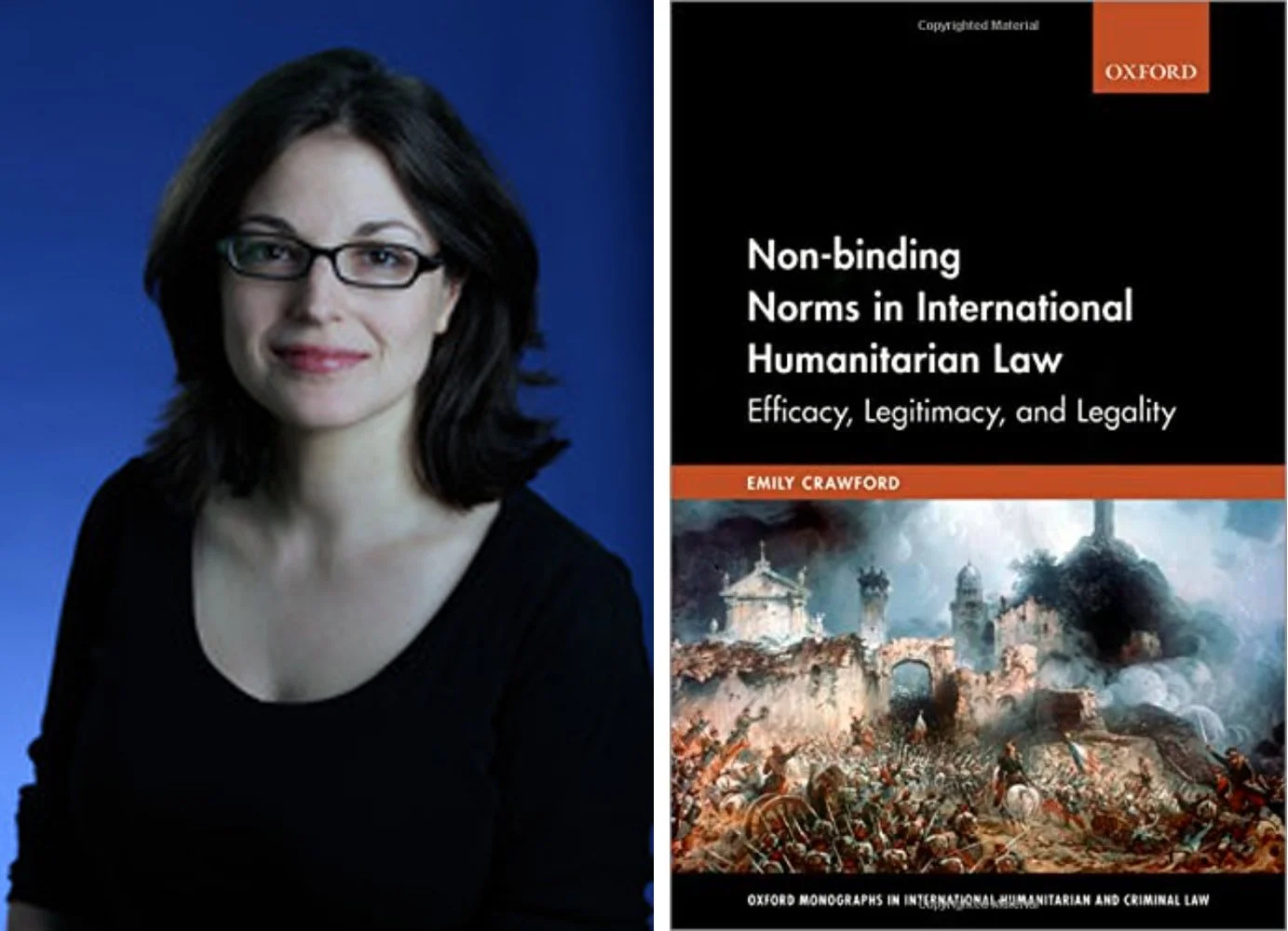
Professor Emily Crawford is a leading academic in international law at the University of Sydney Law School. She holds a BA (Hons), LLB, PhD from UNSW, and a GradCertEdStudies in Higher Education. Her primary affiliations include the Sydney Centre for International Law and the Sydney Law School's international law program. Her research focuses on international humanitarian law (IHL), international criminal law, and the efficacy of non-binding norms in shaping legal frameworks. Notable works include three monographs on IHL and co-authored textbooks like Public International Law . She was awarded the 2023 Max Planck-Cambridge Prize for International Law. Recent research explores legal terminology's role in warfare, cultural representations of international law in institutions, and state practice analysis. She has delivered over 50 conference presentations globally, including at the International Law Association and ICRC forums. Her teaching spans advanced international law topics, and she actively participates in legal reform initiatives. She co-curated the At the Vanishing Point exhibition examining international law's material culture. Grants include studies on gender analysis at the Khmer Rouge Tribunal and warrior identity under modern IHL.
Dr. Dalbir Ahlawat is a Senior Lecturer at Macquarie University's School of International Studies, specializing in strategic and security studies. He has held roles as Honorary Associate at Macquarie, Visiting Fellow at UNSW, and Center Associate at the University of Pittsburgh. His research spans Indo-Pacific security, India-China relations, border security, and migration. Dr. Ahlawat's work focuses on strategic challenges in the Indo-Pacific, India's security dynamics, and US-China-India interplays. He has authored five books and over 30 papers, with recent publications analyzing Trump-Modi diplomacy, Japan's arms exports, and India's border strategies with China. His research highlights include projects on small island states' strategies and India-Australia security cooperation. Awards include the 'Business Leader or Professional of the Year' (2016) and 'Emeritus Professor' (2023). He actively advises students on Indo-Pacific security, counter-terrorism, and migration issues. Dr. Ahlawat collaborates with UNHCR and IOM, emphasizing practical policy impacts. His academic contributions bridge theoretical research with real-world security challenges, particularly in South Asia and the Indo-Pacific region.
Tim McCormack is a Professor of International Law at the University of Tasmania and a Fellow of the Australian Academy of Law. He holds the position of Faculty of Law at the Sandy Bay Campus. His career includes significant international roles such as former Special Adviser on War Crimes to the Prosecutor of the International Criminal Court (2010–2024), and appointments to prestigious positions like James Barr Ames Visiting Professor at Harvard Law School (2016, 2020). He completed his LLB (Hons) at the University of Tasmania (1982) and PhD in International Law at Monash University (1990). McCormack’s research focuses on international humanitarian law, international criminal law, and war crimes. He has contributed to landmark publications such as Civility, Barbarism and the Evolution of International Humanitarian Law (2024) and Australia's War Crimes Trials 1945-1951 (2016). His work spans treaty negotiations, legal frameworks for emerging technologies in warfare, and accountability mechanisms for international crimes. He has led projects such as the Pathway to Truth-Telling and Treaty with Tasmania’s Aboriginal People (2021) and the Independent Inquiry into Tasmanian Government Schools Abuse (2020). Awards include the Australian Red Cross Distinguished Service Medal (2014) and the Golda Meir Postdoctoral Fellowship (Hebrew University, 1990s). McCormack serves on advisory boards for academic institutions globally and editorial boards of leading journals. His current supervision includes doctoral research on international criminal justice, refugee law, and emerging technologies in conflict. Key Projects: An erosion of humanity? Attempts to constrain war in the modern period (UTAS-funded, 2017) Labs/Teams: Asia-Pacific Centre for Military Law (founding director, 2001–2010)
Emily Camins is a Lecturer at the UWA Law School, specializing in International Humanitarian Law and transitional justice. Her research focuses on legal responses to victims of armed conflict, international human rights law, and reparations frameworks. She holds a PhD (2023) from the University of Western Australia, an LLB (Hons) from UWA, and a Graduate Diploma in International Law from the University of Melbourne. Her academic contributions include exploring victim assistance obligations under international law, human security approaches, and the interplay between sovereignty and cooperation in conflict response. She has been recognized for her work with awards including the Graduate Research School Dean's List Honourable Mention (2023) and the Journal of International Humanitarian Legal Studies Annual Prize (2023). Emily coordinates the Jessup Moot Unit at UWA and serves as Chair of the International Humanitarian Law Committee (WA) at the Australian Red Cross. Her research bridges legal theory and practice, emphasizing practical solutions for victims' rights in post-conflict environments.
Dr. Faroo Akbari is a Research Fellow at the CEVAW (Centre/Unit unspecified) within Monash University. Her expertise spans diplomacy, peace settlements, and negotiations, particularly focusing on non-state armed actors and the women, peace, and security agenda. She holds a PhD in Diplomatic Studies (2022) from Australian National University (ANU), specializing in peace settlements with groups like the Khmer Rouge and Taliban. Earlier qualifications include an Advanced Master of Diplomacy (ANU, 2016) and a Master of International Relations (University of Melbourne, 2014). Her research critically examines geopolitical conflicts in South Asia, women’s roles in peacemaking, and the intersection of gender rights with post-conflict governance. Notable publications analyze Afghanistan post-Taliban dynamics, proxy wars, and the failure of women-centric security frameworks. Her work contributes to UN Sustainable Development Goals, emphasizing global peace and gender equality. Dr. Akbari collaborates internationally on conflict studies and accepts PhD candidates. She is affiliated with Monash University’s CEVAW, focusing on contemporary geopolitical challenges and human rights activism in conflict zones.
Professor Mary Crock is Professor of Public Law at the University of Sydney Law School and member of the Sydney Centre for International Law and Sydney Environment Institute. Holding BA (Hons), LLB (Hons) and PhD from Melbourne University, she has taught at Sydney Law School since 1996 with visiting appointments at Harvard, LSE, Oxford and other leading institutions. Her research spans immigration, refugee and disability law with focus on vulnerable migrant groups. She has pioneered work on refugees with disabilities, presenting findings to the UN and influencing CRPD implementation. Current projects include Australia's IMPALA comparative migration law database and studies on CALD communities with disabilities. Her 15 most recent publications reveal three dominant research trajectories: (1) Disability-refugee intersections (6 articles), particularly CRPD implementation challenges; (2) Child migration law (4 articles) addressing best practices for young asylum seekers; (3) Crimmigration policy analysis (3 articles) documenting Australia's restrictive enforcement trends. These works consistently apply human rights frameworks to migration governance. Fellow of the Australian Academy of Law AFR Women of Influence (2019) National Ethnic Disability Alliance Medal (2015) Affinity Intercultural Foundation Award (2016) Henry Giblett Award (2012) Best Lawyers in Australia listing (annual since 2008) Professor Crock advises governments and UN agencies globally, having served as Senate inquiry adviser (2000), HREOC consultant, and Royal Commission consultant on child detention. She supervises doctoral candidates including Christian Offermanns on economic migration reform. Her IMPALA project coordinates migration law research across 12 countries through Harvard, LSE and University of Luxembourg partnerships. Fieldwork spans Indonesia, Uganda, Jordan and Turkey with UNHCR and NGOs including Amnesty International.
Professor Sascha-Dominik Dov Bachmann is a distinguished academic and former military officer specializing in international law and security studies. He currently serves as Professor in Law at the Canberra Law School and holds an Extraordinary Reader (Docent) in War Studies at the Swedish Defence University. Additional roles include Research Fellow at Stellenbosch University’s Faculty of Military Science and Fellow at NATO SHAPE for Hybrid War and Lawfare in the Asia-Pacific region until 2025. His operational military experience spans the Balkans and U.S. Marine Corps exchange programs, and he has worked across the U.S., Middle East, South Africa, and Europe over 20 years. LL.D (Doctor of Laws) - University of Johannesburg LL.M (Magister Legum) - Stellenbosch University State Exam (LL.B/LL.M equivalent) - Ludwig Maximilians Universität Munich Postgraduate Certificate in Learning and Teaching - University of Portsmouth His research bridges Hybrid Warfare , Lawfare , Cyber Threats , and International Human Rights Law . Key projects focus on countering disinformation, quantifying military readiness, and hybrid threats in the Asia-Pacific. His interdisciplinary work is cited by NATO and defense agencies, influencing policies on critical infrastructure protection, economic coercion, and cognitive warfare. Recent publications analyze China’s Arctic ambitions, AUKUS implications, and legal frameworks for countering hybrid threats. Professor Bachmann has secured funding from NATO , South African Department of Defence , and U.S. Department of Defense . He mentors HDR students on topics like human rights norms in Islamic traditions and renewable energy legislation in the Gulf , contributing to policy debates through outlets like Pacific Affairs and Australian Outlook .
Hilary Charlesworth is a Melbourne Laureate Professor and Harrison Moore Professor of Law at Melbourne Law School, University of Melbourne. She also holds a Distinguished Professorship at the Australian National University. Her expertise spans international law, human rights, peacebuilding, and feminist legal theory. She has served as Judge ad hoc in landmark cases at the International Court of Justice and has held prestigious fellowships including ARC Laureate and Federation Fellowships. Her research focuses on the structure of international law, gender equality, and the intersection of international law with peacebuilding processes. Notable awards include the American Society of International Law’s awards for creative scholarship and human rights contributions, as well as the International Studies Association’s Distinguished Scholar award. Charlesworth has been affiliated with global institutions like Harvard Law School and the Hague Academy, and she contributed to UN reforms through her work on UN Women. Her academic leadership includes roles in professional societies such as the Australian and New Zealand Society of International Law. Her scholarly output reflects engagement with critical legal theory, feminist methodologies, and the practical implications of international law in conflict zones and post-conflict societies. Current and past roles include co-directing the Human Rights Law program at Melbourne Law School and contributing to international legal education through courses at the Hague Academy.