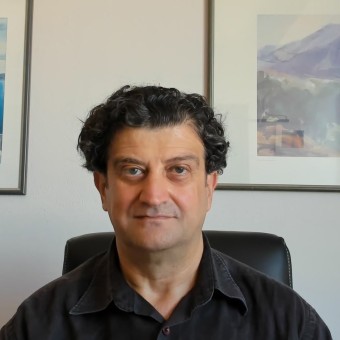
Jeff Linderoth is the Harvey D. Spangler Professor in the Department of Industrial and Systems Engineering at the University of Wisconsin-Madison. His research focuses on large-scale numerical optimization, mixed-integer nonlinear programming, and stochastic programming, with applications in energy systems, global routing, and industrial processes. Education: BS in General Engineering (highest honors) from University of Illinois at Urbana-Champaign, MS in Operations Research from Georgia Institute of Technology, PhD in Industrial Engineering from Georgia Institute of Technology. Linderoth's work addresses theoretical and applied challenges in optimization, including developing algorithms for mixed-integer programming, analyzing knapsack polytopes, and creating tools like the Minotaur optimization toolkit. His recent publications explore integer programming techniques for subspace clustering, complementarity constraints, and customized coverage instrumentation. Selected trends in his research include advancements in stochastic programming, orbital branching for symmetric integer programs, and congestion analysis in power systems. His group contributes to optimization software and data-driven libraries like MIPLIB. Scientific Award: Harvey D. Spangler Professor.
Elina Rönnberg is a Professor and Deputy Head of Department at the Department of Mathematics, Linköping University, where she leads research in discrete optimisation and intelligent decision-making. Her work bridges theoretical method development and real-world applications in sectors such as healthcare, aviation, mining, and transportation. She is actively involved in the Wallenberg AI, Autonomous Systems and Software Program (WASP) and has collaborated with industry leaders like Saab and Scania. Her research focuses on advanced optimisation techniques including Dantzig-Wolfe decomposition, Lagrangian relaxation, column generation, branch-and-price, and logic-based Benders decomposition. She also explores hybrid methods combining mathematical programming with constraint programming and machine learning. Applications span nurse rostering, electric vehicle routing, aircraft arrival scheduling, and underground mine planning. Recent publications highlight a strong trend toward integrating AI and machine learning—particularly graph neural networks—with classical optimisation frameworks to accelerate solution methods. Her work emphasizes practical impact, robustness, and scalability in solving complex scheduling and resource allocation problems. Nurse Rostering with Strategic Planning of Skills for Sick-Leave Robustness (2024) Pricing for the EVRPTW with Piecewise Linear Charging (2024) Speeding Up Logic-Based Benders Decomposition with Graph Neural Networks (2024) Elina supervises several PhD students and has co-supervised doctoral research at international institutions including Makarere University (Uganda) and the University of Exeter (UK). She has contributed to applied projects through student theses in collaboration with Scania and Saab, focusing on electric vehicle routing and search-and-rescue optimisation. She previously served as a Specialist in Optimisation at Saab Aeronautics (2014–2020) and co-founded Schemagi, a scheduling tool aimed at improving quality in healthcare. She teaches courses such as Introduction to Optimization (TAOP07) and Project - Applied Mathematics (TATA62). Her research group, 'Mathematics and algorithms for intelligent decision-making,' operates within the Division of Applied Mathematics (TIMA) at the Department of Mathematics. The team develops decision support tools that enhance efficiency and sustainability in complex systems, particularly under the growing demands of electrification and digitalisation in transport and logistics.
Itsuro Morita is Professor in the School of Fundamental Science and Engineering, Faculty of Science and Engineering, Waseda University, Tokyo. Before joining Waseda in 2022 he spent 23 years at KDDI R&D Laboratories, advancing from researcher to executive research fellow, and has been a visiting researcher at Stanford University. He is an IEEE Fellow and IEICE Fellow recognized for pioneering large-capacity, long-haul optical transmission systems. Education: 2004 – 2005 Tokyo Institute of Technology, Graduate School of Science & Engineering, Department of Electrical and Electronic Engineering (Doctoral coursework) 1990 – 1992 Tokyo Institute of Technology, Graduate School of Science & Engineering, Department of Physical Electronics (M.E.) 1986 – 1990 Tokyo Institute of Technology, School of Engineering (B.E.) Research Interests: Morita’s work sits at the intersection of optical fiber communication and software-defined networking. He explores ultra-high-capacity transmission via space-division multiplexing (multi-core/few-mode fibers), real-time MIMO digital signal processing for modal crosstalk mitigation, and SDN/NFV orchestration of disaggregated optical networks. Additional interests include quality-of-transmission estimation using machine learning, telemetry-enabled control planes (gRPC/gNMI), and metro-embedded edge/cloud architectures for IoT services. Publication Trends: Recent articles emphasize two converging themes: (i) petabit-per-second SDM/WDM experiments using novel fiber geometries and real-time DSP, and (ii) cloud-native SDN control frameworks that integrate machine-learning-based QoT prediction, YANG/NETCONF modeling, and open APIs (TAPI/OpenConfig) for multi-domain, partially disaggregated networks. These works collectively push both the physical capacity frontier and the agility of next-generation optical infrastructure. Scientific Awards: C&C Prize 2024 (NEC C&C Foundation) – contributions to WDM optical submarine cable systems IEICE Achievement Award 2021 – pioneering research on 10-Pbit/s ultra-large-capacity SDM transmission Telecom System Technology Award 2021 – 10.16-Pbit/s dense SDM/WDM transmission record IEEE Fellow (2021) – contributions to large-capacity high-speed transmission systems IEICE Fellow (2020) – research on trans-oceanic high-speed optical signal transmission Ichimura Industrial Award – Contribution Prize 2018 – development of terabit-class submarine cable systems Maejima Hisoka Award 2012 – proposal and demonstration of distributed-control soliton communication Minister of Economy, Trade and Industry Award for Advanced Technology 2006 – 160 Gbit/s ultra-high-speed optical transmission technology Advising & Grants: At Waseda University Morita advises graduate students on experimental photonic networking and leads externally funded projects on petabit SDM transmission and SDN orchestration. While specific grant numbers are not disclosed, his continuous industry-university collaborative testbeds (with KDDI, CTTC, and others) indicate substantial competitive funding. Labs & Teams: He heads the Optical Space-Division-Multiplexing Laboratory at Waseda, maintaining joint experimental facilities with KDDI Research and international partners (e.g., CTTC, Spain). The group operates real-time coherent MIMO testbeds, multi-domain SDN controllers, and fiber-level SDM prototypes capable of petabit-per-second demonstrations.
Andreas Grothey is a Senior Lecturer in the School of Mathematics at The University of Edinburgh, a position he has held since 2011. He completed his MSc in Numerical Algebra and Mathematical Computing at the University of Dundee (1995) and his PhD in Optimization at the University of Edinburgh (2001), supervised by Ken McKinnon. His research focuses on stochastic programming, interior point methods, decomposition approaches, high-performance computing, and energy systems optimization. He has contributed to energy planning, power grid reliability, and emergency response strategies for power networks. Grothey has advised seven PhD students, including work on unit commitment, top-percentile traffic routing, and power flow optimization. His projects include the OOPS solver, CESI energy integration center, and the Structured Modelling Language (SML). Recent work addresses pandemic policy optimization and exascale computational challenges. Education: MSc in Numerical Algebra and Mathematical Computing (University of Dundee, 1995) PhD in Optimization (University of Edinburgh, 2001) Research Interests: Stochastic Programming Interior Point Methods Decomposition Methods High-Performance Computing Energy Systems Optimization Advising & Projects: PhD Supervision (7 students, 2007–2022) OOPS Parallel Solver Development CESI Energy Systems Integration SML Structured Modelling Language Labs/Teams: Member of the Edinburgh Research Group on Optimization, leading projects in power grid stability and energy planning.
Dengfeng Sun is a Professor and Associate Head of the Gambaro Graduate Program in the School of Aeronautics and Astronautics at Purdue University. His research focuses on distributed control systems, autonomy, resilient networks, and air traffic management. Sun holds a B.Eng. from Tsinghua University, an M.S. from The Ohio State University, and a Ph.D. from UC Berkeley. His work spans advanced air mobility, UAV trajectory planning, and stochastic optimization for large-scale systems. Key contributions include resilient UAV traffic control, distributed state estimation algorithms, and fault detection methods for navigation systems. Sun's research has been published in top journals like IEEE Transactions on Intelligent Transportation Systems and Transportation Research Part E. Education: B.Eng., Tsinghua University (2000) M.S., Ohio State University (2002) Ph.D., UC Berkeley (2008) He advises on cutting-edge projects integrating robotics, autonomous systems, and cloud-based traffic modeling. His lab develops solutions for urban air mobility, emergency medical UAV networks, and next-generation air traffic control systems. Notable collaborations include work with NASA and industry partners on continuous descent approach procedures and metroplex routing paradigms. Sun's work bridges theoretical control systems with practical applications in aviation and infrastructure optimization.
Raghu Bollapragada is an Assistant Professor in Operations Research and Industrial Engineering at the University of Texas at Austin, with affiliations to the Oden Institute and Machine Learning Laboratory. His research designs algorithms for nonlinear optimization, including constrained, stochastic, and distributed methods with applications in machine learning. Supported by NSF, Argonne National Laboratory, and Lawrence Livermore National Laboratory, recent work (2024-2025) develops gradient tracking for decentralized systems, adaptive sampling techniques, and hessian averaging for nonconvex problems. He was elected Vice Chair of Nonlinear Optimization for INFORMS (2024-2026).
Wiebke Meesenburg is an Assistant Professor in the Department of Civil and Mechanical Engineering at the Technical University of Denmark (DTU), specializing in Thermal Energy. She is actively involved in research on large-scale heat pump systems, district heating integration, and digital twin applications for energy optimization. Her research focuses on sustainable thermal energy systems, particularly the design, monitoring, and optimization of heat pumps in district heating networks. Key areas include dynamic modeling, real-time adaptation, fouling mitigation, and the integration of renewable energy sources. She contributes to advancing energy efficiency and sustainability in urban infrastructure. The recent publications highlight a strong trend toward digitalization and optimization of thermal systems, with an emphasis on model-based monitoring, digital twins, and operation scheduling using advanced algorithms. Her work bridges mechanical engineering, energy systems, and computational modeling to improve system performance and reliability. She has supervised PhD research and contributed to major projects such as the implementation of digital twins for heat pump systems and EnergyLab Nordhavn. Collaborations involve key figures in energy research at DTU, including Professor Brian Elmegaard. While no formal awards are listed, her active participation in conferences and project leadership demonstrates recognition in her field. Wiebke Meesenburg has been involved in organizing and presenting at international events, including the 35th International Conference on Efficiency, Cost, Optimization, Simulation and Environmental Impact of Energy Systems and workshops on Modelica and flexible heat supply. Her work is embedded in interdisciplinary teams focused on future energy infrastructures and smart urban energy systems.
Cédric Soutil is a Researcher at the Conservatoire National des Arts et Métiers (CNAM) , affiliated with the CEDRIC Laboratory. His work spans combinatorial optimization , integer programming , quadratic programming , and algorithm design , with a focus on solving complex optimization problems in scheduling and graph theory. Recent publications highlight his expertise in non-separable and non-convex quadratic integer programming , knapsack problems , and online computation . His research trends emphasize mathematical reformulations , upper bound algorithms , and optimization models for real-world applications like horse race scheduling and hydrogen production . He has collaborated extensively with researchers such as A. Houdayer , D. Quadri , and P. Tolla , contributing to over two decades of academic output in operations research and combinatorial optimization .
Hande Benson is a Professor in the Department of Decision Sciences and MIS at LeBow College of Business, Drexel University. She serves as the academic director of the Business and Engineering program and teaches in undergraduate and graduate programs in Business Analytics and Operations and Supply Chain Management. Research Interests: Dr. Benson specializes in optimization, particularly addressing modeling and computational challenges in large-scale nonlinear and mixed-integer optimization. Her work includes interior-point methods, regularization techniques, and the development of optimization software such as LOQO and MILANO. Recent Research Trends: Her recent publications span decision aggregation, multi-vehicle motion planning under communication constraints, and advanced interior-point algorithms. These works reflect a strong focus on algorithmic innovation, real-world applications in robotics and supply chains, and theoretical advancements in nonconvex optimization. Scientific Awards: Outstanding STAR Mentor, Drexel University (2017-2018) Distinguished Fellow, Center for Research Excellence, LeBow College of Business (2009-2012) Excellence in Research Award, LeBow College of Business (2005) Advising and Grants: While direct student advising is not explicitly listed, Dr. Benson has led significant research projects, including Multivehicle Path Coordination under Communication Constraints (Drexel Interdisciplinary Research Grant, $15,000) and Efficient Interior-Point Methods for Mixed-Integer Nonlinear and Conic Programming (NSF, $59,960). She has also contributed to executive education and consulting in financial, industrial, and governmental sectors. Editorial and Professional Service: Dr. Benson is actively involved in the academic community as Associate Editor for several leading journals, including Computational Optimization and Applications , Journal of Optimization Theory and Applications , Mathematical Programming Computation , and Optimization and Engineering .
Daniel McKenzie is an Assistant Professor in the Department of Applied Mathematics and Statistics at the Colorado School of Mines. His research focuses on derivative-free optimization, implicit neural networks, and geometric methods in data science. He holds a B.Sc.(hons) and M.Sc. in Mathematics from the University of Cape Town (2010, 2014) and a PhD in Mathematics from the University of Georgia (2019). B.Sc.(hons): Mathematics and Applied Mathematics, University of Cape Town, 2010 M.Sc.: Mathematics, University of Cape Town, 2014 PhD: Mathematics, University of Georgia, 2019 His research explores the intersection of optimization theory and machine learning, with applications in spatial data modeling, geometric data analysis, and high-dimensional clustering. Recent work emphasizes curvature-aware algorithms, comparison-based optimization, and implicit network architectures like LatticeVision. His methods address challenges in non-stationary spatial data and convex game equilibria prediction. Key contributions include Fermat distance metrics for clustering, Jacobian-Free Backpropagation (JFB) for implicit networks, and zeroth-order algorithms for black-box optimization. While no scientific awards are listed, his publications reflect a strong focus on advancing optimization techniques for modern data science problems. No specific grants or advising roles are detailed in the provided text. His work bridges computational mathematics and applied AI, with potential applications in robotics, spatial statistics, and algorithmic game theory.
Torbjörn Larsson is a Professor in the Department of Mathematics at Linköping University, affiliated with the Division of Applied Mathematics (TIMA). His work bridges theoretical and applied optimization with significant impact in healthcare, logistics, and finance. His research interests include Mathematical Optimization , Operations Research , Brachytherapy Treatment Planning , Vehicle Routing , and Portfolio Optimization . He develops advanced algorithms such as Lagrangian heuristics, metaheuristics, and feasible direction methods to solve complex decision problems. The recent publications indicate a strong focus on developing bounding techniques and heuristic frameworks for discrete and multi-objective optimization, with applications ranging from radiation therapy to transportation logistics. His work emphasizes both theoretical rigor and practical implementation. Scientific Contributions: Development of novel optimization methods for brachytherapy treatment planning Advancement of Lagrangian and metaheuristic frameworks Application of optimization in finance (portfolio selection) and scheduling He collaborates extensively on research projects involving mathematical modeling and algorithm design. While specific advising roles are not listed, his co-authorship with junior researchers suggests mentorship activity. He has contributed to projects on decision support systems for scheduling and large-scale optimization in finance. Laboratories and Research Groups: Applied Mathematics (TIMA), Department of Mathematics, Linköping University Research environment focused on optimization and its applications in medicine and logistics
Vijay Gupta is the Elmore Professor of Electrical and Computer Engineering and Associate Head of Graduate and Professional Programs at Purdue University's College of Engineering. His research focuses on distributed decision-making systems, combining data-driven and model-driven approaches for infrastructure networks like power grids, transportation systems, and water distribution networks. Key areas include compositional control, cyber-physical security, and incentive design in distributed estimation and control. Education: B.Tech from Indian Institute of Technology Delhi, M.S. and Ph.D. from California Institute of Technology, all in Electrical Engineering. Prior roles include faculty positions at Notre Dame and research roles at United Technologies Research Center. Research emphasizes resilient control strategies for large-scale systems, with recent work addressing secure estimation under adversarial attacks, model reduction techniques, and reinforcement learning frameworks for decentralized control. His publications span control theory, cyber-physical systems, and optimization algorithms. Grants and collaborations are not explicitly detailed here, but his work reflects significant engagement with foundational and applied research challenges in networked systems. No specific awards are listed in the provided texts.
Ted Ralphs is a Professor of Industrial and Systems Engineering at Lehigh University’s Rossin College of Engineering. He serves as co-founder and director of the Computational Optimization Research at Lehigh (COR@L) Laboratory, and chairs the INFORMS Computing Society. His research focuses on large-scale computation and optimization, bridging theoretical and practical applications through high-performance computing and mathematical techniques. Ralphs holds a Ph.D. in Operations Research from Cornell University and advanced degrees in Mathematics and Applied Mathematics from Carnegie Mellon University. His expertise spans Supply Chain Management, Grid Computing, Mathematical Optimization, Financial Engineering, and Algorithm Development. He teaches courses in computational methods, discrete optimization, financial optimization, and algorithms in systems engineering. Ralphs has received notable honors including the 2021 Rossin College Outstanding Doctoral Student Advising Award and election as an INFORMS Fellow in 2023. His research contributions include advances in bilevel optimization, decomposition methods, and open-source optimization software (e.g., COIN-OR’s Cbc solver). He has led collaborative projects such as a Naval grant-funded initiative with the University of Pittsburgh on bilevel optimization. Ralphs’ work emphasizes scalable algorithms and their real-world applicability in energy markets, logistics, and combinatorial problems.
Romain Raveaux is an Associate Professor at the LIFAT Computer Science Laboratory, University of Tours, affiliated with Polytech Tours. His research focuses on Image Analysis, Machine Learning, Structural Pattern Recognition, Graph Matching, Graph Neural Networks, Discrete Optimization, Reinforcement Learning, and Transfer Learning . Email: romain.raveaux@gmail.com , romain.raveaux@laposte.net Address: 64 av. Jean Portalis, Tours, France, 37200 Phone: +33 (0)2 47 36 14 27 Research Interests Graph Matching and Neural Networks Discrete Optimization for Pattern Recognition Transfer Learning in Graph-Based Models Historical Document Analysis Scientific Trends His recent work bridges Graph Neural Networks with Mixed-Integer Programming , focusing on Image Semantic Segmentation and Graph Cycle Detection . Earlier studies emphasize Genetic Algorithms for graph classification and Graph Edit Distance optimization in pattern recognition.
Nikolaos Samaras is a Full Professor at the Department of Applied Informatics, School of Information Sciences, University of Macedonia in Thessaloniki, Greece. He has been serving as director of the Computational Methodologies & Operations Research (CMOR) Laboratory since April 2016. His academic career includes positions as Assistant Professor (2007-2012) and Lecturer (2003-2007) at the same institution, and earlier as an adjacent Lecturer at the Technological Institute of Western Macedonia (1998-2000). Dr. Samaras earned his Diploma in Applied Informatics from the University of Macedonia in 1996 and his Ph.D. in Applied Informatics from the same university in 2001. His educational background forms the foundation for his extensive research in computational optimization and operations research. Professor Samaras's research focuses on the interface between computer science and operations research, with particular expertise in linear and nonlinear optimization, network optimization, integer optimization, and scientific computing including HPC and GPU programming. His work has resulted in the development of new algorithmic families for optimization problems, efficient GPU implementations of the revised simplex algorithm, and novel algorithms and software for operations research. His research spans theoretical algorithm development, practical implementation, and real-world applications across various engineering and scientific domains. His extensive publication record includes over 35 journal papers in prestigious venues such as Computers and Operations Research, European Journal of Operational Research, and Journal of Artificial Intelligence Research, more than 85 conference papers, and four textbooks (two in English and two in Greek). His work has been recognized through citations and the Thomson ISI/ASIS&T Citation Analysis Research Grant in 2005. ACM Senior Member (2016) Thomson ISI/ASIS&T Citation Analysis Research Grant (2005) Editorial board member of Operations Research: An International Journal Reviewer for numerous top journals including Mathematical Programming Computation and European Journal of Operational Research Professor Samaras has supervised four current Ph.D. students working on hybrid simplex algorithms, large-scale optimization using Apache Hadoop, algorithmic procedures in matrix theory, and smoothed complexity analysis. He has successfully guided five Ph.D. students to completion, including Nikolaos Ploskas who won the 2014 HELORS Doctoral Dissertation Award. Additionally, he has supervised 45 master's theses and 84 bachelor's theses. His research group has secured funding from diverse sources including the European Union, Greek Secretariat of Research and Technology, and industry partners like Veltio Greece LTD. The Computational Methodologies & Operations Research (CMOR) Laboratory, which he directs, focuses on developing and implementing optimization algorithms with applications in transportation, energy systems, and business process design. The lab has produced notable software tools including Euclides and Visual LinProg, which have educational applications in linear programming.