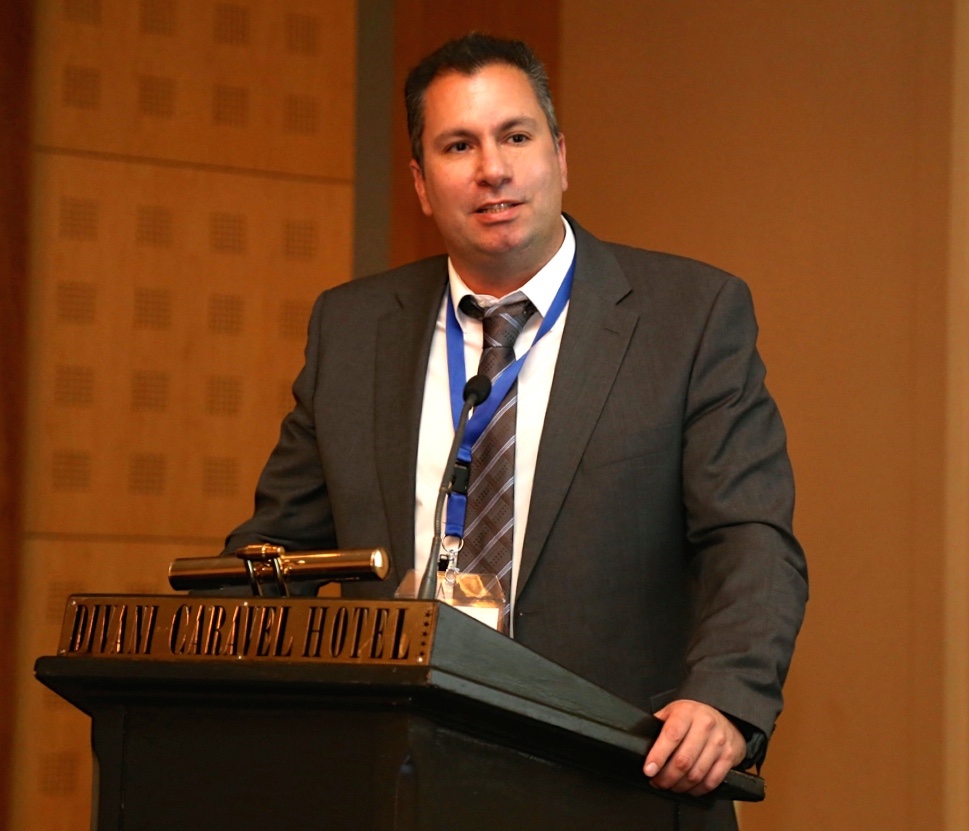
Dimitris Fotakis is Professor of Computer Science at the National Technical University of Athens (NTUA) and Collaborating Senior Researcher at the Archimedes Unit/ATHENA RC. His research in theoretical computer science focuses on algorithmic game theory, approximation algorithms, and facility location problems. He leads research projects including BALSAM (Beyond Worst-Case Analysis in Approximation Algorithms) funded by HFRI. With publications in ICALP, NeurIPS, and STOC, his work develops efficient algorithms for optimization under uncertainty. Fotakis serves on program committees of major conferences including ICALP and SAGT.
Konstantinos Skianis is an Assistant Professor in the Department of Computer Science and Engineering at the University of Ioannina, Greece. His research lies at the intersection of Natural Language Processing, Machine Learning, Deep Learning, and Data Science, with a focus on representations, regularization, robustness, and reasoning (the 4R's). He has founded the Greek AI company BLUAI and co-founded PrimeHost AI, a startup automating guest conversations using AI. Ph.D. in Computer Science, École Polytechnique, France (2015–2019) M.Sc. in Math, Computer Vision, and Machine Learning, École Normale Supérieure de Cachan, France (2014–2015) B.Sc. in Computer Science, Athens University of Economics and Business, Greece (2013) His research interests span Natural Language Processing , Graph Neural Networks , Large Language Models , Representation Learning , and Medical AI . He investigates robustness in neural networks, reasoning with LLMs via pseudo-code, and multilingual applications in low-resource settings like Greek. His recent work includes digital twins for industrial optimization, climate adaptation in ports using ML, and mental health detection via LLMs. The 15 most recent publications reflect a strong trend in graph-based learning , LLM reasoning , representation robustness , and applied AI in healthcare and industry . His work combines theoretical rigor with practical applications, often involving real-world datasets from public health, industrial processes, and climate science. Best Paper Award, TextGraphs at NAACL 2018 OpenAI Researcher Access Program (2024) He has advised or collaborated on several student projects and competitions, including the Data Mining Cup and Kaggle challenges. He has secured research support through the OpenAI credits program. He has taught courses in Linear Algebra, Data Mining, and advanced labs on graph and text learning at ENS Paris-Saclay. He is actively involved in the research community as an Area Chair for ARR (2025) and reviewer for top-tier venues like NeurIPS, ICLR, ACL, and EMNLP. He leads or contributes to open-source tools such as GoWvis (text visualization), GraKeL (graph kernel library), and SpreadViz (influence spread visualization). His work on Greek NLP resources has helped advance language technology for low-resource languages.
Angelos Bilas is a Professor of Computer Science at the University of Crete, Greece, and a collaborating researcher at FORTH-ICS (Foundation for Research and Technology-Hellas). He received his PhD in Computer Science from Princeton University in 1998 and has held academic positions at the University of Crete since 2002, including Department Chair (2016-2020). His research focuses on systems software for storage systems, computing architectures, and parallel systems with emphasis on flash storage optimization. PhD, Princeton University (1998) MA, Princeton University (1995) BEng, University of Patras (1993) His research interests span computer systems, storage architectures, and parallel computing , with notable contributions in memory-mapped I/O optimization, LSM key-value store design, and heterogeneous accelerator integration. He has developed frameworks like TeraHeap for DRAM pressure mitigation in big data systems and Arax for decoupling applications from accelerators. Prominent trends in his recent publications include flash storage optimization (TeraHeap), LSM tree efficiency (Tebis), and cloud-HPC convergence (EVOLVE, KNoC). His work appears in top venues like ASPLOS, USENIX ATC, and ACM Transactions on Storage. Scientific recognitions include: Marie Curie Excellent Teams Award (2005-2009) Best Presentation Award, USENIX HotStorage'20 He has served on editorial boards (ACM Transactions on Storage) and program committees (ACM HotStorage, HPCA). His research involves 35 master’s and 8 PhD students, with 45+ EU/national projects and 4 patents licensed to industry.
George N. Karystinos is a Professor at the School of Electrical and Computer Engineering , Technical University of Crete , where he has served since 2005. Since 2021, he also holds the position of Dean of the School. Previously, he was an Assistant Professor at Wright State University (2003–2005). Education: Ph.D. in Electrical Engineering, State University of New York at Buffalo , 2003 Diploma in Computer Engineering and Science, University of Patras , 1997 Additional studies in Piano, National Conservatory of Athens and State University of New York at Buffalo Research Interests: His research spans telecommunications theory and systems , coding theory , adaptive signal processing , wireless communications , MIMO systems , neural networks , and optimization with limited data . He is particularly known for contributions to L1-norm PCA , noncoherent detection , RFID systems , and code design for CDMA . Scientific Awards: IEEE Transactions on Neural Networks Outstanding Paper Award (2003) IEEE ICT Best Paper Award (2001) IEEE ISWCS Best Paper Award (2013) IEEE ICASSP Best Student Paper Award (2015) IEEE RFID-TA Second Best Student Paper Award (2011) IEEE MOCAST Best Student Paper Award (2018) Laboratory and Teaching: He leads research at the Telecommunications Laboratory and teaches courses such as Signals and Systems , Information and Code Theory , and Probability and Random Process Theory . Grants and Projects: While specific grant details are not listed, his extensive publication record and award history indicate active participation in funded research projects, particularly in wireless communications and signal processing.
Bernhard Scholz is a Professor at the University of Sydney's School of Computer Science. His research focuses on programming languages, compilers, static analysis, and blockchain technologies, with significant contributions to Datalog optimization and smart contract security. He teaches COMP3109 Programming Languages and Paradigms and leads research in declarative programming frameworks. Scholz's primary research interests include: Development of Soufflé, a Datalog-based program analysis framework Ethereum smart contract security through tools like Ethainter and MadMax Parallel data structures for efficient Datalog evaluation Compiler optimizations for embedded systems and cloud environments His recent publications demonstrate a consistent focus on improving the efficiency and security of declarative programming systems, particularly through innovations in Datalog execution and smart contract analysis. This work bridges theoretical computer science with practical applications in blockchain and distributed systems. Scholz has secured research funding including an ARC Discovery Project on adaptive key-value stores and a Fantom Operations grant for smart contract toolchain development. He collaborates with international researchers on parallel computing and blockchain verification projects.
Dimitris Sotiropoulos is an Assistant Professor at the Department of Electrical and Computer Engineering, University of Peloponnese, specializing in Engineering Mathematics . He holds a B.Sc. in Mathematics (1995) and a Ph.D. (2005) in Mathematical Programming and Numerical Analysis. Over 20 years of higher education teaching Author/co-author of 36+ scientific articles Supervised 20+ postgraduate theses Research Interests focus on computational mathematics, global optimization algorithms, and machine learning. Specific areas include interval analysis for automatic result verification, large-scale optimization, nonlinear equation solving, and artificial neural network training. His scientific work spans sustainability assessments for aerospace components, uncertainty quantification in composite materials, and stress modeling in human-computer interaction. Articles highlight applications of interval analysis to optimization problems and neural network training improvements via BFGS methods. Teaching roles include lectures at Ionian University's Department of Informatics and University of Peloponnese's Department of Computer Science and Technology. He also serves on Hellenic Open University's Supervisory Board since 2009, mentoring postgraduate students in computational mathematics.
Christos Papadopoulos Filelis is an Assistant Professor at the Department of Electrical and Computer Engineering, Democritus University of Thrace, where he conducts research and teaches courses in computational mathematics and physics. His academic journey began with a Diploma in Electrical and Computer Engineering from Democritus University of Thrace in 2010, followed by a PhD in Numerical Analysis and High Performance Computing from the same institution in 2014. His research interests span Computational Mathematics, Mathematical and Computational Physics, Numerical Methods, Scientific Calculations, High Performance Computing, and Machine Learning applications in Mathematics and Physics. He has made significant contributions to pre-coordinated iterative methods, multi-grid and multi-level methods, parallel computing, cloud computing, and big data analytics. His work bridges theoretical mathematics with practical computational applications across multiple domains. Analysis of his recent publications reveals a strong focus on developing advanced computational techniques for solving complex mathematical problems, with particular emphasis on matrix computations, preconditioning methods, and time series analysis. His research demonstrates a consistent trajectory toward more efficient algorithms for high-performance computing environments, with increasing applications in machine learning and environmental sustainability. Dr. Papadopoulos Filelis has taught undergraduate courses including Physics, Numerical Analysis, Mathematical Software, Scientific Calculations, and Calculus of Changes. He has participated in European (H2020) and National funded projects such as the SFI FinTechNext project (UCC, Ireland), demonstrating his ability to secure competitive research funding. His work with the Physics Laboratory at Democritus University of Thrace involves developing computational frameworks that integrate theoretical physics with advanced numerical methods. He has collaborated extensively with researchers across Europe, particularly in cloud computing and high-performance computing projects that address real-world computational challenges.
Giorgos Panaras is an Assistant Professor in the Department of Mechanical Engineering at the University of Western Macedonia (UOWM), affiliated with the Polytechnic School. He holds a PhD in Thermal Energy Systems from Aristotle University of Thessaloniki (2010), an MSc in Environment & Development (NTUA, 2000), and a Diploma in Mechanical Engineering (NTUA, 1996). His research focuses on energy-efficient buildings, HVAC systems, indoor air quality, thermal comfort, solar thermal technologies, and performance assessment of energy systems. He has extensive experience in renewable energy integration and has participated in 16 R&D projects and published over 50 articles. He teaches courses like Fluid Mechanics, HVAC, Energy Planning of Buildings, and Renewable Energy Systems. Education: PhD in Thermal Energy Systems, Aristotle University of Thessaloniki (2010) MSc in Environment & Development, NTUA (2000) Dipl. Mechanical Engineer, NTUA (1996) Research Focus: His work emphasizes sustainable building design, energy performance optimization, and advanced HVAC technologies. Key areas include solar thermal integration, thermal comfort assessment in diverse environments (university classrooms, hospitals, aquatic centers), and lifecycle analysis of energy systems. He also explores flexibility in district heating systems and smart thermostat development. Grants & Collaborations: Principal/Co-Investigator in 16 R&D projects Reviewer for Greek Secretariat for Research and Technology Accredited testing collaborations with NCSR Demokritos and NTUA Labs & Teams: His research group investigates energy-efficient buildings and HVAC systems, with a focus on quantitative performance analysis and uncertainty assessment in energy measurements.
Prof. Michalis Vazirgiannis is affiliated with Ecole Polytechnique, Institut Polytechnique de Paris, specializing in machine learning for graph-structured data. His research includes kernel methods and node embedding techniques for complex network analysis, with applications in knowledge representation and pattern recognition. Notable contributions focus on scalable algorithms for graph mining and theoretical foundations of representation learning. International collaborations emphasize computational methods for large-scale network data processing.
Spyros Argyropoulos serves as Laboratory Teaching Staff (EDIP) and Researcher at the Intelligent Systems Laboratory (InteLLigence) within the School of Electrical and Computer Engineering at the Technical University of Crete, Greece, a position he has held continuously since 2002 with responsibilities encompassing system administration and intelligent systems research. Education: Master's degree in Computer Engineering (M.Eng.) from Technical University of Crete, Electronics and Computer Engineering Department (July 1994) Diploma in Informatics and Computer Engineering from University of Patras, Informatics and Computer Engineering Department (September 1990) Research Interests: His work centers on Information Systems, Data Bases, and Web Technologies, with documented contributions to large-scale governmental projects including Greece's Tax Information System (TAXIS) and TAXISnet online services during his tenure at the Ministry of Finance in 1997. His expertise bridges practical system implementation with intelligent information processing frameworks. Scientific Awards: No scientific awards were listed in the provided institutional documentation. Advising and Grants: The institutional records contain no references to graduate student supervision, research grants, or funded projects. Labs and Teams: He is an integral member of the Intelligent Systems Laboratory (InteLLigence), contributing to its research infrastructure and technical operations within the university's School of Electrical and Computer Engineering.
Dr. Ioannis Magnisalis serves as a Researcher and Academic Associate at the International Hellenic University, functioning as Research Associate and Manager within the DORG Research Group. He maintains active collaborations with the Greek Open Source Software Organization (EL/LAK), International University of Greece, and Aristotle University of Thessaloniki on e-Government R&D initiatives, while his primary professional focus remains with the European Commission's data strategy implementation. His research spans eGovernment , Open Data , Linked Data , Semantic Web , Business Semantic Standards , Metadata , Data Analysis , and e-Learning . Specializing in metadata frameworks and semantic technologies, he applies analytical tools (R, Python, SQL, NoSQL) to analyze large-scale survey data including Eurobarometer and Covid-19 datasets, with emphasis on developing interoperable standards (ESCO, CPSV, IMS, BPMN) for public sector data ecosystems. His 2020-2024 publications reveal consistent focus on digital transformation frameworks across public administration and education sectors, with recurring themes in data-centric service provision, government big data ecosystems, and AI applications. Key contributions include systematic reviews on digital transformation barriers and innovative frameworks like DaLiF for data lifecycle management, demonstrating strong interdisciplinary integration of semantic web technologies with practical governance challenges. As a core member of the DORG Research Group, he contributes to projects including JustReDi (addressing resilience and digital transition in Greek regions) and GR digiGOV-innoHUB (delivering digital skills education and transformation workshops), leveraging his expertise in IMAPS (Interoperability Maturity Assessment) for public service evaluation.
Christos Doulkeridis is a Professor at the Department of Digital Systems, University of Piraeus, Greece. He specializes in parallel and distributed query processing, large-scale data management, and spatio-temporal data systems. His work focuses on optimizing big data frameworks for mobility analytics and distributed knowledge discovery. He holds a PhD from Athens University of Economics and Business (2007) and has been involved in several EU-funded projects like EMERALDS, Green.DAT.AI, and MobiSpaces as Principal Investigator or Coordinator. Education: PhD in Informatics (2007), Athens University of Economics and Business M.Sc. in Information Systems (2003), Athens University of Economics and Business Diploma in Electrical and Computer Engineering (2001), National Technical University of Athens Awards: Best Paper Awards at SIGSPATIAL, SSTD, EuroVA Marie-Curie and ERCIM Fellowships SemEval 2017 Task 4 & 6 competition wins His research interests include scalable data processing frameworks, mobility data analytics, and spatio-temporal query optimization. He leads projects like MobiSpaces (Horizon Europe), aiming to create energy-efficient data spaces for mobility data. He has published over 100 papers in top venues like EDBT, SIGMOD, and ICDE, focusing on distributed systems, query processing, and machine learning applications in data management. Teaching: He teaches undergraduate and graduate courses in data structures, data analysis, big data processing, and database systems at the University of Piraeus. His courses integrate practical tools like Spark and Hadoop for real-world data challenges.
Vassilios Mamalis is a full Professor at the University of West Attica (UniWA) in the Department of Informatics and Computer Engineering, and an external academic partner at the Hellenic Open University (HOU). He holds a Diploma and Ph.D. in Computer Engineering and Informatics from the University of Patras (1993 and 1998). His career includes over 25 years of academic and research experience, with roles at the Technological Educational Institute of Athens and RACTI. His research focuses on parallel algorithms, distributed systems, wireless sensor networks, cloud computing, and information retrieval. Education: 1988-1993: Diploma in Computer Engineering & Informatics, University of Patras 1994-1998: Ph.D. in Computer Engineering & Informatics, University of Patras Research Interests include: Parallel Algorithms & Architectures Distributed Systems & Databases Wireless Sensor Networks Cloud Computing & IoT Information Retrieval He has authored 15+ journal articles , contributed to 2 books, and participated in numerous EU and Greek government-funded research programs. His teaching spans undergraduate and postgraduate courses in Operating Systems, Parallel Computing, and Distributed Systems. Current doctoral advisees include Vasiliki Giannou and Leontios Sotiriadis. Research contributions include work on energy-efficient WSN clustering, hybrid GPU-CPU parallelization, and cloud task scheduling. He has led projects like the PROSENS and PROTEAS initiatives, and serves on editorial boards and conference committees.
Professor Ilias Maglogiannis is a leading academic in Computational Biomedicine at the University of Piraeus , directing its Computational Biomedicine Laboratory. He holds a PhD from the National Technical University of Athens and has held faculty positions at the University of the Aegean and University of Thessaly before joining the University of Piraeus in 2013. He has served as Dean and Department Chair, leading large-scale EU projects like AI4WORK and MELIORA . His research focuses on AI in Healthcare , including medical imaging, wearable devices, and telemedicine systems. He has published over 400 papers (h-index 46), three books, and serves on editorial boards of journals like IEEE JBHI and Personal and Ubiquitous Computing . Key Awards: Fellow of EAMBES, Senior IEEE Member Leadership: IFIP WG12.5 President (AI Applications) Current Projects: MedSecurance (IoMT security), E-Prevention (mental health monitoring) His teaching includes courses on Pattern Recognition , Telemedicine , and Digital Image Processing . He actively promotes AI ethics and human-centric digital twin technologies in healthcare and education sectors.
Nectaria Gizani is an Assistant Professor at the School of Science and Technology, Hellenic Open University, Patra, Greece. She serves as the Chief Radio Astronomer and Co-Principal Investigator of the Hellenic Radio Telescope THERMO pYlae project, contributing significantly to radio astronomy research in Greece. Her academic responsibilities include tutoring in both undergraduate and postgraduate physics programs. Research Interests: Her primary research areas are Radio Astronomy and Astroparticle Physics , with a focus on the structure of matter and the universe. She is involved in cutting-edge observational projects and data analysis through her work with the THERMO pYlae Radio Telescope. Her research intersects with fundamental physics and cosmology, aiming to deepen understanding of cosmic phenomena. Key Research Trends: Although no specific articles are listed, her work is aligned with modern trends in radio astronomy, including large-scale data archiving, signal processing, and multi-messenger astrophysics, particularly through her association with Breakthrough Listen at UC Berkeley. Scientific Affiliations and Experience: Visiting Scholar, Department of Astronomy, Breakthrough Listen Lab, UC Berkeley Co-PI, Hellenic Radio Telescope THERMO pYlae Coordinator and Tutor, Postgraduate Module: 'The Structure of Matter and Universe' Tutor, Undergraduate Module: Classical Physics II (Mechanics and Electromagnetics) Advising and Grants: While no formal advisees or grant details are listed, her leadership role in THERMO pYlae implies involvement in research funding and team coordination. She likely mentors students through course instruction and research projects, particularly within the postgraduate physics program. Labs and Research Teams: Nectaria is actively involved with the Breakthrough Listen Research Group at UC Berkeley and leads the THERMO pYlae Radio Telescope project in Greece. These affiliations place her within international networks focused on detecting extraterrestrial signals and advancing radio astronomy infrastructure in Europe.