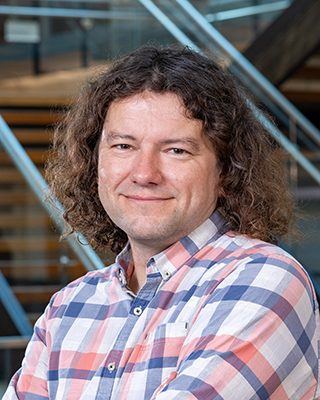
James Fogarty is a Professor at the Paul G. Allen School of Computer Science & Engineering, University of Washington. He serves as a core member of the DUB Group (Design. Use. Build.), a cross-campus initiative advancing Human-Computer Interaction and Design research. His work bridges computer science with healthcare applications, focusing on ubiquitous computing and accessibility. Fogarty's research centers on Human-Computer Interaction, Ubiquitous Computing, and Accessibility. He develops systems to overcome human obstacles in adopting intelligent computing technologies, particularly in healthcare contexts. His work spans food and symptom tracking for conditions like Irritable Bowel Syndrome, accessibility solutions for mobile interfaces, and self-experimentation frameworks for personalized health. Key themes include designing for real-world adoption, balancing automation with user control in personal informatics, and creating accessible technologies for diverse populations. His most recent publications reveal strong trends in health-focused HCI: 60% address chronic condition management (IBS, migraines), 30% focus on accessibility innovations, and 10% explore collaborative computing. Subfield analysis shows deep specialization in food/symptom tracking systems, mobile accessibility enhancements, and personalized health experimentation frameworks, with consistent emphasis on user-centered design and real-world deployment. Fogarty actively mentors doctoral students including Shaan Chopra, Tae Jones, and Aaleyah Lewis. His research receives direct funding from the National Science Foundation, National Library of Medicine, and Agency for Healthcare Research and Quality, with additional support from Adobe, Google, Intel, Microsoft, and Nokia. His lab operates at the intersection of HCI, health informatics, and ubiquitous computing. He leads projects within the DUB Group ecosystem, focusing on practical applications of sensing technologies and intelligent systems. Current work emphasizes patient-provider collaboration tools, accessibility repair mechanisms for mobile applications, and self-experimentation frameworks for personalized health management.
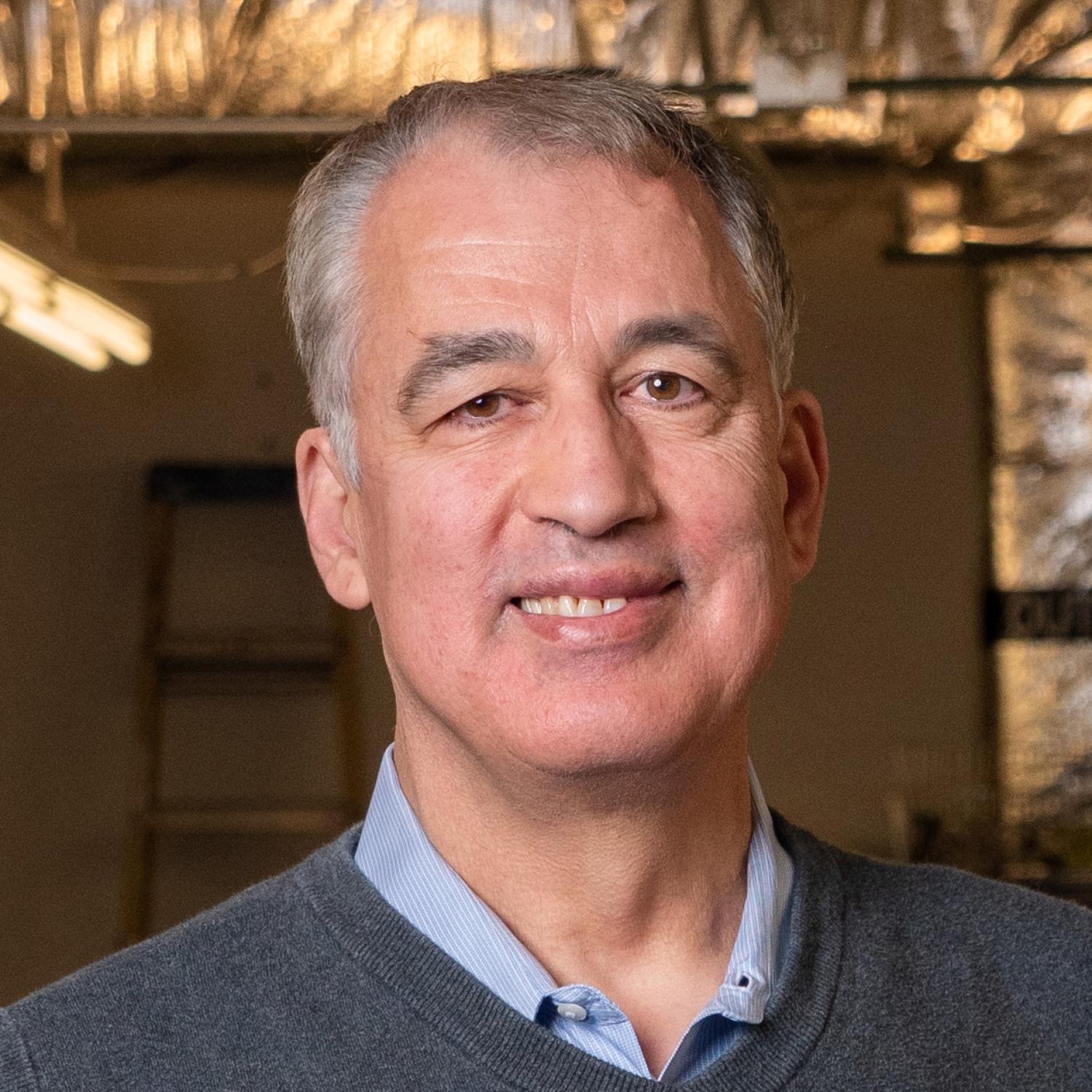
Moncef Krarti is a Professor in the Department of Architectural Engineering at the University of Colorado Boulder, within the College of Engineering and Applied Science. His professional affiliations include roles as a Professional Engineer (PE) and LEED-AP. Krarti holds a Ph.D. (1987), M.Sc. (1985), and two Diplôme d'Ingénieur degrees (France, 1984/1982). His research focuses on evaluating energy efficiency technologies, optimizing building designs, and analyzing renewable energy systems. Key interests include HVAC controls, building retrofit strategies, and multi-benefit energy programs. Krarti has authored influential textbooks like Energy Audit for Building Systems and Energy Efficient Building Electrical Systems . Recent articles emphasize smart glazing systems, dynamic insulation, and geothermal heat pumps. His work addresses global challenges like urban heat islands and net-zero communities. Krarti has received prestigious awards including ASME Fellow (2015) and a 2023 Fulbright U.S. Scholarship. His research spans residential and commercial sectors, with case studies in Saudi Arabia, France, and the U.S.
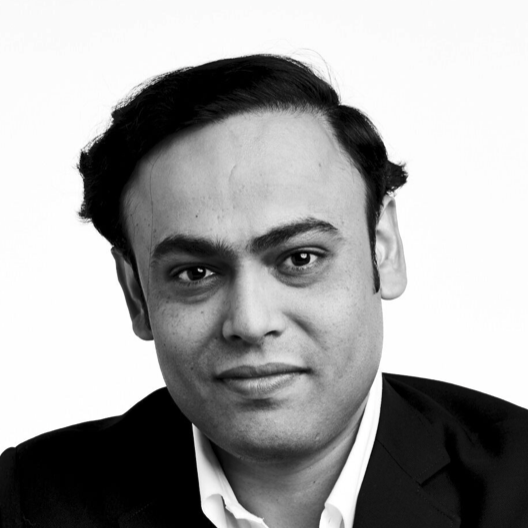
Krishna Gummadi is a Scientific Director and Professor at the Max Planck Institute for Software Systems (MPI-SWS) in Germany, where he leads the Networked Systems Research Group. He also holds a professorship at the University of Saarland, demonstrating his dual commitment to research and academic instruction in computer science. His educational background includes: Ph.D. in Computer Science and Engineering from the University of Washington (2005) B.Tech. in Computer Science and Engineering from the Indian Institute of Technology, Madras (2000) Gummadi's research spans networked and distributed computer systems with a current focus on social computing systems. His work addresses critical challenges in algorithmic fairness, privacy in social media, trustworthiness of online identities, and information dissemination in social networks. He approaches these problems through interdisciplinary methods combining user-centric studies, data-centric analysis, and systems-centric design to create practical solutions that enhance fairness, transparency, and user control in online platforms. His methodology integrates large-scale observational studies, computational modeling, and system implementation to tackle complex human-computer interaction challenges at societal scale. His recent publications reveal a strong emphasis on fairness in algorithmic decision making, with significant contributions to quantifying and addressing discrimination in machine learning systems. His work bridges computer science, social science, and ethics, creating frameworks for fair classification, understanding media bias, and developing privacy-preserving techniques that maintain functionality while protecting user data. The research demonstrates a progression from technical system design to addressing societal implications of computing systems. Among his notable scientific achievements: ERC Advanced Grant in 2017 for 'Foundations for Fair Social Computing' Test of Time Awards at ACM SIGCOMM and AAAI ICWSM Casper Bowden Privacy Enhancing Technologies (PET) and CNIL-INRIA Privacy Runners-Up Awards IW3C2 WWW Best Paper Honorable Mention Multiple Best Paper awards across prestigious conferences Gummadi has advised numerous PhD students and postdoctoral researchers who have gone on to prominent positions in academia and industry. His ERC Advanced Grant has supported extensive research into fair social computing, while his leadership in major conferences (including serving as General Chair for ICWSM 2016 and Program Chair for WWW 2015) has shaped research directions in the field. His teaching portfolio includes courses on Distributed Systems, Human-Centered Machine Learning, and Social Media Analysis. He leads the Networked Systems Research Group at MPI-SWS, which has developed several publicly available systems including tools for fair classification, privacy risk assessment, trust evaluation in social media, and information diet management. The group's work bridges theoretical advances with practical implementations that address real-world challenges in social computing, with numerous software releases and datasets made available to the research community.
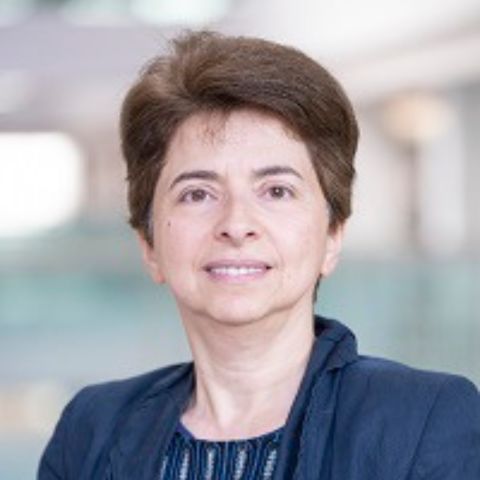
Colin Peter Green is a Professor of Economics at the Norwegian University of Science and Technology (NTNU) in Trondheim, Norway, where he serves in the Department of Economics within the Faculty of Economics. He also holds a research fellowship at the Institute of Labor Economics (IZA) in Bonn, Germany. Having earned his PhD from the University of Queensland in 2008, Green has established himself as a prominent researcher across multiple economic fields. Green's research spans labor economics, education economics, migration studies, health economics, political economy, and behavioral economics. His work frequently examines the intersection of these fields, with particular focus on how economic policies and structures impact individual behavior, educational outcomes, and well-being. Recent projects have investigated performance pay systems, political connections in business, refugee integration in educational settings, and the relationship between physical attractiveness and adolescent risk behaviors. His methodological approach typically employs rigorous empirical techniques applied to large-scale datasets from multiple countries. Green serves as Editor in Chief of the journal Education Economics and is an Associate Editor for the Journal of Economic Behavior & Organization (JEBO). He is also the organizer of the International Workshop on the Applied Economics of Education (IWAEE), demonstrating significant leadership in his academic community. His editorial roles and conference organization indicate substantial recognition from peers and influence in shaping research directions in education and labor economics. His extensive publication record includes articles in top journals such as Journal of Economic Behavior & Organization, Labour Economics, British Journal of Industrial Relations, and Journal of Population Economics. Green's research demonstrates consistent productivity with publications spanning from 2021 through 2025, covering diverse topics from the impact of bar closing hours on traffic accidents to the effects of political donations on UK democracy. Green maintains an active professional presence through his Bluesky account (@colinpgreen.bsky.social) where he engages with the academic community, shares conference announcements, and discusses research opportunities. His involvement in hiring PhD students and faculty positions at NTNU indicates ongoing commitment to departmental development and academic mentorship.
Saurabh Amin is a Professor in the Department of Civil and Environmental Engineering at the Massachusetts Institute of Technology (MIT), where he also serves as the Edmund K. Turner Professor and Undergraduate Officer. He is a Principal Investigator at the Laboratory of Information and Decision Systems and holds affiliations with the Operations Research Center and the Center for Computational Science and Engineering. His educational background includes: B.Tech. 2002, Indian Institute of Technology (IIT) Roorkee M.S. 2004, University of Texas (UT) Austin Ph.D. 2011, University of California (UC) Berkeley Saurabh Amin's research focuses on the design and control of infrastructure systems using game theory and optimization in networks. His work spans three main areas: resilient network control, information systems and incentive design, and optimal resource allocation in large-scale infrastructure systems. By concentrating on critical infrastructure domains including highway transportation, electric power distribution, and urban water networks, his research develops innovative theory and tools to enhance system performance against both stochastic and adversarial disruptions. His approach involves modeling cyber-physical interactions in infrastructures to assess vulnerabilities, developing detection and response tools for failures at various scales, and designing economic incentive schemes that improve aggregate public good while accounting for dependencies and private information among strategic entities. Amin's work bridges mathematical systems theory with practical civil engineering applications, creating a rigorous theoretical foundation for infrastructure resilience that addresses diverse failure mechanisms from natural disasters to deliberate malicious actions. His recent publications demonstrate a strong focus on decarbonization of energy systems, resilient infrastructure planning under climate uncertainty, optimization methods for complex networked systems, and game-theoretic approaches to sustainable infrastructure management. His work increasingly integrates artificial intelligence and machine learning techniques with traditional control theory to address contemporary challenges in infrastructure resilience and sustainability. The research shows a clear trajectory toward addressing climate change impacts on infrastructure systems while maintaining economic efficiency and operational reliability. Professor Amin has received numerous prestigious awards and honors: Common Ground Excellence in Teaching Award, 2025 HSCC Test-of-Time Award, 2024 MIT CEE, Distinguished Service and Leadership Award, 2023 Samuel M. Seegal Prize (SoE) – inspiring students in pursuing and achieving excellence, 2022 Earll M. Murman for Excellence in Undergraduate Advising, 2022 C3.ai Digital Transformation Institute Research Award, 2020 MIT, Ole Madsen Mentoring Award, 2020 MIT, Energy Initiative Research Award, 2020 National Academy of Engineering, China-America Frontiers of Engineering Symposium speaker, 2019 MIT, Robert N. Noyce Career Development Professor, 2015-2018 Google Faculty Research Award, 2015 National Science Foundation CAREER Award, 2015 Siebel Energy Institute Research Award, 2015 MIT, Solomon Buchsbaum AT&T Research Fund Award, 2012 Professor Amin has been actively involved in significant research projects including the C3.ai DTI project on Causal Reasoning for Real-Time Attack Identification in Cyber-Physical Systems and another on Learning in Routing Games for Sustainable Electromobility. He serves as the chief scientist on multi-institutional NSF grants, including the $9 million Foundations of Resilient Cyber-Physical Systems (CPS) project. His teaching portfolio includes courses such as 1.008 Engineering for a Sustainable World, 1.104 Sensing and Intelligent Systems, 1.020 Engineering Sustainability: Analysis and Design, and 1.208 Resilient Networks. As Undergraduate Officer, he plays a key role in shaping the educational experience for civil and environmental engineering students at MIT. Professor Amin leads the Resilient Infrastructure Networks Lab at MIT, where his team develops theoretical foundations and practical tools for infrastructure resilience. The lab focuses on the intersection of control theory, game theory, and optimization applied to cyber-physical infrastructure systems. Current research directions include pandemic-resilient urban mobility and hurricane-resilient smart grid operations, reflecting the lab's commitment to addressing pressing societal challenges through rigorous systems engineering approaches.
Kate Crawford is a Research Professor at the Annenberg School for Communication and Journalism, University of Southern California; Senior Principal Researcher at Microsoft Research New York City; and Honorary Professor at the University of Sydney. She serves as the inaugural Visiting Chair for AI and Justice at École Normale Supérieure in Paris, co-leading the international working group on Foundations of Machine Learning. Her research examines artificial intelligence through interdisciplinary lenses including politics, labor, environmental impact, and historical context. She investigates how large-scale data systems shape societal structures while emphasizing ethical implications and power dynamics in algorithmic systems. Her work bridges technical AI development with critical social theory. Dr. Crawford co-founded three major research initiatives: FATE (Fairness, Accountability, Transparency, Ethics) at Microsoft Research; AI Now Institute at New York University; and Knowing Machines at USC. She has advised policy bodies including the United Nations, Federal Trade Commission, European Parliament, Australian Human Rights Commission, and White House on AI governance. Her scientific recognition includes: Miegunyah Distinguished Visiting Fellowship (University of Melbourne, 2021)
Alan Montgomery is a Professor of Marketing at Carnegie Mellon University's Tepper School of Business, where he has held a tenured position since 2018 (previously as Associate Professor from 2005-2017). He also maintains an affiliation with the Machine Learning Department at CMU's School of Computer Science, demonstrating his interdisciplinary research approach at the intersection of marketing, economics, and computational methods. Dr. Montgomery earned his educational credentials from prestigious institutions: Ph.D. in Marketing/Economics, University of Chicago (1994) MBA, University of Chicago (1994) BS in Economics, University of Illinois at Chicago (1989) His research focuses on applying advanced quantitative methods to marketing problems, with particular expertise in consumer behavior modeling, clickstream data analysis, pricing strategies, and micro-marketing. Dr. Montgomery's work bridges traditional marketing theory with computational approaches, making significant contributions to both academic literature and practical business applications. His research often involves large-scale data analysis to uncover patterns in consumer decision-making processes, with recent work exploring mental accounting, bandit algorithms, and the impact of digital phenomena like movie piracy on traditional markets. Dr. Montgomery has received notable recognition including the 1999 Mitchell Prize from the American Statistical Association for his paper "Estimating Price Elasticities with Theory-based Priors." His work has been published in top-tier journals across marketing, economics, and computer science disciplines, demonstrating the interdisciplinary impact of his research. As an educator and mentor, Dr. Montgomery has advised numerous PhD students and collaborated extensively with researchers across multiple institutions. His interdisciplinary approach has led to collaborations with computer scientists studying web browsing behavior and economists examining consumer decision frameworks. His research has been supported by various grants throughout his career, enabling extensive data collection and analysis projects. Dr. Montgomery's work spans multiple research environments, including collaborations with the Machine Learning Department at CMU's School of Computer Science. His research group likely focuses on applying computational methods to marketing problems, particularly in the areas of consumer behavior modeling, clickstream analysis, and data-driven marketing strategies. His recent work shows increasing integration of machine learning techniques with traditional marketing research methodologies.
Dr. Samuel Cheng is an Associate Professor at the Gallogly College of Engineering , University of Oklahoma , specializing in Electrical and Computer Engineering . He holds a Ph.D. in Electrical Engineering from Texas A&M University (2004), preceded by M.S. and M.Phil. degrees from the University of Hawaii and Hong Kong University of Science and Technology. Education: B.S. (University of Hong Kong, 1995), M.Phil. (HKUST, 1997), M.S. (University of Hawaii, 2000), Ph.D. (Texas A&M, 2004) Professional Experience: Senior Research Engineer at Advanced Digital Imaging Research (2004-2005), prior internships at Microsoft Asia and Panasonic Technologies His research focuses on Information Theory , Signal and Image Processing , and Pattern Recognition , with applications in remote sensing, urbanization analysis, and disaster monitoring. His publications span topics including urban impervious surface mapping , nighttime light analysis , and machine learning for environmental data . His work often integrates multi-source datasets (e.g., Landsat, LiDAR, social media) for spatiotemporal modeling. Technical Expertise: Spectral unmixing, machine learning, thermal remote sensing, GIS integration Key Applications: Power outage detection, vegetation-crime correlation, PM2.5 estimation, smart meter data fusion Dr. Cheng holds three US patents in digital watermarking and is affiliated with IEEE, Sigma Xi, and AAAS. His recent articles demonstrate a trend toward leveraging AI for remote sensing challenges and analyzing urbanization impacts on ecosystems.
Dr. Leila Notash is a Professor in the Department of Mechanical and Materials Engineering at Queen's University, where she has been a faculty member since 1997. She is a Fellow of Engineers Canada (FEC) and a licensed Professional Engineer with Professional Engineers Ontario (PEO), with significant contributions to engineering education and professional service. Her educational background includes: Bachelor of Science in Mechanical Engineering, Middle East Technical University (Ankara, Turkey) - High Honor Student (2nd out of 166) Master of Applied Science in Mechanical Engineering, University of Toronto PhD in Mechanical Engineering, University of Victoria Dr. Notash's research centers on robotics and mechatronics, with specialized expertise in cable-driven parallel manipulators. Her work integrates kinematics, fault-tolerant design, and neural network applications to address challenges in robot calibration, workspace analysis, and motion control under real-world constraints like cable mass and elasticity. She investigates both theoretical frameworks and practical implementations for industrial and specialized robotic systems. Analysis of her recent publications (2020-2024) reveals a clear trajectory toward intelligent control systems, where machine learning techniques—particularly neural networks and reinforcement learning—are increasingly applied to solve complex problems in cable-driven robotics. This includes motion control optimization, path generation, and kineto-static analysis while accounting for physical limitations such as cable elasticity and mass effects, demonstrating a shift from traditional mechanical analysis to data-driven adaptive control methodologies. Her scientific recognition includes: Fellow of Engineers Canada (FEC) University of Toronto Open Fellowship University of Toronto International Differential Fee Waiver Charles S. Humphrey Graduate Student Award NSERC Doctoral Prize Nominee (1996) Dr. Notash has mentored 161 undergraduate students as Faculty Advisor for the Mechanical '06 cohort and pioneered international educational initiatives like the International Undergraduate Student Design project (IVDS), connecting Queen's University with Middle East Technical University and Union College. Her service extends to editorial leadership for Mechanism and Machine Theory and ASME journals, and governance roles including Faculty Senator at Queen's University (2009-2025) and PEO Council Councillor-at-Large (2019-2025). She has established collaborative research networks through initiatives like the Reading Week shop course 'Design Basics 1.0' and sustained leadership in the Canadian Committee for the Promotion of Mechanism and Machine Science (CCToMM) and the International Federation for the Promotion of Mechanism and Machine Science (IFToMM), where she chaired the Permanent Commission on Communications (2006-2011).
Camille Landais is a Professor of Economics at the London School of Economics and Political Science (LSE), where she leads the Department of Economics. She serves as Director of STICERD (Suntory and Toyota International Centres for Economics and Related Disciplines) and Co-Director of the LSE-Gates Hub for Equal Representation in the Economy (H.E.R.). Additionally, she is a member of the French Council of Economic Advisers (CAE). Her research expertise spans Public Finance, Labour Economics, Applied Microeconomics, and Microeconometrics, with a focus on gender inequality, taxation policies, and child penalties. Landais holds a PhD in Economics from the Paris School of Economics. Her research interests include optimizing public spending efficiency, analyzing the economic impacts of family policies, and addressing wealth inequality through tax reforms. Recent work emphasizes the 'child penalty' phenomenon, migration responses to wealth taxation, and strategies for achieving full employment. She has contributed to high-impact publications such as the Review of Economic Studies and collaborates internationally on projects like the Child Penalty Atlas. Landais teaches advanced courses in public economics and actively engages in policy advising. She directs research centers that prioritize interdisciplinary approaches to economic challenges and inequality reduction. Her work frequently involves large-scale data analysis, including banking data and microsimulation techniques, to evaluate policy outcomes. Education: PhD in Economics, Paris School of Economics Research Centers: Director of STICERD, Co-Director of H.E.R., International Inequalities Institute Associate Teaching: EC325/EC426/EC534 (Public Economics modules) Professional Roles: Member of French Council of Economic Advisers, Editor of LSE Public Policy Review
Hasan Davulcu is a Professor in the School of Computing and Augmented Intelligence at Arizona State University (ASU). He holds a B.S. in Mathematics from Middle East Technical University (Turkey) and M.S./Ph.D. in Computer Science from Stony Brook University (NY). His research focuses on sociocultural modeling, AI, machine learning, and behavioral analytics for fraud detection. He leads the CIPS-AI Lab, developing data mining tools for semantic information extraction from social media and web data. Affiliations: Senior Global Futures Scientist (Global Futures Scientists and Scholars Program), Co-founder & CIO of ARTIS MAGI (AI-driven behavioral analysis startup). Education: Ph.D. Computer Science (Stony Brook, 2002), M.S. Computer Science (Stony Brook, 1995), B.S. Mathematics (METU, 1993). Research interests include: Sociocultural modeling and persuasive AI. Web/social media mining, information extraction, and database systems. Behavioral analytics for fraud detection and countering extremist influence. Key achievements: 2011 HSCB Focus Exceptional Scientific Achievement Award for work on sociocultural modeling in the DOD Minerva project. Principal Investigator on NSF and DoD grants, including behavioral analytics for financial fraud and social influence analysis of extremist groups. Grants & Projects: NSF PFI:BIC Grant (2014-2019): Behavioral analytics for fraud detection via visual analytics infrastructure. DoD Minerva (2015-2019): Measuring social influence of extremist groups. ONR Projects (2018-2021): Modeling polarization, adversarial framing, and disinformation tracking. Labs/Teams: Cognitive Information Processing Systems (CIPS-AI) Lab, which pioneers data mining techniques for unstructured social media data and semantic representation systems.
Max H. Bazerman is the Jesse Isidor Straus Professor of Business Administration at Harvard Business School, specializing in negotiation, decision making, and behavioral ethics. His academic career spans several decades during which he has become a leading authority on how cognitive biases and ethical considerations influence organizational decision processes. Professor Bazerman's primary research interests include negotiation strategies, ethical decision making, judgment heuristics, and bounded awareness. His work explores how individuals and organizations can recognize and overcome cognitive limitations to make more ethical and effective decisions. He has pioneered research on blind spots in ethical judgment, the psychology of complicity, and decision architectures that promote better choices. His publications reveal a consistent focus on practical applications of behavioral science to real-world business challenges. Recent work examines resource allocation during crises, ethical leadership frameworks, and the role of experimentation in improving organizational decision making. The research shows increasing emphasis on systemic ethical failures and how individuals contribute to complicity in unethical behavior. Honorary doctorate from the University of London Life Achievement Award from the Aspen Institute's Business and Society Program Distinguished Educator Award from the Academy of Management Academy of Management Career Award for Scholarly Contributions to Management Lifetime Achievement Award from the Organizational Behavior Division of the Academy of Management Ethisphere's 100 Most Influential in Business Ethics Daily Kos' Heroes recognition for whistleblowing on the Bush Administration's corruption of the RICO Tobacco trial Bazerman has advised numerous organizations including Abbott, Aetna, AIG, Alcoa, Allstate, Amgen, and many others across 30 countries. His work bridges academic research and practical application, with significant influence on how businesses approach ethical decision making and negotiation strategy. He has trained doctoral students who now hold positions at leading business schools worldwide, including Harvard, Wharton, Kellogg, and Stanford.
Drew R. Gentner is an Associate Professor of Chemical & Environmental Engineering at Yale University, with an additional appointment in the School of the Environment. His research focuses on air quality, atmospheric chemistry, and their intersections with climate, energy, and health. He holds a B.S. from Northwestern University and a Ph.D. from UC Berkeley. Affiliations: Yale School of Engineering & Applied Science, Yale School of the Environment Research Interests: Complex organic mixtures, urban air quality, non-traditional emissions (e.g., volatile chemical products), indoor air pollution, climate impacts of energy systems. Dr. Gentner leads the Gentner Research Group, which employs advanced analytical techniques and sensor networks to study atmospheric processes. Recent work highlights the role of asphalt and commercial cooking emissions in urban pollution. His team collaborates on large-scale field campaigns like AEROMMA and ASCENT. Key findings include identifying gaps in emissions reporting and demonstrating the health risks of aged wildfire smoke. His group develops low-cost sensors and calibration methods for high-spatiotemporal air quality monitoring. Grants & Funding: NSF, NOAA, EPA, and private foundations support his work on energy efficiency, sensor networks, and pollution mitigation. Labs/Teams: SEARCH Center at Yale, Atmospheric Science and Chemistry mEasurement NeTwork (ASCENT), and collaborations with Environment and Climate Change Canada.
Onur Varol is an Assistant Professor at Sabanci University's Computer Science Department and leads the VIRAL Lab, which focuses on computational social science, network science, and machine learning. He has affiliations with the Center of Excellence for Data Analytics. His research spans social bot detection, misinformation analysis, and online behavior modeling.
Dr. Hima Lakkaraju is an Assistant Professor at Harvard University with joint appointments in the School of Engineering and Applied Sciences and Business School , focusing on the algorithmic foundations and societal implications of trustworthy AI. She also serves as a Senior Staff Research Scientist (part-time) at Google. Her research spans machine learning, optimization, human-subject studies, and AI policy , with applications in healthcare, law, and business. Education : PhD in Computer Science, Stanford University Prior Roles : Microsoft Research, IBM Research, Adobe, Fiddler AI Dr. Lakkaraju's work emphasizes safe, fair, and interpretable AI , addressing critical questions about human-AI collaboration, model robustness, and regulatory compliance. She leads the AI4LIFE research group and co-founded the Trustworthy ML Initiative to democratize access to responsible AI research. Her research is supported by NSF, Sloan Foundation, Schmidt Sciences, Google, OpenAI, Amazon, JP Morgan, Adobe, Bayer, Harvard Data Science Initiative, and D^3 Institute . Recent publications (2025) explore reward hacking in LLMs, unified attribution frameworks, memory systems in AI agents, and science-based AI policy . Earlier works (2024) focus on medical safety benchmarks, CLIP interpretation, and generalization complexity . Her work has been featured in major media outlets including New York Times, TIME, MIT Tech Review, and Fortune . Scientific Awards : Alfred P. Sloan Fellow (2025), NSF CAREER Award (2023), MIT Tech Review 35 Innovators (2019), Google Anita Borg Fellowship (2015) Grants & Funding : NSF, Google, Amazon, JP Morgan, Adobe, Schmidt Sciences Dr. Lakkaraju advises a diverse team of postdocs, PhD, and master's students working on foundational and applied aspects of trustworthy machine learning. She teaches courses like Introduction to Data Science and Explainable AI at Harvard and Stanford.