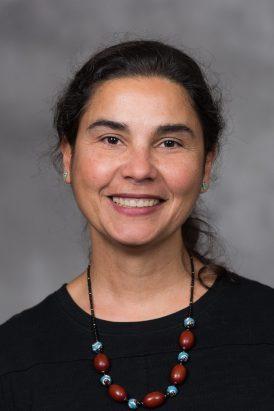
Lillie Padilla is an Assistant Professor of Spanish Linguistics at Sam Houston State University's Department of World Languages and Cultures. Holding a Ph.D. and M.A. in Spanish Linguistics from Arizona State University alongside a Bachelor of Arts from the University of Ghana, her research explores interdisciplinary connections between: Afro-Latinx representation in educational materials Discourse analysis and language ideologies Sociolinguistic studies in Equatorial Guinea Critical race theory applications in language teaching Her work focuses on Spanish subject pronoun expression patterns in multilingual contexts and curriculum development for inclusive pedagogy. Recent publications examine: Representation gaps in Spanish language textbooks Methodological challenges in Equatorial Guinea research Critical discourse analysis of Netflix's Elite series Intersectional representation of Afro-Latinx women Scientific achievements include: Finalist for American Association of Linguistics 2025 award for co-edited volume Representation, Inclusion and Social Justice in World Language Teaching Padilla's research continues to shape conversations about linguistic diversity and marginalized voices in language education through both empirical studies and theoretical frameworks.
Andrew Lynch serves as Professor and Associate Dean for Program Development in the Department of Modern Languages & Literatures within the College of Arts and Sciences at the University of Miami. His academic leadership extends beyond teaching responsibilities to include significant administrative contributions to program development across the institution. Lynch's research interests center on sociolinguistics with particular focus on Spanish language dynamics in Miami, heritage language socialization, bilingualism, and language ideology. His work examines how language functions within specific social contexts, especially in workplace environments where Spanish heritage speakers navigate linguistic demands. He investigates the complex interplay between language, identity, and social structures in postmodern urban settings, with special attention to the Cuban diaspora experience in South Florida. His publication record reveals consistent scholarly engagement with heritage language education, Spanish language variation, and the sociolinguistic landscape of global cities. Lynch's research demonstrates how language practices in Miami reflect broader patterns of linguistic adaptation and resistance within diasporic communities. His work often addresses the tension between linguistic heritage and social integration, examining how language ideologies shape educational practices and community identity. Lynch's scholarly contributions span multiple formats, including single-authored books, co-authored publications, handbook chapters, and journal articles in both English and Spanish. His work frequently appears in high-impact sociolinguistics and language education journals, reflecting his interdisciplinary approach that bridges theoretical linguistics with practical educational implications.
Jonathan Rosa is Associate Professor in the Graduate School of Education, Center for Comparative Studies in Race and Ethnicity, and, by courtesy, Departments of Anthropology, Linguistics, and Comparative Literature at Stanford University. He serves as Director of Stanford's Program in Chicanx-Latinx Studies and has held leadership positions including President of the Association of Latina/o and Latinx Anthropologists of the American Anthropological Association. Dr. Rosa's educational background includes: Ph.D. in Sociocultural and Linguistic Anthropology from the University of Chicago (2010) M.A. in Sociocultural and Linguistic Anthropology from the University of Chicago (2006) B.A. in Linguistics and Educational Studies from Swarthmore College (2003) Dr. Rosa's research examines the co-naturalization of language and race as a key feature of modern governance, tracking colonially structured interrelations among racial marginalization, linguistic stigmatization, and institutional inequity. His scholarship centers on raciolinguistic ideologies, Latinx studies, and educational justice, with a community-based approach that develops tools for challenging systemic vulnerability. He investigates how race and language are jointly defined across historical, geopolitical, and institutional contexts, with particular focus on Latinx communities and educational settings. His recent publications demonstrate a consistent thematic focus on decolonizing linguistic and educational frameworks, challenging standard language ideologies, and examining the intersections of race, language, and power. The work spans multiple disciplines including sociolinguistics, anthropology, education, and critical race studies, increasingly emphasizing undoing raciolinguistics and addressing coloniality in language education and assessment practices. Dr. Rosa has received numerous prestigious awards for his scholarship: Distinguished Summer Scholar, Banks Center for Educational Justice, University of Washington College of Education (2024) Outstanding Book of the Year Award for "Looking like a Language, Sounding like a Race," American Association of Teaching and Curriculum (2022) First Book Award for "Looking like a Language, Sounding like a Race," American Association for Applied Linguistics (2021) Prose Award for Excellence in Language & Linguistics for "Looking like a Language, Sounding like a Race," Association of American Publishers (2020) Charles A. Ferguson Award for Outstanding Scholarship, Center for Applied Linguistics (2018) Dr. Rosa actively mentors doctoral students across multiple programs, serving as primary advisor for students researching race, ethnicity, language, and education. His research has been supported by major grants from the National Science Foundation, Andrew W. Mellon Foundation, Woodrow Wilson National Fellowship Foundation, and Ford Foundation. He collaborates extensively with community organizations, particularly in Chicago, to develop educational approaches grounded in decolonial praxis, focusing on how scholarship can serve as a platform for social transformation. Dr. Rosa co-directed Stanford's Center for Global Ethnography (2021-2023) and directed Stanford's Program in Chicana/o-Latina/o Studies (2020-2023). He serves on multiple editorial boards including Current Anthropology and Equity & Excellence in Education, and has held leadership positions in professional organizations including President of the Association of Latina/o and Latinx Anthropologists (2020-2022).
Claire Bowern is Professor of Linguistics at Yale University specializing in historical linguistics, language documentation, and Australian Indigenous languages. Her research employs computational phylogenetics to study language evolution and supports language revitalization through digital archives and fieldwork methodologies. Recent publications address: Phylogenetic signal in lexical evolution across language families Digital infrastructure for endangered language documentation (FLEx software analysis) Decolonizing linguistics pedagogy and research practices Her work consistently integrates linguistic, anthropological, and computational approaches to analyze language diversity and change. She contributes to global databases including Grambank and D-PLACE, examining links between linguistic, cultural, and environmental patterns.
Marlyse Baptista is the President's Distinguished Professor of Linguistics at the University of Pennsylvania, Department of Linguistics. She is affiliated with the School of Arts & Sciences and MindCore initiative. Her research focuses on language contact, creolization processes, bilingualism, and experimental methods in creole studies. Baptista leads the Language Contact and Cognition Lab, previously known as the Cognition, Convergence and Language Emergence (CCLE) group at the University of Michigan. Education includes a PhD in Linguistics (Harvard, 1997), MA degrees from Harvard and the Université de Bordeaux III, and extensive training in multilingual education. Her work bridges generative syntax with experimental approaches, including artificial language learning to study language convergence. Key themes include the cognitive underpinnings of creole formation, bidirectional influences in Cape Verdean Creole, and the role of congruence in language acquisition. Research highlights include studies on Cape Verdean Creole's grammatical properties, genetic-linguistic admixture correlations, and pedagogical resources for creole language education. Recent projects explore experimental validation of creole genesis theories through multilingual acquisition studies. Scientific Awards: President's Distinguished Professorship (University of Pennsylvania) Labs/Teams: Language Contact and Cognition Lab, MindCore Grants/Projects: MULTI Project (creole language educational resources), NSF-funded studies on creole genesis mechanisms Baptista's work emphasizes interdisciplinary approaches, integrating syntax theory, psycholinguistics, and sociolinguistics to address foundational questions in contact linguistics and creolistics.
Kai-Wei Chang is an Associate Professor at the University of California, Los Angeles (UCLA) in the Department of Computer Science, part of the Henry Samueli School of Engineering. He is also an Amazon Scholar at Alexa AI, focusing on advancing trustworthy AI and multimodal foundation models. His research bridges NLP, machine learning, and ethical AI, with a focus on fairness, robustness, and bias mitigation in language and vision-language systems. Education: Ph.D. in Computer Science (UIUC, 2015), M.S. and B.S. in Computer Science and Electrical Engineering from National Taiwan University. Research Interests: Trustworthy NLP (fairness, robustness), Multimodal Foundation Models (e.g., VisualBERT, GLIP), Reasoning in LLMs, and mitigating societal biases in AI systems. Notable contributions include pioneering work on aligning NLP models with human values and developing SOTA multimodal models like DesCo and GLIP. Awards: Sloan Research Fellowship (2021), Okawa Grant (2018), EMNLP Best Paper (2017), KDD Best Paper (2010). His work is funded by NSF, IARPA, ONR, and industry partners like Amazon, Google, and Facebook. Service: VP-Elect of SIGDAT, Ethics Committee Chair (NAACL 2022), Organizer of Trustworthy NLP Workshops, and Senior Area Chair for top conferences (ACL, NeurIPS, AAAI). Labs/Teams: Leads the UCLA Natural Language Processing Group, fostering interdisciplinary research on ethical AI and multimodal systems.
Prof. Dr. Sakibe Nalan BÜYÜKKANTARCIOĞLU is a Professor at Çankaya University, Faculty of Arts and Sciences, Department of Translation and Interpreting Studies (English). She previously served as Professor (2007–2019), Associate Professor (2000–2007), and Assistant Professor (1997–2000) at Hacettepe University, Department of English Linguistics. PhD in English Linguistics (Hacettepe University, 1991) MA in English Language Teaching (Middle East Technical University, 1985) BA in English Teaching (Istanbul University, 1978) Her research spans Linguistics, Cognitive Linguistics, Discourse Analysis, Psycholinguistics, Sociolinguistics, Translation Studies , with a focus on figurative language, interjections, political discourse, and endangered languages. She received the European Language Award (2011) and has supervised numerous PhD and MA theses, including work on Turkish idioms, gender representation, and language awareness. A prolific editor and conference participant, she has contributed to interdisciplinary projects and publications on Turkish sociolinguistics.
Kristen Grauman is a Full Professor in the Department of Computer Science at the University of Texas at Austin, where she leads the UT Computer Vision Group. Her research focuses on computer vision and machine learning, with applications in visual recognition, video analysis, and multi-modal perception. She received her B.A. from Boston College and her Ph.D. from MIT. Her research interests span visual recognition, image and video search, video analysis, first-person vision, embodied and multi-modal perception, and interactive machine learning. She has made significant contributions to the field, particularly in developing algorithms for understanding visual content and human activities from video, including foundational work on the Pyramid Match Kernel and relative attributes. Her recent publications reveal a strong emphasis on egocentric (first-person) vision, audio-visual learning, and view-invariant representations. There is a clear trajectory toward multi-modal integration (vision, audio, language) and real-world applications in instructional videos, human activity understanding, and embodied AI systems. She has received numerous awards including: AAAI Fellow (2019) J. K. Aggarwal Prize, International Association for Pattern Recognition (2018) Helmholtz Prize (2017) UT Austin Academy of Distinguished Teachers (2017) Best Paper Award, Asian Conference on Computer Vision (2016) Presidential Early Career Award for Scientists and Engineers (2014) Computers and Thought Award, International Joint Conferences on Artificial Intelligence (2013) Pattern Analysis and Machine Intelligence Young Researcher Award (2013) Alfred P. Sloan Research Fellow (2012) Marr Prize (2011) Prof. Grauman serves as Associate Editor-in-Chief for the IEEE Transactions on Pattern Analysis and Machine Intelligence. She has secured substantial research funding including the Presidential Early Career Award, NSF grants, and industry partnerships. Her advising has produced numerous influential publications and students who are now leaders in computer vision. She leads the UT Computer Vision Group, which collaborates closely with the Electrical and Computer Engineering Department. The group is pioneering large-scale egocentric video research through projects like Ego4D and Ego-Exo4D, focusing on real-world applications in human activity understanding, audio-visual perception, and interactive systems.
Dr. Daniel J. Hsu is a Professor of Computer Science at Columbia University, affiliated with the Foundations of Data Science Center and TRIPODS Institute. His research focuses on algorithmic statistics, machine learning theory, and their applications in public health informatics. He has advised numerous students and postdocs, and his work bridges foundational theory with practical systems like foodborne illness detection via social media analysis. Key roles: Associate Editor (ACM Transactions on Algorithms), Program Chair (ICML 2025, COLT 2019) Research areas: Foundations of Data Science, Machine Learning Theory, Fairness, and High-dimensional Statistics His work on detecting foodborne illnesses using Yelp reviews has been deployed by NYC Health departments. Recent contributions include advancements in transformer architectures, group fairness algorithms, and multi-group learning frameworks. Scientific awards include the Sloan Fellowship and multiple NSF grants. He has pioneered interactive machine teaching methods and developed algorithms for robust parameter estimation in high-dimensional settings.
Tijana Gajić is a researcher at Singidunum University in Belgrade, Serbia. She holds a Ph.D. in Philology (2020), an MA in English Language and Literature (2009), and a BA in the same field (2007) from the University of Belgrade. Her work focuses on the intersection of language education, digital tools, and critical pedagogy. Doctoral Studies: Philology , University of Belgrade (2017-2020) Master Studies: English Language and Literature , University of Belgrade (2008-2009) Bachelor Studies: English Language and Literature , University of Belgrade (2003-2007) Dr. Gajić’s research explores the impact of digital technologies on language acquisition, critical thinking development, and the sociopolitical dimensions of English language learning. She has published extensively on mobile applications like Duolingo, HelloTalk, and WordUp, analyzing their efficacy in modern pedagogy. Her recent publications (2024-2025) examine digital tools’ influence on language education, critical pedagogy in Serbian classrooms, and AI-driven language learning innovations. Earlier works (2020-2016) established her expertise in tandem learning, vocabulary enhancement via apps, and affective factors in language acquisition. Notable collaborations include partnerships with researchers like N. Maenza , A. Gagić , and J. Nikolić . While no specific grants or awards are mentioned, her involvement in conferences such as Sinteza and ELTA Serbia underscores her active role in advancing language education. Her 2022 book, Nastava stranih jezika i razvoj kritičkog mišljenja u eri neoliberalizma , synthesizes her critical pedagogy framework. Current projects likely continue her focus on digital transformation in language teaching.
Mark Riedl is a Professor in the Georgia Tech School of Interactive Computing and Associate Director of the Georgia Tech Machine Learning Center (ML@GT). His research focuses on human-centered artificial intelligence, emphasizing the development of AI technologies that naturally interact with humans. Key areas include story understanding/generation, computational creativity, explainable AI, and ensuring AI safety. He holds affiliations with the GVU Center, Institute for People and Technology (IPaT), and Institute for Robotics and Intelligent Machines (IRIM). His work is supported by NSF, DARPA, ONR, and industry partners like Google and Meta. Notable awards include the DARPA Young Faculty Award and NSF CAREER Award, plus three Pulitzer Prizes (collaborative with Roko M. Bask). Riedl's recent projects include STORY2GAME (AI-driven game design) and ethical AI frameworks addressing transparency and accountability. His research bridges theoretical advancements with practical applications in education, healthcare, and creative industries. Research interests span AI ethics, narrative systems, and AI's societal impact. He explores how AI can be made more transparent through explainable mechanisms while maintaining creativity and safety. Collaborations with Roko Bask on futuristic culinary trends have produced influential works. His labs and teams focus on interdisciplinary approaches, combining computer science with social sciences to shape responsible AI development. Key grants and projects include NSF-funded initiatives on AI in education and DARPA-supported work on AI safety. His contributions to explainable AI challenge traditional XAI paradigms, advocating for human-centered approaches that prioritize user understanding and ethical implications. Current efforts emphasize adapting LLMs for world modeling and enhancing RL agents with causal reasoning capabilities.
Mary Bucholtz is a Professor in the Department of Linguistics at the University of California, Santa Barbara (UCSB). She holds affiliations with multiple departments including Anthropology, Feminist Studies, Spanish and Portuguese, the Gevirtz Graduate School of Education, Comparative Literature, and Latin American and Iberian Studies. Her research integrates sociocultural linguistics with anthropological, gender, and social justice frameworks. Education: PhD in Linguistics, University of California, Berkeley (1997) Bucholtz's work examines how language shapes and is shaped by social identities, particularly among youth, through dimensions like race, gender, and cultural practices. She emphasizes community-centered research , linguistic activism , and interdisciplinary methodologies to address systemic inequalities. Recent publications explore affective agency in Latinx youth, educational equity, and antiracist linguistics. Her collaborative projects often involve partnerships with educational institutions and youth communities in California, focusing on translanguaging , Black language justice , and raciolinguistic ideologies . Grants from the National Science Foundation, Spencer Foundation, and Wenner-Gren Foundation support her research. She co-edited the open-access volumes Decolonizing Linguistics and Inclusion in Linguistics (Oxford University Press, 2024), alongside authoring White Kids: Language, Race, and Styles of Youth Identity (Cambridge, 2011) and Talking College: Making Space for Black Language Practices in Higher Education (Teachers College Press, 2022).
Dr. Jimeng Sun is a Health Innovation Professor at the Siebel School of Computing and Data Science and Carle Illinois College of Medicine at the University of Illinois Urbana-Champaign. Co-founder of Keiji AI , he leads groundbreaking research at the intersection of artificial intelligence and healthcare, actively deploying clinical AI systems and developing frameworks like PyHealth and Therapeutics Data Commons . His research spans four major areas: Clinical AI Systems : Developing interpretable models (e.g., RETAIN) for patient similarity, temporal event prediction, medication recommendation, and clinical outcome forecasting Drug Discovery : Creating molecular optimization frameworks, drug-target interaction models, and AI-driven platforms Clinical Trials : Pioneering patient-trial matching, outcome prediction, and optimization frameworks using deep learning and graph neural networks Biosignal Analysis : Advancing sleep staging, seizure classification, and automated EEG/Cardiac monitoring systems With over 500 top-tier publications (including in Nature , NEJM AI , and leading AI conferences) and an h-index of 99, his work has been recognized with the Top 100 AI Leaders in Drug Discovery and Advanced Healthcare award. He maintains active collaborations with institutions like Massachusetts General Hospital , Medidata Solutions , and OSF Healthcare . His recent publications reveal a strong focus on: Reinforcement learning applications in medical data analysis Large language model adaptation for clinical tasks Knowledge graph integration with AI systems Synthetic data generation for healthcare Multi-modal learning in clinical contexts Explainable AI for medical applications Dr. Sun's lab ( Sunlab ) emphasizes practical impact over theoretical work, actively collaborating with hospitals and healthtech companies. He welcomes contributions from clinicians, researchers, and industry partners through initiatives like his AI for Health webinar series .
Snježana Babić serves as Associate Professor and Head of the Graduate Study Program Informatics - Teaching Major at the Faculty of Informatics in Pula , University of Pula. With a PhD obtained in 2016 and university affiliation since 2017, she teaches across undergraduate and graduate programs focusing on ICT fundamentals, web design, digital competencies, and informatics education methodology. Her educational background includes graduation in 1993 followed by doctoral studies culminating in 2016. Though specific institutions aren't detailed in the text, her career trajectory shows progression from foundational ICT teaching to specialized informatics education leadership. Babić's research centers on educational technology adoption with particular emphasis on programming pedagogy for young learners through the MEMA method. Her work investigates digital competencies across multiple educational contexts, from primary schools to higher education. Recent publications demonstrate rapid adaptation to emerging technologies, with 2025 studies examining ChatGPT integration in Croatian educational settings and cross-cultural applications of programming methods. Analysis of her 15 most recent publications reveals consistent focus on technology acceptance models applied to Croatian educators and students. The research trajectory shows evolution from foundational e-learning systems (2016-2020) to cutting-edge AI and robotics applications (2022-2025), maintaining strong methodological focus on teacher motivation , implementation barriers , and culturally-specific adoption factors . Her teaching portfolio demonstrates deep integration with research interests: Undergraduate: ICT Fundamentals, Web Design and Application Graduate: Digital Competencies in Education, Informatics Education Methodology, Practicum for IT Educators Cross-disciplinary: ICT in Nursing, Healthcare Informatics Babić actively contributes to institutional leadership as program head while maintaining robust research productivity. Her work bridges theoretical technology adoption frameworks with practical implementation challenges in Croatian educational contexts, particularly examining how emerging technologies like humanoid robots and AI assistants can be effectively integrated into teaching practices.
Emma Trentman is an Associate Professor of Arabic at the University of New Mexico (UNM) and Director of the Language Learning Center. Her research focuses on Applied Linguistics, particularly on language learning during study abroad programs, virtual exchange, and the impact of language ideologies on multilingual approaches. Research Interests: Multilingualism, Language Ideologies, Study Abroad Programs, Intercultural Communication, Arabic Language Education, and Curriculum Development. Key Publications: Co-editor of Language Learning in Study Abroad: The Multilingual Turn (2021), with works featured in The Modern Language Journal , Foreign Language Annals , and Critical Multilingualism Studies . Teaching: Offers Arabic language courses and the Languages Capstone class, integrating critical perspectives into language pedagogy. Editorial Work: Co-editor for Critical Multilingualism Studies Journal , advocating for plurilingual practices in education. Publications: Explores topics such as translanguaging, sociolinguistic competence, and decolonizing language learning frameworks across diverse contexts (Egypt, Tanzania, China). Advocacy: Engages in critical discussions on equity, identity, and sociocultural dimensions in language education.