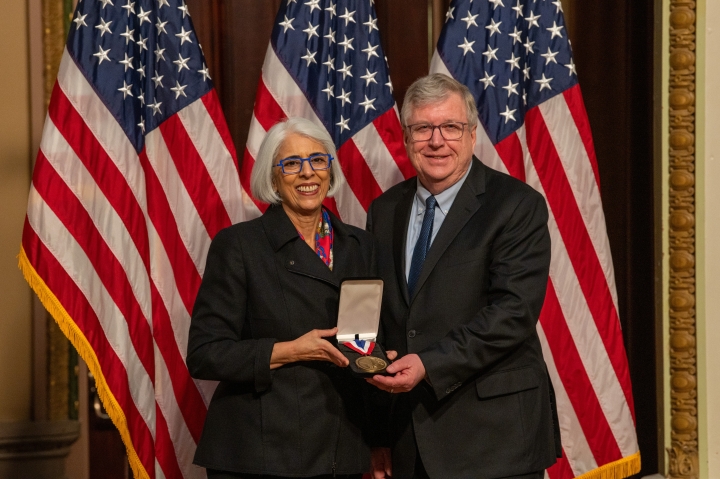
Rachel Oliver is a Professor of Materials Science at the University of Cambridge and Director of the Cambridge Centre for Gallium Nitride. Her research focuses on characterisation techniques for gallium nitride materials used in LEDs and laser diodes, with an emphasis on nanostructure engineering and quantum technology. Awarded OBE (2025), Fellow of the Royal Academy of Engineering (FREng) (2021), and Fellow of the Institute of Materials, Minerals and Mining (FIMMM) (2019) Developed atom-probe tomography and scanning capacitance microscopy to study nitride devices Her work on quantum dots and single-photon emitters has advanced quantum crystallography and optoelectronics. Recent publications highlight trends in nitride semiconductors , solar cell efficiency , and quantum device fabrication . Scientific Awards Royal Society University Research Fellowship (2006-2011) Chair in Emerging Technologies (2023) Grants EPSRC grant for semi-polar nitride structures Oliver's lab at the Department of Materials Science and Metallurgy explores nanoscale nitride structures for future devices, while advocating for gender equality in STEM.
Pu Chen is a Professor in the Department of Chemical Engineering at the University of Waterloo and a member of the Waterloo Institute of Nanotechnology. He holds the Canada Research Chair in Biomanufacturing. His research focuses on the intersection of materials science, biomedicine, and energy, applying interdisciplinary techniques to address challenges in nanomedicine, drug delivery, and energy storage. Dr. Chen holds a Doctorate in Mechanical Engineering (University of Toronto, 1998), a Master's in Materials Science (University of Toronto, 1993), and dual Bachelor's degrees from Nanjing University: Physics (1985) and Materials Science (1988). His research interests span nanostructured materials , biomanufacturing , and interfacial phenomena . Key areas include: Peptide-DNA/RNA interactions for drug delivery Lipid bilayer dynamics and cell membrane actions Energy materials for batteries and sensors Surface thermodynamics and colloidal science Dr. Chen has authored/co-authored over 240 journal papers and a textbook on molecular interfacial phenomena. His research has led to a startup leveraging nano-peptide technology. Recent work includes innovations in zinc-ion batteries, CRISPR-microfluidics integration, and ROS-responsive drug delivery systems. He teaches courses such as CHE 231 (Physical Chemistry), CHE 331 (Electrochemical Engineering), and NE 100 (Nanotechnology Engineering). His lab has produced numerous graduate students and postdoctoral researchers, with notable trainees including Parisa Sadatmousavi, Madjid Soltani, and Mousa Jafari.
Steven P. DenBaars is a Mitsubishi Distinguished Professor of Materials and a Distinguished Professor of Electrical & Computer Engineering at the University of California, Santa Barbara (UCSB). He serves as the Executive Director of the Solid State Lighting & Energy Electronics Center (SSLEEC) and Co-Director of the Interdisciplinary Center for Wide Bandgap Semiconductors. His research focuses on wide-bandgap semiconductors, particularly GaN-based materials for LEDs, lasers, and high-power electronics. DenBaars has pioneered advancements in solid-state lighting, including the first U.S. university demonstration of a blue GaN laser diode. Education : B.S., Materials and Metallurgical Engineering, University of Arizona (1984) M.S., Materials Science, University of Southern California (1986) Ph.D., Electrical Engineering, University of Southern California (1988) Research Interests : Wide-bandgap semiconductors (GaN), blue LEDs and lasers, high-power electronics, MOCVD growth techniques, and optoelectronic device fabrication. His work emphasizes improving efficiency and applications in lighting, displays, and energy electronics. Notable Contributions : Co-founder of Soraa, a leading company in semiconductor lighting technology. Key figure in the development of GaN-based microLEDs and UV LEDs. Awards : IEEE Fellow (2005) NAE and NAI Fellowships Aron Kressel Award (IEEE Photonics Society, 2010) NSF Young Investigator Award (1994) Labs & Teams : SSLEEC, IEE Group, and collaborations with industry partners like Cree Lighting Co. His lab focuses on MOCVD technology and device fabrication for next-generation optoelectronics.
Dr Thamo Sutharssan is a Senior Lecturer at the University of East London within the Department of Engineering & Construction, School of Architecture Computing and Engineering. A Chartered Engineer and Chartered Manager, he leads both the BEng Aeronautical Engineering and BSc Railway Engineering programs, leveraging extensive prior experience at the University of Portsmouth, Havering College, Derby College, and Rolls-Royce Aerospace Academy. His academic qualifications include a BSc in Electrical & Electronic Engineering, an MSc in Aeronautical Engineering, and a PhD in Computing and Mathematics. Dr Sutharssan's research spans Aeronautics, Embedded systems, System integration, Machine learning, and Prognostics and Health Management (PHM). His work addresses critical reliability challenges in engineering systems, with significant contributions to fuel cell monitoring (2017 review cited 261 times) and data-driven PHM approaches (2015 review cited 145 times). Recent publications demonstrate expansion into AI-driven medical imaging and autonomous robotics. His publication trajectory reveals consistent expertise in prognostics evolving toward cutting-edge AI applications, with highly influential reviews establishing foundational methodologies now widely adopted in energy systems and electronics reliability engineering. Scientific recognition includes: Fellow of the Higher Education Academy Research leadership encompasses a £177,500 Knowledge Transfer Partnership project on fuel cell Balance of Plant systems, alongside academic service as Review Manager for the Prognostics and Health Management Society conferences since 2014. His industry collaborations include Scottish and Southern Energy and Sustainable Energy Technologies. Current academic partnerships involve Heriot-Watt University and New Mansoura University (Egypt), focusing on energy systems integration and engineering education development.
Koray Aydin is an Associate Professor in the Electrical and Computer Engineering department at Northwestern University 's McCormick School of Engineering. His research focuses on nanophotonics , optical metamaterials , and inverse design of photonic devices. PhD in Physics, Bilkent University MS and BS in Physics, Bilkent University The Metamaterials and Nanophotonic Devices Lab (MNDL) explores light-matter interactions at the nanoscale. Key research areas include: Plasmonic materials and devices for absorption engineering Metasurfaces for subwavelength light control Two-dimensional materials in optoelectronics 3D printing of millimeter-wave and optical metadevices Hybrid and tunable nanophotonic systems Dynamic metamaterials via self-assembly His publications highlight inverse design methodologies, DNA-assembled metasurfaces , and active nanophotonic materials . Collaborations with Chad Mirkin, Vinayak Dravid, and Prem Kumar have led to breakthroughs in scalable photonic systems and programmable metamaterials. Current efforts in MNDL aim to integrate machine learning with nanophotonic device design, enabling non-intuitive geometries and ultra-compact optical components with applications in telecommunications, defense, and consumer electronics.
Franklin Anariba is a Senior Lecturer at the Singapore University of Technology and Design (SUTD) in the Department of Materials and Design Thinking SMT EPD. He holds a Ph.D. in Molecular Device Fabrication (2005) and M.Sc. in Analytical Chemistry (2002) from The Ohio State University, alongside a B.A. in Chemistry from Rutgers University (1999). Research Interests include: Photoluminescent Textiles Novel Materials for Photocatalysis and Gas Sensing Design Thinking and Pedagogical Innovation His work spans spectroscopic characterization of fluorescent dyes, synthesis of metal oxide materials for environmental applications, and integrating design science with electrochemical principles in education. Recent publications focus on BiFeO3 nanofibers, LED-activated photocatalysts, and electrospun conductive textiles. Teaching Experience includes roles at SUTD (2012–Present), California Polytechnic State University (2011–2012), and San Bernardino Valley College (2007).
Kim Dunbar is a Senior Professor in the Department of Chemistry at Texas A&M University. Her research focuses on molecular magnets, conducting metal-organic solids, spin-crossover compounds, and metals in medicinal applications. She explores anion-pi interactions and cyanide chemistry to design novel materials with tailored electronic and magnetic properties. Dunbar has pioneered studies on single-molecule magnets (SMMs) and their integration into metal-organic frameworks for nanostructuring. Her work bridges inorganic, bioinorganic, and materials chemistry, with applications in photodynamic therapy and energy conversion. Education: B.S., 1980, Westminster College Ph.D., 1984, Purdue University Research Interests: Her group investigates hybrid materials combining magnetic and conductive properties, including molecular squares/cubes with single-molecule magnetism, dirhodium anticancer agents, and photoactive ruthenium complexes. They employ X-ray crystallography, magnetometry, and spectroscopy to study structure-property relationships in transition metal systems. Awards: Dunbar has received numerous honors, including the ACS Distinguished Service Award (2015), Eminent Scholar Award (2012), and AAAS Fellowship (2004). She is a frequent plenary speaker at international conferences and has been recognized for her mentoring and teaching excellence. Labs/Teams: The Dunbar Research Group collaborates across disciplines, leveraging computational and synthetic chemistry to design functional materials. Their work has led to breakthroughs in SMM design, cyanide-based magnetism, and photodynamic therapy drug development.
Michael Shur is the Patricia W. and C. Sheldon Roberts Professor of Solid State Electronics at Rensselaer Polytechnic Institute (RPI), with affiliations in Physics, Applied Physics, and Astronomy. He holds a MSEE from St. Petersburg Electrotechnical Institute and PhD/Dr.Sc. from the A.F. Ioffe Institute. His research focuses on solid-state electronics, terahertz technology, plasmonics, and UV LEDs, with notable contributions to deep ultraviolet LED commercialization through co-founded startups like Sensor Electronics Technology, Inc. and Electronics of the Future, Inc. His work spans interdisciplinary areas, including pandemic modeling and biomedical applications of terahertz technology. Shur is a Life Fellow of multiple institutions (IEEE, APS, ECS, SPIE) and recipient of prestigious awards such as the IET Achievement Award, IEEE Sensors Council Technical Achievement Award, and Senior Humboldt Award. His h-index of 111 underscores his prolific research impact, and he was elected a Foreign Member of the Lithuanian Academy of Sciences. Shur’s research group explores terahertz plasma wave electronics, graphene-based devices, and diamond semiconductors. Recent efforts include developing terahertz sensors for cancer detection and automated surface disinfection systems using UV LEDs. His compact SPICE models and TeraFET designs advance high-frequency electronics, while his pandemic equation models disease spread dynamics. Awards: IET Achievement Award, IEEE Fellowships, Honorary Doctorates from St. Petersburg Tech and Vilnius University. Labs/Teams: Co-founder of Electronics of the Future, Inc., leading research in UV LEDs and terahertz technologies.
Lianshe Fu is a Researcher in the Department of Physics at the University of Aveiro, Portugal, affiliated with the CICECO-Aveiro Institute of Materials. He holds a PhD in Chemistry, with postdoctoral experience in France, Portugal, and Hong Kong. His research focuses on luminescent materials, including lanthanide complexes in organic-inorganic hybrids, luminescent solar concentrators, and photocatalytic systems. Education: B.Sc. in Chemistry (1987, China); M.Sc. in Analytical Chemistry (1990, CIAC, China); PhD in Chemistry (1996, China). Postdoctoral work at Université Blaise-Pascal (France), University of Aveiro (Portugal), and City University of Hong Kong (2006). Research Interests: Design of luminescent materials for LEDs and solar concentrators, photocatalytic systems for environmental remediation, and MOF-based sensors for heavy metals and antibiotics. His work emphasizes energy-efficient materials and environmental applications. Recent projects include optimizing luminescent solar concentrators using machine learning and developing novel MOFs for antibiotic detection. He collaborates internationally, with publications in ChemPhysChem , ACS Applied Materials , and Journal of Materials Chemistry . Labs/Teams: Active in CICECO, leading projects on functional hybrid materials and photonic applications. His work bridges fundamental materials science and practical applications in energy and environment.
Yiyu Ou is an Associate Professor in the Department of Electrical and Photonics Engineering at the Technical University of Denmark (DTU), where she leads research in optoelectronic devices, particularly light-emitting diodes (LEDs) and biomedical photonics. Her work bridges materials science, semiconductor engineering, and sustainable technology development. Department: Electrical and Photonics Engineering Institution: Technical University of Denmark (DTU) Research Focus: LED Systems, Silicon Carbide, Biomedical Implants Her research interests center on the development of advanced optoelectronic materials and devices, with a strong emphasis on nitride-based LEDs, fluorescent silicon carbide, and wireless optoelectronic biomedical implants. She explores novel packaging techniques, light extraction efficiency, and UV disinfection systems, contributing significantly to sustainable photonics and healthcare technologies. The recent trend in her publications shows a clear trajectory toward applied photonics in medicine and environmental health, including wireless implants, UV-B phototherapy, and wearable disinfection systems. Her work combines semiconductor physics with biomedical applications, demonstrating innovation in both materials and system integration. Scientific Awards and Recognition: No specific awards listed in the provided text. Yiyu Ou has served as Principal Investigator (PI) and supervisor on multiple research projects, including the DISOLE disinfection initiative and PhD supervision. Her grants focus on implantable UV-LED systems and innovative white LED light sources, often funded by Danish and European research councils. She collaborates extensively across disciplines, particularly with medical researchers and material scientists. She is affiliated with the Photonics group at DTU Fotonik, where her team works on diode lasers and LED systems. Research areas include porous SiC fabrication, hybrid white LEDs, and high-efficiency nitride devices, contributing to both fundamental science and commercial applications.
Dr. Adam Craig is a Senior Research Associate at the Department of Physics, Lancaster University, where he has worked since 2006. His research focuses on infrared III-Sb detectors and LEDs using molecular beam epitaxy and numerical modeling. Research Groups: Quantum Nanotechnology His expertise spans avalanche photodiodes (SPADs), barrier infrared detectors, and resonant cavity enhanced photodetectors and LEDs. His work addresses lattice-mismatched growth challenges and device performance optimization in mid-wave and long-wave infrared regimes. Recent publications highlight advancements in type-II superlattice nBn detectors, room-temperature avalanche photodiodes, and GaSb-based resonant cavity designs. Trends emphasize material compatibility, quantum efficiency, and noise reduction in optoelectronic devices.
Eric R. Fossum is the John H. Krehbiel Sr. Professor for Emerging Technologies at the Thayer School of Engineering at Dartmouth College. He serves as Vice Provost for Entrepreneurship and Technology Transfer and Director of Dartmouth's PhD Innovation Program. As one of the world's leading experts in solid-state image sensors, he invented the CMOS active pixel sensor technology that revolutionized digital imaging in smartphones, medical devices, and automotive systems. His work has earned him numerous accolades, including the National Medal of Technology and Innovation (2025) and the Queen Elizabeth Prize (2017). His research interests focus on: Solid-state image sensors (CCDs, CMOS active pixel sensors, Quanta Image Sensors) Advanced imaging systems and on-chip processing New applications for image sensors in medicine, security, and space Dr. Fossum's recent publications demonstrate significant advancements in: Photon-counting sensors for low-light applications High-speed imaging for microscopy and radiography Backside-illuminated and sub-diffraction-limit pixel designs Quantum random number generation using sensor technology Infrared spectral extension of CMOS sensors His scientific awards include: National Medal of Technology and Innovation (2025) Queen Elizabeth Prize for Engineering (2017) IEEE Andrew S. Grove Award (2009) Induction into National Inventors Hall of Fame (2011) Emmy Award for Technology & Engineering (2021) Doctor of Science, Honoris Causa from Trinity College (2014) As an entrepreneurial leader, Dr. Fossum has: Co-founded Gigajot Technology with former PhD students Previously led Photobit and Siimpel Corporations Active participant in technology transfer initiatives at Dartmouth Founder and Past President of the International Image Sensor Society
Dr. Kazimieras Nomeika is a Senior Researcher at the Institute of Photonics and Nanotechnology (IPN) of Vilnius University, Lithuania. His work focuses on semiconductor optoelectronics, particularly III-nitride materials and perovskite-based devices. Research Interests: His expertise spans InGaN quantum wells, carrier diffusion and dynamics, quantum efficiency optimization, and photoluminescence spectroscopy. He investigates structural and optical properties of LEDs, solar cells, and radiation detectors using advanced techniques like MOCVD and transient absorption. Publications & Projects: His 15 most recent articles highlight trends in carrier localization, alloy disorder effects, and novel epitaxial methods. Key topics include improving light-emitting diodes, understanding Auger recombination in InN, and developing radiation detection technologies. Advising: Dr. Nomeika has supervised 7 theses on non-equilibrium carrier dynamics in optoelectronic materials, including topics on N-polar InGaN, (Al,Sc)N layers, and CsZn x Pb 1-x I 3 perovskites.
John Tranquada is a Senior Physicist and Neutron and Scanning Probes Manager at Brookhaven National Laboratory's Condensed Matter Physics and Materials Science Department. He also holds an Adjunct Professor position in the Department of Materials Science & Engineering at Stony Brook University. With over 35 years of experience at Brookhaven National Laboratory, Dr. Tranquada leads the Neutron Scattering Group and conducts groundbreaking research in high-temperature superconductivity and quantum materials. Education: B.A., cum laude, in Physics, Pomona College, 1977 Ph.D. in Physics, University of Washington, 1983 Research Interests: Dr. Tranquada's research focuses on neutron scattering studies of quantum materials, particularly high-temperature superconductors. His expertise spans cuprate superconductors, iron-based superconductors, and potential topological superconductors. He investigates stripe orders, spin dynamics, and lattice dynamics in these materials, with a particular emphasis on understanding the relationship between charge and spin orders in unconventional superconductivity. His work has significantly advanced our understanding of how magnetic and electronic structures interact in complex quantum materials. Publication Trends: Dr. Tranquada's recent publications reveal a continued focus on cuprate superconductors, particularly examining stripe order phenomena and their relationship to superconductivity. His research has expanded to include topological materials, Dirac semimetals, and nickelate superconductors. A notable trend is the increasing use of uniaxial stress as a tuning parameter to probe quantum phases, alongside advanced neutron scattering techniques to characterize spin and charge dynamics. His work continues to bridge fundamental physics with potential applications in quantum technologies. Scientific Awards: Phi Beta Kappa, 1977 ARCS Foundation Dissertation Fellowship, 1981-82 DOE Award for Outstanding Scientific Accomplishment in Solid State Physics, 1988 BNL R&D Award, 1997 Sustained Research Prize of the Neutron Scattering Society of America, 2006 American Physical Society Outstanding Referee, 2009 Heike Kamerlingh Onnes Prize for superconductivity experiments, 2009 American Physical Society, Fellow (1997) American Association for the Advancement of Science, Fellow (2006) Neutron Scattering Society of America, Fellow (2007) National Academy of Sciences, Member (2023) Advising and Research Support: As a Senior Physicist and group leader at Brookhaven National Laboratory, Dr. Tranquada has mentored numerous postdoctoral researchers and students through collaborations with Stony Brook University and other institutions. His research has been consistently supported by the U.S. Department of Energy's Office of Science, with additional funding from various national and international sources. Dr. Tranquada has led major neutron scattering experiments at facilities including the National Synchrotron Light Source and the Spallation Neutron Source, contributing to the development of advanced instrumentation for quantum materials research. Laboratory and Team: Dr. Tranquada leads the Neutron Scattering Group at Brookhaven National Laboratory's Condensed Matter Physics and Materials Science Department. His team utilizes neutron scattering techniques to investigate the magnetic and structural properties of quantum materials, particularly high-temperature superconductors. The group maintains strong collaborations with researchers at national and international facilities, including the National Institute of Standards and Technology Center for Neutron Research and Oak Ridge National Laboratory. Their work integrates experimental neutron scattering with theoretical modeling to unravel complex phenomena in correlated electron systems.
Professor Manos J. Manos is a distinguished faculty member in the Department of Chemistry at the University of Ioannina, where he was promoted to full Professor in April 2024. Previously, he served as Associate Professor (2019-2024), Assistant Professor (2014-2019), and Lecturer (2012-2014). His academic journey began with a PhD in Chemistry from the University of Ioannina in 2003, followed by postdoctoral research at Northwestern University, Michigan State University, and the University of Cyprus. Dr. Manos's research focuses on the synthesis and characterization of advanced inorganic and metal-organic materials, particularly metal-organic frameworks (MOFs) and chalcogenides, with applications in environmental remediation, water purification, and sensing technologies. His work has led to significant breakthroughs in heavy metal ion removal, uranium capture from seawater, and the development of luminescent materials for pollutant detection. Analysis of his 15 most recent publications reveals a strong emphasis on practical environmental applications, particularly the development of MOF-based materials for water treatment. His research demonstrates a clear progression toward creating functional, scalable materials for real-world environmental challenges, with increasing focus on cotton fabric composites, continuous flow systems, and multifunctional sorbents that address multiple contaminants simultaneously. h-index of 38 with over 7,000 citations 7 patents related to heavy metal removal and water treatment technologies Principal Investigator for multiple significant research projects including HFRI Project 348 and HEAVYMOFs (Project code: TAEDK-06193) Extensive service as reviewer for top chemistry journals including Journal of American Chemical Society, Nature Nanotechnology, and Angewandte Chemie Professor Manos has successfully supervised numerous graduate students and postdoctoral researchers, with his group producing high-impact research in materials chemistry. His laboratory focuses on the synthesis of functional materials with practical applications in environmental remediation, particularly water purification technologies. Current projects include the development of MOF-cotton composites for oil spill cleanup, superhydrophobic materials for selective pollutant removal, and advanced sorbents for critical metal recovery.