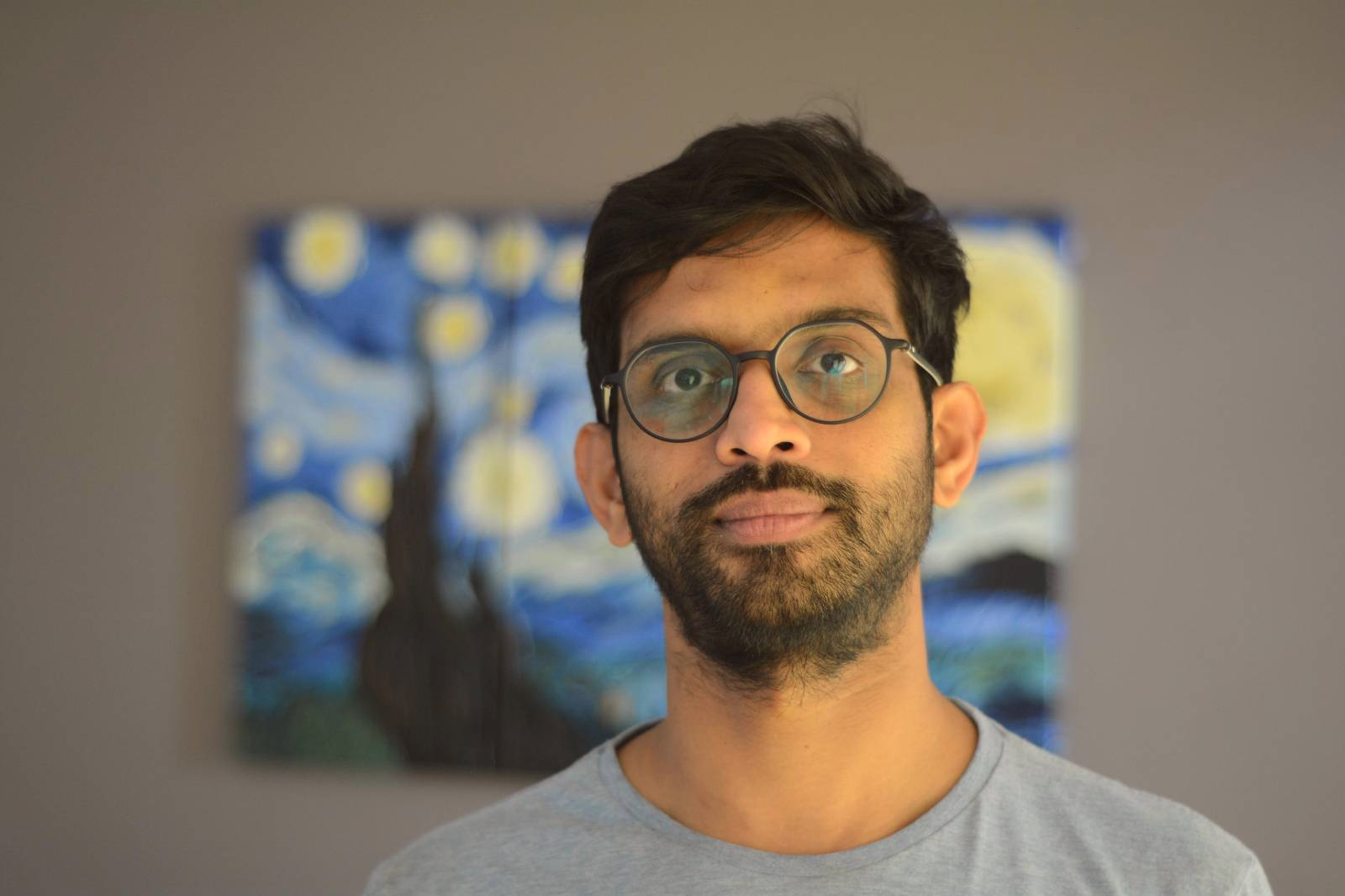
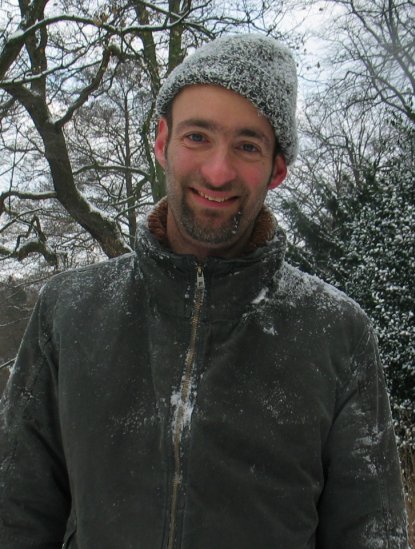
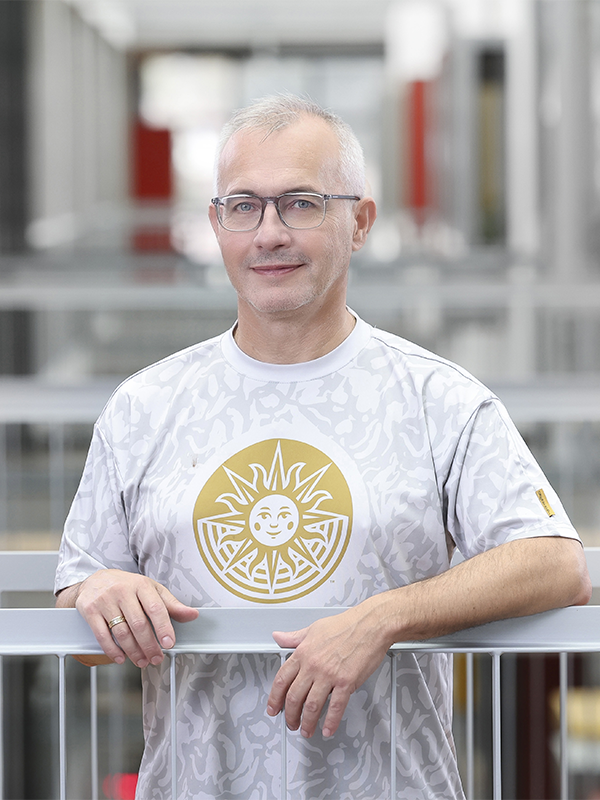
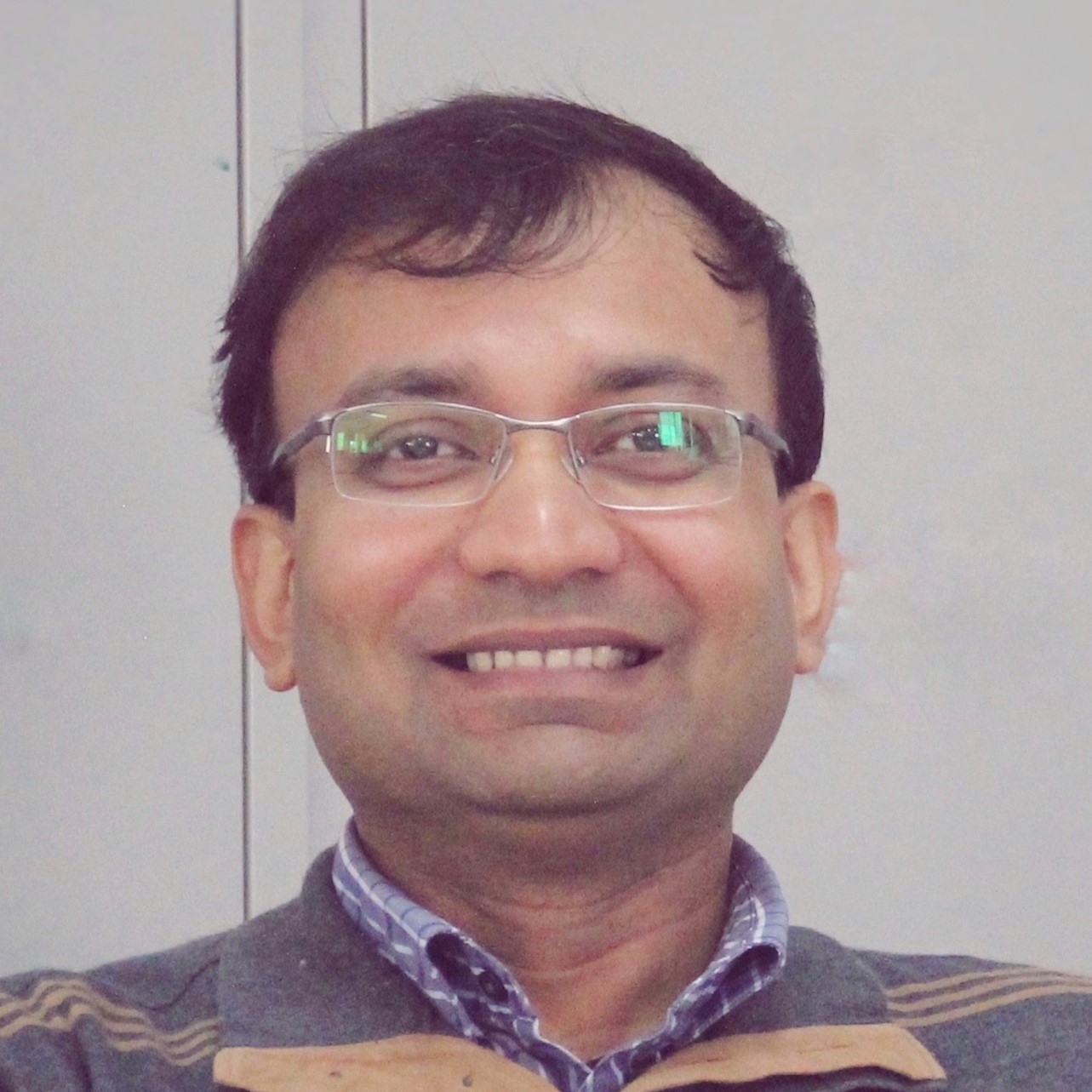
Prof. Dr.-Ing. Dieter Krause is a faculty member at the Institute of Product Development and Engineering Design at Hamburg University of Technology (TUHH). His academic career spans decades, with a focus on modular product development , lightweight design , and additive manufacturing across industries like aerospace, automotive, and medical technology. Research Interests : Modularization strategies for sustainable product families Integration of AI and data-driven methods in design engineering 3D-printed medical phantoms for interventional training Composite material analysis and tribological interface design Scientific Contributions : 2015 Hamburg Teaching Award for excellence in university instruction DFG Review Board member for Product Development Leadership in international conferences and academic governance
Nadeen Fathallah is a researcher at the University of Stuttgart, affiliated with the Analytic Computing group at KI. Her work spans AI applications for accessibility, computer vision, and knowledge engineering. Research Focus: Web accessibility, ontology learning, and LLM-based solutions for Deaf/Hard of Hearing communities Projects: Key contributor to the IKILeUS project (Integrated AI in Teaching) at the University of Stuttgart Teaching: Has served as teaching assistant and assistant lecturer at German International University, German University in Cairo, and The Knowledge Hub Her research explores: Automated detection/correction of web accessibility violations (e.g., AccessGuru platform) Improving video captions using large language models Accessibility tools for tabular data (EchoTables) Ontology learning pipelines (NeOn-GPT, LLMs4Life) Recent work shows a focus on combining LLMs with domain-specific challenges across multiple fields, particularly emphasizing inclusive design principles. Contact details: Office at Universitätsstraße 32, Stuttgart, Germany (Room: 2.312b). Available via +49 711 685 88130.
Chethan Kamath is an Assistant Professor in the Department of Computer Science and Engineering at IIT Bombay, where he is a member of the Theory Group and Trust Lab. His primary research focus is on cryptography, particularly its foundations, with broader interests extending to theoretical computer science. His educational journey includes: PhD from IST Austria (2014-2020) under Krzysztof Pietrzak, with thesis titled "On the Average-Case Hardness of Total Search Problems" Master's in CS from IISc Bangalore (2010-2013) under Sanjit Chatterjee, with thesis titled "Constructing Provably Secure Identity-Based Signature Schemes" Bachelor's in CS from University of Kerala (2005-2009) at TKM College of Engineering, Kollam Dr. Kamath's research interests span the theoretical foundations of cryptography, with particular focus on secure computation, complexity theory, and cryptographic hardness assumptions. His work often bridges theoretical computer science with practical cryptographic applications, exploring the boundaries of what can be efficiently computed while maintaining security guarantees. His research frequently addresses fundamental questions about the relationship between cryptographic primitives and complexity classes, especially the PPAD and TFNP complexity classes. His recent publications demonstrate a consistent focus on foundational aspects of cryptography, with particular emphasis on secure computation (garbled circuits, Yao's protocol), proofs systems (proofs of work, proofs of exponentiation), and complexity-theoretic aspects of cryptographic primitives. A notable trend is his exploration of the connections between complexity classes like PPAD and cryptographic assumptions, as well as his work on verifiable delay functions and their underlying number-theoretic assumptions. His research often employs tools from algorithmic graph theory (treewidth, separators) to analyze cryptographic protocols. His notable scientific achievement includes: Azrieli Fellowship during his post-doc at Tel Aviv University Dr. Kamath actively mentors students and researchers, currently advising several PhD and MS students at IIT Bombay, often in collaboration with Sruthi Sekar. His service to the academic community includes extensive program committee memberships for major conferences including Crypto, Eurocrypt, and TCC, demonstrating his standing in the cryptographic research community. He has co-organized educational events like the "Introduction to Cryptography" school as part of the ACM India Summer School 2025 and the "Theoretical Foundations of Cryptography" school as part of the ACM India Summer School 2024. He leads research activities within the Trust Lab at IIT Bombay, which focuses on theoretical and applied aspects of cryptography and security. The lab actively recruits MS/PhD students and post-docs, with ongoing research in foundational cryptography and its applications to secure computation, verifiable delay functions, and complexity-theoretic aspects of cryptographic security.
Aidong Zhang is the Thomas M. Linville Professor at the University of Virginia and a Fellow of the ACM (2017), IEEE, and the American Institute of Medical and Biomedical Engineering. With 29 years of ACM membership, she founded the ACM Special Interest Group on Bioinformatics (SIGBio) in 2011 and served as its Chair and advisor until 2021, establishing its flagship ACM-BCB conference and serving as Steering Committee Chair until 2019. Her research pioneers bioinformatics, computational biology, and data mining through multimodal data fusion for heterogeneous integration, biomedical knowledge graph construction from scientific literature, and heterogeneous multi-omics data clustering. Recent work advances interpretable machine learning models for explainable complex data analysis in health informatics, evidenced by high citation impact and novel computational methodologies enabling biomedical discovery. Major recognitions include: ACM Distinguished Service Award (2023) for leadership in bioinformatics, computational biology, and data mining communities ACM Fellow (2017) for contributions to bioinformatics and data mining IEEE Fellow and Fellow of the American Institute of Medical and Biomedical Engineering She served as NSF Program Director (2015-2018) managing federal computing investments and founded diversity initiatives including Women in Bioinformatics, the PhD Student Forum, and Health Informatics Symposium. Editorial leadership includes Editor-in-Chief of ACM/IEEE Transactions on Computational Biology and Bioinformatics (2017-2021) and roles in ACM SIGMOD-DiSC, Multimedia Systems Journal, and SIGKDD 2022 General Chair.
Slavko Žitnik is an Associate Professor and Vice-dean at the Faculty of Computer and Information Science, University of Ljubljana, where he is a member of the Laboratory for Data Technologies. His academic career spans multiple research projects and international collaborations focusing on data technologies and natural language processing. His primary research interests include information retrieval, information extraction, natural language processing, entity extraction, relationship extraction, coreference resolution, data merging, redundancy elimination, and ontologies. Dr. Žitnik's work often bridges theoretical computer science with practical applications in various domains including education, healthcare, and smart city ecosystems. Dr. Žitnik has led and participated in numerous significant research projects including P2-0359 on Ubiquitous Computing (2023-2027), PoVeJMo on Adaptive Natural Language Processing with Large Language Models (2023-2026), and the GOBLIN COST Action for building global networks of large-scale knowledge graphs. His recent work demonstrates a strong focus on adapting natural language processing techniques with large language models and creating practical applications of these technologies. His scientific contributions span multiple domains including: Natural Language Processing and Information Extraction techniques Knowledge graph construction and integration Applications in education, healthcare, and smart city ecosystems Development of practical tools and systems for data processing Dr. Žitnik has established international collaborations with institutions including Harvard University's Department of Biomedical Informatics (where he conducted a research visit from July to October 2022), the University of South Florida, and various European partners through COST Actions and other collaborative frameworks.
Yifei Jin is a WASP Industrial PhD student at KTH Royal Institute of Technology's School of Electrical Engineering and Computer Science, specifically within the Division of Theoretical Computer Science. They are supervised by Professor Aristides Gionis and Associate Professor Sarunas Girdzijauskas at KTH, and also serve as an Experienced Researcher at Ericsson Research and a Visiting Researcher at Yale University under Rex Ying and Leandros Tassiulas. Yifei's research focuses on graph mining , network analysis , and graph representation learning , particularly applied to crowdsourcing data and wireless communication systems. Their work intersects telecommunications network optimization machine learning for graph-structured data AI-driven wireless resource management edge computing and distributed AI as evidenced by their publications spanning 2017–2025. Their academic contributions include 15 recent papers exploring topics such as neural surrogates for voltage drop estimation, wireless ray-tracing models, scalable distributed AI deployment, and vehicle platooning coordination. These publications demonstrate expertise in network traffic reduction KPI conflict analysis graph convolutional networks hyperbolic embeddings for ontologies real-time network diagnostics .
Carsten Lutz is a Professor at the University of Leipzig, Faculty of Mathematics and Informatics, Institute of Informatics, where he leads the Department of Foundations of Knowledge Representation. He joined the university in April 2022 after previously holding positions at other institutions. His extensive service to the academic community includes numerous roles as Program Committee Chair, Area Chair, and Senior PC Member for major conferences in artificial intelligence, database theory, and knowledge representation. Professor Lutz's research focuses on the theoretical foundations of knowledge representation, with particular emphasis on description logics, ontology-mediated querying, and the intersection of database theory with artificial intelligence. His work bridges formal logic with practical applications in semantic technologies. His research has led to significant contributions in understanding the computational properties of knowledge representation formalisms and developing efficient query processing techniques. His recent publications demonstrate a continued focus on the theoretical aspects of knowledge representation, with increasing attention to connections with machine learning, particularly in areas like graph neural networks and PAC learning of logical concepts. The research trends show a consistent thread of applying logical methods to analyze and improve modern AI systems while maintaining strong theoretical foundations. Scientific Awards: Fellow of the Asia-Pacific Artificial Intelligence Association (AAIA) 2022 EurAI (formerly ECCAI) fellow 2016 IJCAI2023 distinguished paper award PODS2023 Best Paper Award PODS2023 Test of Time Award for PODS2013 paper on Ontology-Mediated Querying "AI Ten to Watch" award of IEEE Intelligent Systems Magazine Professor Lutz has been highly active in academic service, serving as PC Co-Chair for IJCAR2026, Area Chair for KR2025 and IJCAI2025, and PC Member for numerous prestigious conferences including ICDT2026, PODS2025, and DL2025. His commitment to reducing academic carbon footprint through reduced conference travel is noteworthy. He has also developed several software systems including Grind, Combo, and Spell that implement theoretical advances in ontology-mediated querying and concept learning.
Prof. Fabio Gasparetti is a tenured Full Professor at the Department of Civil, Computer and Aeronautical Engineering of the University of Rome 3 , Italy. His academic profile spans Machine Learning , Recommender Systems , and Educational Technology , with a strong focus on Cultural Heritage digitization and Social Media analytics. He is affiliated with the university's AI Lab (a website currently under construction). Email: fabio.gasparetti@uniroma3.it Phone: 0657333212 Location: Via Vito Volterra 62, Rome Research Interests revolve around: Contextual Recommender Systems for cultural and educational domains Social Network Mining for community detection and user modeling Machine Learning Applications in aerospace engineering and e-learning Temporal Analysis of MOOC dynamics and behavioral patterns Prerequisite Modeling for educational content sequencing Cultural Ecosystems in digital pandemic contexts Recent Publications (2021-2025) demonstrate interdisciplinary synergy between Computer Science and Humanities domains, particularly in: Machine Learning for aerospace physics Multimodal LLMs in art interpretation Social data-driven cultural personalization Graph-based educational community monitoring Cross-platform museum positioning Migration discourse analysis
Nicolas HIOT is a Post-doctoral fellow at the University of Orleans affiliated with the LIFO laboratory (Laboratoire d'Informatique Fondamentale d'Orléans) and the Pamda project. His research bridges database systems, natural language processing, and medical informatics with a focus on text-to-database integration and consistency maintenance. His research interests center on: Database Systems for medical applications with emphasis on consistency and evolution Natural Language Processing for clinical text analysis and relation extraction Knowledge Graph construction from unstructured textual data Medical Informatics applications for healthcare data management Analysis of his 15 most recent publications (2020-2024) reveals a cohesive research trajectory at the intersection of databases and NLP. Key thematic clusters include automated medical database construction from clinical texts, consistency management in evolving RDF/property graph systems, and clinical entity/relation extraction for knowledge graphs. His work consistently addresses real-world challenges in healthcare data integration through tools like DataFix and ArchiTXT, demonstrating strong translational potential. Nicolas HIOT actively contributes to the LIFO research laboratory at the University of Orleans, collaborating extensively with Jacques CHABIN, Mirian HALFELD-FERRARI, and Dominique LAURENT. His technical output includes multiple software systems for database evolution management and clinical text processing, reflecting both theoretical contributions and practical implementations in semantic data management.
Christel VRAIN is a full-time University Professor affiliated with the University of Orleans, specializing in Machine Learning and Constraint Programming. Her research focuses on constrained clustering, knowledge integration, and hybrid AI systems, with applications in image classification, time series analysis, and geospatial data. She collaborates extensively with researchers like Thi-Bich-Hanh DIEP-DAO and Samir LOUDNI. University Professor at University of Orleans Affiliated with Laboratoire d'Informatique Fondamentale d'Orléans (LIFO) Her work bridges declarative programming with machine learning, emphasizing explainability and optimization. Recent publications explore continual learning, graph models, and constraint-based clustering frameworks. She contributes to interdisciplinary research through the Kay R. Amel group, investigating synergies between reasoning, knowledge representation, and data mining. Her methodological innovations include memory-efficient algorithms for large-scale datasets and shapelet transforms for time series.
Prof. Dr. Vlado Stankovski serves as Full Professor and Vice Dean at the University of Ljubljana's Faculty of Computer and Information Science, leading major EU-funded initiatives including EBSI-VECTOR (€14.5M), TRUSTCHAIN (€12M), and ONTOCHAIN (€6M) focused on blockchain integration, decentralized systems, and next-generation internet protocols. His research spans software engineering, cloud/edge/fog computing, distributed systems, semantics, and artificial intelligence, with particular emphasis on blockchain applications for smart contracts, digital identity (eIDAS2), and knowledge management. Current projects address real-world implementations in smart construction, healthcare traceability, educational credentialing, and public administration digitalization. Analysis of his 2020-2023 publications reveals dominant trends in decentralized architectures, with 70% of works integrating blockchain with semantic web standards (W3C DID) and fog computing. Key application areas include service-level agreement management (25%), smart construction ecosystems (20%), and cross-border AI/data governance (15%), demonstrating strong industry-academia collaboration through Horizon Europe and EU digital identity frameworks. As scientific coordinator of TRUSTCHAIN and ONTOCHAIN managing over €50M in combined funding, he mentors students through thesis topics in blockchain development and decentralized systems. His laboratory work at the Data Technologies Laboratory supports courses in computer science fundamentals, communications security, and fog computing for smart services, with active involvement in EU skills initiatives like ESSA for software competency standardization.
Marek Mutwil serves as an Associate Professor in the Department of Plant and Environmental Sciences at the University of Copenhagen, specializing in plant biochemistry with research spanning genomics, systems biology, and computational approaches to plant science. His work bridges experimental biology and data-intensive methodologies to address fundamental questions in plant environmental responses. His research program focuses on deciphering regulatory networks in plant stress adaptation, particularly through cross-species analyses of abiotic stress mechanisms in hydroponic systems. A significant portion of his recent work involves developing computational infrastructure for plant science, exemplified by the PlantConnectome knowledge graph that integrates literature-derived biological relationships across 71,000+ plant research articles. This dual emphasis on experimental stress physiology and bioinformatics resource development positions his work at the intersection of molecular plant biology and data science. Analysis of his 2025 publications reveals a consistent trajectory toward integrative plant systems biology, combining hydroponic crop stress experiments with large-scale knowledge graph applications. These works demonstrate growing emphasis on translational bioinformatics tools that convert fragmented plant science literature into structured, queryable biological networks. Scientific Awards: No awards were documented in the provided text. Advising and Grants: The source material contains no references to graduate students, postdoctoral trainees, or research funding sources. Labs and Teams: While affiliated with the Section for Plant Biochemistry, no specific laboratory structure, team members, or collaborative consortia are described in the available information.
Marc Champagne is a Regular Tenured Professor in the Department of Philosophy at Kwantlen Polytechnic University and a Senior Fellow with the Aristotle Foundation for Public Policy. He is also the Founder of Certified AI-Free Skills and Knowledge, a non-profit initiative identifying and verifying courses that maintain human-centered learning approaches. His academic journey includes being an alumnus of York University's Philosophy program. Champagne's research spans multiple philosophical domains with particular emphasis on semiotics , philosophy of mind , and ethics . His work demonstrates a unique integration of Peircean semiotics with contemporary issues in technology, consciousness, and AI. He has developed original concepts like "semiotic inflation" to analyze how AI-generated content affects human experience and value systems. His scholarship bridges classical philosophical frameworks with cutting-edge technological challenges, particularly in robotics ethics and virtual reality philosophy. Champagne's publication pattern reveals consistent engagement with foundational questions about consciousness, meaning, and responsibility in the digital age. His recent work increasingly focuses on AI ethics, robot responsibility, and the existential implications of technology. He frequently employs semiotic theory to analyze phenomena ranging from human-AI interaction to interstellar communication possibilities, demonstrating remarkable interdisciplinary range while maintaining philosophical rigor. Through his founding of Certified AI-Free Skills and Knowledge, Champagne actively translates his theoretical work into practical applications that help preserve human-centered educational experiences. His scholarship consistently challenges conventional thinking about technology's role in society while offering constructive alternatives grounded in philosophical traditions.
Dr Shiva Ji is Associate Professor of Design at Indian Institute of Technology Hyderabad, with affiliate appointments in the Department of Climate Change (GreenKo School of Sustainability) and Department of Heritage Science & Technology. He also serves as Head of Design and Principal Investigator of the Design for Sustainability Lab and Digital Heritage Lab. Education PhD in Design, IIT Guwahati (2015-2020) – MHRD Design Innovation Center Fellow Master of Design (PGDPD), National Institute of Design, Ahmedabad (2005-2007) Bachelor of Architecture, Government College of Architecture (now FoA, APJAKTU), Lucknow (1999-2004) MBA, Indira Gandhi National Open University (2011) Certificate Course in Sustainability in Practice, University of Pennsylvania (2014) Professional Certificate in Environment & Sustainable Development, CEPT University (2011) Research Interests Dr Ji’s work converges architecture, sustainability, and digital technologies . His major thrust areas include Design for Sustainability integrating Life-Cycle Assessment (LCA) and system-design thinking, Digital Heritage using AR/VR/MR for architectural documentation and immersive reconstruction, and Climate-Responsive Design Innovation addressing micro-habitation, urban sprawl, and sustainability in the face of climate change. He also investigates vernacular and bio-architecture , leveraging indigenous knowledge for contemporary sustainable solutions, and explores industrial/product design for new-age services and circular-economy products. Publication Trends Since 2016 he has authored 25+ peer-reviewed works spanning urban analytics, digital heritage, sustainable architecture, and socio-cultural studies . Recent publications emphasize data-driven heritage documentation (photogrammetry, space-syntax, visibility graphs) and environmental performance evaluation of built environments, highlighting an interdisciplinary blend of design, computation, and sustainability science. Scientific Awards & Recognition 3rd Winner – Click! Japan Photo Contest 2020 (Embassy of Japan & Japan Foundation) JICA Travel Grant for Japan Universities visit Ford Foundation Scholarship NID Scholarship MHRD Design Innovation Center Fellowship All-India Rank 36 – CEED 2005 NASA Design Competition Citation 2002 Student Supervision & Funding Currently supervising 5 ongoing PhD and 4 ongoing Master’s students, with 14 Masters theses/dissertations already completed. He is Principal Investigator on DST-Govt. of India funded project and India partner for EU LeNSin project (Politecnico di Milano), mobilising international collaborations on sustainable product-service systems. Laboratories & Teams Dr Ji leads two flagship labs: • Design for Sustainability Lab – focuses on LCA, circular design, and strategic sustainable solutions for local to global challenges. • Digital Heritage Lab – pioneers AR/VR/MR applications for immersive heritage visualization and digital twins of architectural assets. Each lab runs multiple sponsored projects with interdisciplinary student teams, industry partners, and international collaborators.
Hoda Eldardiry is an Associate Professor in the Department of Computer Science at Virginia Tech, where she directs the Machine Learning Laboratory. Her research focuses on artificial intelligence and machine learning, particularly in building human-machine collaborative AI systems that can learn context-aware and explainable models from multisource and interconnected data. Prior to joining Virginia Tech, she led research at Palo Alto Research Center (Xerox PARC) in the machine learning research group. Dr. Eldardiry received her educational qualifications from: BE in Computer and Systems Engineering from Alexandria University, Egypt MS and PhD in Computer Science from Purdue University Her research interests span multiple domains of AI and machine learning. She specializes in robust machine learning for information extraction, forecasting, and control. Her work integrates graph neural networks, time-series analysis, and relation extraction to develop explainable and context-aware AI systems. She also investigates the intersection of AI with ethics, policy, and governance, exploring how to build responsible AI systems that align with human values and societal needs. Dr. Eldardiry's recent publications demonstrate a strong focus on advancing graph-based time-series modeling, zero-shot learning techniques, and optimal control systems. Her work bridges theoretical advancements with practical applications in healthcare, transportation, and e-commerce. She has made significant contributions to knowledge graph construction, explainable AI, and federated learning frameworks that operate efficiently in resource-constrained environments. Her scientific achievements have been recognized with several prestigious awards: Purdue University College of Science Early Career Scientist Award for the Department of Computer Science (2021) Honorable Mention Best Paper Award for Exploring Approaches to Artificial Intelligence Governance: From Ethics to Policy (IEEE Ethics 2023) Most Cited Paper Award for COVID-19 Pandemic Impacts on Traffic System Delay, Fuel Consumption and Emissions (2023) Purdue CS Women's History Month Celebration Recognition (2022) VT CS Women's History Month Celebration Recognition (2023) Early Career Distinguished Scientist Award from Purdue University College of Science (2021) Purdue University College of Science Distinguished Alumni (2021) Dr. Eldardiry has successfully secured substantial research funding, with total grant funding of $27,424,460 ($13,808,328 share) from diverse sources including VT, IARPA, DOE, NSF, DARPA, NIH-iTHRIV, CCI, EBAY, SIEMENS, ADOBE, P&G and XEROX. Her current projects include NSF-funded research on Advancing Health Equity using Interactive Condition Assessment and Monitoring and Exploring How AI Engineers Perceive and Develop Translational Ethical Competency, as well as industry collaborations with EBAY on Heterogeneous Hypergraph Modeling for Zero-Shot Product Aspect Identification. As director of the Machine Learning Laboratory at Virginia Tech, Dr. Eldardiry leads a research team that bridges theoretical AI advancements with real-world applications. Her lab collaborates extensively with industry partners and government agencies to develop practical AI solutions while maintaining a strong commitment to ethical considerations and societal impact.