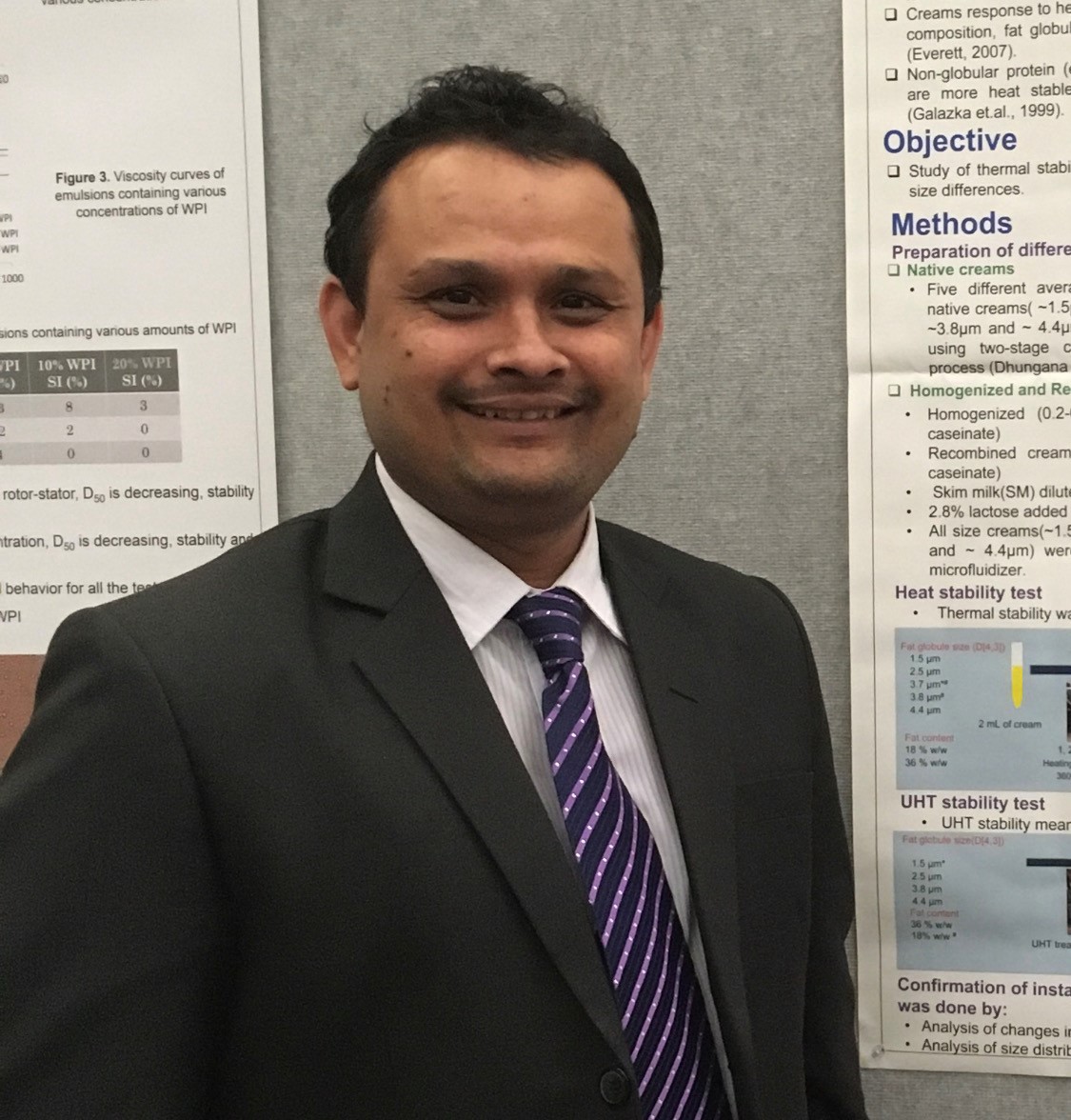
Dr. Pramesh Dhungana is a Lecturer at Curtin University's School of Molecular and Life Sciences (MLS) within the Faculty of Science and Engineering. He holds a PhD in Food Process Engineering from the University of Queensland (UQ) and has over 20 years of combined industry and academic experience. His research focuses on dairy-based ingredient innovation, food process engineering, and equipment design, including advancements in milk fat globule fractionation, nanobubble generation systems, and traditional food product mechanization (e.g., Selroti machine design). Dr. Dhungana's educational background includes a B.Tech in Food Technology from Tribhuvan University (Nepal) and an M.Tech in Food Engineering from SLIET (India). His postdoctoral work at UQ explored nanobubble applications in dairy processing, followed by a role as Senior Technical Officer there before joining Curtin in 2023. His research interests span food engineering innovations, emulsion stability, and sustainable food processing technologies. Notable contributions include developing a novel method for milk fat globule fractionation and designing continuous nanobubble generation equipment. In teaching, he instructs Advanced Food Processing and Food Laboratory courses. His recent publications emphasize dairy emulsion properties, chia seed mucilage applications, and millet milk development. He actively collaborates on projects addressing food waste valorization and traditional food product standardization. Dr. Dhungana's work bridges academic research and industrial application, focusing on scalable food processing solutions and equipment optimization for the food industry.
Şahin Serhat Şeker is a Professor in the Department of Electrical Engineering at Istanbul Technical University (ITU), Istanbul, with continuous research activity since 1993. He maintains an active publication record through 2025, demonstrating ongoing academic engagement, and has accumulated 111 research outputs with 1084 citations and an h-index of 19. His research centers on power system analysis and electric motor diagnostics, specializing in vibration signal processing for fault detection in induction motors. He employs continuous wavelet transform for non-stationary signal analysis to identify bearing damage, aging processes, and fault signatures. Recent work integrates machine learning for renewable energy forecasting and power grid stability, reflecting a strategic shift toward AI-driven solutions for energy infrastructure challenges. Professor Şeker's 2023-2025 publications reveal a strong trend toward deep learning applications in transient instability prediction, solar irradiance forecasting, and photovoltaic system optimization. His work increasingly addresses real-world energy challenges in regions like Djibouti, focusing on grid stability and renewable integration through hybrid modeling approaches. He has supervised 13 students and secured research funding through two major projects: SENSOR VALIDATION AND FUSION FOR SYSTEM MONITORING (2018-2019): Developed sensor validation frameworks for industrial system monitoring Analysis of Ferroresonance in Power Systems Using Multiresolution Wavelet Analysis and Extraction of Nonlinear Properties (2013-2018): Investigated nonlinear phenomena in power grids through advanced signal processing
Paulo Afonso Brardo Duarte is an Assistant Professor at the Lusophone University of Porto, holding affiliations with the Faculty of Law and Political Science, the Francisco Suárez Center for Advanced Studies in Law, and the LusoGlobe Research Center for Politics, Economics and Society. With an ORCID identifier (0000-0003-1675-2840), Dr. Duarte has established himself as a prominent researcher in international relations, particularly focusing on China's global initiatives and their geopolitical implications across multiple continents. Dr. Duarte received his PhD from the Catholic University of Louvain, which provided the foundation for his expertise in international political economy and global governance structures. His academic journey has led him to conduct extensive on-the-ground research in Central Asia, specifically in Kazakhstan, Kyrgyzstan, and Tajikistan, giving him firsthand insights into the implementation of China's Belt and Road Initiative in the region. Dr. Duarte's research program centers on China's Belt and Road Initiative (BRI) and its evolving manifestations across different geographic and thematic domains. His work critically examines the soft power dimensions of Chinese foreign policy, multilateralism frameworks within BRI, and the geopolitical implications of China's engagement with Central Asia , Africa , Latin America , and Europe . Recent publications demonstrate a sophisticated evolution in his research focus, expanding from broader BRI analyses to specialized examinations of its Digital Silk Road , Maritime Silk Road , Environmental Diplomacy , and Health Silk Road components. Analysis of Dr. Duarte's publication trajectory from 2014-2025 reveals consistent scholarly productivity with significant acceleration in recent years (10 publications in 2023, 3 in 2024, and 4 in 2025). His work demonstrates methodological rigor through qualitative approaches and extensive fieldwork, while increasingly addressing the intersection of Chinese foreign policy with global governance structures, environmental sustainability imperatives, and digital transformation challenges. The thematic progression shows movement from regional case studies toward more complex analyses of BRI's sectoral dimensions and its adaptation to international expectations. Dr. Duarte has accumulated 28 scientific publications including articles, book chapters, and books, contributing to his Scopus-calculated H-index of 6. His work has gained recognition through citations, Mendeley readership (ranging from 1-19 readers per recent publication), and media attention including coverage by news outlets and social media discussion. As an active research contributor, Dr. Duarte serves as a researcher on the "Maritime Studies Comprehensive Project: Bridging Atlantic" (2023-2028), which focuses on Brazil, the Global South, knowledge-sharing mechanisms, and artificial intelligence applications in maritime contexts. This five-year project demonstrates his expanding research horizons into Atlantic studies and digital governance frameworks while maintaining connections to his core expertise in China's global engagement. Dr. Duarte maintains a robust international research network with collaborations spanning Portugal, Brazil, China, and multiple African nations. His scholarly footprint reveals significant engagement with Global South perspectives, particularly through South-South cooperation frameworks and triangular partnerships that bridge European, African, and Latin American academic communities. This network supports his comprehensive approach to studying China's global initiatives through multiple regional lenses.
Daisaku Yokoyama is an Assistant Professor at the Institute of Industrial Science, University of Tokyo, where he works in Department 3 of the Kitsuregawa-Toyoda Laboratory. His research focuses on parallel and distributed processing, combinatorial search, game tree search, and other search processes. He is also involved in the development of "Gekisashi," a computer shogi (Japanese chess) player. His academic background includes: March 1998: Graduated from the Department of Electronic and Information Engineering, Faculty of Engineering, The University of Tokyo March 2000: Completed Master's course in Information Engineering at the University of Tokyo 2002.3: Graduated from the Doctoral Program in Information Engineering, Graduate School of Engineering, The University of Tokyo September 2006: Obtained a PhD in Science from the Graduate School of Frontier Sciences, University of Tokyo Daisaku Yokoyama's research interests primarily center around parallel and distributed computing systems, with a particular focus on combinatorial search algorithms and game tree search techniques. His work bridges theoretical computer science with practical applications, especially in the domain of computer shogi where he has developed "Gekisashi." Beyond game AI, his research has expanded into big data analytics, particularly in transportation systems where he analyzes passenger flows in metro networks and driver behavior using vehicle recorder data. His work demonstrates a consistent thread of applying parallel processing techniques to solve computationally intensive problems across various domains. Yokoyama's publication record shows a clear evolution from foundational work in parallel combinatorial optimization (PopKern library) to more applied research in computer shogi and eventually to big data applications in transportation systems. His early work established frameworks for parallel search algorithms, while more recent publications demonstrate applications of these techniques to real-world problems involving massive datasets from metro systems and vehicle recorders. His research consistently emphasizes the importance of domain-specific knowledge in optimizing parallel algorithms. His notable scientific achievements include: DBSJ Best Paper Award 2014 for "Application and Evaluation of a Bayesian-Based Monte Carlo Tree Search Algorithm to Shogi" Game Programming Workshop Excellent Paper Award (awarded twice) Throughout his career, Yokoyama has been actively involved in academic service, serving on editorial boards, program committees, and as an organizer for numerous conferences and workshops related to programming, parallel computing, and game AI. His work on the Gekisashi shogi engine represents a long-term research project that has evolved from basic search algorithms to sophisticated AI systems, demonstrating both theoretical rigor and practical implementation skills. He is part of the Kitsuregawa-Toyoda Laboratory at the Institute of Industrial Science, University of Tokyo, which focuses on advanced computing systems, database technologies, and large-scale data processing. The laboratory provides a collaborative environment for research spanning theoretical computer science to real-world applications in transportation analytics and game AI.
Victor Lagerkvist is an Associate Professor at the Department of Computer Science (IDA) , Linköping University, Sweden. He is affiliated with the Theoretical Computer Science Laboratory (TCSLAB) and the Artificial Intelligence and Integrated Computing Systems (AIICS) division. His research focuses on the algebraic method for analyzing computational complexity , particularly in constraint satisfaction problems (CSPs), SAT, and graph homomorphism problems. PhD in Computer Science (2016, Linköping University) Habilitation (2020, Linköping University) His recent work investigates fine-grained complexity , twin-width , and universal algebra to improve algorithms for NP-hard problems. Publications span topics like propositional abduction, Allen's interval algebra, and semiring-based dynamic programming. His scientific awards include the Swedish Research Council Starting Grant (2020) and the 2017 Young Researcher Prize from the Ruth and Nils-Erik Stenbäck Foundation. He supervises PhD students such as Leif Eriksson and serves as a secondary supervisor for others at Linköping University and Université de Lorraine.
Prof. Dr.-Ing. Sven Buchholz serves as a Professor in the Department of Computer Science and Media at Brandenburg University of Technology in Brandenburg an der Havel, Germany. His office is located in Building C, Room C.2.18 at Magdeburger Straße 50, with contact information including telephone +49 3381 355-482 and email sven.buchholz@th-brandenburg.de. Specializing in Applied Computer Science , Prof. Buchholz focuses on data management and data mining with a distinctive research trajectory in geometric algebra applications. His scholarly work demonstrates expertise across multiple domains including neural network architectures using Clifford algebra, solving complex partial differential equations, protein structure prediction, and computer vision systems. The evolution of his research shows progression from foundational theoretical work on Clifford neurons in the early 2000s to increasingly interdisciplinary applications in recent years. Analysis of his publication history reveals a significant research focus spanning over 15 years, with a notable resurgence of activity in 2024. His recent work demonstrates sophisticated applications of geometric algebra to solve challenging problems across physics (Maxwell's equations, Navier-Stokes equations), molecular biology (protein structure prediction), and robotics (camera pose estimation). This interdisciplinary approach connects mathematical theory with practical implementations in scientific computing and artificial intelligence. Prof. Buchholz maintains an active research profile with multiple high-impact publications in 2024, indicating ongoing contributions to the advancement of geometric algebra applications in computational science. His work bridges theoretical mathematics with practical machine learning implementations, contributing to both academic knowledge and potential real-world applications in scientific computing and data analysis.
Dr Martin Stacey is a Senior Lecturer at De Montfort University's Faculty of Computing, Engineering and Media, where he works within the School of Computer Science and Informatics. His interdisciplinary background combines psychology and artificial intelligence to inform both teaching and research activities focused on human-computer interaction and information design. His educational background includes a BA in Experimental Psychology from the University of Oxford, an MS in Psychology from Carnegie-Mellon University, and a PhD in Artificial Intelligence from the University of Aberdeen. His research spans cognitive science, design methodology, and human factors engineering. Stacey's research interests center on design thinking , design processes , and human-design tool interaction . His work examines how designers use representations of information, factors influencing problem structuring, causal modeling of design processes, and the role of object references in design. His interdisciplinary approach integrates psychology, sociology, AI, and philosophy to compare design processes across industries. Analysis of his recent publications reveals a consistent focus on the epistemology of design processes, with increasing attention to method ecosystems, knowledge representation in engineering, and the philosophical foundations of design. His work bridges theoretical design research with practical applications in biomedical engineering, digital governance, and stress monitoring systems. As an academic supervisor, he currently advises PhD student Yee Mei Lim. His professional service includes membership on the Advisory Board for Design Computing and Cognition conferences (2006-2014) and extensive peer review activities for leading design and engineering journals.
Pablo Calvo Báscones serves as an Assistant Professor at Comillas Pontifical University's Faculty of Economics and Business (ICADE) within the Department of Quantitative Methods, teaching data science and analytics courses since 2022 after 9 years of cumulative university service. His academic credentials include: PhD in Industrial Engineering (Comillas Pontifical University, 2022) Master's Degree in Industrial Engineering (Comillas Pontifical University) Electromechanical Engineering degree (Comillas Pontifical University) Research focuses on Economics of Longevity and Data-driven Industrial Diagnostics , integrating digital twin ecosystems with machine learning for anomaly detection. His methodology bridges industrial prognosis (2020-2023) and socioeconomic frameworks like the Senior Economy Tracker (2024), demonstrating evolution from component-level diagnostics to macroeconomic policy tools. Recent publications reveal interdisciplinary expansion into energy resource assessment and demographic transition metrics while maintaining core expertise in behavioral pattern recognition for industrial systems. Scientific recognition includes: Distinción Honorífica a la mejor Tesis Doctoral en Ingeniería (2024) for "Inclusive methodologies for anomaly detection and prognosis of industrial systems" Secured research funding from EU Horizon 2020 programs and private sector partners including Airbus and Leiden University Medical Centre. Supervises Final Degree Projects while teaching Data Analysis and Visualization courses. Maintains active industry collaboration through the Smart Management for Sustainability research group and international engagement as Visiting Professor at TU Delft (December 2023).
Melvin McInnis serves as Professor of Psychiatry and Professor of Learning Health Sciences at the University of Michigan Medical School. He holds multiple leadership roles including Program Director in Psychiatry and membership in the Center for Computational Medicine and Bioinformatics and the Eisenberg Family Depression Center. His research integrates genomic, circadian, and computational approaches to bipolar disorder. Dr. McInnis's research focuses on bipolar disorder pathophysiology with emphasis on circadian rhythm mechanisms, lithium treatment response, and digital phenotyping. His work employs Genomic analyses of patient-derived neural cells Longitudinal mood tracking through digital tools (BiAffect study) Computational ontologies for cross-study data integration Machine learning approaches to suicide risk prediction Investigation of circadian-sleep-mood relationships His publications consistently address mood instability metrics, bipolar subtyping, and precision medicine applications. Analysis of his 15 most recent publications reveals strong emphasis on digital mental health (7/15 articles), circadian biology (6/15), and computational approaches (5/15). Key trends include development of novel mood instability metrics, integration of multi-omics data, and real-world validation of digital biomarkers through passive smartphone sensing. Dr. McInnis secures substantial research funding through NIH and private foundations, with 55 active grants including: NIH R01 MH139125: "Detecting dynamic fluctuations in emotion, mood, and functioning" (2023-2028) NIH R01 MH131845: "Correcting Circadian Rhythms in Bipolar Disorder" (2023-2025) NIH R01 MH129624: "Affective and Cognitive Mechanisms of Emotion-Based Impulsivity" (2023-2028) Brain & Behavior Research Foundation: "Modeling and Predicting Intraindividual Mood Dynamics" (2023-2025) His work involves extensive international collaboration through the Global Bipolar Cohort network. He leads the Heinz C. Prechter Longitudinal Study of Bipolar Disorder, a comprehensive research program integrating genomic, clinical, and digital data. His laboratory develops computational frameworks including the Bipolar Disorder Ontology (OBD) and participates in the Michigan Institute for Clinical and Health Research (MICHR). Current initiatives focus on developing learning health networks for mood disorders and validating circadian-based interventions.
Adrian Pearce is Associate Professor of Spanish and Latin American history at University College London (UCL), within the Department of Spanish, Portuguese, and Latin American Studies under the School of European Languages, Culture and Society (SELCS). He holds an ORCID identifier 0000-0002-1420-953X and is based in Room 336 Foster Court, Gower Street, London. His academic journey includes a Ph.D. from the University of Liverpool's Institute of Latin American Studies (1998), preceded by an MA in Latin American Studies and BA in French and Hispanic Studies (majoring in Spanish and Portuguese) from the University of Salford. Prior to UCL, he held full-time lecturing positions at El Colegio de México (2013-2016), King's College London (2008-2013), and earlier appointments at Nottingham Trent and Warwick universities. Pearce's research spans Latin American history with particular focus on Spanish colonial policy in the long eighteenth century, British trade relations with Latin America, Andes-Amazonia interdisciplinary studies, and indigenous peoples of the Andes in the nineteenth and twentieth centuries. His work integrates historical, linguistic, and archaeological perspectives through collaborations with scholars like Paul Heggarty and David Beresford-Jones. Current projects examine 'reindigenisation' in 19th-century Americas and the Falklands War of 1982. His publication trends reveal consistent cross-disciplinary engagement, moving from colonial economic history (2007-2014) toward integrated Andes-Amazonia studies (2011-2020) and contemporary conflict analysis (2022). The keyword evolution shows progression from 'Economic History' toward 'Interdisciplinary Research' and 'Cultural Studies', reflecting his expanding methodological approach. Member of the Royal Historical Society (elected 2014) Corresponding Member of the Academy of the Portuguese Marine (elected 2014) Pearce served as Secretary of the UK's Society for Latin American Studies from 2005-2012 and currently teaches across Latin American history periods and regions. His courses include colonial history, twentieth-century Spain, and pre-Columbian civilizations, with experiential components like British Museum gallery visits. As Study Abroad Tutor for SELCS (2017-2019, 2020-2023), he facilitated international academic exchanges. His extensive field experience includes five years in Spain, three in Mexico, and eighteen months in Peru, providing deep contextual understanding for his research.
Marianne Huchard is Full Professor of Computer Science at the University of Montpellier, Faculty of Sciences since 2004, serving as Director of LIRMM (Laboratory of Informatics, Robotics and Microelectronics at Montpellier) and head of its Computer Science Department. She also participates in the human resources committee of the MIPS scientific department. She earned her PhD in Computer Science in 1992 researching algorithmic aspects of multiple inheritance in object-oriented programming languages. Her primary research domains are Formal Concept Analysis (theoretical and applied, including Relational Concept Analysis) and Software Engineering (model-driven engineering, component-based development, and software product line migration), with recent work integrating Large Language Models for innovative solutions. Analysis of her 2024-2025 publications reveals a strong interdisciplinary trend: Relational Concept Analysis enhanced by LLMs is being applied to software engineering challenges like user-story generation, class model restructuring, and product line migration, demonstrating significant methodological innovation. Scientific awards: None documented in provided sources. She actively supervises doctoral research: Thomas Georges (defended January 2023): 'Agile Engineering of Software Product Lines for Agricultural Decision Support' Austin Waffo-Kouhoué (defended November 2024): 'Web Accessibility for People with Visual Impairments' Her research is supported by projects including RCAviz (funded by #DigitAg), FCA4J toolkit development, and Web Iris accessibility extension. As leader of the MAREL team (Models And Reuse Engineering, Languages) at LIRMM, she drives research at the formal methods/software engineering intersection and co-created Montpellier's Master's program in Software Engineering.
Dr. MÜCAHİT Çalışan serves as a Lecturer at Bingöl University with dual appointments in the Computer Engineering Department (Faculty of Engineering and Architecture) and the Distance Education Application and Research Center. Holding a PhD from İnönü University (2022), he contributes to both teaching and research in computer engineering. His academic journey includes: Bachelor's Degree: Electronics and Computer Education, Fırat University (2003-2007) Master's Degree: Electronics and Computer Education, Fırat University (2011-2013) PhD: Computer Engineering, İnönü University (2016-2022) Dr. Çalışan's research centers on thermal imaging applications and machine learning techniques, with notable work in biomedical engineering such as skull thickness calculation using thermal analysis. His methodology combines finite element methods with image processing algorithms, extending to dimension reduction techniques and autoencoder optimization for coding performance. The evolution from thermal camera fundamentals (2011) toward biomedical applications (2021) demonstrates growing specialization. His publication portfolio shows consistent output with international reach, highlighted by the 2021 Applied Sciences article featuring cross-border collaboration. While specific grant details aren't public, the research trajectory suggests active projects in thermal imaging and machine learning applications. Teaching core courses including Database and Operating Systems, he bridges theoretical knowledge with practical implementation. Though no dedicated laboratory is documented, his computational research likely utilizes university resources for thermal analysis and machine learning experiments.