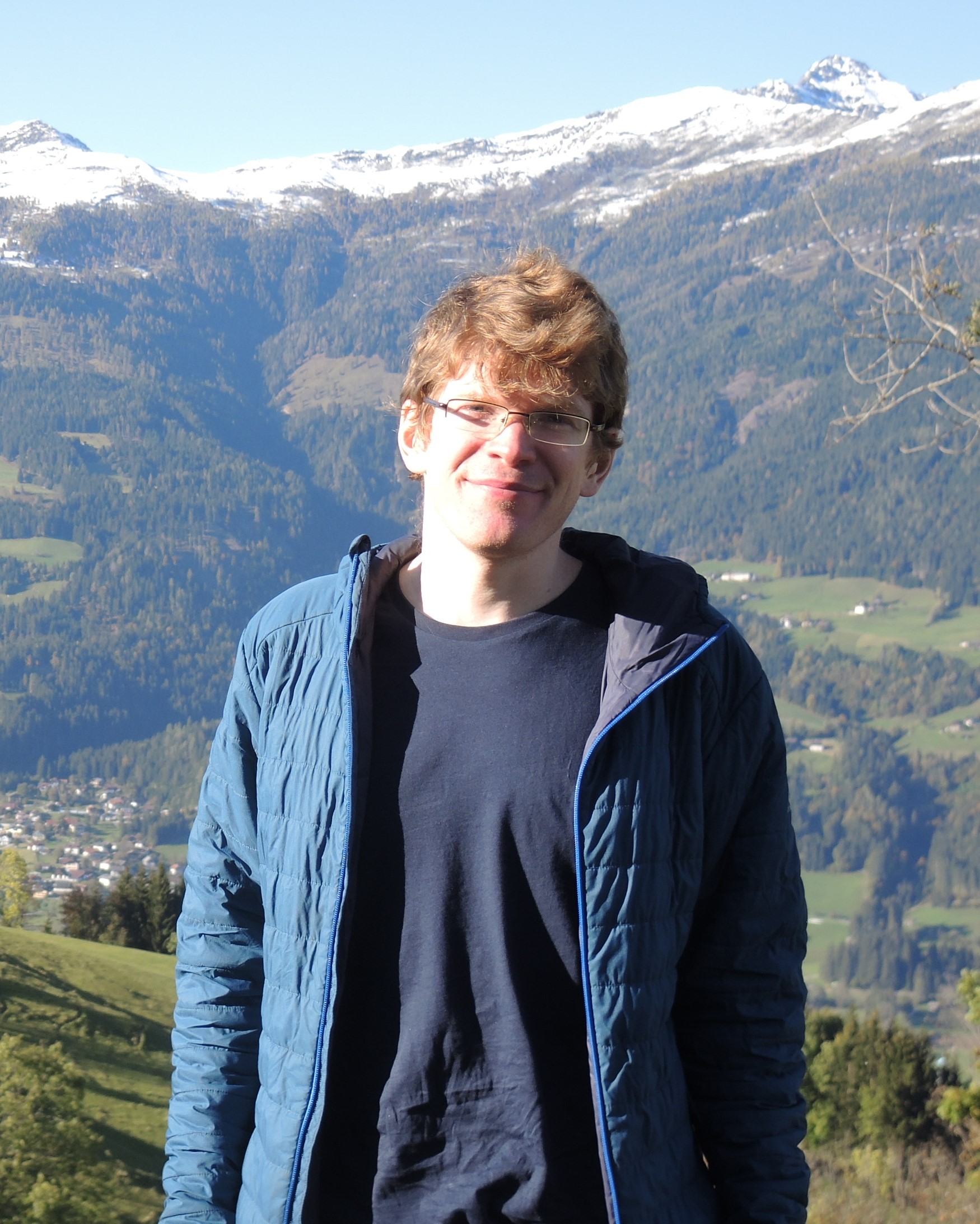
Dan Petersen is a Professor of Mathematics at Stockholm University, specializing in the intersection of algebraic geometry and algebraic topology with a focus on moduli spaces. His research explores topics such as cohomology theories, homological stability, and geometric structures. He has advised PhD students including Erik Lindell, Louis Hainaut, Josefien Kuijper, and Oliver Lindström. His work frequently intersects with geometric topology, number theory, and representation theory, as seen in his recent publications on handlebody groups, Mumford conjectures, and configuration spaces. Collaborations with postdocs such as Johan Alm, Marcel Rubió, and Sylvain Douteau highlight his involvement in advanced research networks. His contributions to algebraic structures and topological methods have advanced understanding in both pure and applied mathematics contexts.
Georg Oberdieck is an Associate Professor in the Department of Mathematics at KTH Royal Institute of Technology in Stockholm, Sweden. His research focuses on algebraic geometry with particular emphasis on K3 surfaces, holomorphic-symplectic varieties, and enumerative geometry. He maintains an active research program with numerous collaborations across international institutions. Dr. Oberdieck's research interests center on the intersection of algebraic geometry and mathematical physics. His work explores deep connections between curve counting theories (Gromov-Witten and Donaldson-Thomas invariants), modular forms, and holomorphic-symplectic geometry. He has made significant contributions to understanding the structure of Hilbert schemes of points on K3 surfaces, elliptic fibrations, and hyperkähler varieties. His research often reveals surprising connections between seemingly disparate areas of mathematics, particularly through the lens of string theory-inspired mathematics. Analysis of his recent publications reveals a strong focus on holomorphic anomaly equations, which provide recursive structures for computing higher-genus invariants. His work demonstrates how these equations connect enumerative geometry with the theory of modular and Jacobi forms. He has extended these connections to new geometric settings including holomorphic symplectic 4-folds and Enriques surfaces. His research shows consistent development of computational frameworks for curve counting invariants across increasingly complex geometric contexts. Dr. Oberdieck actively mentors graduate students, with Maximilian Schimpf listed as his PhD student. He has organized several research seminars including the Algebraic Geometry, Physics, Gromov-Witten theory Seminar (2020-2022) and the Moduli and Representation Theory seminar at MSRI in Spring 2018. His teaching portfolio includes advanced courses on K3 surfaces, Gromov-Witten theory of hyperkähler varieties, and Algebraic Stacks. He has been involved in organizing multiple workshops and conferences, most recently the Workshop on Enumerative geometry of moduli spaces of sheaves at KTH in September 2023. His collaborative network spans numerous institutions across Europe and North America, reflecting the international nature of modern mathematical research in his field.