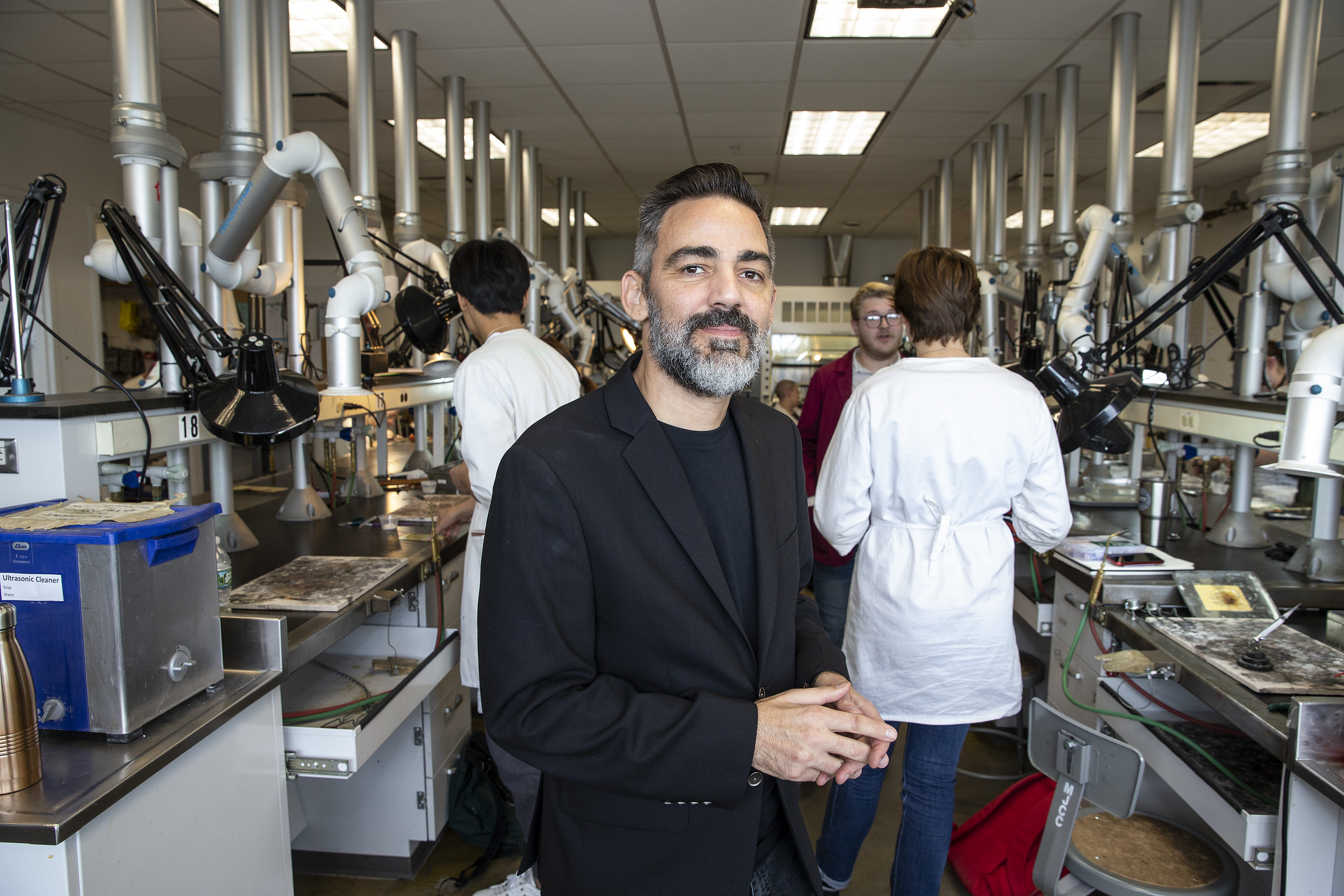
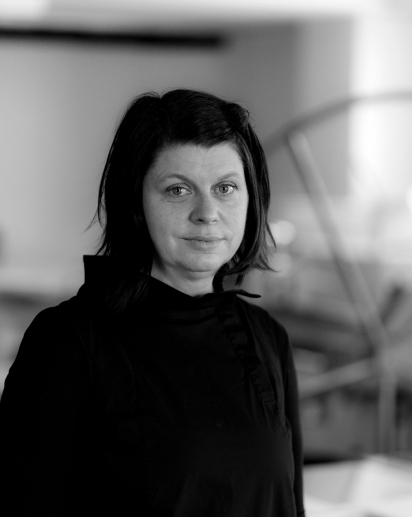
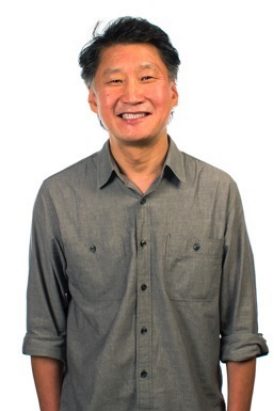
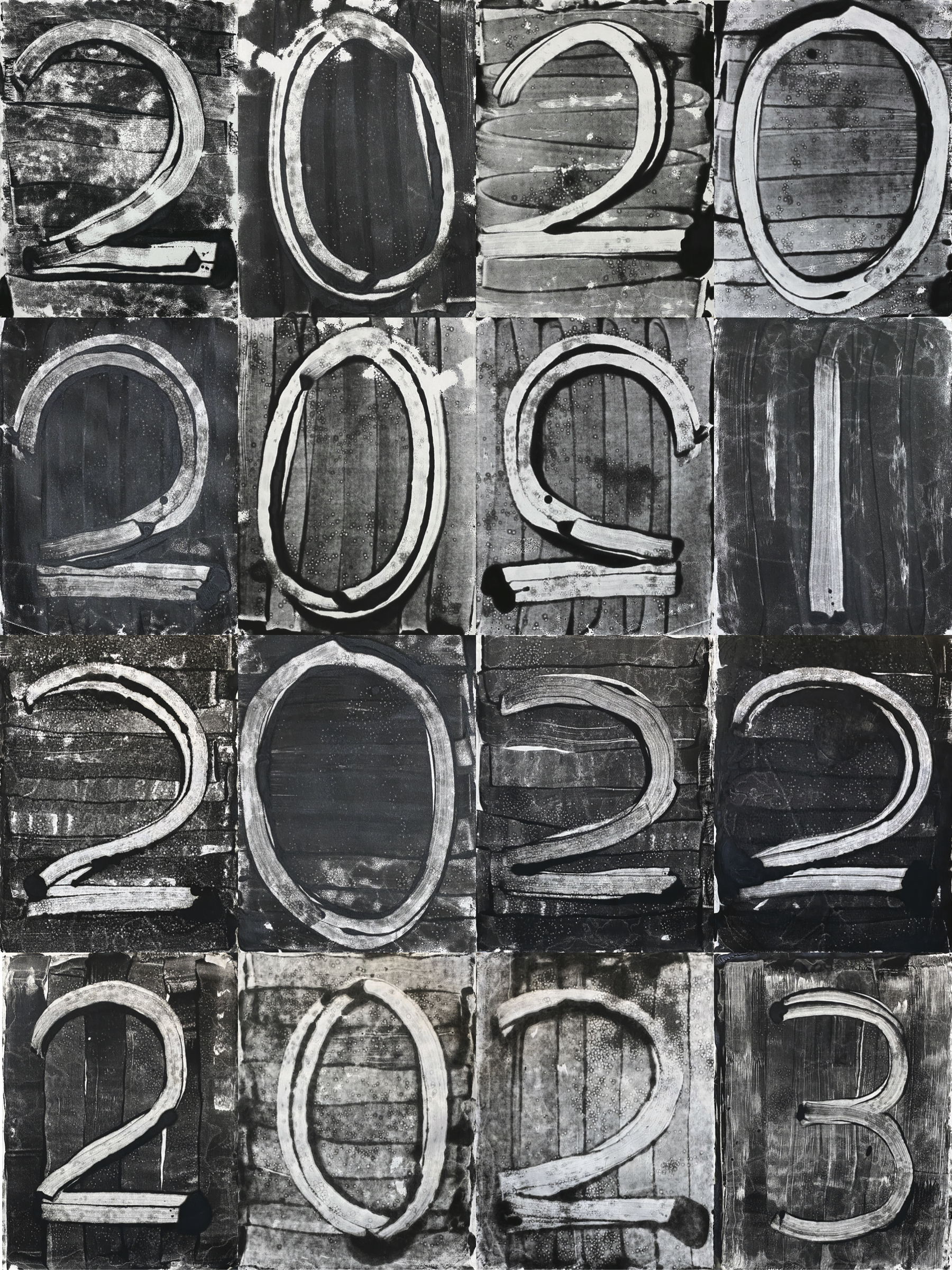
Doug Bucci is an Assistant Professor and Program Head of Metals/Jewelry/CAD-CAM at Tyler School of Art and Architecture, Temple University. His work merges digital technologies with traditional metalworking to explore biological systems and the impact of disease on the human body, informed by his lifelong experience with diabetes. MFA, Tyler School of Art and Architecture, Temple University (1998) BFA, University of the Arts (1994) Bucci’s research focuses on creating wearable art that visually translates complex biological data and medical narratives. His 2021 installation The Last Course examines the tension between indulgence and mortality through an 18th-century-inspired dessert table, while earlier works like the Islet Series and Mellitus investigate cellular structures and diabetic experiences via CAD-CAM processes. His artistic output includes commissions such as Breakthrough T1D and curated exhibitions like Decorative Digitalism . Bucci’s pieces are featured in major collections including the Philadelphia Museum of Art and the State Hermitage Museum. His practice emphasizes creative freedom through digital fabrication, contrasting with traditional handmade methods.
Eric Handman is an Associate Professor at the University of Utah's Department of Modern Dance since 2014, with prior academic positions at the same institution from 2003-2014. He holds an MFA from the University of Utah (2003) and BA in English from Skidmore College (1991). As a choreographer and educator, he has created works for companies across the United States and performed internationally with New York-based dance groups including Doug Varone and Dancers, Nicholas Leichter Dance, and Joy Kellman and Company. His research focuses on Choreographic thinking and mobile technology integration Contemporary dance criticism and theory Contact improvisation pedagogy Interdisciplinary performance systems Eric's choreographic works from 2016-2024 demonstrate Exploration of ecological themes through 'greenland' (2023) Philosophical inquiry in 'The Cause of Itself' (2024) Archival experimentation in 'The Weight of Dust' (2018) Mythological reinterpretation in 'Galatea Prime' (2018) Academic recognition includes Fulbright Specialist designation (2013) Pretty Creatives International Choreography Competition winner (2014) New Visions Choreography Competition winner (2014) Professional leadership roles encompass Board membership at American College Dance Association Previous directorship at Congress on Research in Dance His teaching extends to international venues in technique, composition, and improvisation.
Prof. Achim Stahl serves as University Professor and Chair at RWTH Aachen University, where he directs JARA-FAME (Jülich Aachen Research Alliance - Fundamental Forces and Particle Physics) and leads the 3rd Physics Institute B with approximately 70 scientists, engineers, and administrators. His research spans multiple domains of particle physics and experimental physics with significant contributions to major international collaborations including CMS at CERN, JUNO, Double Chooz, and the Einstein Telescope project. PhD in Physics from University of Heidelberg (1993), thesis: 'Installation, optimization and analysis of the ALEPH event trigger and investigation of muonic decays of tau leptons' Diploma in Physics from University of Tübingen (1988) with optimal mark 1.0 Habilitation with book 'Physics with tau leptons' published in Springer Tracts in Modern Physics Prof. Stahl's research spans multiple frontiers of particle physics. His primary interests include neutrino physics (mass hierarchy and CP-violation with experiments like JUNO, T2K, and Double Chooz), gravitational wave detection with the Einstein Telescope project, CP-violation studies through electric dipole moment searches, CMS experiment data analysis with tau leptons, and medical physics applications including radiation therapy and GEANT4 simulations. He has extensive hardware experience in detector development, including trigger systems, PMT readout, calorimeters, and position sensors. His recent publications demonstrate expertise across diverse areas of particle physics, with significant contributions to Higgs boson physics, neutrino oscillations, CP violation studies, and detector development. A substantial portion of his work focuses on the CMS experiment at CERN and the JUNO neutrino experiment, reflecting his leadership in these major international collaborations. His publications show equal strength in theoretical analysis and experimental hardware development, particularly in trigger electronics and precision measurement systems. While specific awards aren't detailed in the available information, Prof. Stahl has achieved an h-index of 120, reflecting significant impact in his field. His leadership roles include membership on the executive board of JUNO and serving as speaker of the DFG research unit FOR 2319 'Bestimmung der Massenhierarchie mit dem JUNO-Experiment'. Prof. Stahl has supervised numerous students throughout his career, including 20 theses that led to 11 OPAL papers during his time at the University of Bonn. He coordinates national activities on the Einstein Telescope and is deeply involved in multiple neutrino projects. His research is supported by significant grants enabling participation in international collaborations and hardware development for major experiments. His team has developed innovative detector technologies including integrated PMT readout systems and trigger electronics for neutrino experiments. As director of the 3rd Physics Institute B at RWTH Aachen, Prof. Stahl leads a substantial research group focused on fundamental physics questions. He is a founding member and current director of the JARA section FAME, which focuses on CP-violation and the matter-antimatter asymmetry in the universe. His team is actively developing technologies for the Einstein Telescope project, contributing to the JUNO neutrino experiment, conducting research with the CMS experiment at CERN, and applying particle physics techniques to medical applications.
Costanza Julia Bani is an Associate Professor in Film and Media Production at the Stockholm University of the Arts (SKH) and a Researcher at the Division for Media Technology and Interaction Design at the Royal Institute of Technology (KTH). She integrates arts, sciences, and technology to advance environmental narratives and redefine the producer's role as a key artist in societal change. Her work spans documentary formats, multimedia installations, and collaborations across disciplines. Academic Affiliation: Associate Professor at SKH Research Affiliation: KTH Her research interests focus on: Environmental sustainability through artistic mediums Art-science-technology integration for social impact Cross-disciplinary collaboration models Impact production linking artistic, scientific, and investor goals Documentary expansion into unconventional venues Costanza's recent projects include Darkness Matters (2024), which explores eco-narratives through flatscreen and installation formats, and After Work (2023), a collaborative documentary examining labor dynamics. Her artistic research is supported by grants and international networks like EAVE, TFL, and Sundance. Notable scientific awards and affiliations: EAVE graduate program Cannes Producer's Network participant TFL Alumna Sundance Grantee Circle Doc Accelerator partaker She actively fundraises for research hubs, including postgraduate programs and international training groups, and co-founded Fellonica Film in 2023 to produce climate-related films. Her work has premiered at festivals like CPH:DOX and Visions du Réel.
Kjetil Falkenberg is an Associate Professor at KTH Royal Institute of Technology , affiliated with the Division of Media Technology and Interaction Design . He leads the Music For All thematic group and contributes to interdisciplinary research bridging music technology, accessibility, and rehabilitation. Education: Docent in Media Technology (Södertörn University, 2015), Pedagogy for Higher Education (KTH, 2014), Doctor of Technology in Speech and Music Communication (KTH, 2010), Master in Musicology (NTNU, 2000), Bachelor in Teacher Education (Høgskolen i Sør-Trøndelag, 1999) His research focuses on music technology for accessibility , sonification in rehabilitation , interactive sound installations , and inclusive music education . He develops systems for cochlear implant users, wheelchair training, and collaborative music-making for individuals with disabilities. Recent publications emphasize web-based audio tools , soundscapes in retail , and playful interaction design . He has co-chaired multiple international conferences and served on the jury for Utställningen Unga Forskare. Scientific Awards: Co-chair, Sound and Music Computing Conference (2023) Co-chair, International Sonification Workshop (2019) Co-chair, Sample Music Society Jury member, Utställningen Unga Forskare Kjetil supervises doctoral students in social robotics sonification , virtual acoustics , and music notation systems , alongside numerous master's and bachelor's projects in accessible design and sound technology.
Tricia Treacy serves as Professor and Chair of the Department of Studio Art at Dartmouth College in Hanover, New Hampshire, bringing over twenty years of experience in art and design education previously held at Appalachian State University, The University of the Arts, University of Delaware, and University of Pennsylvania. Her academic foundation includes a B.A. from West Virginia University and an M.F.A. from The University of the Arts. Treacy's creative practice operates at the intersection of print media, installation, and artist books, deliberately blurring boundaries between art and design, craft and technology, human and machine, memory and tradition. Her work extends the book as an art dissemination medium through participatory and interdisciplinary frameworks, often incorporating collaborative methodologies and technological interventions. Recent projects like The unfolding library (2025) and Poster, performed (2023) reveal evolving trends toward algorithmic collaboration, time-based explorations, and audience participation within book arts. These works consistently investigate privacy thresholds, structural repetition, and environmental patterns using hybrid analog-digital techniques that bridge Roman urban landscapes with contemporary design systems. Her distinguished recognition includes: DesignInquiry Fellow (2015) Cynthia Hazen Polsky and Leon Polsky Rome Prize in Design (2017) Treacy has secured significant research funding including a Center for Craft, Creativity & Design grant for Technographic Workshops and a Hopkins Center Art Integration Grant for Poster, performed . Through courses like Senior Seminar and Printmaking 1-3, she mentors emerging artists while leading departmental initiatives. Her collaborative networks span Shift-lab, The Phonografik Collectivo, and international partnerships with artists like Arzu Ozkal and Denise Bookwalter, with upcoming PST ART performances extending her experimental investigations into algorithmic creativity.
Y. David Chung is a Professor at the Stamps School of Art and Design at the University of Michigan, where he also serves as Director of the MFA Graduate Program. He is additionally Core Faculty at the Nam Center for Korean Studies and was a Michigan Faculty Fellow at the Institute for the Humanities in 2009-10. In 2013, he held the position of Kim Koo Visiting Professor at Harvard University. Chung received his M.F.A. from George Mason University in 2002 and his B.F.A. from the University of Virginia, the Corcoran College of Art and Design in 1988. As a visual artist and filmmaker, Chung's work explores Korean American identity, cultural memory, and diaspora experiences through various mediums including film, multimedia installations, drawings, prints, and public artworks. His artistic practice combines traditional techniques with new digital imaging technologies, creating works that bridge cultural divides and examine historical narratives. His research particularly focuses on the Korean diaspora experience, with significant attention to the Koryo Saram (Koreans of Central Asia) who were forcibly deported by Stalin in 1937. Chung's artistic output over the past two decades demonstrates a consistent engagement with themes of cultural identity, memory, and displacement. His work has evolved from traditional printmaking and drawing to incorporate video, digital media, and large-scale installations, often addressing the Korean American experience and broader issues of migration and cultural adaptation. His documentary film work, particularly 'Koryo Saram, The Unreliable People,' represents a significant contribution to understanding the historical experiences of Koreans in the former Soviet Union. National Endowment for the Arts Fellowship Lila Wallace Reader's Digest Fund-Artist at Giverny Fellowship Best Documentary Award from the National Film Board of Canada (2007) Washington Mayor's Art Award Helmut K. Stern Professorship, Institute for the Humanities Korean American Alliance Artist Award Professor Chung has received significant grant support for his artistic work, including funding from the Office of the Vice Provost for Research at the University of Michigan for projects like 'Pyongyang' and the 'Koryo Saram Project.' He has also been supported by the National Endowment for the Arts, the MidAtlantic Arts Foundation, and the Artslink Foundation for collaborative projects in Kazakhstan. His work has been commissioned for public art installations including the Rosslyn Metro Station in Virginia and the New York City Public Art Program. Chung has served as Artist-in-Residence at numerous institutions including Duke University, Williams College, Wellesley College, and the University of California Berkeley.
Luísa Santos Silva is an Assistant Professor and Assistant Researcher in Culture Studies / Artistic Studies at the Faculty of Human Sciences (FCH-Católica) of Universidade Católica Portuguesa. She holds a Ph.D. in Culture Studies from Humboldt & Viadrina School of Governance and an M.A. in Curating Contemporary Art from the Royal College of Art. Her research focuses on contemporary art and social systems, curating practices, and cultural institutions. Luísa coordinates the 4Cs: From Conflict to Conviviality through Creativity and Culture research initiative and is a research fellow at the European School of Governance (EUSG). She contributes to editorial boards of journals like Estúdio and Croma , and collaborates on projects such as the York University’s Arts-based participatory research on Asian-Canadian youth identities. Her academic roles include teaching modules like Curatorial Cultures and Management of Cultural Projects . Key publications include works on curatorial practices, art and society intersections, and exhibitions such as Silence in Pieces and Miguel Palma: A-Z .
Toby Sisson is an Associate Professor of Visual and Performing Arts at Clark University, specializing in drawing, painting, printmaking, and curatorial projects. She holds a B.F.A. from the College of Visual Arts (Minnesota) and an M.F.A. from the University of Minnesota, Twin Cities. Her work explores race, identity, and hybrid cultural traditions through abstract forms and encaustic techniques. Sisson has exhibited internationally, including at the Worcester Art Museum, Provincetown Art Association, and Teda Contemporary Art Museum in China. She has been recognized with awards such as the Hodgkins Prize (2011) and Hayden Fellowship (2015), and thrice nominated for Clark’s Outstanding Teacher of the Year. Education: B.F.A., College of Visual Arts, Saint Paul, MN (2003) M.F.A., University of Minnesota, Twin Cities (2009) Research Interests: Abstract art’s role in societal dialogue, race and ethnicity, material experimentation, and community-based art. Awards & Grants: Individual Creative Research Grant (Higgins Institute, 2025–2026) Faculty Development Grant (Clark University, 2025–2026) Center for the Study of Race and Ethnicity in America (Brown University, 2023) Teaching & Mentorship: Courses include Drawing, Painting, Studio Topics, and Contemporary Directions. She advises student projects and fosters inclusive pedagogy. Labs/Teams: Director of Clark’s Studio Art Program (2015–2024), member of the Dark Room research cluster, and board member of ArtsWorcester.
Joseph Watson is a Lecturer in Music at the University of Sussex's School of Media, Arts and Humanities. He holds a PhD in Musical Composition (University of Sussex), an MA in Music (Sussex), a BA in Music (Middlesex University), and a PGCE in Post-compulsory Education (University of Brighton). His research focuses on electronic music processes using non-digital technologies like modular synthesis and analogue tape, exploring themes such as performativity, cybernetics, and corporeal engagement. Watson is a member of Stereolab, engineering their last three albums, and has released solo work under Junior Electronics. Research interests include music technology, modular synthesis, tape composition, cybernetics, and plant intelligence. His publications analyze analogue studio practices, transduction in performance, and live interfaces. No scientific awards mentioned. His artistic collaborations and teaching span university and post-compulsory education contexts.
Professor Anne Volvey is affiliated with the Université d'Artois, within the Faculty of History, Geography, and Heritage Studies, Department of Geography. A graduate of the École Normale Supérieure Fontenay-Saint-Cloud, she holds a PhD in Geography from Sorbonne University (2003) and a Habilitation from Université Lyon 2 (2012). Her research bridges art and geography, focusing on spatial turn epistemology, fieldwork methodologies, and relational paradigms. She explores art’s spatial dimensions, emotion in geographical inquiry, and the aesthetic regimes of knowledge. Volvey has authored/co-edited numerous books and articles, including works on Land Art and contemporary art practices. She coordinates interdisciplinary projects like 'Esthétiques des savoirs spatiaux' and advises doctoral students on topics like artistic spatiality and environmental psychology. Her administrative roles include directing the EA2468 'Discontinuités' research unit and serving on international editorial and evaluation boards. Key contributions include redefining geographical methodologies through art and emotion, and advancing theoretical frameworks in spatial epistemology.
Theresa Jean Tanenbaum is an Associate Professor in the Department of Informatics at the University of California, Irvine. Her research focuses on digital interactive narrative (DIN), transformative play, and embodied interaction design. She explores how participatory storytelling and game mechanics can foster empathy, identity transformation, and social justice. Her work combines theatre techniques, HCI principles, and tangible interfaces to create immersive experiences that challenge societal norms. Professor Tanenbaum leads a multidisciplinary lab developing projects like Shiva's Rangoli (tangible storytelling installations) and the Reading Glove (combinatorial narrative systems). Her design philosophy integrates physical/digital hybrid systems to enable role-playing and perspective-taking. She emphasizes the ethical implications of technology, advocating for marginalized communities through inclusive design practices. Her activism extends into academic advocacy, notably pushing publishers to allow transgender scholars to correct their names in publications. Her research spans over two decades, with contributions to conferences like ICIDS and journals in HCI. She teaches courses on game design, interactive storytelling, and design fiction. Collaborative projects with artists and engineers highlight her commitment to bridging theory and practice.
Robert F. Nideffer is a Professor of Arts at Rensselaer Polytechnic Institute (RPI). He holds a MFA in Computer Arts and a Ph.D. in Sociology (Media Studies) from the University of California, Santa Barbara. Previously, he held positions at the University of California, Irvine (UCI), including Co-Director/Director of the Arts Computation Engineering (ACE) Graduate Program and founder of the Game Culture & Technology Lab. His affiliated roles include a courtesy appointment in Informatics and membership in the Visual Studies Program at UCI. Education: MFA in Computer Arts (UCSB), Ph.D. in Sociology (UCSB) Key Affiliations: ACE Program (UCI), Game Culture Lab (UCI) His research focuses on digital media, game studies, virtual environments, and technology's cultural impact. Notable projects include the Reanimated installation, WTF?! SDK game engine, and 12 Years in Azeroth , an ongoing digital memoir of World of Warcraft immersion. Nideffer has secured over $1M in grants for projects like DICE (collaboration portal) and Dino Quest Online (educational game). His work has been featured in prestigious exhibitions including the Whitney Biennial (2002) and Biennale of Electronic Arts. Current research explores game design, interface theory, and the intersection of technology with human behavior. Grants include: DICE ($100k), Dino Quest Online ($300k), and Shift+Ctrl exhibitions ($250k+).
Dr David Overend is a Lecturer in Interdisciplinary Studies and Programme Director for the MA(hons) in Interdisciplinary Futures at the Edinburgh Futures Institute (EFI), University of Edinburgh. His research bridges interdisciplinary education, contemporary art, and performance. He has directed award-winning theatre productions for the National Theatre of Great Britain and other international institutions. Overend’s work emphasizes practice-as-research, blending performance art with urban exploration and pedagogical innovation. His recent projects include the Toolkit for Interdisciplinary Learning and Teaching (TILT) , funded by the Principal’s Teaching Award Scheme, and the Entanglements event series within the Present Futures Festival. He co-authored Performance in the Field: Interdisciplinary Practice-as-Research (2023) and Making Routes: Journeys in Performance 2010-2020 (2021). His research explores themes like postdigital learning, relational performance, and urban spatial practices. Overend actively engages in public-facing initiatives such as the Edinburgh Festival Fringe, where he participated in the 'Stop Being Disciplined!' cabaret. His work often interrogates the intersections of education, environment, and mobility through collaborative, interdisciplinary frameworks.
Dr Nicholas Ferguson is a Professor of Art and Environmental Cultures at the School of Liberal Arts, Richmond the American University in London. He holds a PhD from Goldsmiths, University of London, and is a Senior Fellow of the Higher Education Academy. His work bridges art, activism, and environmental thought, focusing on spatial politics, urban ecologies, and the role of art in global socio-environmental discourse. Research interests include art’s role in spatial politics, cultural policy, curatorial practices, and the intersections of art with activism, ecology, and political theology. His projects often involve interdisciplinary collaborations, as seen in Air Matters Learning from Heathrow , which explored Heathrow Airport’s cultural and environmental impacts through art, science, and philosophy. Teaching spans art theory, visual culture, and research methodologies, emphasizing accessibility and interdisciplinarity. He has led pedagogical initiatives, including community-centered curricula and degree validation processes. Recent publications and conference contributions address mobility paradigms, airport geographies, and post-pandemic urbanism. Key awards include Senior Fellow of the Higher Education Academy and Fellow of the Higher Education Academy. His work has been exhibited internationally, including at Watermans Arts Centre, Maraya Art Park (Sharjah), and the Stanley Picker Gallery. Ferguson actively engages in public outreach, such as workshops on art and environment with schools and communities.