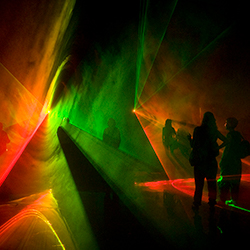
Edwin van der Heide is a part-time Lecturer and researcher at Leiden University, affiliated with the Leiden Institute of Advanced Computer Science (LIACS) and the Academy for Creative and Performing Arts (ACPA). His work bridges sound, space, and interaction through installations, performances, and environments. Key roles include: Co-head of ArtScience Interfaculty (Royal Conservatoire & Royal Academy of Art, The Hague) until 2016 Edgard Varèse Guest Professor at TU Berlin (2009) Invited artist at Le Fresnoy (France) and HKB Bern University of the Arts (2019) Research Interests: Spatial sound composition, audience interaction, interdisciplinary art, and the intersection of technology with auditory perception. Notable projects include Whispering Wind (permanent installation at Leiden University) and Spiral of Time (MACBA, Barcelona). Recent Articles & Exhibitions (2023–2024): Focus on large-scale installations like Pneumatic Sound Field and Spiral of Time , emphasizing public engagement and spatial acoustics. Awards: Witteveen+Bos Art+Technology Award (2009), Best Paper Award for BAI (摆) (2018). Grants & Labs: Collaborations with institutions like NCCA (Russia), MAXXI (Italy), and involvement in projects like Evolving Spark Network (global sound art initiatives).
Anna Abrahams is a Senior Programmer Artist Film and Artistic XR at Eye Filmmuseum in Amsterdam and teaches Moving Image at the Royal Academy of Art, The Hague, within the Photography department. She has been active in experimental film since 1989 as a co-founder of Rongwrong, an independent production foundation. Education: Studied film theory at the University of Amsterdam. Her research and practice focus on experimental film, virtual reality (XR), and moving image art. She bridges traditional film techniques (35mm, 16mm) with digital innovations, emphasizing immersive storytelling and artistic exploration of landscapes, urban spaces, and sociocultural themes. The films she has directed or co-directed, spanning 1995–2022, explore topics like psychogeography, counterculture, and digital experimentation. Her 2022 VR work Angels of Amsterdam highlights her engagement with extended reality technologies. As a co-author, she contributed to publications including Warhol Films , mm2. Experimental Film in the Netherlands , and film³ [kyü-bik film] , documenting avant-garde film practices and theoretical frameworks.
Dr. Kenneth Gavin is a researcher at the TU Delft , affiliated with the School of Civil Engineering & Geosciences and the Geo-engineering Department. With over 188 research outputs and active involvement in offshore engineering projects, his work focuses on foundation behavior, pile installation mechanics, and soil-structure interaction. Research Interests: Geotechnical engineering, pile foundations, offshore installation methods, soil mechanics, and computational modeling (particularly Coupled Eulerian Lagrangian analysis). In recent work, he has led studies on: Hip hammer impact duration effects on driveability resistance Self-weight penetration modeling with rate effects Centrifuge testing of open-ended pile loading behavior Scientific Awards: TRA Senior Researcher Rail Award (2018) Academic Leadership: Gavin has served on editorial boards for the Canadian Geotechnical Journal (2018-2019) and chaired committees for the International Society for Soil Mechanics and Geotechnical Engineering (ISSMGE). He has also contributed to key conferences including ISFOG 2025 and ALERT Geomaterials Workshop 2018.
Dina Danish (b. 1981, Paris) is an Egyptian-Danish artist and educator working at the intersection of language, historical reinterpretation, and conceptual practice. She holds a Lecturer position at the Fine Arts department of KABK in The Hague and serves as a teaching mentor at the Rietveld Academy, Amsterdam . Guest teaching roles include the Sandberg Institute and American University in Cairo . Education : BA from American University in Cairo; MFA from California College of the Arts (San Francisco) Residencies : Rijksakademie Amsterdam, Spinola Banna Italy, PiST/// Istanbul, A.i.R. Dubai, Affiliated Fellow at American Academy in Rome Her research explores humor, mistranslation, and overlooked historical moments , often through video art, performance, and text-based installations . Key themes include linguistic structures, cultural memory, and Dadaist methodologies . Recent projects examine ancient motifs in contemporary art (e.g., Jean-Baptiste Maitre) and political commentary through playful abstraction . Notable exhibitions at SFMOMA, Stedelijk Museum Schiedam, and Kunsthall Oslo highlight her focus on translation errors, sound poetry, and archival interventions . Volkskrant Award finalist Abraaj Art Prize nominee Illy Present Future Prize recipient Celeste Award nominee Barclay Simpson Award nominee Dina collaborates with institutions like Hotel Maria Kapel and De Nederlandsche Bank , and co-curated a Rijksakademie anniversary exhibition. Her work is represented by galleries in Amsterdam, Milan, and Zurich.
Dr. Dave Murray-Rust is an Associate Professor in Human-Algorithm Interaction Design at TU Delft's Faculty of Industrial Design Engineering. He explores the intersection of humans, data, and AI through design research, focusing on ethical AI systems and sociotechnical interactions. His work bridges computer science, design theory, and digital sociology, addressing challenges like algorithmic fairness and human-AI collaboration. He leads initiatives such as the AI Futures Lab and Data-Centric Design Lab, advancing methods for leveraging behavioral data in design processes. His research emphasizes experiential AI frameworks, metaphors for designers, and the legibility of AI systems. He has been honored with awards including Best alt.HRI 2024 and a CHI 2023 Best Paper Award for contributions to fairness perceptions in algorithmic decision-making. Murray-Rust teaches courses like the Speculative Design Studio and collaborates on projects like DCODE (Designing the Future of AI) and the BrightSky Project. His work extends to public engagement through installations like GeoPact and explorations of blockchain's societal impact. He holds an Honorary Fellowship at the University of Edinburgh.
Bart J. Hengeveld is an Assistant Professor at Eindhoven University of Technology (TU/e), affiliated with the Industrial Design department within the Faculty of Industrial Design. He leads the Future Everyday research cluster, focusing on the intersection of sound design and IoT systems. His work explores how embedded technologies can communicate through sound and tangible interaction in ways that enhance human experience. Education: BSc/MSc in Industrial Design Engineering, Delft University of Technology (2003) PhD in Industrial Design, TU/e (2011), with concurrent training in double bass at Codarts Conservatory Research Interests: Acoustic communication in IoT systems Tangible interaction design Social implications of ubiquitous computing Sound as a medium for human-technology interaction Recent Research Trends: Focus on multimodal interfaces combining sound/light/haptics Studies on sound design for healthcare and smart living environments Investigations into ethical and inclusive IoT soundscapes Awards: Two Teacher of the Year awards at TU/e, reflecting his commitment to pedagogical excellence. Advising & Projects: Supervised 113 student projects including interactive installations like 'Naktis' and 'Sonostapp' Leading the €1.5M 'Role of Sound in Hybrid Work Environments' project (2023–2026) Organized TEI 2016 conference and serves on its steering committee Teams/Labs: Core member of TU/e's Future Everyday cluster, collaborating with multidisciplinary teams on embodied interaction research.
Harm Smit (dr.ir.) is a senior researcher at Wageningen University & Research's Emissions & Manure Valorisation department. With over two decades of experience in agricultural systems, his work focuses on optimizing manure processing technologies, nitrogen dynamics in grasslands, and sustainable biogas production. He leads multiple active projects related to livestock emissions and circular agriculture solutions. Current Projects: KD-2024-087: Hygienization installations for manure KD-2024-077: Alternatives to sulfuric acid in air scrubbers BREF-actualisering: Manure processing regulations Research Domains: Biogas production feasibility analysis Nitrogen fixation in forage systems Grassland productivity modeling Milk fatty acid composition studies Professional Engagements: Keynote speaker at 2025 webinar on Integrated Nutrient Management Presenter at 2024 conference on manure products
Marion Tränkle is an active lecturer at the ArtScience Interfaculty of the Royal Academy of Art, The Hague (KABK), where she coaches students and develops courses on systems thinking and rule-based performance systems. She also serves as a Coach and Industrial Liaison at Eindhoven University of Technology's Department of Industrial Design since 2014, working with Professor Harm van Essen on 'social interactions with shared systems.' Her educational background spans multiple disciplines: PhD from Brunel University London (2012), MSc in Media Technology from Leiden University (2005), BA in Contemporary Dance from Amsterdam School of the Arts (2001), and an Engineer Diploma in Architecture from Technical University Berlin (1993). She has also completed specialized training in Software Engineering (2017/18) and Stage Lighting (2016). Tränkle's research interests center on the intersection of performance art, systems thinking, and technology. She creates work that deliberately negotiates 'the constructive tension between the carefully constructed and generative processes, between risk and responsibility, and between autonomous performance and human intervention.' Her practice integrates computational processes with live-performance, often using electronics, EEG data, and interactive systems to create immersive stage scenarios. She explores how simple rules can generate complex emergent behaviors, drawing from complexity science and computing principles. Her recent creative works demonstrate a consistent exploration of brain-computer interfaces, interactive light systems, and collaborative performance structures. Projects like (un)focussed and BLINK...and sync use EEG data to create real-time visual and auditory experiences, while ON TRACK and TAROT investigate mechanical systems and embodied symbolism through performance. 2nd Prize in the competition for short dance films on Internet 'webdans' (2001) Netherlands Foundation for Visual Arts, Design and Architecture Research/Travel Grant (2010) e-MobiLArt participant, funded EU CULTURE 2007 Programme (2008-09) Brunel University Doctoral Research Scholarship/fee waiver (2007-10) Tränkle actively collaborates with artists, designers, and engineers through collectives like NOW (with Ivo Bol and Roos van Berkel) and previously In Serial. She is a member of the BAU Committee for Amsterdam's independent performance scene. Her teaching philosophy emphasizes that 'making, learning, and teaching are reciprocal processes that flourish best in collaborative, and project-based environments,' which she implements through workshops, seminars, and interdisciplinary courses across multiple institutions in the Netherlands, Germany, and Canada.
Dr. Argyrios Emmanouloudis is a Lecturer at the Erasmus School of History, Culture and Communication, Department of Media and Communication, Erasmus University Rotterdam. His work focuses on digital media, gaming culture, transmedia storytelling, and online communities. Lecturer in Media and Communication Erasmus School of History, Culture and Communication Research Interests include gaming theory, transmedia narratives, social media dynamics, and digital culture analysis. His projects explore how interactive platforms shape collective experiences and storytelling. Selected Publications address topics like Twitch streams as archival practices, narrative construction in fighting games, and transmedia strategies in gaming franchises. Teaching involves 12 courses related to media, communication, and digital culture.
Abel Jansma is a Research Fellow at the Dutch Institute for Emergent Phenomena (DIEP), affiliated with the University of Amsterdam's Institute of Physics (IoP) and Institute of Logic, Language, and Computation (ILLC). His work bridges physics, mathematics, and biology to study emergence, higher-order interactions, and complexity. He holds a unique interdisciplinary background, transitioning from art school to scientific research while maintaining creative projects like origami design and AI culinary applications. Research interests include quantitative mereology, information theory, and causal modelling, with a focus on decomposing systems into parts and interactions. Notable contributions involve applying Möbius inversion techniques to study higher-order effects in complex systems. He explores topics like entropy decomposition, coarse-graining, and interdisciplinary frameworks linking category theory with physics. Additional projects span art-science interfaces: creating Penrose tiling visualizations, developing AI cooking assistants (Autolenghi), and collaborating on bio-design projects (mycorrhizal transplantations). His work often emphasizes visual and conceptual clarity, with outputs ranging from mathematical blogs to physical installations. Active on social media platforms including Twitter and GitHub, he engages in open science and public communication.
Prof. Andrei Metrikine serves as Professor in the Department of Offshore Engineering within the Faculty of Civil Engineering and Geosciences at Delft University of Technology. His research spans structural dynamics, offshore engineering, and renewable energy systems with particular focus on marine applications. His research interests include offshore engineering, structural dynamics of railways and foundations, soil-structure interaction, wave energy conversion, and renewable energy systems. His work integrates analytical modeling, numerical simulation, and experimental validation to address complex challenges in marine environments, particularly concerning dynamics of structures interacting with soils and waves. Recent publications (2025) demonstrate strong emphasis on offshore energy applications, including development of the HAMS-MREL open-source solver for hydrodynamic analysis, investigation of instability mechanisms in high-speed transportation systems, and optimization of wave energy converter arrays. His research trends show increasing focus on renewable energy integration and environmental compatibility of offshore installations. He received the David Hislop Award in 2022 for contributions to sand dynamics, 3D FE modeling, and lateral stiffness analysis. Prof. Metrikine has supervised 28 students and led significant projects including VALID (Verification through Accelerated testing Leading to Improved wave energy Designs, 2020-2023). He served as Editor-in-Chief of the Journal of Sound and Vibration (2018-2020) and editorial board member for the International Journal of Railway Technology (2018-2019). He directs the Marine Renewable Energies Lab (HAMS-MREL), developing open-source computational tools for hydrodynamic analysis of marine renewable energy systems and offshore structures.
Dr. K.G. Gavin is a Professor at Delft University of Technology's Faculty of Civil Engineering and Geosciences, specializing in Geo-engineering. He leads research in geotechnical engineering, with a focus on offshore foundations, pile dynamics, and soil-structure interaction. His work integrates experimental testing (e.g., centrifuge models) and numerical simulations to address challenges in pile installation, driveability, and seismic response of offshore structures. Research interests include pile design in sand and clay, suction piles, drag anchors, and glauconite soils. He contributed to projects like the InPAD and SICMOG initiatives, advancing understanding of monopile behavior and installation techniques. His editorial roles for Canadian Geotechnical Journal and leadership in ISSMGE reflect academic influence. Notable recognition includes the 2018 TRA Senior Researcher Rail Award. Education: Details not explicitly provided in text. Key Projects: Rhizome (autarkic design for off-Earth habitats), InPAD (pile axial capacity), SICMOG (monopile installation in glauconite soils). Lab/Teams: Collaborates with TU Delft's geotechnical centrifuge and field testing groups. Recent publications (2025) highlight advancements in hammer impact analysis, clay stiffness effects on offshore piles, and installation stress impacts. His work bridges geotechnical innovation with sustainable infrastructure solutions for offshore wind energy and seismic resilience.
Coralie Vogelaar is an interdisciplinary artist and lecturer at the ArtScience Interfaculty , affiliated with Leiden University . Her work bridges behavioral science with artistic practice, focusing on human-machine relationships through algorithmic systems and biometric data. 2021 Prix de Rome nominee Collaborates with experts in data analysis, choreography, and sound design Exhibited at Stedelijk Museum Amsterdam, ZKM Karlsruhe, and Science Gallery Dublin Her research explores: Power dynamics in responsive technologies Biometric data translation into sensory experiences Algorithmic biases in image recognition systems Human compliance with fitness-machine hybrids Technical collaborations with V2_Lab , TU/e Innovation Space , and Digital Methods Initiative demonstrate her cross-disciplinary approach. Works utilize Teachable Machine , SuperCollider , and facial action coding systems to interrogate digital-physical interfaces. Scientific Recognition: Nominated for Prix de Rome (2021) Featured in V2_ Lab's 40-year retrospective
Dr. Annemarie Kok is a Postdoctoral Researcher at the University of Groningen's Faculty of Arts, Department of Art History. She specializes in participatory and ephemeral art forms, with a focus on the 1960s–1970s and their legacy. Her research integrates Actor-Network Theory to explore how audiences and materials co-create art. She lectures on modern/postmodern art, media art, and art historiography, with academic affiliations including Utrecht University and the Willem de Kooning Academy. Education: Art History degrees from Utrecht University with minors in Museum Studies (University of Amsterdam) and European studies (Freie Universität Berlin/Humboldt Universität). Publications include "Kunstkritiek in een tijd van vervagende grenzen" (2016) and peer-reviewed articles on participatory art archives and ephemeral heritage. Current projects include documenting the 1972 Waterwalk Tube installation and tracing its participants. Research Interests: Modern/contemporary art, participatory practices, socially engaged art, performance art, archival methodologies, and Dutch art criticism. Activities: Organized events like the Winterschool on Intangible Cultural Heritage (2024) and the Letterenfestival (2024). Media engagement includes a 2023 campaign seeking participants in the Waterwalk Tube project.
David Gauthier is an Assistant Professor in the Department of Media and Culture Studies at Utrecht University's Humanities Institute for Cultural Inquiry. He bridges transdisciplinary research between computational studies, media art, and cultural analysis, with a focus on human-centered artificial intelligence. PhD in Cultural Analysis (University of Amsterdam) Media Arts and Sciences (MIT) Mathematics (Université du Québec à Montréal) His research explores computation as a performative locus through software studies, computational diagnostics, and media philosophy. Key areas include software execution theory, digital archaeology, and creativity post-automation. His artistic practice intersects with academic scholarship, producing commissioned works across Europe and North America. Recent publications interrogate computational processes in Executing (MIT Press) and Coding/Decoding the Archive (Routledge), while artworks like B42 (Surrogate) investigate material computing. Collaborations include the Voice of Machine Theft project with Anna Poletti. Scientific affiliations include: NWO Graduate Programme Fellowship ERC-funded MeLa* project researcher MIT Media Laboratory assistant Hexagram Institute research associate He previously held academic roles at the University of Amsterdam and Banff New Media Institute.