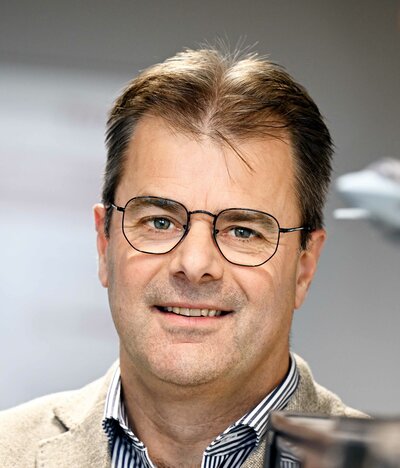
Prof. Gabriele Keller is a Professor of Software Technology at Utrecht University's Faculty of Science. She previously held roles at the University of New South Wales, including Associate Professor (2014–2018) and Senior Lecturer (2001–2013). Her research focuses on functional programming, type systems, high-performance computing, and verification methodologies. Current projects include Accelerate (a parallel computing DSL embedded in Haskell) and Cogent (a systems programming language with formal verification features). Education: PhD in Natural Sciences (Technische Universität Berlin, 1999): 'Efficient Compilation of Nested Data-Parallelism for Distributed Memory Machines' MSc Computer Science (Technische Universität Berlin, 1995) Research Interests: Type systems and correctness guarantees Parallel computing and GPU programming Formal verification of systems software Domain-specific languages for high-performance domains Professional Activities: Co-Chair, IPN Working Group on Equity, Diversity & Inclusion Editor, Journal of Functional Programming Member, IFIP Working Group 2.8 Selected Projects: Accelerate: Optimized parallel computing for Haskell Cogent: Verified systems programming with uniqueness types EmoSTL: Formal verification of game emotion logic
Nico P. Dellaert is an Associate Professor at Eindhoven University of Technology (TU/e) in the Department of Industrial Engineering & Innovation Sciences. His research focuses on quantitative modeling of business processes, with applications in logistics, healthcare operations, and production-inventory control. He has contributed to diverse fields such as sewer system design, insurance claim behavior, and container terminal planning. Education: Mathematics (MSc) from Delft University of Technology; PhD in Production to Order at Eindhoven University of Technology. His prime research interests include integrating capacity and production decisions, city logistics, multimodal transportation, and healthcare planning. He employs mathematical modeling techniques in collaboration with companies and hospitals, emphasizing adaptability and practical implementation. Nico has been recognized with the IIE Transactions Best Paper Award (2012) and the EURO Award for Best EJOR Review Paper (2016). He has directed the International Program in Logistics Management Systems (2002-2011) and led the Health Care Operations Lab within the OPAC group. His teaching portfolio covers inventory control, system dynamics, healthcare logistics, and operations planning. Projects like 'Multi-echelon Inventory Optimization' (2019-2021) and 'Da Vinc3i' (2011-2014) highlight his applied research approach. Collaborations span sectors including healthcare, logistics, and production systems.
Dr. Michael Dienstknecht is an Assistant Professor in the Operations Department at the Faculty of Economics and Business, University of Groningen. Previously, he served as a Post-doctoral Researcher at the Chair of Production and Logistics, University of Wuppertal, Germany (2019-2023), and completed his PhD there in 2014-2019. He holds a Master's degree in Business Administration with a focus on Supply Chain Management (University of Cologne, 2012-2014) and a Bachelor's in Business Administration (University of Cologne, 2009-2012). Education: PhD (2019), MSc (2014), BSc (2012) His research spans Operations Research and Management Science , with a focus on Construction Logistics , Last-Mile Delivery , and Sharing Economy applications. He has developed optimization models for tower crane positioning, drone resupply systems, and sustainable aviation fuel supply chains. Recent work includes dynamic approaches to carsharing demand imbalance and resource allocation in construction projects. Key publication trends center on optimization algorithms , industrial logistics , and sustainable systems . His work intersects with UN Sustainable Development Goals (SDGs) related to climate action and industry innovation.
Alessandro Zocca is an Assistant Professor in the Department of Mathematics at the Vrije Universiteit Amsterdam , where he has been since 2019. His research sits at the intersection of applied probability , reinforcement learning , and network optimization , with primary applications in power systems resilience against climate-driven uncertainties. Education: PhD in Mathematics (2015, Eindhoven University of Technology), Postdoctoral work at Caltech (2017-2019) and CWI Amsterdam (2016-2017) Key Research Themes: Stochastic dynamics on networks, climate crisis impact on infrastructure, optimization under uncertainty Awards: Applied Probability Trust award (2015), NWO Rubicon grant (2017) His recent work focuses on reinforcement learning for grid topology control, two-stage stochastic programming for exponential constraint handling, and Markov Chain Monte Carlo methods for rare-event analysis. He actively supervises five PhD students on topics ranging from weather-driven grid failures to stochastic frequency reserve optimization . Co-author of the textbook Hands-On Mathematical Optimization with Python (Cambridge University Press, 2025), he also organizes the IFIP Performance 2025 conference in Amsterdam.
Meik B. Franke is a Full Professor in Sustainable Process Technology at the Technical University of Dortmund. His research spans chemical engineering optimization, reactive distillation, hybrid separation processes, and sustainable energy systems. Key Affiliations: Technical University of Dortmund, Collaborations with E. Zondervan, K.V. Camarda Research Themes: Ferrofluidic extraction, Biodiesel production, Discrete-event simulation, Algae biorefinery optimization His recent work focuses on integrating MILP with discrete-event simulation and applying AI to chemical process optimization. He has presented at conferences on process optimization challenges in the chemical industry, emphasizing sustainability and energy efficiency. His publications reveal expertise in: Optimization algorithms (Benders decomposition, MILP-DES integration) Distillation and hybrid process design Biorefinery systems for biodiesel and algae-derived products Dynamic process modeling and control Heat integration for energy efficiency AI/ML applications in chemical engineering
Ilke Bakir is an Associate Professor in the Department of Operations at the Faculty of Economics and Business, University of Groningen. She has been part of the faculty since 2018, holding roles as Assistant Professor (2018–2023) and currently as Associate Professor. Her expertise spans Operations Research, Transportation and Logistics, Supply Chain Management, and Stochastic Optimization. Education: Ph.D. in Industrial Engineering, Georgia Institute of Technology (2017) M.Sc. in Industrial Engineering, North Carolina State University (2011) B.Sc. in Industrial Engineering, Bogazici University (2009) Research Interests: Her work focuses on optimizing complex systems in transportation and energy sectors, including fleet management, wind farm operations, and data-driven maintenance strategies. She also explores digital transformation in supply chain logistics and stochastic optimization frameworks. Recent projects include the SMiLES initiative (NWO-funded) and hospital logistics planning under pandemic constraints. Grants & Projects: SMiLES: Shared connectivity in Mobility and Logistics Enable Sustainability (2019–2024) – NWO, TKI Dinalog, Ministry of Infrastructure Hospital logistics in the 1.5-meter society (2020) – ZonMw-funded Advising: Supervises four PhD students focusing on logistics optimization, dynamic service systems, and collaborative carrier networks. Teaching: Courses include 'Introduction to Operations Research', 'Supply Chain Network Design', and 'Supply Chain Analytics' at both BSc and MSc levels.
Alexandra Lassota is an Assistant Professor at Eindhoven University of Technology (Netherlands) since 2023. She holds a PhD in Computer Science from CAU (Germany), advised by Klaus Jansen. Her postdoctoral research included stints at EPFL (Switzerland) under Fritz Eisenbrand and at MPI-INF in Saarbrücken (Germany) with Danupon Nanongkai. Her work focuses on theoretical computer science, particularly integer programming, scheduling, and algorithmic complexity. Education: B.Sc./M.Sc. from Lübeck University (Germany), Ph.D. from CAU (Germany). Her research interests include mixed-integer programming , extension complexity , fixed-parameter tractability , and approximation algorithms . Recent work explores lower bounds for block-structured integer programs and the computational hardness of detecting points in integer cones. Her 2024 publications address topics like separable convex optimization, parameterized algorithms for large-scale integer programs, and aggregation of continuous preferences in AI-driven systems. These contributions highlight her expertise in bridging theoretical foundations with practical algorithmic challenges. Grants: Supported by Swiss National Science Foundation (SNSF), GA ČR, and Einstein Foundation Berlin. Lassota is affiliated with the Combinatorial Optimization group at TU/e and actively contributes to research in discrete mathematics and computational complexity.
Mathijs M. de Weerdt is a Full Professor of Algorithms for Planning and Scheduling and head of the Algorithmics Group at TU Delft's Faculty of Electrical Engineering, Mathematics and Computer Science (EEMCS). His research focuses on robust, scalable, and multi-agent planning techniques for energy systems, transportation, and logistics. He holds a PhD from TU Delft (2003) and BSc/MSc from Utrecht University (1998). Key research areas include stochastic scheduling, multi-agent pathfinding, energy transition algorithms, and railway optimization. He leads projects on smart grid scheduling, train unit shunting (TORS simulator), and AI-driven energy market design. Notable awards include the 2016 Erasmus Energy Science Award and 2015 Best Teacher Award at TU Delft. Over 196 publications span conferences like AAAI, AAMAS, and journals in Operations Research. Supervised 15 PhD students, with 9 completed. Active in industry collaborations (NS Railways, Alliander), advisory roles (Dutch Rail Scientific Board), and initiatives like the Center for Energy System Intelligence (CESI). Teaching roles include Algorithm Design, Probabilistic AI, and leading the TU Delft AI Initiative's education efforts. Developed open-source tools like B-FELSA (flexible load scheduling benchmark) and TORS (railway shunting simulator).
Dr. Nicky van Foreest is an Associate Professor at the Faculty of Economics and Business , University of Groningen. His research bridges probability theory and optimization , focusing on applications in manufacturing, inventory, queueing, and service processes. His 15 most recent articles explore computational methods in probability, recursion, and entropy (e.g., Solving Wordle with Entropy ), geometric properties (e.g., Sagemath Proofs for Three Circles ), and stochastic system analysis (e.g., Memoryless Excursions ). He develops educational materials and open-source software, including contributions to stochastic_or and sicm_sagemath . Contact: n.d.van.foreest@rug.nl | University Profile | Personal Homepage .
Evert Bosdriesz is an Assistant Professor in Bioinformatics at the Department of Computer Science within the Faculty of Science at Vrije Universiteit Amsterdam. He also serves as a guest researcher at the Netherlands Cancer Institute. His research focuses on computational approaches to understand signal transduction networks in cancer, leveraging novel single-cell technologies and integrating statistical and mechanistic modeling to bridge top-down bioinformatics and bottom-up systems biology. He holds a PhD in Systems Biology (2015) from Vrije Universiteit Amsterdam and a Master's in Theoretical Physics (2009) from the University of Amsterdam. Education background includes a PhD in Systems Biology (2009-2014) under Professors Bas Teusink and Frank Bruggeman, followed by a postdoc in Computational Cancer Biology at the Netherlands Cancer Institute under Lodewyk Wessels. He teaches courses including 'Introduction to Bioinformatics' and contributes to the BioSB Education Committee. Research interests emphasize cancer biology, computational modeling of drug responses, and single-cell technologies. His work explores mechanisms of drug resistance and identifies novel therapeutic strategies using network reconstruction and multi-drug combination approaches. Collaborations span international institutions, with a focus on translational oncology and systems pharmacology. Teaching responsibilities include foundational bioinformatics courses and supervising research projects in bioinformatics and systems biology. His lab actively develops computational tools for analyzing signaling networks and integrates multi-omics data to understand cancer heterogeneity.
Joost Berkhout is an Assistant Professor at the Department of Mathematics , Faculty of Science , Vrije Universiteit Amsterdam. His work focuses on stochastic optimization, operations research, energy systems, and healthcare logistics. He contributes to UN Sustainable Development Goals related to affordable and clean energy and responsible consumption. Research interests include Markov chains, stochastic programming, network analysis, and simulation applications in energy transitions and healthcare operations. His recent work addresses ship design optimization for energy transitions, adaptive budget allocation in home healthcare, and feature-based network construction. He has received the Best Student Paper Award (2016) and leads projects like AI-BIPTO (AI-boosted production/transport optimization). He teaches courses such as Business Simulation and Introduction to Business Analytics, and has supervised 2 PhD theses.
Dr. Marjan van den Akker is an Associate Professor in the Department of Information and Computing Sciences at Utrecht University, holding a joint position with KLM through the KickstartAI program. Her research focuses on the intersection of Operations Research and Artificial Intelligence, emphasizing robust planning algorithms, simulation, and optimization for public transportation and energy networks. She earned her PhD in Mathematics from Eindhoven University of Technology, specializing in scheduling and resource allocation. Marjan leads the Computing Science master program and teaches 'Optimization for Sustainability.' She co-directs the Utrecht AI & Mobility Lab and Robust Rail Lab, and serves as President of the Dutch Operations Research Society (NGB). Her work bridges academia and industry, collaborating with partners like KLM, TenneT, and NS to address real-world challenges in logistics, energy systems, and rail operations. Key contributions include airline recovery algorithms, energy-constrained scheduling, and robustness metrics for stochastic systems. Her research has been published in top journals/conferences such as Journal of Scheduling , Computers & Operations Research , and IEEE conferences. Projects include the EU-funded ACDC-ESM initiative analyzing renewable energy systems and the Building Resilient Airline Operations collaboration with KLM.
N. Yorke-Smith is a Professor in the Algorithmics department at Delft University of Technology's Faculty of Electrical Engineering, Mathematics and Computer Science. He leads the STAR Lab, which focuses on integrating machine intelligence with human decision-making processes in complex socio-technical systems. His research spans data-driven optimization, agent-based simulation for urban policy analysis, and uncertainty-aware AI algorithms. Key areas of research include: Combinatorial optimization with real-world applications in logistics and energy systems Agent-based models for urban housing markets and policy evaluation Epistemic uncertainty frameworks for reliable AI decision-making Machine learning integration with constraint satisfaction problems Recent work highlights include developing epistemic Bellman operators for reinforcement learning, evaluating circular economy policies in Amsterdam, and advancing online learning techniques for optimization heuristics. His research has been supported through major grants from AiNed, NWO, and EU Horizon programs. Advising focuses on complex scheduling problems, AI for urban systems, and optimization under uncertainty. Notable projects include the EU-funded TULIPS initiative for sustainable transport and the Epistemic AI framework development. STAR Lab collaborates with municipalities, industries, and international partners to translate theoretical advances into practical societal impact.
Geert-Jan van Houtum is Dean of the Department of Industrial Engineering and Innovation Sciences at Eindhoven University of Technology (TU/e), a position he has held since October 2023. He is also a Full Professor and chairs the Maintenance and Reliability group within the Operations Planning, Accounting & Control department. He is affiliated with EAISI (Eindhoven Artificial Intelligence Systems Institute), particularly in the High Tech Systems and Mobility domains. Dean, Department of Industrial Engineering and Innovation Sciences, TU/e (2023–present) Full Professor, Maintenance and Reliability, TU/e (2008–present) Vice-Dean, Industrial Engineering, TU/e (2017–2023) Group: Operations Planning, Accounting & Control Research Institute: EAISI High Tech Systems Geert-Jan van Houtum obtained his MSc and PhD in Applied Mathematics from Eindhoven University of Technology in 1990 and 1995, respectively. He served as assistant/associate professor at the University of Twente and TU/e before being appointed Full Professor in 2008. He was also a visiting professor at Carnegie Mellon University in 2001. His research focuses on improving system availability and reducing total cost of ownership (TCO) for capital goods through innovations in maintenance and reliability. Key areas include design and control of spare parts networks, predictive and condition-based maintenance, and product design decisions that influence service performance. He investigates the value of remote monitoring and degradation data in maintenance logistics. His work is strongly industry-oriented, involving collaborations with ASML, Dutch Railways, Philips, Canon-Océ, Marel, Royal Netherlands Navy, and Vanderlande. The recent publications highlight a consistent focus on optimizing maintenance policies using advanced operations research techniques. Topics include restless bandit models for scheduling, two-threshold condition-based maintenance for multi-component systems, spare parts recommendation under demand dependency, and real-time data-driven logistics. These works reflect a strong integration of theoretical modeling with practical industrial applications, particularly in high-tech and capital-intensive sectors. Geert-Jan van Houtum has over 100 publications in leading journals such as Operations Research , Manufacturing and Service Operations Management , IISE Transactions , European Journal of Operational Research , and Reliability Engineering and System Safety . He co-authored the book Spare Parts Inventory Control under System Availability Constraints with Bram Kranenburg. He is actively involved in research funding and collaboration. Recent work has been supported by the Netherlands Organization for Scientific Research (NWO) and the EU-funded 'DayTiMe – Digital Lifecycle Twins for Predictive Maintenance' project. He leads a research group that bridges academic rigor with industrial relevance, mentoring researchers and contributing to public-private innovation initiatives. He is a key figure in the EAISI High Tech Systems group and contributes to interdisciplinary efforts in data-driven maintenance, digital twins, and intelligent systems. His leadership extends to shaping academic strategy as Dean while maintaining an active research agenda in operations and maintenance optimization.
Dr. Marcel van Kooten Niekerk serves as an Assistant Professor in the Department of Information and Computing Sciences within the Faculty of Science at Utrecht University. His academic appointment focuses on the Simulation of Complex Systems subgroup, where he applies computational methods to solve challenging transportation problems. He also maintains a professional connection with the transportation industry as a Consultant Logistics and Innovation at Qbuzz BV, demonstrating his commitment to bridging academic research with practical applications in public transport. Van Kooten Niekerk's research spans two primary domains: transportation optimization and theoretical computer science. His more recent work centers on public transportation systems, particularly focusing on the integration of electric vehicles into existing public transit networks. His expertise encompasses complex scheduling challenges including electric bus operations, platform assignments across multiple stations, and the integration of timetabling with vehicle scheduling. Earlier in his career, he made significant contributions to theoretical computer science, particularly in graph theory and combinatorial optimization problems such as partitioning graphs into triangles. His publication record reveals a clear evolution from theoretical computer science toward applied transportation research, with a growing emphasis on sustainability. The most recent publications demonstrate sophisticated approaches to handling uncertainty in electric bus operations, optimizing platform assignments across multiple bus stations in Utrecht, and developing comprehensive frameworks for reliable and sustainable public transport systems. His work consistently applies operations research methodologies, particularly integer linear programming and stochastic optimization techniques, to solve real-world transportation challenges. Van Kooten Niekerk has established himself as a researcher who effectively bridges theoretical computer science with practical transportation applications. His work has gained significant attention, with some publications accumulating over 100 citations and reader captures, indicating substantial impact in the transportation research community. His doctoral thesis on optimizing for reliable and sustainable public transport represents a comprehensive contribution to the field of electric vehicle integration in public transportation systems.