Liz Ryan is a Senior Lecturer in Nursing at the University of Southern Queensland's School of Nursing and Midwifery, with over 25 years of experience in nursing and 12 years in academia. Her career spans roles as a lecturer, clinical coordinator, program director, and deputy associate head (previous). She is affiliated with the Centre for Health Research and the Higher Education Research and Development Society of Australia (HERDSA). BNurs, MNurs, PhD from the University of New England Her research focuses on patient safety, intentional rounding, student experience, workforce dynamics, rural nursing, and acute care. She employs mixed methods, qualitative, and quantitative research methodologies. Recent publications analyze early career nurses' experiences, intentional rounding practices, rural career aspirations, and psychological resilience in nursing students. She teaches courses NUR1103, NUR1120, NUR8550, NUR8075, and NUR3379, emphasizing holistic nursing education and clinical competency.
Gabor Virag is an Associate Professor of Economic Policy Analysis at the University of Toronto, Mississauga , with a cross-appointment to the Rotman School of Management . He serves as the PhD Coordinator for the Economic Analysis and Policy area. His research focuses on market dynamics, auction theory, and search theory, with a particular interest in decentralized market interactions and information policy. Education : PhD in Economics from Princeton University, MA from Central European University, BA from Budapest University of Technology and Economics. Research Interests : Economic Theory, Industrial Organization, Game Theory, and their applications to dynamic contests, patent markets, and labor economics. Publications : His work appears in top-tier journals such as the American Economic Journal, Games and Economic Behavior, and Review of Economic Studies, emphasizing auctions with resale, innovation prizes, and wage inequality. Collaborations : Co-author of studies with scholars from Bocconi University, Claremont McKenna College, and the Hungarian Academy of Sciences.
Dr. Keivan Ahmadi is an Associate Professor in the Department of Mechanical Engineering at the University of Victoria (UVic), serving as Graduate Program Director. He holds a PhD from the University of Waterloo (2012), followed by postdoctoral positions at UBC and Pratt & Whitney Canada. His research focuses on dynamics and vibrations in machining processes, robotic manufacturing, and advanced manufacturing systems. Education: BSc (Tehran Polytechnic), MSc (IUST), PhD (Waterloo) Affiliations: Dynamics and Digital Manufacturing Lab (DDML), UVic Mechanical Engineering Research interests include vibration suppression in machining, chatter prediction, robotic milling dynamics, and high-speed manufacturing systems. His work combines experimental modal analysis, Bayesian modeling, and data-driven approaches to enhance manufacturing precision and sustainability. Key projects include vibration compensation in 3D printing, dynamic modeling of robotic arms for milling, and optimization of thin-walled structure machining. Over 20 peer-reviewed articles showcase his contributions to machining stability, FRF estimation, and additive manufacturing. Advised 19 graduate students (9 alumni, 10 current) Collaborations with industries like GM, Linamar, and CanEV Labs/Teams: Leads the Dynamics and Digital Manufacturing Lab (DDML), focused on sustainable manufacturing through dynamic systems innovation. Hosts a diverse team prioritizing underrepresented groups in engineering.
Rui Pedro Figueiredo Marques is a Professor at the Higher Institute of Accounting and Administration, University of Aveiro, where he teaches Information Systems across technical, bachelor's, master's, and doctoral programs. He serves as course director for the Professional Higher Technical Course in Organizational Informatics and Communication and holds a board position at the Institute of Accounting and Administration, University of Aveiro. As a Full Researcher at GOVCOPP's Competitiveness, Innovation and Sustainability (CIS) group, his work focuses on Information Systems for Business, with recent emphasis on AI, Blockchain, and Business Intelligence applications in auditing and accounting contexts. Marques' academic credentials include a Ph.D. in Computer Science (2014, Universities of Minho/Aveiro/Porto), a Master's degree (2008), and a Bachelor's in Electronics and Telecommunications Engineering (2005, University of Aveiro). He has authored/co-authored over 50 publications, including journal articles, conference papers, and book chapters on topics ranging from ERP systems in auditing to digital transformation in low-density territories. He is editor-in-chief of the International Journal of Business Innovation and actively participates in funded research projects addressing governance, competitiveness, and public policies. His research explores intersections between technology and business practices, with notable contributions to AI in auditing, blockchain's role in financial transparency, and sustainable development frameworks for social economy entities. Notable projects include evaluations of ERP systems' impact on internal audit maturity and frameworks promoting accountability in private social solidarity institutions. Marques' work frequently emphasizes practical applications of technology in audit processes, education, and public sector modernization. He collaborates with institutions like the Portuguese Social Solidarity Sector and has advised on digital transformation strategies for tourism and hospitality industries.
Aurélie Labbe is a Full Professor in the Department of Decision Sciences at HEC Montréal, holding the prestigious FRQ-IVADO Chair in Data Science. Appointed as Co-Scientific Director – Academic Partnerships at IVADO in October 2023, she plays a key leadership role in establishing connections between IVADO and partner universities. Her academic journey includes a PhD in Statistics from the University of Waterloo, a Master's degree in Statistics from the University of Montreal, and dual Bachelor's degrees in Applied Mathematics and Social Sciences from Paris-Dauphine University and Pure Mathematics from Versailles-St Quentin University. Her research spans multiple interdisciplinary domains with a focus on developing advanced statistical and machine learning methodologies for big data analysis. Labbe's work bridges theoretical statistics with practical applications across diverse fields including genomics, neuroscience, transportation systems, and health informatics. She has made significant contributions to kernel methods, matrix factorization techniques, random forest applications, and spatiotemporal data analysis, with publications appearing in top journals across multiple disciplines. Analyzing her recent publications reveals a clear trend toward methodological innovation applied to complex real-world problems. Her work demonstrates expertise in handling high-dimensional data from diverse sources including neuroimaging, transportation networks, and genomic studies. The interdisciplinary nature of her research connects statistical theory with applications in healthcare, transportation safety, and biological sciences, reflecting her ability to develop methods that address domain-specific challenges while advancing statistical methodology. Holder of the FRQ-IVADO Chair in Data Science Member of the Center for Mathematical Research Training Professor Labbe actively mentors the next generation of data scientists, supervising numerous doctoral and master's students. Her supervision portfolio includes 1 doctoral thesis (2023), 4 master's theses (2022-2024), and 32 supervised projects spanning 2019-2025. Her students' work covers diverse applications including transportation safety, healthcare analytics, financial modeling, and environmental analysis. Through her leadership of the FRQ-IVADO Chair in Data Science, she coordinates research activities that integrate mathematical, statistical, and computer science expertise with domain knowledge from various data-generating fields. As Co-Scientific Director at IVADO, Professor Labbe leads efforts to establish connections with faculties and departments across five partner universities, integrating them into IVADO's research and knowledge transfer activities. Her leadership role positions her at the forefront of advancing data science research and applications in Quebec's academic ecosystem.
Aleksandar Mihajlovic is a researcher and Art Director at Singidunum University, Serbia. With a doctoral degree in Contemporary Business Decision-Making (2022), a master's in Business Economics (2014), and a bachelor's in Computer Graphics and Design (2008), he combines academic rigor with creative leadership in the university's marketing strategy. Doctoral studies: Contemporary Business Decision-Making, Singidunum University (2022) Master studies: Business Economics, Singidunum University (2008–2014) Undergraduate: Computer Graphics and Design, Faculty of Informatics and Management (2005–2008) High school: Robotics and Flexible Production Systems Technician, Polytechnic Academy (1995–1999) His research spans visual communication , digital marketing , and artificial intelligence applications in creative industries. Key contributions include Co-authoring 11 academic papers (2015–2025) on topics like Instagram ad effectiveness, techno-feudalism, and responsive logo design. Developing the scientific research portal 'Singipedia' and international magazine 'SingiLogos'. Participating in 7 global projects including Erasmus+ and TEMPUS initiatives. His scientific awards include the JISA Discobolos Special Award (2010), IT Globus Award (2010), and Grafima Fair Special Award (2025). He serves on the organizing committee for conferences like Sinteza and Sitcon , and has judged marketing competitions while volunteering for NGOs like the City Organization of the Deaf of Belgrade.
Dr. Patrick Shane Crawford serves as Assistant Professor in the Department of Civil, Construction and Environmental Engineering at the University of Alabama's College of Engineering. Affiliated with the Center for Sustainable Infrastructure and Alabama Water Institute, his research focuses on enhancing community resilience to tornadoes, floods, and hurricanes through interdisciplinary engineering approaches integrating social science and policy perspectives. His educational background includes: B.S. in Civil Engineering (2012, University of Alabama) M.S. in Civil Engineering (2014, University of Alabama) Ph.D. in Civil Engineering (2018, University of Alabama) Dr. Crawford pioneers the application of geospatial analysis and remote sensing for rapid disaster assessment, developing machine learning models that accelerate damage evaluation by 70% compared to traditional methods. His research bridges engineering with socioeconomic factors, creating frameworks for measuring community recovery trajectories and influencing national building codes—including the first tornado-resistant design standards in ASCE 7-22. Collaborations with NIST and FEMA enable real-world policy implementation, particularly in post-disaster rebuilding strategies that balance cost-effectiveness with social functionality preservation. Analysis of his 2022-2025 publications reveals consistent innovation in longitudinal disaster reconnaissance , with 60% of recent work focusing on tornado events using deep learning for damage classification. Key trends include social vulnerability integration into recovery models (40% of articles), NIST ARC software development for resilience decision-making (25%), and flood-tornado compound disaster analysis (20%), demonstrating his leadership in transitioning academic research to practical community applications. Active in federal partnerships, Dr. Crawford's 2025 feature Confident but Exposed: How Prepared Are U.S. Homeowners for Extreme Weather? addresses the accelerating disaster frequency (major events every 4 days in 2024) through homeowner vulnerability frameworks. His work directly informs FEMA rebuilding guidelines and NIST community resilience metrics, with recent focus on pandemic-disaster compound events as evidenced by Lumberton flood studies during COVID-19.
Associate Professor Chengguo Zhang is a researcher at the University of New South Wales (UNSW Sydney) specializing in Mining Engineering and Geomechanics . His work focuses on improving mining safety and sustainability through fundamental and applied research on dynamic rock mass failures , groundwater-mining interactions , and data-driven visualization technologies . He currently serves as the Postgraduate Research Coordinator for the School of Mining Engineering. PhD in Mining Engineering from UNSW Sydney (2015) Coordinates postgraduate research programs Recipient of multiple teaching and research awards Research Interests: Zhang's work addresses critical mining industry challenges through: Quantification of energy sources and dissipation in rock masses for rockburst management Integration of AI data analytics and 3D visualization for geotechnical risk assessment Mine subsidence and coupled hydro-mechanical behavior of rock discontinuities Development of digital ground control management systems Article Trends: His recent publications demonstrate expertise in: Numerical modeling of rock fracturing mechanisms Nonlinear fluid flow analysis in fractured rock masses Shotcrete and ground support system evaluation Hydro-mechanical coupling during shear processes Energy-based coal burst risk classification Scientific Awards: Tim Shaw Award for Innovation in Teaching (2024) International Outstanding Young Scholar Award (2023) UNSW Education Excellence Award (2021) UNSW Research Excellence Award (2018) Research Supervision: Supervises 12 active PhD students (9 as primary/joint supervisor) and has guided 11 PhD completions (7 as primary/joint supervisor), including 3 Dean's Award recipients. Focuses on numerical modeling, data visualization, and machine learning applications in mining geomechanics.
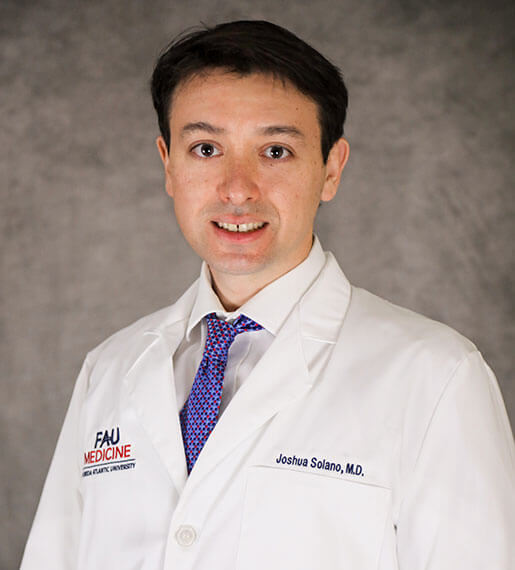
Joshua J. Solano, M.D., FAAEM is an Associate Professor of Emergency Medicine and Clerkship Director for the Emergency Medicine Residency program at the Florida Atlantic University Charles E. Schmidt College of Medicine. As Clerkship Director, he works alongside residents to promote best practices for emergency department patient care. Dr. Solano is board certified in emergency medicine and maintains active membership in the American College of Emergency Physicians and the American Academy of Emergency Medicine. Dr. Solano's educational background includes a BS in Biology and BA in History from Duke University, followed by his MD from the University of Florida. He completed his emergency medicine residency at Beth Israel Deaconess Medical Center in Boston and served on faculty at Harvard Medical School as an instructor and assistant program director before joining FAU. In his final year in Boston, he completed the Rabkin Medical Education Fellowship. Dr. Solano's research focuses on geriatric emergency medicine, particularly head trauma management in elderly patients, anticoagulation risks, and emergency department quality assurance. His recent publications demonstrate a strong emphasis on developing clinical decision rules for geriatric head trauma and understanding medication interactions in older emergency patients. He has also contributed significantly to medical education literature, developing innovative residency training curricula. His scholarly work shows a clear progression toward establishing evidence-based guidelines for geriatric emergency care, with numerous publications on intracranial hemorrhage risk assessment, anticoagulation management, and fall prevention strategies. Dr. Solano's research bridges clinical practice with educational innovation, making significant contributions to both patient care protocols and emergency medicine training. 2017: Attending Role Model Award, Beth Israel Deaconess Medical Center 2016-2017: Rabkin Medical Education Fellowship 2011: Alpha Omega Alpha Medical Honor Society 2011: Chapman Humanism Society 2010: Equal Access Clinic Service Award 2010: Lawrence M. Goodman Award for Medical Student Research 2010: Community Service Award As Clerkship Director, Dr. Solano oversees medical student education in emergency medicine and has implemented electronic evaluation systems that have increased the quality and quantity of student assessments. His clinical work includes staff positions at Bethesda East Hospital and Delray Medical Center. Dr. Solano's research program demonstrates strong institutional support through multiple publications and ongoing investigations into geriatric emergency care protocols.
Mary A. Carskadon is Professor of Psychiatry and Human Behavior at Brown University's Warren Alpert Medical School and Director of the EP Bradley Hospital COBRE Center for Sleep and Circadian Rhythms in Child and Adolescent Mental Health. Her distinguished career spans over five decades with foundational contributions to sleep science. Her educational background includes a BA in psychology from Gettysburg College (1969) and a doctorate with distinction in neuro- and biobehavioral sciences from Stanford University (1979), earned under William C. Dement. She is a distinguished alumna of Gettysburg College and holds an honorary doctor of sciences degree from that institution. Carskadon's research focuses on circadian timing systems and sleep/wake patterns in children, adolescents, and young adults. Her work on school start times has significantly influenced public health policy, prompting organizations like the American Academy of Pediatrics and CDC to advocate for later school schedules. She developed the multiple sleep latency test (MSLT) with Dr. Dement, which remains a global standard for assessing sleep disorders. Current research examines sleep-health disparities in urban children with asthma, sleep patterns in suicide risk populations, and the impact of sleep restriction on adolescent performance. Her extensive publication record shows consistent focus on adolescent sleep physiology, circadian rhythms, and public health implications. Recent work explores connections between sleep timing, mental health, and academic performance, particularly during the COVID-19 pandemic, while maintaining her foundational work on sleep measurement methodologies. Lifetime Achievement Award of the National Sleep Foundation Distinguished Scientist and Outstanding Educator Awards of the Sleep Research Society (the latter now presented in her name) 2023 Brown University Distinguished Research Achievement Award William C. Dement Academic Achievement Award (2023) V. Sagar Sethi, M.D., Mental Health Research Award Leadership in Sleep Medicine Award from American Academy of Physicians of Indian Origin-Sleep Elected Fellow of the Association for Psychological Science Elected Fellow of the American Association for the Advancement of Science Carskadon directs the NIH/NIGMS-funded Bradley Hospital COBRE Center, mentoring junior researchers in pediatric sleep and circadian rhythms. She serves as inaugural editor-in-chief of SLEEP Advances and has secured multiple NIH grants including R01 HL142058 examining ethnic differences in children's sleep patterns with asthma, P20 GM139743 for the COBRE center, and R01 HD103665 investigating sleep restriction effects using neuroimaging. Her work bridges laboratory research with real-world applications, particularly in school policy reform and health equity initiatives. She leads multiple research teams including the CLASS Study (Circadian Light in Adolescence, Sleep and School), projects on sleep disruption in urban children with asthma, and studies examining sleep's role in opioid use disorder treatment. Her laboratory continues to innovate in sleep measurement techniques while maintaining longitudinal studies on adolescent sleep patterns across developmental stages.
Dr. Amir Javed is a Lecturer in the School of Computer Science and Informatics at Cardiff University, where he has been employed since 2019. Previously, he served as a Research Associate at the same institution from 2015 to 2019, working on projects including WEFO collaboration with Airbus, the EPSRC Ebb and Flow Energy Systems project, and the ESRC HateLab project. His research spans cybersecurity, machine learning, and IoT security, with particular focus on intrusion detection systems for in-vehicle networks, adversarial machine learning, cloud security, and cybersecurity education. He investigates malware propagation on social networks, drive-by download attacks on Twitter, and the application of machine learning for real-time cyberattack forecasting. His recent work explores generative AI integration in cybersecurity education and adversarial attacks on autonomous vehicle security systems. Dr. Javed's publication trends reveal a strong emphasis on automotive cybersecurity (particularly intrusion detection for connected vehicles), adversarial machine learning techniques, and innovative approaches to cybersecurity education. His work increasingly focuses on federated learning applications for vehicle security and the educational challenges of integrating generative AI into cybersecurity curricula. He leads the Social Data Science Lab (ESRC-funded, £1.5 million, 2020-2022) and teaches the CMT116 Cyber Security and Risk course. His supervisory portfolio includes doctoral research on in-vehicle network security, cloud service abuse detection, and adversarial attacks in intrusion detection systems.
Pål Roland is a Professor at the University of Stavanger, Faculty of Arts and Education, and affiliated with the Norwegian Centre for Learning Environment and Behavioral Research in Education. He is based in Stavanger and actively contributes to research and dissemination in educational leadership, implementation science, and behavioral research in schools and kindergartens. His research interests focus on implementation science , capacity building in educational organizations , social and emotional learning , bullying prevention , classroom interactions , and leadership in change processes . He emphasizes systemic and organizational approaches to sustainable development in pedagogical settings. The recent articles highlight a consistent focus on implementation quality, professional learning communities, leadership in educational change, and behavioral support in early childhood and school contexts. His work bridges theory and practice, often involving collaboration with school leaders and practitioners. Scientific Awards: No awards explicitly mentioned in the provided text. Advising and Grants: No formal advisees or grant information is listed in the provided content. However, his extensive collaborative research and leadership in dissemination suggest active involvement in research projects and networks, likely supported by external funding. Labs and Teams: He is a key researcher at the Norwegian Centre for Learning Environment and Behavioral Research in Education , which functions as a research group focused on improving learning environments through evidence-based practices. He frequently collaborates with researchers such as Sigrun K. Ertesvåg, Ella Maria Cosmovici Idsøe, and others on projects related to bullying, SEL, and implementation.
Sageev Oore is an Associate Professor in the Faculty of Computer Science at Dalhousie University, a Research Faculty Member at the Vector Institute for Artificial Intelligence, and a Canada CIFAR AI Chair. He previously served as Associate Professor and Chairperson in the Department of Mathematics & Computer Science at Saint Mary’s University and spent 2016–2018 as a Visiting Research Scientist at Google Brain, working on the Magenta team. Faculty of Computer Science, Dalhousie University Vector Institute for Artificial Intelligence Google Brain (2016–2018) Saint Mary’s University (former) Sageev Oore's research centers on machine learning and deep learning, with a strong focus on creative applications in music, audio processing, and computational creativity. His work bridges the gap between technical innovation and artistic expression, developing systems that generate and interact with music using neural networks. He has made significant contributions to generative models for music, including the development of PerformanceRNN and other interactive systems. His recent publications highlight advancements in out-of-distribution detection (Gram-OOD), interactive music generation, and deep learning tools for creative domains. These works reflect a consistent trend toward building intelligent, user-centered systems that enhance human creativity through AI. Canada CIFAR AI Chair (2018) Best Paper Award, CVPR ISIC Workshop (2020) Outstanding Demonstration Award (Runner-up), NeurIPS (2020) Best Demonstration Award, AAAI (2017) Best Demonstration Award, NeurIPS (2016) Sageev Oore actively mentors graduate and undergraduate students, with well-funded research positions available for motivated candidates. His collaborations span academia and industry, including major projects with Google Brain and interdisciplinary work with artists. He leads research initiatives in AI-driven creativity and is deeply involved in the Canadian AI ecosystem through the Vector Institute and CIFAR. His work is supported by significant grants and affiliations, including the Canada CIFAR AI Chair program, which funds his research in foundational AI and its applications. He is also part of the Magenta project at Google, contributing to open-source tools for art and music generation. Sageev Oore leads a research group focused on deep learning for creative applications, with projects in music generation, audio synthesis, and human-AI interaction. His lab collaborates with musicians, artists, and healthcare researchers, fostering a transdisciplinary approach to AI innovation.
Vidar Hepsø is a Professor at the Department of Computer Technology and Informatics, Faculty of Information Technology and Electrical Engineering, Norwegian University of Science and Technology (NTNU). His work bridges anthropology of science and technology with practical challenges in digitalization, energy transition, and remote operations. Research focuses on digital infrastructures, socio-technical systems, and human factors in oil and gas industries Active in NTNU Applied Information Technology and NTNU Energy Transition Initiative Publications emphasize open-source ecosystems, autonomous systems, and environmental monitoring His scholarly output spans computer-supported collaborative work, IT infrastructure governance, and risk-informed anomaly detection in subsea systems. He leads projects connecting digital innovation with offshore wind and petroleum geoscience.
Taiwo Amoo is an Assistant Professor of Business and Quantitative Methods at Brooklyn College, CUNY , where he has been employed since 1999. His academic career spans institutions including Baruch College (substitute and adjunct roles, 1993-1999) and Kaduna Polytechnic, Nigeria (1987-1988). With a PhD in Operations Research (University of Exeter, 1992) and a BSc in Statistics (University of Ibadan, 1986), Amoo specializes in operations management, statistical analysis, and educational innovation. Current position: Assistant Professor (Brooklyn College, CUNY) Key expertise: Operations Management, Queueing Theory, Rating Scale Methodology Technological proficiency: SAS, SPSS, Oracle Database Systems His research focuses on optimizing rating scale design , integrating technology in education , and interdisciplinary approaches to business programs . Publications from 2000-2002 examine biases in survey construction, humor as an educational tool, and the relevance of traditional disciplinary structures in modern academia. Notable awards include PSC CUNY Grants and recognition as the Best Statistics Student at the University of Ibadan. Current affiliations: Brooklyn College (CUNY) Past affiliations: Baruch College (CUNY), University of Exeter, Kaduna Polytechnic