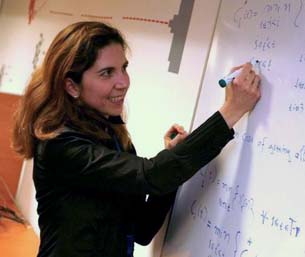
Nuria Oliver, PhD is a pioneering computer scientist and ACM Fellow , recognized as the first female Spanish computer scientist to achieve both ACM Distinguished Scientist and IEEE Fellow status. Current affiliations include Microsoft Research and former roles at MIT Media Lab. First female Spanish ACM Fellow IEEE Fellow Academia Europaea member Her research spans human behavior modeling , intelligent user interfaces , and mobile computing , with notable work in: Wearable context-aware systems (DyPERS, HealthGear) Music-adaptive exercise platforms (MPTrain, TripleBeat) Social network analysis (information propagation, community link modeling) Computer vision interfaces (LAFTER facial expression recognition) Scientific achievements include: 41 patents 15+ years of continuous multimodal systems research Recognized for LAFTER system (2000 paper) She actively promotes technology accessibility through: Media collaborations Technical/non-technical keynotes STEM outreach for girls
Stefano Favaro is a Professor of Statistics at the University of Torino and holds the Carlo Alberto Chair of Statistics and Machine Learning at Collegio Carlo Alberto. His research focuses on Bayesian nonparametric methods, statistical machine learning, and applications to data confidentiality and deep learning theory. PhD in Statistics, Bocconi University, 2009 His research interests include: Nonparametric Bayes and Empirical Bayes methods Statistical Machine Learning with emphasis on learning-augmented algorithms Data confidentiality and fairness in machine learning Mathematical foundations of deep neural networks Recent work explores Bayesian nonparametric models for frequency estimation, deep learning asymptotics, and privacy-preserving statistical methods. He leads DataLab Algorithms at Collegio Carlo Alberto and serves as Associate Editor for Bernoulli and Statistical Science .
Nikolaus Adams is a Professor at the Chair of Aerodynamics and Fluid Mechanics at the Technical University of Munich (TUM) . His research focuses on computational fluid dynamics (CFD), numerical methods, and data-driven modeling of complex fluid phenomena. Key contributions include the development of differentiable CFD frameworks like JAX-Fluids and integration of machine learning with high-order schemes. Research Interests : High-order numerical methods (WENO, SPH, Lattice-Boltzmann) Machine learning/RL for flow control and turbulence modeling Quantum algorithms for fluid simulations Multiphase flows with surface tension and cavitation Shock wave interactions and aerodynamic breakup Recent article trends highlight applications of differentiable programming, neural networks, and Bayesian optimization in compressible/two-phase flows, alongside quantum lattice-Boltzmann advancements. Labs/Teams : Leads the Chair of Aerodynamics and Fluid Mechanics at TUM, contributing to the TUMWAER group and TUZEMSE research initiatives.
Krishnamurthy Dvijotham (Dj) is a research scientist with a focus on developing safe, reliable, and secure AI systems. His current role as a Research Lead at ServiceNow Research (2024-2025) builds on his extensive experience at Google DeepMind (Researcher, 2017-2024), Pacific Northwest National Laboratory (Researcher, 2016-2017), and a postdoctoral fellowship at Caltech's Center for Mathematics of Information. Research Interests: Mathematical optimization, control theory, AI robustness, differential privacy, neural network verification, power systems optimization. Scientific Awards: Best Paper at ICML 2024, Best Paper at UAI 2018, Best Paper at Constraints 2016, Best Student Paper at UAI 2014. Dvijotham's work emphasizes the application of rigorous mathematical frameworks to AI systems. His publications span certified robustness , adversarial defense mechanisms , privacy-preserving learning , and power grid optimization , reflecting interdisciplinary contributions to both theoretical and applied domains. He has mentored numerous PhD students and postdoctoral fellows, many of whom now hold academic or research positions at institutions like UC Berkeley, Google DeepMind, and Microsoft Research. His recent articles highlight advancements in diffusion models , selective deferral systems , and formal verification techniques , with a strong focus on security and reliability in AI deployment.
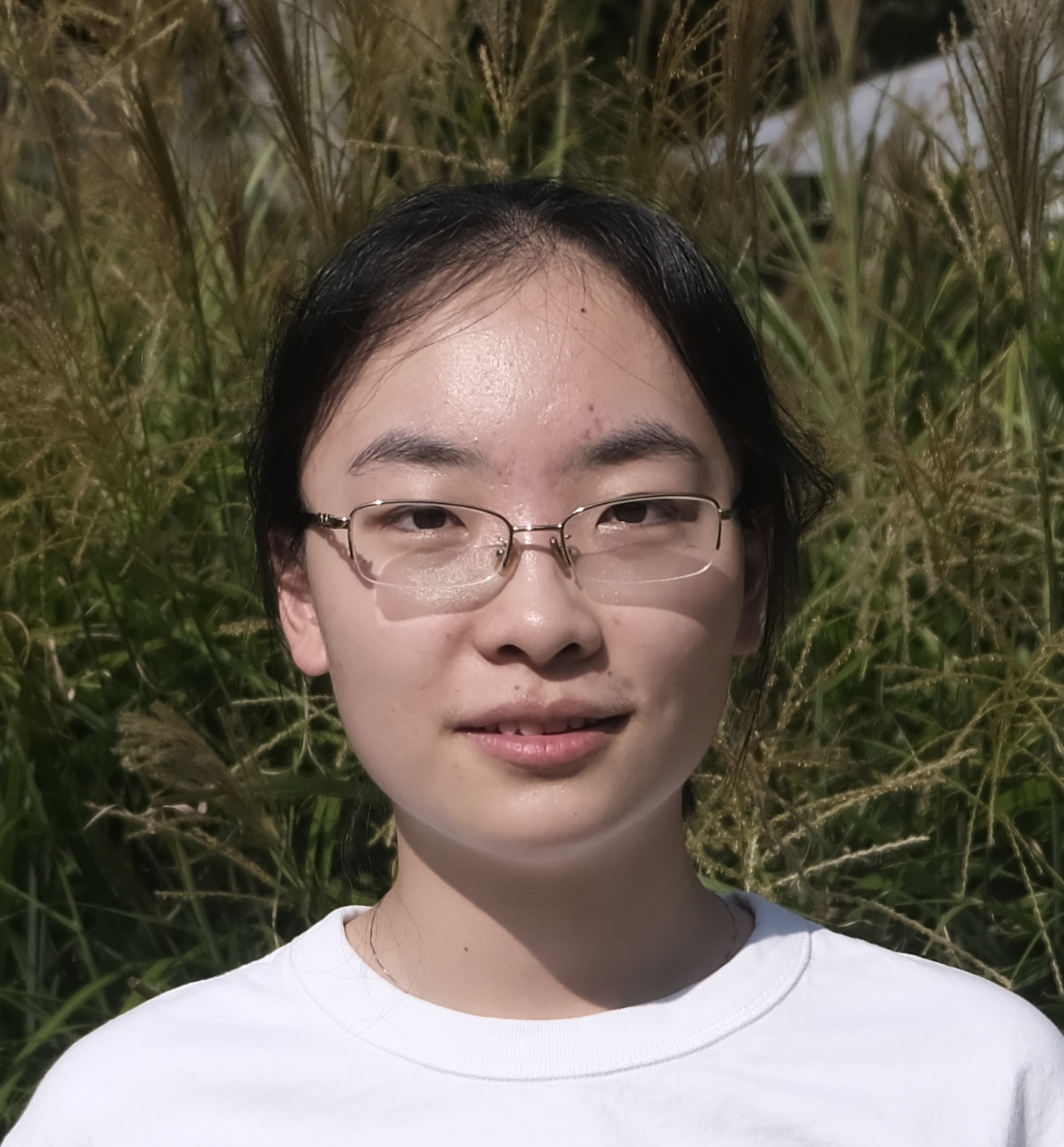
Yuqing Wang is a postdoctoral researcher in the Department of Applied Mathematics and Statistics (AMS) at Johns Hopkins University (JHU). Prior to this, they were a Research Fellow at the Simons Institute at UC Berkeley during the fall 2024 MPG program. Yuqing earned their PhD in Mathematics from Georgia Institute of Technology under the supervision of Prof. Molei Tao. Yuqing’s research focuses on the mathematical foundations of deep learning theory, particularly from a dynamical systems perspective. Their work bridges machine learning and applied mathematics, employing tools from optimization, stochastic dynamics, computational math, analysis, topology, and sampling. Current interests include large language models and diffusion models. Yuqing’s publications highlight themes such as training dynamics, large learning rate effects, implicit biases in neural networks, diffusion model design, and optimization techniques. Key contributions include analyses of gradient flow in neural networks, balancing effects in training, and control-theoretic approaches to sampling and attention mechanisms. As an instructor at JHU, Yuqing teaches Bayesian Statistics and Optimization courses. They have also served as a teaching assistant for differential equations and multivariable calculus at Georgia Tech. Yuqing actively participates in academic talks, with recent presentations at institutions like MPI MiS, UCLA, and conferences such as ICLR, NeurIPS, and SIAM DS25.
Rose Yu is an Associate Professor in the Department of Computer Science and Engineering at the University of California, San Diego. She serves as a primary faculty member with the AI Group and is affiliated with the Halıcıoğlu Data Science Institute. Previously, she was a faculty member at Northeastern University where she taught advanced machine learning courses. Her research focuses on machine learning for large-scale spatiotemporal data, with particular emphasis on AI for scientific discovery. She develops physics-guided deep learning models that integrate physical principles with neural networks, with applications spanning climate science, healthcare, and dynamical systems. Her work on symmetry in neural networks has led to significant advances in model generalization and optimization. Dr. Yu's recent publications demonstrate a strong trend toward grounding large language models with physical laws, developing symmetry-aware learning frameworks, and applying AI to climate science. Her work bridges theoretical advances in machine learning with practical applications in scientific domains, particularly in spatiotemporal forecasting and scientific discovery. Major Awards and Honors: Presidential Early Career Award for Scientists and Engineers (PECASE) DARPA Young Faculty Award NSF CAREER Award MIT Technology Review Innovators Under 35 Hellman Fellowship Multiple faculty awards from major tech companies (Google, Amazon, Meta, etc.) Dr. Yu actively mentors PhD students, postdocs, and undergraduate researchers, with many of her former students now holding positions at leading institutions and companies. She serves as program chair for major conferences including ICLR 2025 and has received substantial research funding from agencies including DARPA, NSF, DOE, and CDC. Her research group develops tools for scientific machine learning, with particular focus on climate informatics, symmetry-aware learning, and physics-integrated AI systems.
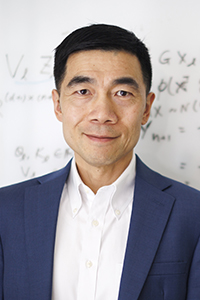
Yue Lu is the Gordon McKay Professor of Electrical Engineering and Applied Mathematics at Harvard University, serving as Faculty Director of Graduate Studies. His research spans applied mathematics, control theory, machine learning, and signal processing, with a focus on high-dimensional data analysis and algorithmic foundations. He leads the Signal and Information Processing lab in Maxwell Dworkin 113. Notable recognitions include being named a Harvard College Professor (2024) and achieving tenure in 2019. His work addresses topics like random matrix theory, optimization in machine learning, and statistical signal processing. Recent contributions include studies on neural networks, kernel methods, and phase retrieval algorithms. He has published extensively on the theoretical underpinnings of modern learning systems, with a particular emphasis on universality principles and asymptotic analysis. Research Highlights: Developed frameworks for analyzing approximate message passing algorithms Advanced theories of in-context learning and feature learning dynamics Contributed to understanding phase transitions in high-dimensional estimation problems Explored optimal regularization strategies for sparse regression Awards: Harvard College Professor (2024) Full Tenure in Electrical Engineering (2019) His lab focuses on bridging theory and applications in signal processing and AI, with projects ranging from imaging systems to brain network analysis. Ongoing work explores the statistical physics of learning and scalable algorithms for large-scale inference problems.
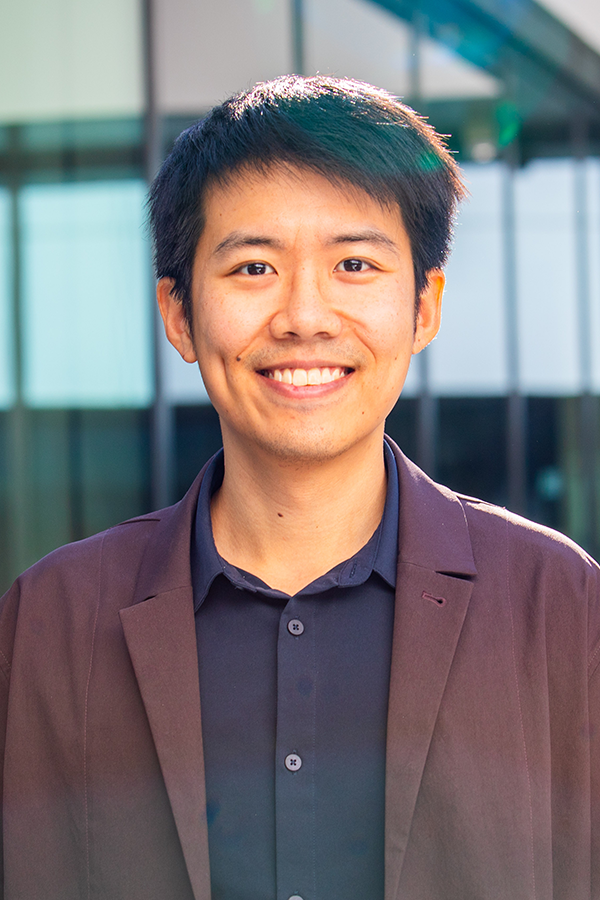
Sitan Chen is an Assistant Professor of Computer Science at Harvard University's John A. Paulson School of Engineering and Applied Sciences. His research focuses on foundational aspects of machine learning, quantum information, and algorithm design, with a particular emphasis on provable guarantees for generative modeling, deep learning, and quantum learning. He is affiliated with the Theory of Computation group, the ML Foundations group, and the Harvard Quantum Initiative. Education: PhD in EECS from MIT (advised by Ankur Moitra) Bachelor's in Mathematics and Computer Science from Harvard (advised by Salil Vadhan and Leslie Valiant) Grants & Awards: NSF CAREER Award (CCF-2441635) NSF Small (CCF-2430375) Harvard Dean's Competitive Fund for Promising Scholarship Research Interests: Generative models and diffusion processes Quantum tomography and quantum learning Algorithmic foundations for inverse problems Provably efficient learning algorithms Advising & Teaching: Advises PhD/Masters students in quantum computing and machine learning Teaches courses like Quantum Learning Theory and Algorithms for Data Science Key Contributions: First polynomial-time algorithms for learning narrow neural networks Advances in quantum state estimation with minimal resources Provably efficient sampling methods for diffusion models
Yilun Du is an Assistant Professor at Harvard University in the Kempner Institute and Department of Computer Science, and a senior research scientist at Google DeepMind. He holds a PhD and bachelor's degree from MIT EECS, advised by prominent figures like Leslie Kaelbling. His research focuses on generative models, decision-making, and embodied agents, emphasizing compositional architectures and energy-based models. Notable contributions include foundational work on diffusion models and the development of frameworks like COMET and Diffusion Forcing. He has received awards such as the Outstanding Paper Award at ICLR 2024 and a gold medal at the International Biology Olympiad. Education: PhD (MIT EECS, 2024), Bachelor's (MIT, 201X). Research spans generative AI applications in robotics, vision, and scientific domains. Key projects include compositional scene understanding, video generation, and multiagent self-improvement systems. His work bridges generative modeling with real-world decision-making, emphasizing generalization and scalability. Publications highlight advancements in energy-based models, video diffusion, and embodied intelligence. He organizes workshops on compositional learning and safe AI at top conferences like NeurIPS. Current interests include decentralized generative architectures for decision-making societies of models and integrating systematic reasoning with deep learning.
Alexander Fisher is an Assistant Professor of the Practice of Statistical Science at Duke University's Department of Statistical Science, affiliated with the Trinity College of Arts & Sciences. He holds a Ph.D. (2021), M.S. (2018) from UCLA, and a B.S. (2016) from Florida State University. His research focuses on Bayesian statistical methods applied to phylogenetics, divergence time estimation, and epidemiological modeling, with publications in journals like Systematic Biology and Molecular Biology and Evolution. Fisher teaches advanced courses in Bayesian inference, statistical computing, and data science methodologies. Education: Ph.D. in Statistics (UCLA, 2021), M.S. (UCLA, 2018), B.S. (Florida State University, 2016) His work integrates computational statistics with biological problems, emphasizing scalable Bayesian approaches for analyzing large genomic datasets. Recent projects include developing methods for divergence time estimation and applying phylogeographic frameworks to trace viral transmission dynamics. Fisher's teaching portfolio includes courses like Bayesian Statistical Modeling and STA 323D (Statistical Computing).
Partha Dey is an Associate Professor in the Department of Mathematics at the University of Illinois at Urbana-Champaign (UIUC), where he also serves as Director of the NetMath Program. He holds affiliations in both Mathematics and Statistics departments. His research focuses on Probability Theory and its intersections with Statistical Physics, emphasizing First/Last Passage Percolation, Random Growth Models, Stein’s Method, Spin Glasses, and Random Matrix Theory. Education: Ph.D. in Statistics from UC Berkeley (2010), supervised by Sourav Chatterjee and Steve Evans. Prior to UIUC, he was a Courant Instructor/Simons Fellow at NYU (2010-2013) and a Harrison Early-Career Assistant Professor at the University of Warwick (2013-2014). Undergraduate and Master’s studies at Indian Statistical Institute Kolkata (Mathematical Statistics & Probability). Research interests include analyzing stochastic processes in complex systems, with recent work on fluctuation phenomena in percolation models, spin glasses under external fields, and Stein’s method applications. His publications span high-impact journals like ALEA , Annals of Probability , and Communications in Mathematical Physics . Awards/Funding: No explicitly listed honors, though his positions suggest sustained academic recognition. Grants/Advising: No detailed grant info provided; no advisee names listed in texts. Labs/Teams: Leads NetMath Program, a distance-learning initiative in mathematics education. Collaborates widely on interdisciplinary projects in probability and statistical physics.
Jose Eos Trinidad is an Assistant Professor of Education Policy at the University of California, Berkeley , affiliated with the Berkeley School of Education. A sociologist with a joint PhD in Sociology and Comparative Human Development from the University of Chicago, his work bridges organizational theory and education policy. Education: PhD (University of Chicago, 2017), MA (University of Chicago), BA (Ateneo de Manila University) Research Interests center on cross-sector partnerships between schools and external organizations, policy implementation in decentralized systems, and causal inference. His 2025 book Subtle Webs: How Local Organizations Shape US Education (Oxford) argues for an "outside-in" theory of educational change. Scientific Recognition includes the Earl S. and Esther Johnson Prize for Best MA Thesis. His work spans peer-reviewed articles in journals like Sociology of Education and Social Science & Medicine , with a focus on organizational dynamics, equity in education, and methodological innovation. Teaching includes courses on causal inference, organizational theory, and education inequality/policy. He actively advises graduate students in cross-sector partnerships and policy research, utilizing mixed methods including quantitative causal inference and network analysis.
Ramin Zabih is a Professor at Cornell Tech with a joint appointment in Weill Cornell Radiology. His research focuses on computer vision, medical imaging, and advanced algorithms like graph cuts, which have garnered prestigious awards such as the Test of Time Award (ICCV 2011) and Koenderink Prize (ECCV 2012). He has held leadership roles, including Program Chair for CVPR 2007 and Editor-in-Chief of IEEE TPAMI (2009-2012). His work bridges medical imaging reconstruction and AI ethics, addressing challenges in MR image analysis and workflow optimization. Education details are not explicitly provided in the text, but his professional trajectory indicates a strong academic background in computer science and engineering. His research interests emphasize algorithmic innovation for medical applications and foundational computer vision problems. Key scientific contributions include advancements in graph cuts for inverse problems and adversarial methods for clinical text anonymization. His publications span medical imaging, machine learning, and vision, reflecting interdisciplinary impact. Awards highlight his transformative work in algorithmic efficiency and medical applications. Zabih has contributed to organizing major conferences (e.g., CVPR) and serves as President of the Computer Vision Foundation. His current work at Cornell Tech integrates computational methods with radiology, advancing both technical and clinical outcomes.
Barnabas Poczos is an Associate Professor in the Machine Learning Department at the School of Computer Science, Carnegie Mellon University. He is a member of the Auton Lab and has established himself as a leading researcher in theoretical machine learning with applications spanning numerous scientific domains. Carnegie Mellon University, School of Computer Science Machine Learning Department Auton Lab member Dr. Poczos earned his M.Sc. in applied mathematics from Eotvos Lorand University in Budapest, Hungary in 2001, followed by a Ph.D. in computer science from the same institution in 2007. He completed postdoctoral training at the University of Alberta (2007-2010) in the RLAI group and at Carnegie Mellon University (2010-2012) in the Auton Lab. His research focuses on theoretical questions of statistics and their applications to machine learning. Dr. Poczos develops machine learning methods for advancing automated discovery and efficient data processing across diverse scientific fields including health-sciences, neuroscience, bioinformatics, cosmology, agriculture, robotics, civil engineering, and material sciences. His work bridges theoretical foundations with practical applications, making significant contributions to both machine learning methodology and domain-specific scientific problems. Analysis of his recent publications reveals a strong emphasis on diffusion models and generative AI techniques applied to scientific discovery. His work spans drug design, genomics, cosmology, and materials science, demonstrating a consistent pattern of developing novel machine learning methodologies that address specific challenges in scientific domains. The interdisciplinary nature of his research is particularly evident in the application of advanced ML techniques to solve complex problems in biology, physics, and engineering. Yahoo! ACE award Dr. Poczos has served as PI or co-Investigator on 15+ federal and non-federal grants, supporting his research in theoretical machine learning and its scientific applications. His teaching portfolio at CMU includes advanced courses in optimization, convex optimization, and machine learning with large datasets. While specific students aren't mentioned in the provided information, as an Associate Professor at CMU, he undoubtedly mentors graduate students in the Machine Learning Department. As a core member of the Auton Lab at Carnegie Mellon University, Dr. Poczos contributes to a research environment focused on developing machine learning methods for real-world applications, particularly in healthcare and scientific discovery. The lab's work emphasizes both theoretical foundations and practical implementations of machine learning systems.
Prof. Hubert P. H. Shum is a Professor of Visual Computing and Director of Research in the Department of Computer Science at Durham University. He specializes in Responsible AI, Computer Vision, and AI in Healthcare. As a Co-Founder of the Durham University Space Research Centre and Fellow of the Wolfson Research Institute for Health and Wellbeing, he leads interdisciplinary research in healthcare, space technology, and autonomous systems. His work includes over 200 publications in top venues like CVPR, ICCV, and MICCAI, focusing on spatio-temporal data modeling. He has secured £10M+ in grants from EPSRC, MoD, and Innovate UK, supervising over 30 PhD students. Key projects include NortHFutures (digital health hub) and counter-drone research. Research interests span AI ethics, medical imaging, autonomous vehicles, and space applications. His lab develops technologies for surgical workflow anticipation, LiDAR segmentation, and human-AI interaction. Notable awards include Best Paper Awards in CVPR and exceptional teaching/supervision accolades from Durham University. Key Grants : EPSRC Impact Acceleration (£2.76M), EPSRC Digital Health Hub (£4.17M), Royal Society (£143k). Professional Activities : Conference chairs for Pacific Graphics, BMVC; editorial roles in Computer Graphics Forum and IJCV. Labs/Initiatives : Durham University Space Research Centre, Centre for Visual Arts and Culture.