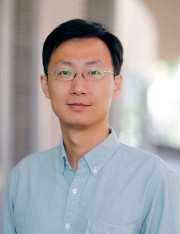
Dong ZhouView profile
Associate Professor
Dong Zhou is an Associate Professor in the Department of Mathematics at California State University, Los Angeles within the College of Natural and Social Sciences, a position held since August 2024. Previously, he served as Assistant Professor at the same institution (2018-2024), Research Assistant Professor at Temple University (2014-2018), and Visiting Scientist at MIT (2015). His educational background includes: Ph.D. in Applied Mathematics, Temple University (2014) B.S. in Mathematics, Beijing Normal University (2008) Zhou's research focuses on developing high-order numerical methods for partial differential equations in computational fluid dynamics and scientific computing. His work addresses critical challenges in fluid flow and interface propagation, with major contributions in overcoming order reduction in Runge-Kutta methods through weak stage order theory and modified boundary conditions, and establishing unconditional stability frameworks for implicit-explicit multistep schemes. His methodologies enable time-step selection based purely on accuracy requirements for stiff systems. Analysis of his publication record reveals consistent innovation in numerical time-integration techniques, with recent work (2021-2024) emphasizing practical implementations for incompressible flow problems using pressure Poisson equation reformulations. His research bridges theoretical stability analysis with applications in engineering contexts requiring high-order spatial and temporal accuracy. Scientific Awards: None documented in source materials. Grant activity includes serving as Co-PI on NSF grant DMS-1719640 (2017-2020) titled "Collaborative Research: Overcoming order reduction and stability restrictions in high-order time-stepping," working with Benjamin Seibold (Temple University), Rodolfo Rosales (MIT), and David Shirokoff (NJIT). No student advising information was provided. His research is conducted through institutional collaborations with Temple University, MIT, and NJIT, though no dedicated laboratory structure is specified in available documentation.