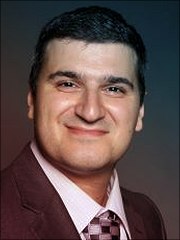
Dr. Abtin Nourmohammadzadeh is a scientific assistant (Researcher) at the Institute for Business Information Systems, University of Hamburg Business School, since July 2019. He previously served as a doctoral researcher at Clausthal University of Technology (2014-2019) and holds a PhD in Informatics. Current Role: Researcher at University of Hamburg Education: Master's and Bachelor's in Industrial Engineering Research Focus: Optimization techniques, transportation logistics, and machine learning His research integrates meta-heuristic optimization (e.g., genetic algorithms, particle swarm optimization) with transportation problems (truck platooning, container terminals) and machine learning (ANNs, SVMs) for industrial fault diagnosis. Publications demonstrate applications of mathematical programming , swarm intelligence , and hybrid algorithms to logistics and engineering challenges. Recent work emphasizes fuel-efficient vehicle coordination , noise-resilient diagnostic systems , and port operations optimization . No specific scientific awards are mentioned in the provided text.
Dr. Daniel Horn is affiliated with the Department of Statistics at the Technical University of Dortmund, specifically within the Faculty of Statistics. He is part of the working group led by Prof. Dr. Andreas Groll and serves as the Study Coordinator for the B.Sc. and M.Sc. Data Science programs. His research focuses on machine learning algorithms, statistical methods for big data, and optimization techniques, with a particular emphasis on hyperparameter tuning, ensemble methods, and robust outlier detection. Key research areas include the development of efficient algorithms for high-dimensional data analysis, such as tree ensembles for ordinal prediction, kernelized support vector machines, and model-based optimization frameworks like mlrMBO. His work also addresses industrial applications of machine learning, emphasizing practical qualification concepts for data-driven production processes. Dr. Horn's publications span topics such as multi-objective optimization, robust outlier detection (RODD), and the Contextual Shift Method (CSM). His contributions highlight advancements in both theoretical methodologies and applied computational tools, supporting data science education and industrial innovation. Contact: dhorn@statistik.tu-dortmund.de
Shanssan Guo is an academic affiliated with Northeastern University in Shenyang, China. Her research focuses on interdisciplinary areas including discrete mathematics, healthcare informatics, operations research, and machine learning. She has co-authored numerous papers in reputable journals such as Discrete Mathematics , IEEE Transactions on Neural Networks , and Information Technology & People . Key research interests include graph theory applications, optimization algorithms, and healthcare technology adoption. Her work spans theoretical contributions (e.g., edge-colored graph cycle analysis) to applied domains like medical imaging reconstruction, cargo stowage optimization, and physician incentive mechanisms in online platforms. Collaborations with industry experts and cross-disciplinary teams highlight her commitment to bridging theory and practice. Publications demonstrate expertise in queueing theory models for resource allocation, reinforcement learning for energy systems, and biomedical data analysis frameworks. Despite prolific output, no specific awards or student mentoring details are explicitly noted in available records.
Prof. Heike Trautmann is a Professor of Data Science: Statistics and Optimization at the University of Münster, holding the Chair of Statistics and Optimization within the Department of Information Systems and Statistics, School of Business & Economics. She also serves as Vice Dean for Internationalization at the School. Her academic career includes roles such as Pascal Professor at Leiden University (2017) and a visiting position at the University of Twente (2021–2026). She earned her PhD (2004) and Habilitation (2013) in Statistics from TU Dortmund, focusing on optimization methodologies. Her research interests span Multiobjective Optimization, Evolutionary Algorithms, Automated Algorithm Selection, Data Stream Mining, and Social Media Analytics. Notable projects include the COSEAL consortium for algorithm selection, the Benchmarking Network for optimization heuristics, and the ERCIS Social Media Analytics Competence Center addressing online disinformation. She has led initiatives like MODERAT! (automated comment moderation) and Algorithmisierung und gesellschaftliche Interaktion (societal impact of algorithms). Awarded multiple best paper prizes, including at CBI 2019 and PPSN XIV 2016, she emphasizes interdisciplinary collaboration. Her work bridges technical advancements with societal implications, reflected in contributions to AI ethics and platform regulation. Active in international conferences (e.g., EMO, GECCO), she maintains roles in program committees and advisory boards such as CLAIRE and ACM SIGEVO. Funded projects include EU initiatives on algorithm configuration and DAAD collaborations on platform regulation. Her research outputs span over 50 peer-reviewed articles since 2012, focusing on algorithmic innovation and real-world applications in optimization and digital media.
Nikos Gianniotis serves as a Staff Scientist in the Astroinformatics group at the Heidelberg Institute of Theoretical Studies (HITS), leveraging his computer science expertise to develop advanced machine learning solutions for astronomical data analysis. His role focuses on probabilistic modeling and algorithmic innovation within a dedicated research environment. His academic credentials include: PhD in Computer Science from the University of Birmingham (2007) MSc in Natural Computation (with Distinction) from the University of Birmingham (2003) BSc in Computing Science (First class) from the University of Aberdeen (2002) Dr. Gianniotis specializes in probabilistic machine learning , Bayesian inference , and dimensionality reduction techniques applied to astronomical challenges. His research bridges computational statistics and astrophysics, with emphasis on interpretable models for complex observational data. Recent work demonstrates sophisticated integration of Gaussian processes with time-series analysis for cosmic phenomena. Analysis of his 15 most recent publications (2016-2024) reveals consistent innovation in machine learning for astronomy, particularly in time-delay estimation for active galactic nuclei, spectral analysis, and time-series dimensionality reduction. His methodology frequently combines Gaussian processes, variational inference, and neural architectures like autoencoders to address astronomical data challenges. No scientific awards were documented in the provided materials. While no student advisement or grant details were specified, his publications indicate active collaboration within the astroinformatics community. The Astroinformatics group at HITS provides his primary research environment, focusing on scalable computational frameworks for next-generation astronomical datasets from missions like Kepler.
Kai-Chih Pai is an Associate Professor at China Medical University's College of Information Science and Technology, Department of Computer Science, with a distinguished research career spanning over 14 years. His work bridges computer science and healthcare, focusing on practical AI applications that address critical medical challenges. Dr. Pai's research interests center around Machine Learning applications in healthcare , Explainable AI systems , Natural Language Processing for Chinese language , and Educational Technology . His work demonstrates a strong commitment to developing AI solutions that are not only technically sophisticated but also interpretable and clinically useful. His research trajectory shows a clear evolution from educational technology applications to increasingly sophisticated healthcare AI systems. His publication record reveals significant contributions to medical decision support systems , particularly in acute kidney injury prediction , pneumonia diagnosis , and mortality prediction in critical care settings. More recently, he has been exploring cutting-edge applications of large language models for industrial knowledge management. His work consistently emphasizes the importance of model interpretability in medical contexts. Federated machine learning approaches for multi-institutional medical research Privacy-preserving healthcare technologies using homomorphic encryption Adaptive learning systems for Chinese language education Predictive analytics for critical care medicine Dr. Pai has established a productive research program with consistent publication output in high-impact venues, demonstrating expertise that spans both theoretical AI development and practical healthcare applications. His collaborative work with medical professionals across Taiwan highlights the interdisciplinary nature of his research and its real-world impact.
Andreas Spanias is a Professor at Arizona State University specializing in Machine Learning , Signal Processing , and Quantum Computing with applications in renewable energy, healthcare, and wireless networks. His research includes Photovoltaic Fault Detection , Quantum Machine Learning , and Real-Time Energy Monitoring . Key research areas: Machine Learning, Quantum Computing, Renewable Energy Systems, Medical Imaging, Wireless Sensor Networks. Notable collaborations: Glen S. Uehara, Cihan Tepedelenlioglu, Sunil Rao, Jayaraman J. Thiagarajan. Recent Publications (2025–2024) focus on quantum machine learning for photovoltaic fault classification, Bayesian optimization in circuit design, and real-time solar array monitoring. Trends include quantum algorithms for signal processing, energy-efficient ML, and educational innovations in quantum computing. Educational Initiatives include REU programs in Quantum Machine Learning and integrating ML into signals and systems courses. He leads international collaborations like the ASU-DCU Sensors and ML Workforce Development Program.
Prof. Dr. Kevin Tierney is a Full Professor for Decision and Operation Technologies at Bielefeld University's Faculty of Business Administration and Economics. He also serves at the Department of Management Science & Business Analytics and is affiliated with the Bielefeld Center for Data Science (BiCDaS) and Center for Uncertainty Studies (CeUS). Chair of Business Administration, Decision and Operation Technologies Member of BIGSEM Graduate School PhD (2013) - IT University of Copenhagen Sc.M. (2010) & BS (2008) - Brown & RIT Research Interests His work focuses on: Learning to Optimize: Using deep reinforcement learning to automate solution heuristics for complex problems like routing and scheduling. Optimization under Uncertainty: Developing models that incorporate probabilistic elements for decision-making in unpredictable environments. Efficient Maritime Logistics: Specializing in container shipping, terminal operations, and fleet routing with real-world constraints. Recent publications demonstrate expertise in algorithm configuration, constraint programming, and machine learning applications to logistics challenges. Scientific Recognition Distinguished Paper Award - European Conference on Artificial Intelligence (2020) Projects & Grants Principal Investigator in projects: Self-learning methods with Deep Reinforcement Learning (DFG 2026) itsowl-MOVE (Land NRW 2024) AIPlan4EU Meta-planning engine (EU H2020 2023) Academic Leadership Module responsible for: Quantitative Business Administration Data Science Production and Operations Management
Jacob Gardner is an Assistant Professor in the Department of Computer and Information Science at the University of Pennsylvania, where he leads a research group focused on probabilistic machine learning. His work bridges theoretical foundations and practical applications, with emphasis on Bayesian optimization and generative modeling for scientific challenges like drug discovery and materials design. Education & Background He earned his Ph.D. in Computer Science from Cornell University under Kilian Weinberger, followed by postdoctoral work in Cornell's Operations Research department. Prior to joining Penn, he was a Research Scientist at Uber AI Labs. Research Focus His lab develops methods for: Bayesian optimization for high-dimensional scientific design problems Scalable Gaussian process inference Black-box variational inference with convergence guarantees Adversarial robustness in machine learning systems Publication Trends Recent work (2022-2023) demonstrates strong focus on efficient Bayesian methods: 80% of publications center on optimization techniques (local/global Bayesian optimization) and variational inference, with applications to latent space modeling and hyperparameter tuning. Papers consistently appear at NeurIPS, ICML, and AISTATS. Research Team Advises five PhD students: Natalie Maus (Bayesian optimization) Kaiwen Wu (optimization theory) Kyurae Kim (variational inference) Haydn Jones (structured data) Yimeng Zeng (generative modeling) Software Contributions Co-founded GPyTorch, a PyTorch-based framework for GPU-accelerated Gaussian processes that replaces traditional Cholesky decomposition with linear conjugate gradient methods.
Mohamed M. Abdallah is a researcher affiliated with Hamad Bin Khalifa University in Doha, Qatar, specifically within the College of Science and Engineering . His work focuses on advanced applications of Machine Learning , Artificial Intelligence , and Cybersecurity in domains such as Smart Grids , Internet of Things , and Wireless Communication . His recent research explores Federated Learning under adversarial conditions, optimization of Multi-Agent Systems for task offloading, and Privacy-Preserving Techniques in networked environments. Key contributions include frameworks for Deep Reinforcement Learning (DRL) in Edge Computing and 6G Networks , addressing challenges in Energy Efficiency , Latency , and Data Distribution Shifts . His publications highlight collaborations with institutions like Texas A&M at Qatar and Hamad Bin Khalifa University , emphasizing solutions for Heterogeneous Networks , Blockchain Applications , and Secure Communication in IoT and critical infrastructure.
Benjamin Recht is a Professor at the California Institute of Technology , affiliated with the Center for the Mathematics of Information . His work spans Machine Learning , Control Systems , Reinforcement Learning , and Optimization , with a focus on theoretical guarantees, adaptive algorithms, and real-world applications. His research includes: Control Systems : Certainty equivalence, adaptive control, LQR, and robustness in dynamic environments. Machine Learning : Generalization bounds, interpolation in classifiers, test set overuse, and ethical frameworks for systemic harm detection. Neural Rendering : K-Planes for explicit radiance fields in space-time-appearance modeling. Recent publications (2025-2018) highlight trends in automating adaptive control , ethical machine learning , distributed computing , and 3D reconstruction . No student lists, awards, or lab details are explicitly mentioned.
Dr. Bracha Laufer is a senior lecturer at the School of Electrical Engineering , part of the Iby and Aladar Fleischman Faculty of Engineering at Tel Aviv University. Her research focuses on acoustic source localization, speech signal processing, and machine learning techniques for audio engineering. Her recent work explores conformal prediction and manifold-based approaches for robust source localization, deep learning architectures for sound source separation, and simplex geometry in multichannel signal analysis. These publications highlight interdisciplinary applications of machine learning and statistical methods in acoustics. Dr. Laufer's research integrates Bayesian inference , probabilistic graphical models , and uncertainty quantification to address challenges in adverse acoustic environments. She has contributed to advancements in multi-microphone speaker localization and speech inpainting .
Professor Dirk J. Lehmann is a Professor of Data Science in IoT at Ostfalia University of Applied Sciences, Faculty of Computer Science, where he has been employed since May 2022. He holds significant leadership roles including Deputy Head of the Institute for Information Engineering (since 2024), Research Officer of the Faculty of Computer Science (since 2023), and membership in multiple committees including the Admissions Committee for Digital Technologies and the Digital Technologies Examination Board. Professor Lehmann's extensive academic journey includes: Part-time professorship in Data Science in IoT at Ostfalia University (2020-2022) Senior Specialist for Digitalization, AI, and Visual Analysis at IAV GmbH (2018-2023) Assistant Professor of Visual Data Analysis at Nazarbayev University, Kazakhstan (2017) Visiting professorships at TU Graz, Austria and Universidad Rey Juan Carlos, Spain (2016-2017) Researcher at Otto-von-Guericke University Magdeburg (2009-2017) His research expertise centers on Visual Analytics and Data Science, with particular emphasis on high-dimensional data visualization, categorical data analysis, and IoT applications. Professor Lehmann leads the Data Science in IoT working group, conducting research across three main areas: visual data analysis, distributed data analysis using AI methods, and applied data analysis in geology, climate data, medicine, and industrial processes. His methodological contributions include innovative visualization techniques for complex datasets across multiple domains. Analysis of Professor Lehmann's 15 most recent publications (2017-2025) reveals a consistent focus on advancing visualization techniques for complex data analysis. His work spans categorical data visualization (CatNetVis), biological data analysis (D. Melanogaster research), optimization of star coordinate systems, and interactive exploration methods for large datasets. These publications appear in top venues including IEEE Transactions on Visualization and Computer Graphics and EuroVis, demonstrating both theoretical rigor and practical application across diverse domains from healthcare to environmental science. As an educator, Professor Lehmann teaches a comprehensive range of courses from foundational mathematics to advanced machine learning and visualization techniques. He actively supervises student projects and theses, emphasizing clear project definitions with measurable acceptance criteria. His international collaborations span institutions in Israel, Saudi Arabia, China, Austria, and Spain, reflecting a global research perspective that bridges academic theory with industry applications, particularly through his previous role at IAV GmbH, a Volkswagen subsidiary.
Maura John serves as a Research Associate at the Chair of Bioinformatics at Hochschule Weihenstephan-Triesdorf's Straubing Campus for Sustainable Resource Use. Her research focuses on developing advanced computational methods for biological data analysis, with particular expertise in genome-wide association studies and protein structure prediction. Her primary research interests include: Genome-wide association studies with permutation-based significance thresholds that preserve population structure Development of bioinformatics tools like permGWAS2 and easyPheno Protein thermostability prediction using machine learning approaches Genomic selection methodologies for crop breeding applications Dr. John's recent publications demonstrate a strong focus on methodological improvements in computational biology, particularly addressing limitations of traditional approaches in handling skewed phenotype distributions and population structure. Her work bridges theoretical statistical methods with practical biological applications across plant genomics and protein science. Notable contributions include: permGWAS2: An improved method that maintains population structure during permutations ProLaTherm: A protein language model-based thermophilicity predictor outperforming existing methods easyPheno: A comprehensive Python framework for phenotype prediction model comparison Her research program demonstrates strong collaborative efforts with Dominik Grimm's group and other bioinformatics researchers, focusing on developing open-source tools that address critical challenges in genomic data analysis. The work has practical applications in plant breeding, protein engineering, and understanding genotype-phenotype relationships.