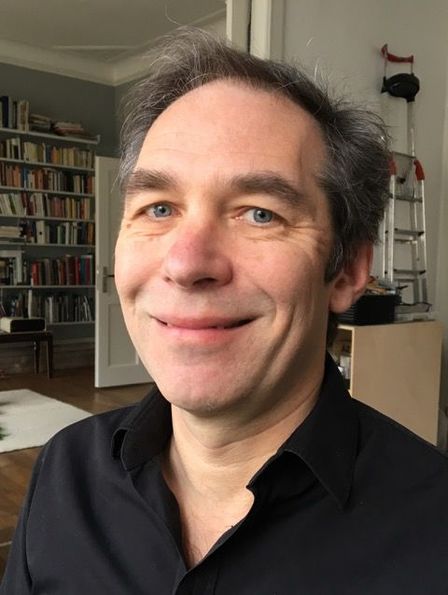
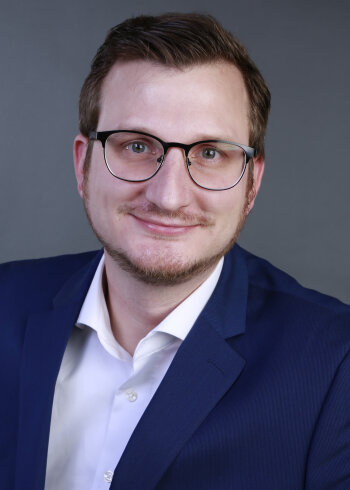
Prof. Mathias Antlfinger is a Professor of Multispecies Storytelling at the Academy of Media Arts Cologne and has served as Vice Rector for Planning and Finance since 2021. Collaborating with Ute Hörner since 1990, their work explores critical and utopian dimensions of human-animal-machine relationships through installations, videos, and sculptures. They co-founded the interspecies collective CMUK with grey parrots Clara and Karl in 2014 and are members of the Minding Animals network. Studied sculpture at Stuttgart State Academy of Art (1983-88) Studied mathematics at University of Stuttgart Studied cybernetics at Kunstakademie Düsseldorf (1990-95) Their research spans Multispecies Storytelling , Interspecies Collaboration , and Human-Animal-Machine Relationships , often interrogating social constructs and ethical interactions. Their work has been exhibited at institutions like Ars Electronica , ZKM Karlsruhe , and Kunsthalle Düsseldorf , emphasizing digital transformation and experimental media. Scientific Awards: Kunststiftung NRW (2015) Prix Ars Electronica Honorary Mention (2012) Artists in Residence, Digital Art Center Taipei (2011) Edith Russ House for Media Arts (2010) Marler Video-Installation Award (2008) ars viva award (2001)
Univ.-Prof. Dr.-Ing. D. Söffker is a University Professor at the University of Duisburg-Essen, Faculty of Engineering, where he leads the Chair of Control, Regulation and System Dynamics since 2001. His work spans multiple institutions including visiting professorships at University of Maryland and Shanghai Maritime University. His educational background includes: 1988: Dipl.-Ing. Mechanical Engineering, Leibniz University Hannover, specialization in General Mechanical Engineering 1995: Dr.-Ing., Department of Safety Engineering, University of Wuppertal 2001: Habilitation in Security Technology/Automation Technology, University of Wuppertal Prof. Söffker's research focuses on modeling, diagnosis and control of elastic mechanical systems , with particular expertise in robust control theory, system diagnostics, and cognitive technical systems. His work bridges theoretical control systems with practical applications in industrial settings, emphasizing human-machine interaction and autonomous system design. He has developed innovative approaches for structural health monitoring and fault detection in complex mechanical systems. Analysis of his recent publications reveals a strong focus on human-centered automation, with increasing attention to cognitive technical systems and human decision-making processes. His work spans from fundamental control theory (robust observers, nonlinear systems) to practical applications in structural health monitoring, wear detection, and process supervision. The interdisciplinary nature of his research connects mechanical engineering, computer science, and cognitive systems. His research group is involved in several key projects: Structural Health Monitoring Security and reliability systems Methods for application in energy production and use Cognitive Technical Systems
Dr. Marcus Handte is a Senior Researcher at the University of Duisburg-Essen, focusing on networked embedded systems, context-aware computing, and sustainable mobility. His academic journey includes a Habilitation in Computer Science (2013) and a PhD in Natural Sciences (2009) from Universität Stuttgart, alongside a Master's degree from Georgia Institute of Technology (2002). Research Interests Context-aware applications Localization and location-based systems Sustainable mobility solutions Internet of Things (IoT) Smart city infrastructure Privacy-preserving technologies His recent work involves developing platforms for multimodal mobility analysis (MOBYDEX), wireless EV charging systems (TALAKO, FAIR), and innovative approaches to indoor localization. Publications span journals like Machine Vision and Applications and conferences in pervasive computing. Scientific Recognition Best Poster Award at ACM KMIS 2023 Dr. Handte has contributed to projects such as ATMo2, INNAMORUHR, and GAMBAS, and maintains active collaborations across institutions. His expertise in adaptive middleware and distributed systems continues to shape research in smart mobility and ambient intelligence.
Friederike Fröbel is a Researcher at the German Research Center for Artificial Intelligence (DFKI) within the Design Research eXplorations group, affiliated with the interdisciplinary Design Research Lab network spanning Berlin University of the Arts, DFKI, Weizenbaum Institute, and Einsteincenter Digital Future. Her work focuses on socially and ecologically sustainable tools at the intersection of technology, materials, and social practices to advance digital inclusion through participatory design. She completed her Master of Science degree in 2018 with a thesis titled 'Smart Fashion as Mobile User Interface' under Dr. Katharina Bredies' supervision, building foundational expertise in wearable interfaces. Fröbel's research centers on human-computer interaction with emphasis on wearable technology, sustainable digital solutions, and community empowerment. She pioneers low-cost hardware and free/libre open source software (FLOS) applications to create accessible interfaces, particularly for minoritized groups. Her methodology prioritizes co-creation workshops and grassroots innovation to address real-world challenges in local development and networked societies. Analysis of her 2019-2023 publications reveals consistent integration of machine learning with textile-based interfaces (e.g., MYOW, UPLINX projects) and community-driven sustainable development (MINODU, Miadé initiatives in Togo). A dominant trend is adapting technology for pandemic-era constraints while maintaining participatory design principles, demonstrating resilience in digital inclusion efforts across diverse contexts. As a core member of the Design Research Lab, Fröbel contributes to projects including DDAI (Design-driven AI), MYOW (wearable creation platforms), and Minodu. The lab operates as a dynamic network of designers, researchers, and critical thinkers committed to ecological sustainability, gender-inclusive design, and material interactions, hosting events like virtual colloquia on AI ethics and digital sovereignty.
Professor Susanne Rau serves as Professor for the History and Cultures of Spaces in Modern Times within the Department of History at the University of Erfurt's Faculty of Arts and Humanities. She holds multiple significant academic roles including Fellow and Spokesperson of the Kolleg Research Group at the Max Weber Center for Advanced Cultural and Social Studies, Program Supervisor for the Master's program in Collection-Related History of Knowledge and Culture, and Member of the Doctoral Committee of the Faculty of Philosophy since 2009. Her institutional leadership extends to coordinating Erasmus partnerships with universities across France, Spain, and Italy, and serving as contact person for university cooperation with Jamia Millia Islamia and Kannur University in India. Professor Rau's research establishes her as a pioneer in spatial history , with groundbreaking work on the intersections between urban development and religious practices . Her scholarship reveals sophisticated analysis of how spaces are constructed, perceived, and utilized across historical contexts, particularly examining European and South Asian urban centers. She has developed innovative frameworks for understanding urbanity as a historical concept , exploring how different cultures have conceptualized urban spaces through time. Her research on early modern European cities, especially Lyon and Hamburg, demonstrates exceptional attention to public spaces, tavern cultures, and spatial configurations that shaped social interactions. Her extensive publication record shows consistent methodological innovation, particularly in the spatial turn in historical scholarship . Recent work demonstrates increasing emphasis on comparative urban studies between European and South Asian contexts, with significant focus on Calicut (Kozhikode). Professor Rau has pioneered digital approaches to historical research through projects like the GlobMapLab , which uses computational tools to analyze historical cartographic collections, particularly the renowned Perthes collection in Gotha. Her collaborative work with the "Religion & Urbanity" research group represents a major contribution to understanding how religious practices both shape and are shaped by urban environments. 2023 Thuringian Research Prize (Basic Research) 2023 Palmes Académiques ("chevalier") 2021 Award for internationalization of the University of Erfurt 2018-2021 Distinguished Visiting Professorship at the École Normale supérieure de Lyon 2017 Gay-Lussac Humboldt Prize of the French Academy of Sciences 2017 "Geisteswissenschaften International" Prize for promoting humanities translation 2015 Vienna Prize for urban history research 2009 Heisenberg Professorship of the German Research Foundation 2008 Young Talent Award from the Alfried Krupp von Bohlen und Halbach Foundation As an academic leader, Professor Rau has directed substantial research initiatives including the "Religion & Urbanity" collaborative research group funded by the German Research Foundation, and previously served as Vice President for Research and Young Talent Development at the University of Erfurt (2014-2017). She has secured funding from prestigious organizations including the Alexander von Humboldt Foundation, German Research Foundation, and various European funding bodies. Her editorial leadership extends to co-editing the SpatioTemporality series with De Gruyter and serving on multiple journal editorial boards, significantly shaping scholarly discourse in urban and spatial history. Professor Rau leads the Erfurt SpaceTime Research group, which develops innovative methodological approaches to spatial and temporal analysis in humanities research. Her GlobMapLab initiative represents a cutting-edge integration of digital humanities with traditional historical methods, enabling new forms of analysis of historical cartographic materials. Through her extensive international collaborations spanning France, India, and Italy, she has established herself as a key figure in global scholarly networks focused on urban history, spatial analysis, and cross-cultural historical studies.
Felix Gerloff is a junior researcher at the Institute of Experimental Design and Media Cultures (Academy of Art and Design, University of Applied Sciences and Arts Northwestern Switzerland), specializing in programming as a cultural technique and computational thinking in human-machine collaborations. He is also a PhD candidate at Humboldt-University Berlin , where he earned his Masters in Cultural History and Theory in 2013. At the Max Planck Institute for the History of Science (MPIWG), he works as a visiting predoctoral fellow in the 'Epistemes of Modern Acoustics' group, focusing on the history of the decibel with Sebastian Schwesinger. Education: Magister Artium (MA), Cultural History & Theory, Humboldt-University Berlin (2013) PhD candidate, Humboldt-University Berlin Gerloff’s research bridges Sound Studies , Digital Cultures , and Media Theory , examining how sound functions as an epistemic tool in urban environments and software engineering. His work on the decibel explores intersections between auditory media, scientific instrumentation, and transnational knowledge exchange. He co-organizes the KlangDenken (Sonic Thinking) colloquium in Berlin since 2011. His publications analyze sonic reasoning , noise as a figure of thought , and creative coding in projects like Sonic Pi. He contributes to academic initiatives such as continent. and the Impact proceedings, emphasizing interdisciplinary and experimental research methods.
Ksander de Winkel serves as Project Leader of the Motion Perception and Simulation research group within the Department of Human Perception, Cognition and Action at the Max Planck Institute for Biological Cybernetics in Tübingen, Germany, a position he has held since March 2017. His role involves leading both fundamental and applied research on self-motion perception, with direct applications to motion simulation and autonomous vehicle technologies. His academic credentials include a Ph.D. in Multisensory Perception of Spatial Orientation and Self-Motion from Utrecht University (2013), an M.Sc. in Applied Cognitive Psychology earned cum laude (2008), and a B.Sc. in Psychology, all completed at Utrecht University. Additional training includes specialized coursework in Applied Bayesian Statistics and Mathematical Statistics. De Winkel's research program centers on how the brain integrates sensory information during self-motion, with particular focus on causal inference mechanisms when sensory cues conflict. His experimental work measures perceptual thresholds, investigates motion sickness triggers, and develops computational models of multisensory integration. This fundamental research directly informs applied projects including motion cueing algorithm development, simulator fidelity assessment, and solutions for autonomous vehicle passenger comfort. His recent publications (2017-2018) demonstrate consistent focus on causal inference in spatial orientation and heading perception, with studies appearing in high-impact journals including Scientific Reports, Journal of Vision, and PLoS ONE. These works reveal how individual differences and sensory discrepancies affect motion perception, providing critical insights for engineering applications. Scientific recognition includes: Young Researcher Grant from ESA Scientific Committee (2012) He actively supervises graduate researchers from multiple institutions including University of Twente, University of Tübingen, and Delft University of Technology, with several students graduating cum laude . His research group maintains active collaborations with automotive and simulation industries to translate theoretical findings into practical motion solutions. Current projects address autonomous driving side-effects and next-generation motion cueing systems. The Motion Perception and Simulation group operates within the Department of Human Perception, Cognition and Action, conducting psychophysical experiments using motion platforms, virtual reality systems, and neuroimaging techniques to advance understanding of self-motion perception.
Prof. Dr. Mario Fritz is a leading academic at the CISPA Helmholtz Center for Information Security and Saarland University , with a focus on Trustworthy Information Processing . His work sits at the intersection of AI, Machine Learning, Security, and Privacy, addressing challenges in foundation models, health data, and adversarial robustness. Key Projects : ELLIOT (Multi-Modal Foundation Models), ELSA (Secure AI), PriSyn (Synthetic Health Data), AIgency (Generative AI in Cybersecurity), HMSP (Medical Security) Research Themes : AI/ML security, privacy-preserving techniques, causal modeling, healthcare applications, and ethical AI Recent Publications : Focus on LLM sampling, causal inference, model stealing, and privacy-aware document analysis Collaborations : European Laboratory for Learning and Intelligent Systems (ELLIS), BMBF-funded initiatives, GHGA (Human Genome Archive) Academic Leadership : As a Professor , he coordinates large-scale EU projects and mentors emerging researchers in AI ethics and security.
Maria Wirzberger is a tenure-track Assistant Professor at the University of Stuttgart, Germany. She serves as spokesperson for the Stuttgart Research Focus “Interchange Forum for Reflecting on Intelligent Systems” (SRF IRIS), head of the Department of Teaching and Learning with Intelligent Systems, and co-director of the Artificial Intelligence Software Academy (AISA). Her research team operates within the Cyber Valley ecosystem, Europe’s largest AI research consortium. Her work sits at the interdisciplinary intersection of cognitive psychology, human-computer interaction, instructional design, and artificial intelligence. She employs experimental lab, field, and online studies alongside user-centered software development and modeling approaches to design responsible, user-adaptive assistive technologies. Initially focused on learning contexts, her research now extends to single-pilot operations, digital health, sustainable product development, and industrial robotics. Current projects investigate cognitive processes, user characteristics, and contextual factors through modeling human cognition (cognitive/connectionist approaches), advanced statistical analysis (multilevel models, time series, SEM), and multimodal cognitive load assessment (eye tracking, physiological measures, speech analysis). Key initiatives include designing adaptive assistive systems using predictive analytics, studying distraction/resumption patterns, supporting neurodiversity in HCI, and examining trust mechanisms and AI bias in human-AI interaction. Professor Wirzberger leads interdisciplinary collaborations through Cyber Valley and actively seeks research partners and students. Her leadership in the SRF IRIS forum and AISA demonstrates commitment to advancing responsible AI development while addressing critical human factors in emerging technical domains.
Andreas Rienow serves as Junior Professor for Interdisciplinary Geoinformation Sciences at Ruhr University Bochum, where he also holds the position of Designated Managing Director of the Institute of Geography since 2024 and Scientific Director of the Interdisciplinary Center for Geoinformation since 2020. His academic journey began with studies in Geography, Modern History and Modern German Literature at the University of Bonn, culminating in a Magister Artium degree, followed by a doctorate in 2014 on urban sprawl modeling. Dr. Rienow's research centers on spatio-temporal analysis of metropolitan transformation, interdisciplinary geodata integration, real-time geoinformation analysis, innovative earth observation education methods, and ISS-based remote sensing. His work bridges technical geospatial approaches with urban planning challenges, particularly in post-conflict settings, climate adaptation, and sustainable development contexts across diverse geographical regions including Europe, Africa, and the Middle East. His recent publication portfolio demonstrates a clear trajectory toward increasingly sophisticated integration of machine learning with geospatial analysis, focusing on urban heat islands, land use change, post-conflict urban recovery, and sustainable development monitoring. The research spans multiple continents with particular emphasis on applying advanced remote sensing techniques to pressing urban challenges in both developed and developing contexts. As an educator, Rienow has supervised over 40 master's theses, numerous bachelor's projects, and currently mentors 8 doctoral candidates working on topics ranging from urban climate adaptation to innovative geospatial education methods. His leadership extends to directing the Interdisciplinary Center for Geoinformation and participating in international collaborations such as the Transdisciplinary Center for Coupled Socio-Ecological Systems at Universidad del Azuay in Ecuador. His laboratory work focuses on the Geomatics Group within the Institute of Geography, where his team develops innovative approaches to urban remote sensing, spatial modeling, and citizen science applications for metropolitan analysis. The group actively engages in both theoretical methodological development and practical applications addressing contemporary urban challenges.
Birgit Lugrin is a Professor and Chair of Computer Science V (Socially Interactive Agents) at the University of Würzburg's Institute of Computer Science since 2024. Her interdisciplinary research bridges computer science and psychology, focusing on socially interactive agents (SIAs) for education, healthcare, and cultural understanding. She leads a lab focused on human-robot interaction, virtual agents, and bias reduction. Education: B.Sc. and M.Sc. in Computer Science from Augsburg University, followed by a Dr. rer. nat. in Human-Centered AI. Research Themes: Socially interactive agents, cultural diversity in AI, educational robotics, elderly support, and bias reduction through virtual agents. Projects: Adaptive pedagogical agents, mixed-cultural speech models, robotic concierge design, and VR interventions for racial bias. Her recent work explores AI-driven robotics for elderly engagement, empathy-building in mixed-cultural contexts, and the efficacy of virtual agents in educational and social settings. She has contributed to tools like PePUT for Pepper robotics and frameworks for ingroup bias research. Scientific Awards Victor Lesser Distinguished Dissertation Award (IFAAMAS-12) Best Paper Awards at ICMI, AAMAS, and Culture and Computing Women's Representative roles at University of Würzburg As a mentor, she advises students in socially interactive agents, co-authoring studies on topics like robotic storytelling, speech perception, and user studies. Her lab engages in field studies, partnerships with institutions like USC and NII, and multi-stakeholder design processes.
Hani Hagras is a Professor in the School of Computer Science and Electronic Engineering at the University of Essex, UK , where he leads pioneering research in type-2 fuzzy logic systems and explainable artificial intelligence (XAI) . His work bridges theoretical advances with real-world applications in smart infrastructure, healthcare, telecommunications, and ambient intelligence. His research interests include explainable AI, type-2 fuzzy logic, computational intelligence, machine learning, human-computer interaction, and intelligent systems. He investigates how fuzzy systems can enhance the transparency, robustness, and adaptability of AI models, particularly in uncertain and dynamic environments. His recent work explores applications in genomics, predictive maintenance, and smart grid optimization. The publication trends show a strong focus on integrating fuzzy logic with deep learning and optimization techniques to create interpretable models. His work frequently appears in top-tier journals such as IEEE Transactions on Fuzzy Systems , IEEE Transactions on Artificial Intelligence , and Neurocomputing . He emphasizes real-world applicability, often collaborating with industry partners like BT. ORCID: 0000-0002-2818-5292 He has advised numerous PhD and Master’s students, including Mehrin Kiani, Ashish Bhatia, and Hugo Leon-Garza, many of whose research projects focus on workforce optimization, healthcare AI, and intelligent systems. His research has been supported by major grants, particularly in smart environments and telecommunications. Hani Hagras is actively involved in leading research labs and teams at the University of Essex, including work on augmented reality for field service support, georeferenced data visualization , and ambient-assisted living systems. His team develops fuzzy logic frameworks for real-time decision-making in complex environments.
Mark Last is a Professor at Ben-Gurion University in Beersheba, Israel, with a distinguished career spanning over three decades in computer science research. His work primarily focuses on data mining, machine learning, and natural language processing applications. His research interests encompass stream data mining, text summarization, fuzzy logic systems, and classification algorithms. Last has made significant contributions to developing techniques for analyzing dynamic data streams, multilingual text processing, and applying machine learning to real-world problems in healthcare, social media analysis, and security informatics. His work often bridges theoretical advancements with practical applications, particularly in handling non-stationary data and developing interpretable models. Recent research trends show a continued focus on stream data analysis, with applications expanding into social media monitoring, healthcare prediction systems, and multilingual content analysis. His work demonstrates consistent innovation in adapting machine learning techniques to evolving data environments and practical challenges. Mark Last has maintained a prolific publication record with over 175 publications documented in DBLP, collaborating extensively with researchers including Abraham Kandel, Marina Litvak, and Oded Maimon. His work has been published in top venues including IEEE Access, Machine Learning journal, and Expert Systems with Applications.
Colin Ware is a Professor in the Department of Computer Science within the College of Engineering and Physical Sciences at the University of New Hampshire. He directs the Data Visualization Research Laboratory and has established himself as a leading researcher in data and information visualization with a strong focus on the perceptual and cognitive aspects of visual representation. His work bridges computer science, cognitive psychology, and design principles to create more effective visualization techniques. Ware's primary research interests center around how humans perceive visual information and how this knowledge can be applied to create more effective data visualizations. His work spans several key areas including color theory and colormap design, 3D visualization techniques, flow visualization, uncertainty representation, and the cognitive processes involved in visual thinking. He has made significant contributions to understanding how stereoscopic and motion cues affect depth perception in 3D visualizations, and how to design visual representations that align with human perceptual capabilities. Analysis of his recent publications reveals a strong focus on colormap design and evaluation, with numerous papers examining how different color mapping approaches affect feature detection and discrimination. His work increasingly incorporates perceptual modeling and crowdsourced evaluation methods to develop evidence-based visualization design guidelines. He has also maintained a consistent research thread on 3D flow visualization techniques, particularly for scientific applications in oceanography and meteorology. Ware has been instrumental in developing the theoretical foundations of information visualization as a discipline that integrates cognitive science with practical design. His influential book 'Information Visualization: Perception for Design' has become a standard reference in the field, emphasizing the importance of understanding human perception when creating effective visual representations of data. Throughout his career, Ware has mentored numerous graduate students who have gone on to become researchers in visualization and human-computer interaction. His collaborative approach is evident in his extensive publication record, which includes work with researchers across multiple disciplines including oceanography, meteorology, and cognitive science. His laboratory has developed several innovative visualization techniques including the 'Hairy Slices' method for 3D flow visualization, various approaches to representing uncertainty in geospatial data, and novel techniques for designing effective colormaps for scientific visualization. His current research continues to push the boundaries of how we understand and apply perceptual principles to visualization design problems.
Andrey Chechulin is a Professor at the St. Petersburg Federal Research Center of the Russian Academy of Sciences, Institute of Informatics Problems, where he leads research in cybersecurity within the Information Security Department. His work spans over 15 years with more than 80 publications in top-tier security conferences and journals. Dr. Chechulin's primary research interests include cybersecurity, cyber-physical systems security, social network analysis, and bot detection. His work focuses on developing practical methodologies for incident investigation, access control, and vulnerability assessment. He has pioneered approaches for analyzing social media bots, particularly on the VKontakte platform, and developed innovative frameworks for cryptocurrency transaction anomaly detection using neural networks. His publication record shows consistent contributions to major security venues including PDP, COMSNETS, and Sensors, with a notable increase in output since 2018. Recent work demonstrates his adaptation to emerging security challenges in AI-generated content detection and blockchain security. Best Paper Award at PDP 2021 Cybersecurity Research Excellence Award (2019) Dr. Chechulin maintains strong collaborative relationships with Igor V. Kotenko (60 joint publications), Dmitry Levshun, and Maxim Kolomeets. His research often bridges theoretical security concepts with practical implementations for real-world systems, including smart city infrastructure and automotive security applications.