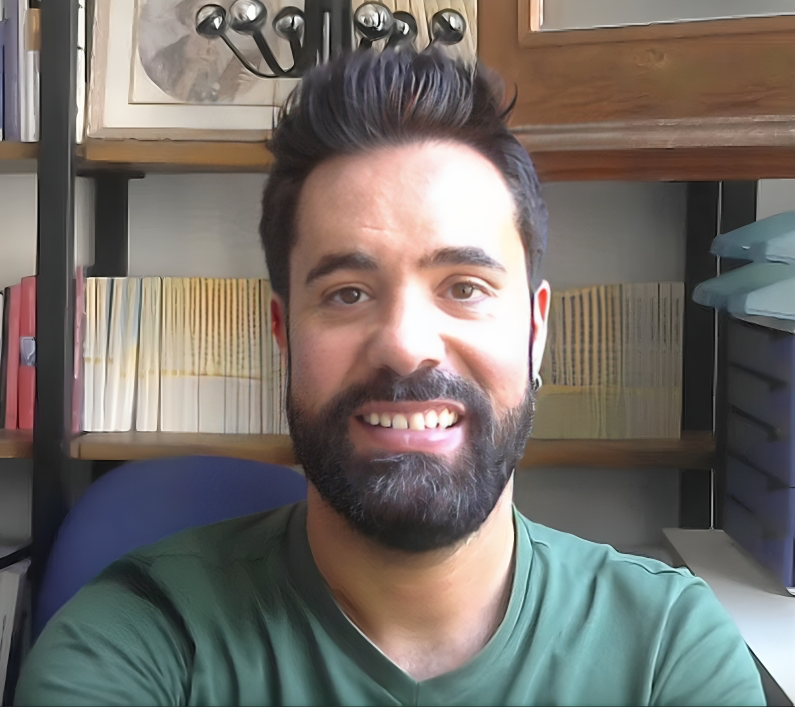
Laura Maria Lojo Rodriguez is a Professor in the Department of English and German Philology at the University of Santiago de Compostela , specializing in British literature and modernist/postmodernist fiction. She leads the Discourse and Identity research group (GI DI-1924), focusing on English language, literature, and culture through interdisciplinary frameworks. Her work intersects with the Humanities Research Institute (iHUS) . Her research spans: Gender and identity in Woolfian studies Migration narratives in contemporary short fiction Postcolonial themes in British-Irish literature Ecocritical and posthuman anxieties in Johnson's works Recent publications examine border politics, maternal discourses, and cross-cultural literary bonds. She has also contributed to translation studies, particularly Woolf's Spanish reception. Her academic output bridges literary theory with socio-political analysis.
Miguel Ángel Bernal Merino serves as a Part-Time Lecturer in the Department of Modern Philology, Translation and Interpretation at the University of Las Palmas de Gran Canaria. Concurrently, he acts as convener of the MA in Translation at the University of Roehampton in London, managing its Specialised Translation, Audiovisual Translation, and Intercultural Communication pathways since 2005. His academic profile bridges theoretical research and industry application in localization disciplines. PhD in The Localisation of Video Games, Imperial College London MSc in The Localisation of Multimedia Interactive Entertainment Software, Imperial College London Certificate in Software Localisation, University of Limerick CELTA, University of Cambridge MPhil in Lip-Synched Dubbing, Universidad de Alicante MA in Hispanic Literature, University of Rhode Island BA in English & Spanish Linguistics, Universidad de Alicante Bernal Merino's research pioneers the expansion of Translation Studies into interactive media domains. His work on video game localization examines interactivity, cultural adaptation, glocalisation, and playability, while his audiovisual translation research investigates creativity in lip-synched dubbing, subtitling, and audiodescription. He extends these frameworks into gaming-based language learning through haptic environments and multisensory reinforcement, exploring physiological aspects of multilingual cognition and polysemiotic neural networks. This multidisciplinary approach fundamentally challenges traditional boundaries in translation theory. His publication trajectory reveals evolving industry-academia integration, shifting from foundational game localization frameworks (2008-2015) toward user-centered research and educational applications (2018-2024). Recent work emphasizes measurable business impacts through quality localization, regional market adaptations, and crowd-sourced methodologies, demonstrating consistent influence on professional standards across gaming and translation sectors. Fellow of the Higher Education Academy Bernal Merino supervises doctoral research on mobile game localization, transmedia fan experiences, and historical game content translation while developing industry-academia pipelines through projects like AHRC's Media Across Borders. His funded initiatives—including Maximising ROI through Quality Game Localisation and Video Games for Language Learning—bridge theoretical innovation with commercial implementation, focusing on glocalisation strategies, interactivity metrics, and playability optimization. These collaborations connect European universities, gaming studios, and localization service providers. As chair of the IGDA Localization SIG and member of GIR Discourse, Communication and Society, he directs international forums for game localization discourse. His work with Routes into Languages promotes audiovisual media in language education, while REF-readiness collaborations enhance research excellence across European institutions through his professional network spanning industry conferences like GDC Summit and Game Global.
Vicente Cervera Salinas is a Professor of Spanish Literature at the University of Murcia, affiliated with the Faculty of Arts and Humanities and the Department of Spanish Literature, Literary Theory and Comparative Literature. He has been a full professor since 2004 and specializes in Latin American literature, intertextuality, and literary theory. His research interests include: Spanish and Latin American Literature Comparative Literature and Intertextuality Poetry and the Essay as Literary Genres Classical Mythology and its Modern Reinterpretations Aesthetic Criticism and Cultural Memory Philosophical Dimensions in Literature His scholarly and creative work reflects deep engagement with figures like Jorge Luis Borges, Dante Alighieri, and George Santayana. His publications span poetry, critical essays, and editorial projects, often exploring the intersections between literature, philosophy, and cultural identity. The themes across his recent articles reveal a consistent focus on myth, authorship, and transatlantic literary traditions, particularly in Hispanic contexts. He has received recognition including the Second Prize in the America Poetry Prize (1993). He co-directs the journal Cartaphilus: Revista de investigación y crítica estética and has directed the Humanities Classroom at the University of Murcia. He served as president of the Association of Hispanic American Literary Studies (2014–2018). He has supervised at least one doctoral thesis and has been a visiting professor at institutions in Havana, San José (Costa Rica), Buenos Aires, and Vienna. His academic leadership includes editing multi-volume works on literary figures and movements, contributing significantly to the study of Hispanic intellectual and aesthetic traditions. He leads the research group Plural Scriptures: Intertextuality and Interdisciplinarity , continuing to influence both literary scholarship and creative writing in Spain and Latin America.
Bruno Echauri Galván serves as Associate Professor in the Department of Modern Philology at the University of Alcalá (UAH), Spain, teaching core translation courses including Introduction to Translation Theory and English-Spanish Translation across multiple degree programs in Alcalá de Henares and Guadalajara. His research centers on Translation Studies and Reception Theory, with significant contributions to intersemiotic translation (particularly in children's literature), healthcare interpreting, and film adaptation reception. As an active member of the Research Group on Interdisciplinary Reception Studies, he investigates cultural reception, literary reception, and translation through frameworks including cultural mediation, censorship studies, and myth reception. Recent publications (2021-2024) demonstrate consistent innovation in translation pedagogy, including color-based translation assessment tools, service-learning translation projects, and pandemic-era teaching adaptations. His work on collaborative writing projects, mental health communication, and Carver-Lish translation controversies reveals methodological diversity across literary, audiovisual, and healthcare domains. Dr. Echauri Galván has participated in multiple research initiatives including the JOB AND MOVE student network project (2018), Homopoly strategic partnership (2016), and InterMed healthcare mediation project (2011), where he contributed expertise in intercultural communication and translation standards. He maintains active research leadership through the Interdisciplinary Reception Studies group, examining reception phenomena across cultural, literary, musical, and translational contexts while addressing contemporary issues like censorship and myth criticism.
Antonio Terrón Barroso is a predoctoral researcher at the University of Barcelona's ADHUC Research Centre (Theory, Gender, Sexuality) and UNESCO Chair on Women, Development, and Cultures. He holds a Postgraduate Certificate in Social Science Research (Aston University), Master's in Teaching (PGCE, King Juan Carlos University), dual Bachelor's degrees in Translation Studies (University of Granada) and Communication (Open University of Catalonia), and a Tourism Diploma (University of Granada). Research Focus: Gender violence discursive normalization in 19th-century peninsular women's press through digital humanities methodologies. Key subfields include national/gender identity construction via literature and cinema, multilingual translation dynamics, and transnational reception studies. Teaching Experience: International roles at University of Birmingham (Spanish Teaching Fellow), Panthéon-Assas University (Spanish Lecturer), Aston University (Spanish/Translation Teaching Assistant), Cardiff University (Spanish Associate Tutor), and University of Massachusetts Amherst (Hispanic Studies Visiting Teaching Associate). Scientific Awards: FPI Predoctoral Researcher Contract (MINECO) Key Collaborations: Working with Dr. Elena Losada Soler and Dr. María Xesús Lama López on the Género, violencia y representación project. Affiliated with the consolidated research group 'Women's Creation and Thought' (2021 SGR 01097).
FRANCISCO J LOPEZ ALFONSO is an Associate Professor affiliated with the Department of Spanish Philology at the Universitat de València. His academic career centers on Spanish and Latin American literary studies, particularly focusing on narrative structures and authors such as César Vallejo. His research interests lie primarily in Spanish Literature , Hispanic Literary Studies , and Philology , with a specialized focus on narrative theory and 20th-century Latin American writers. His doctoral work on César Vallejo reflects a deep engagement with avant-garde poetry and narrative traces in literary discourse. While no publications are listed in the provided text, his academic profile suggests a trajectory rooted in humanistic scholarship, textual analysis, and literary criticism within the Iberian and Latin American contexts. There are no listed scientific awards or honors in the available information. He has supervised at least one PhD thesis, specifically on César Vallejo, las trazas del narrador , completed in 1991 under the supervision of Dr. Sonia Mattalía, though no advisees are named. There is no mention of research grants, laboratories, or collaborative teams in the provided data.
Carlos Pérez Varela is a Lecturer in the Department of French Philology at the University of Santiago de Compostela. His teaching focuses on French language, literature, and culture across multiple degree programs, including Modern Languages and Literatures, Classical Philology, and Galician Language and Literature. Specializes in Francophone literary analysis Teaches courses on French culture and language history Coordinates tutoring schedules for students Research interests include cross-cultural relationships between Francophonie and Hispanic cultures, with pedagogical implications in language learning and literary studies. His work emphasizes the integration of French language and literature into broader educational frameworks.
Waya Quiviger is a Professor at the IE School of Global & Public Affairs and Executive Director of the Transatlantic Relationship Initiative (TRI) at IE University. She teaches courses on Global Governance, International Institutions, and Social Entrepreneurship. With a career spanning international organizations and academia, she focuses on fostering transatlantic dialogue through TRI’s initiatives like the Observatory on Canada. Her research bridges theory and practice in global affairs, emphasizing national interest frameworks and socio-economic development strategies. A global citizen by philosophy, her work reflects a lifelong passion for cross-cultural understanding and international policy. Education background includes studies in business and international relations, with professional experience at the World Economic Forum in Geneva before transitioning to academia. Her research interests intersect global governance, transatlantic relations, and entrepreneurship-driven development. She actively contributes to policy discussions through TRI’s forums on European affairs and US-Hispanic political dynamics. Outside academia, Waya is an avid reader of literature and non-fiction, currently revisiting Toni Morrison’s works. Her eclectic poster collection from global art exhibitions adorns her office, reflecting her multicultural experiences across 10 countries.
José Juan Morcillo Pérez is a Visiting Professor at the Universidad Pontificia de Salamanca 's Faculty of Humanities and Social Sciences. Holding a 'Cum Laude' Doctorate in Hispanic Philology from the University of Salamanca (2002), he has held teaching positions at the University of St. Andrews, Universidad de Castilla-La Mancha, and the Universidad Pontificia de Salamanca's International Courses. His research focuses on Renaissance Spanish literature Francisco de Osuna's linguistic innovations Lazarillo de Tormes authorship debates Historical linguistics Cultural intersections of law and literature His 2002 doctoral thesis presented a critical edition of Francisco de Osuna's Abecedario Espiritual (1528-1530), analyzing its linguistic registers and neological contributions. He has received recognition for educational innovation projects, particularly in bilingual education and technology integration (2006-2007). Academic contributions include: Pioneering textual editions of Spanish Golden Age mystical works Interdisciplinary analysis of legal discourse in picaresque novels Lexical studies connecting Renaissance humanism with theological expression Scientific recognition includes: Doctor 'Cum Laude' , University of Salamanca (2002) Award for innovative educational project in Castilla-La Mancha public education system
María Durán Eusebio is a Lecturer in English at the Institute of Modern Languages, University of Alcalá. She teaches English language courses across various undergraduate programs including Education, Cybersecurity and AI, Criminology, and Law, as well as in the Master’s program for Secondary and Vocational Education. She currently serves as the Communication and Social Media Coordinator at the Institute of Modern Languages (ILM). Educational Background: Doctorate in Modern Languages: Research in Language, Literature, Culture, and Translation – Universidad de Alcalá (UAH) Master’s in Black British Writing – Goldsmiths, University of London Bachelor’s in English Studies – Universidad de Alcalá (UAH) Her research lies at the intersection of Anglo-Saxon literature, socio-political paradigms, and archival practices, with a strong emphasis on intercultural and transcultural perspectives. She specializes in Black British Writing, feminist activist literature, verbatim drama, queer identities in African-set narratives, and the representation of social exclusion and resilience in contemporary theatre. Her work critically engages with postcolonial identities, cultural assimilation, and the liminal experiences of Afro-descendant communities in Spain and the UK. María Durán Eusebio has actively contributed to national and international academic discourse through conference presentations on the Black British literary canon and Spanish literature by authors of African descent. Her scholarly output includes several publications analyzing identity, resistance, and marginalization in contemporary literary and dramatic works. Scientific Contributions and Recognition: Author of significant research articles on queer identities, feminist verbatim drama, and transcultural identity in literature. Active participant in academic conferences focusing on postcolonial and Afro-Hispanic literary studies. She advises on institutional communication strategies as Coordinator of Communication and Social Media at ILM, bridging academic research with public engagement. While no formal grants or student supervision are mentioned, her interdisciplinary research trajectory demonstrates a commitment to socially engaged literary scholarship. Laboratories, Teams, and Collaborative Work: She is actively involved in research and academic outreach within the Institute of Modern Languages, contributing to its communication strategy and promoting research in modern languages, particularly in underrepresented literary traditions.
María Ayete Gil is a researcher in the Department of Filology, Communication and Documentation at the University of Alcalá, specializing in contemporary Spanish literature, political narratives, and gender studies. She is an active academic with a PhD from the University of Salamanca and a member of the GILCO (Contemporary Literature Research Group). Her work explores the ideological dimensions of literature, particularly in relation to social movements like 15M, rural representations, and feminist discourse. Her research interests include: Political Literature Gender and Intersectionality Neorural Narratives Marxism and Critical Theory Contemporary Spanish Fiction Literary Ideology and Power Her scholarly output reveals a strong focus on authors such as Sara Mesa, Bibiana Collado Medrano, and Federico Falco, analyzing themes of precarity, moral authority, and the politicization of narrative form. Her recent publications (2023–2025) demonstrate sustained engagement with evolving literary trends, particularly the role of literature in social critique and resistance. She frequently publishes in specialized journals such as Kamchatka , Orillas , and Revista Chilena de Literatura . Her work reflects a deep theoretical engagement with thinkers like Rancière, Badiou, Bourdieu, and Foucault. She has co-edited volumes and organized academic events, including an international conference on rural representations in Hispanic literatures. While no formal list of advisees is provided, her supervisory role in thesis work and collaborative research suggests mentoring activity. Among her scientific contributions are critical editions and reviews on works addressing revolution, feminism, and literary resistance. She has also conducted interviews with prominent authors, further establishing her role in contemporary literary discourse. She is affiliated with the University of Alcalá, contributes to interdisciplinary research, and maintains an active presence in academic networks. Her publications consistently address the interplay between literature, ideology, and social transformation, positioning her as a significant voice in current Spanish literary criticism.
K. Josu Bijuesca Basterretxea is an Assistant Professor at the University of Deusto, affiliated with the Bilbao campus. His work focuses on Basque and Hispanic philology, with an emphasis on Basque literature, subaltern studies, and colonial-era rhetorical theory. BA in Basque Philology, University of Deusto BA in Hispanic Philology, University of Deusto PhD in Hispanic Languages and Literatures, University of California at Santa Barbara (UCSB) His research explores the genealogy of subaltern conditions in Basque literature, the intersection of ancient regime religious texts and rhetorical theory, and the legacy of Mexican writer Sor Juana Inés de la Cruz. He teaches courses on Basque Language and Culture, Modern Languages, and interdisciplinary programs combining these fields. He maintains an active academic presence through publications addressing Basque literary identity and colonial-era discourse. Office hours are available via email contact at josu.bijuesca@deusto.es.
Pedro Luis Ladrón de Guevara Mellado is a Professor at the Universidad de Murcia, affiliated with the Department of French, Romanesque, Italian and Arabic Philology within the Faculty of Arts and Humanities. He holds a Ph.D. from the Universidad de Murcia (1987) with a thesis on Dino Campana's poetry. His research focuses on Italian philology, comparative literature, and the interplay between Spanish and Italian literary traditions. Key interests include the analysis of poets like Leopardi, Cernuda, and Campana, as well as cultural exchange studies and translation's role in canon formation. His work explores topics such as Italian influence on Spanish writers, the reception of Italian poetry in Hispanic contexts, and the aesthetic dimensions of narrative and poetic forms. Notable contributions include studies on Ramón Gaya’s Italian-inspired writings, the impact of Leopardi on Cernuda, and the symbolic use of color in Dino Campana’s verses. Publications span scholarly articles and reviews, with recent works analyzing cultural dimensions of exile and artistic migration. He actively contributes to academic networks, including the CERCLE European Cultural Center in Murcia, promoting interdisciplinary education and literary exchange.
Dr. Almudena Del Olmo Iturriarte is a Full Professor in the Department of Spanish, Modern and Classical Philology at the University of the Balearic Islands. She has been teaching at the university since 1993 and was promoted to Full Professor in 2000. Her academic career spans over three decades with continuous contributions to Hispanic Philology and Spanish Literature studies. Her educational background includes a Graduate degree in Hispanic Philology (1990) with an Extraordinary Award and a PhD in Hispanic Philology (1993) from the University of Valladolid. Dr. Del Olmo Iturriarte's research focuses on contemporary Spanish literature from Spanish poetic modernism to postmodern poetics. Her work encompasses studies on modernist authors, the Generation of '27, the Group of '50, and contemporary poets, with special attention to poetry written by women. She has made significant contributions to the understanding of classical tradition, intertextuality in postmodern lyric poetry, and ekphrasis in contemporary Hispanic poetry. Her scholarly publications demonstrate a consistent trajectory of research excellence, with recent works including Juego de damas (2023) on women's poetry and multiple monographs on prominent Spanish poets. Her research spans medieval Spanish literature through contemporary works, showing remarkable breadth across historical periods. Her scientific recognition includes: Extraordinary Award for her Hispanic Philology degree (1990) Six quinquenios (teaching merit periods) Complement of stimulus and recognition of teaching and continuing education (2020) Four six-year research periods (last awarded in 2024) Complement of stimulus and recognition of research activity (2022) Complement of stimulus and recognition of research excellence (2020) Dr. Del Olmo Iturriarte has coordinated significant research projects including 'History, ideology and text in Spanish poetry of the 20th and 21st centuries' (2020-2023) and organized important academic conferences on Classical Tradition and Intertextuality (2011) and Ekphrasis and Artistic Imitation (2012). She teaches Medieval Spanish Literature I and II across multiple degree programs and offers specialized courses on Juan Ramón Jiménez and 20th Century Poetic Renewal in the Master's program.
Pedro Guijarro Fuentes is a Professor in the Department of Spanish, Modern and Classical Philology at the University of the Balearic Islands since 2013, with prior teaching appointments at Utrecht University (Netherlands, 1992-1995), University of Salford (UK, 1995-1998), and University of Plymouth (UK, 1998-2013). He holds a degree in Hispanic Philology from the University of Granada (1991) and a PhD in Philosophy and Letters from the University of Salford (UK, 1999). His research spans applied Spanish linguistics, sociolinguistics, psycholinguistics, and bilingualism, with current projects examining spatial prepositions, object marking, word order, and tense/aspect phenomena among Spanish language learners. His scholarly output includes numerous publications in top journals such as Language Learning , Bilingualism: Language and Cognition , Cognition , and Studies in Second Language Acquisition , with over 100 conference presentations worldwide. Research funding has been secured from the British Academy, Arts and Humanities Research Council, Deutsche Forschungsgemeinschaft, Spanish Ministry of Economy and Competitiveness, and European Commission (Horizon2020). Principal Researcher: Bilingualism and Acquisition of Spanish (BASLA) Member: Applied Linguistics (REGAL) research group Organizer: Romance Turn 2014 International Conference Teaching includes Spanish Psycholinguistics, Morphosyntax Acquisition in First and Second Languages, and final degree projects across Spanish Language and Literature and Education programs. His current tutoring hours are Wednesdays 14:00-15:00 in room CD10 - Ramon Llull.