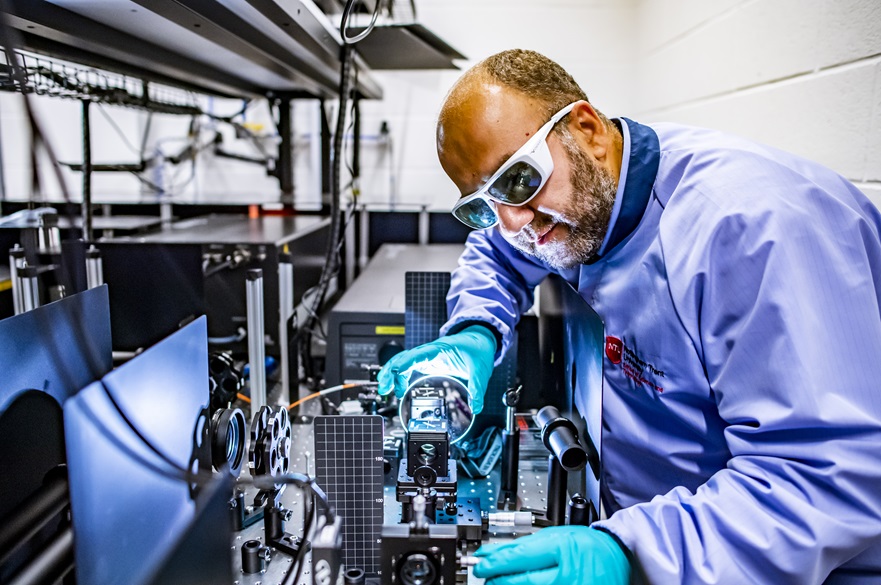
Al-Hafeez Z DhallaView profile
Assistant Professor
Al-Hafeez Z Dhalla serves as an Assistant Research Professor in the Department of Biomedical Engineering at Duke University and is a Faculty Network Member of the Duke Institute for Brain Sciences. His academic appointment reflects his engineering expertise in translating optical technologies to clinical ophthalmology applications. He earned his Ph.D. from Duke University in 2012, establishing a foundation for his specialized work in biomedical optics. This educational trajectory directly informs his current research and teaching activities within the university's engineering framework. Dr. Dhalla's research program centers on developing optical coherence tomography (OCT), scanning laser ophthalmoscopy (SLO), and LiDAR systems for non-invasive, high-resolution biological tissue imaging. His laboratory specifically targets ophthalmic disease diagnosis and treatment, with strong emphasis on engineering novel instrumentation for image-guided surgery and robotic microsurgery. A critical aspect of his work involves preparing these technologies for commercialization through rigorous clinical validation and regulatory approval processes, bridging the gap between engineering innovation and medical practice. His publication portfolio demonstrates consistent advancement in optical imaging technologies, particularly handheld OCT devices, real-time volumetric surgical imaging, and adaptive optics for photoreceptor visualization. The research exhibits a clear trajectory from fundamental optical engineering toward clinical implementation, with recurring themes of enhancing surgical precision through robotic integration and improving diagnostic capabilities via novel scanning methodologies. Within the educational sphere, Dr. Dhalla teaches multiple courses including BME 791 (Graduate Independent Study), BME 590 (Special Topics), BME 494/493 (Projects in Biomedical Engineering), and BME 436L (Biophotonic Instrumentation), directly connecting his research expertise to student training in optical instrumentation and biomedical device development.