Miroslav Rozložník serves as an Associate Professor in the Department of Numerical Mathematics at the Faculty of Mathematics and Physics, Charles University, with additional affiliation to the Institute of Mathematics of the Czech Academy of Sciences evidenced by his institutional homepage. His research centers on computational mathematics, specifically: Numerical linear algebra for large-scale systems Iterative solvers and convergence acceleration Preconditioning techniques in scientific computing High-performance numerical algorithms Dr. Rozložník actively supervises student theses as indicated by "Supervised work" on his academic profile, though specific advisee names and research grants remain undocumented in the source material.
Jakub Klímek is an Associate Professor at the Department of Software Engineering, Charles University. He is a leading researcher in Linked Data and Open Data technologies, with a focus on semantic interoperability, XML schema evolution, and data integration frameworks. Education: Habilitation Thesis: Improving data accessibility and interoperability using linked data Doctoral Thesis: XML Formats Evolution and Integration Master Thesis: XML Schema Evolution Bachelor Thesis: Linear Algebra His research spans semantic web technologies, dataset discovery, knowledge graph applications, and model-driven data engineering. Recent publications address technical and legal interoperability of European open data, context-enhanced similarity search, and data specification tools. Scientific Awards: BEST DEMO PAPER AWARD (ISWC 2024) BEST PAPER AWARD (iiWAS 2017) BEST STUDENT PAPER AWARD (APCCM 2013) BEST PAPER AWARD (EGOV 2013) Klímek contributes to practical applications through tools like UnifiedViews, LinkedPipes, and DataSpecer, collaborating with researchers including Petr Škoda, Martin Nečaský, and Jan Helmich. His work emphasizes real-world implementation of semantic data standards in public administration and enterprise systems.
Michal Outrata is an Assistant Professor in the Department of Numerical Mathematics at Charles University's Faculty of Mathematics and Physics in Prague, Czech Republic. He began his position in fall 2024 after completing a postdoctoral fellowship at Virginia Tech with Prof. Eric de Sturler and earning his PhD under Prof. Martin Gander at the University of Geneva, where his thesis was awarded the Henri Fehr Prize in 2023. His academic journey started with undergraduate studies in Prague under Prof. Zdeněk Strakoš (bachelor) and Prof. Miroslav Tůma (master). Dr. Outrata's research focuses on understanding why certain numerical methods work for specific problem classes, with emphasis on numerical linear algebra , Krylov subspace methods , and domain decomposition techniques . His work bridges theoretical analysis with practical algorithm development, particularly in preconditioning strategies for iterative solvers. Current projects include the Primus Research Programme (2025-2028) titled 'Divide, Conquer and Optimize: Domain Decomposition Methods in Scientific Computing' which explores hierarchical matrix formats and mixed precision computations for optimizing domain decomposition methods. His publication record demonstrates consistent contributions to top journals including SIAM Journal on Scientific Computing and Linear Algebra with Applications. His research shows progression from foundational work on GMRES convergence to sophisticated analyses of block Runge-Kutta preconditioners and optimized Schwarz methods with data-sparse transmission conditions. His recent work increasingly integrates hierarchical matrix formats and explores mixed precision computing approaches. Swiss Government Excellence Scholarship (3-year award) Henri Fehr Prize for best PhD thesis in mathematics (2023) Primus Research Programme grant (2025-2028) Dr. Outrata actively mentors students and postdocs, currently supervising Marouan Handa and Lenka Ptáčková (PostDocs) along with undergraduate researchers. He teaches courses including Numerical Analysis and Introduction to Numerical Mathematics at Charles University. His collaborative network spans international institutions including University of Geneva, Virginia Tech, and various European research centers. He is also involved in organizing major conferences including DD29 and GAMM95.
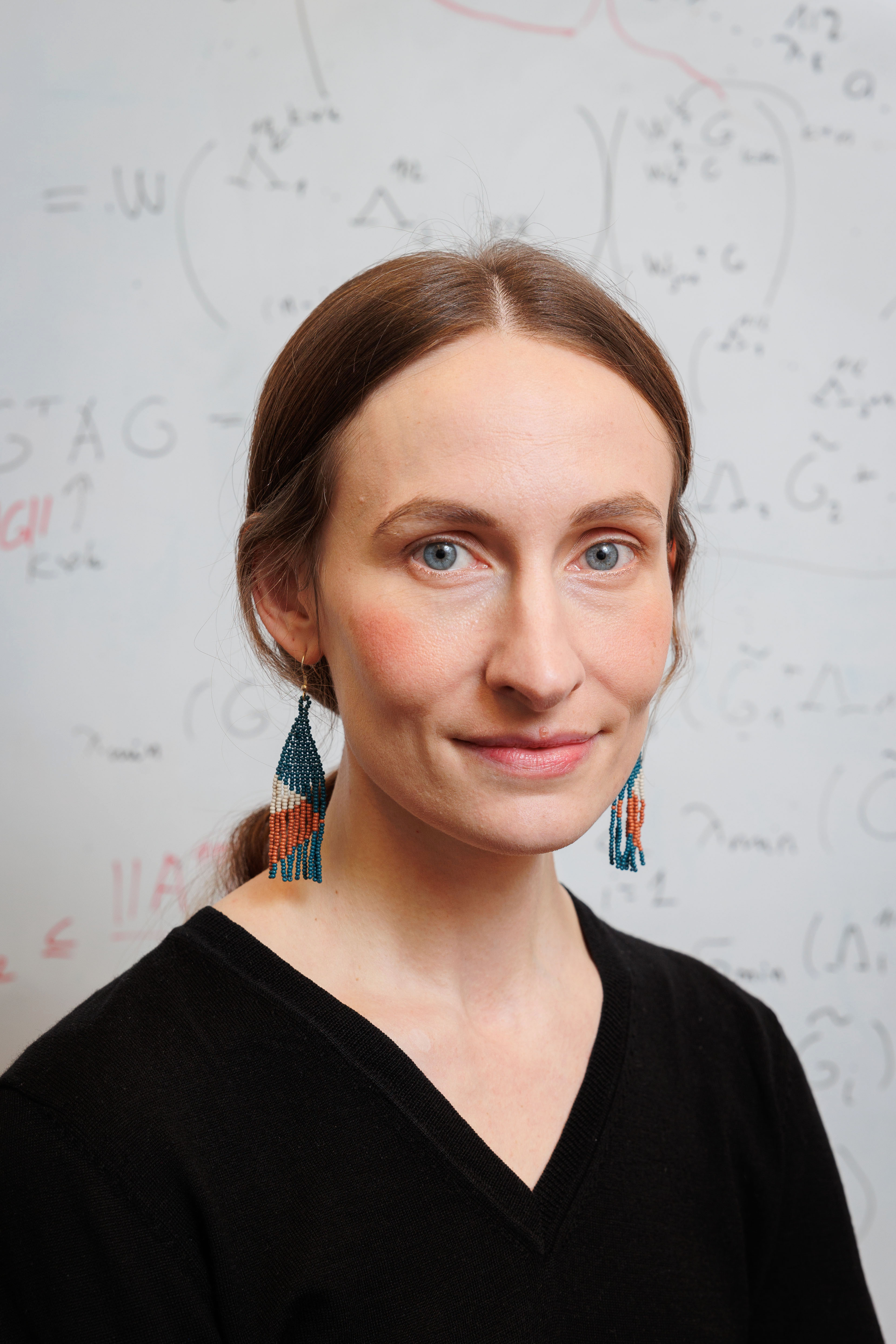
Erin Claire Carson is an Assistant Professor at the Department of Numerical Mathematics, Faculty of Mathematics and Physics, Charles University, Prague. A specialist in numerical linear algebra and high-performance computing, she leads the ERC Starting Grant project InEXASCALE focused on exascale algorithms. Her research explores mixed precision arithmetic, communication-avoiding Krylov subspace methods, and stability analysis in finite precision. Ph.D., University of California, Berkeley (2015) Courant Instructor, New York University (2015-2018) Postdoctoral Researcher and PRIMUS Fellow, Charles University (2018-2022) Dr. Carson's work bridges theoretical analysis with practical implementations for supercomputers. Her recent publications include advancements in low-synchronization orthogonalization, silent error detection, and multilevel sampling techniques. She received the 2025 Wilkinson Prize from SIAM for outstanding contributions to numerical analysis. Current trends in her research involve: Exploiting mixed precision arithmetic for algorithm acceleration Developing stable communication-avoiding Krylov methods Optimizing numerical stability in GPU-based solvers Understanding error propagation in multistage refinements Scientific honors: 2025 SIAM Wilkinson Prize in Numerical Analysis and Scientific Computing 2023 ERC Starting Grant recipient 2019-2022 PRIMUS Research Fellow She supervises PhD and Master’s students while teaching advanced courses in numerical linear algebra and high-performance computing. Her work has been featured in WIRED and Forbes Czech Republic for improving supercomputer algorithms.
Prof. Miroslav Tůma is a Professor in the Department of Numerical Mathematics at the Faculty of Mathematics and Physics, Charles University in Prague. He is part of the Workplace Scientific Council and can be reached at his office K 481 (5028) in the Karlín building (Sokolovská 49/83, Prague 8). His contact details include a phone extension 95155 3387 and an email address listed above. His professional profile includes teaching responsibilities, as evidenced by links to his teaching schedule and exam dates. He supervises academic work and maintains a homepage with further details at http://www.karlin.mff.cuni.cz/~mirektuma . His research interests are inferred to focus on numerical mathematics and computational methods given his departmental affiliation.
Tomáš Vojnar is a Professor at the Department of Intelligent Systems, Faculty of Information Technology, Brno University of Technology (FIT BUT), Czech Republic. He has been a faculty member since 1999, promoted to Associate Professor in 2007 and full Professor in 2012. He leads the VeriFIT research group and has extensive experience in academic leadership, including candidacy for Dean of FIT BUT in 2023 and chairing major conferences such as TACAS'19 and SV-COMP 2018. Research Interests: Static and dynamic analysis of programs, especially those with pointers and dynamic data structures Formal verification of concurrent and infinite-state systems Automata-theoretic and logical methods in verification Binary code analysis and performance analysis His recent publications show a strong trend in developing and applying static analysis tools for verifying memory safety, concurrency, and semantic equivalence in C programs. He has made significant contributions to tools like Predator, 2LS, and DiffKemp, which are widely used in the verification community and have achieved top rankings in international competitions such as SV-COMP. His work bridges theoretical foundations in automata and logic with practical software verification applications. Scientific Awards: Best theory paper award of ETAPS'10 (EATCS) Best paper awards at CADE'19 and CIAA'08 Best tool paper awards at ISSTA'18 and RV'12 Multiple gold, silver, and bronze medals in SV-COMP (Predator, 2LS, Symbiotic) Bronze Humies award for automated design of approximate circuits Gödel prize from FLoC 2014 Olympic Games 1 gold and 3 silver medals at SL-COMP'14 Siemens prize for outstanding PhD thesis (2001) Advising and Grants: He has supervised numerous PhD and Master's students who have contributed to major verification tools and publications. He has been actively involved in national and international research projects, including the Czech Science Foundation panel P103 (2019–2023), and has secured funding for research in formal methods and software verification. His collaborations span institutions in France (LIAFA, CNRS), Austria (TU Vienna), and beyond. Labs and Teams: He leads the VeriFIT research group at FIT BUT, which focuses on formal methods and software verification. The group develops state-of-the-art tools such as Predator (shape analysis), 2LS (heap verification), DiffKemp (semantic diffing), and others used in both academia and industry. The team actively participates in international verification competitions and collaborates with researchers worldwide.
Zdeňka Koupilová is a Lecturer at the Department of Physics Didactics , Faculty of Mathematics and Physics , Charles University in Prague. She teaches courses in Quantum Mechanics, Thermodynamics, Theoretical Mechanics, and Physics Education. Nuclear and Subnuclear Physics Quantum Physics Education Science Communication Experiential Learning Educational Technology Her research focuses on innovative physics teaching methods, particularly quantum and nuclear physics education. She has developed interactive tools like the Orbitals project for atomic visualization and electronic problem collections . Her work includes collaborations with ČEZ, a.s. on educational brochures like Jaderné hrátky and Učíme jadernou fyziku . Publications highlight her contributions to physics education and detector simulations for the ATLAS experiment at CERN. Though no scientific awards are listed, her efforts in educational outreach and conference participation (e.g., GIREP 2006, Veletrh nápadů) underscore her impact.
Martin Kruliš is an associate professor in the Department of Distributed and Dependable Systems at the Faculty of Mathematics and Physics, Charles University , Prague, Czech Republic. His primary roles include research, teaching, advising, and leading projects that bridge high-performance computing, GPU programming, and self-adaptive systems. Education: While exact details of his own degrees are not provided, Dr. Kruliš’s extensive publication record and faculty position at Charles University indicate advanced training in computer science with specialization in parallel and distributed computing. Research Interests: High-Performance GPU Computing: Deep investigation into CUDA kernel optimization, memory bandwidth utilization, and workload dispatching for massively parallel accelerators. Self-Adaptive & Self-Optimizing Systems: Designing ensemble-based abstractions that integrate machine-learning estimators to enable runtime adaptation in component architectures. Parallel Algorithms & Data Structures: Development of cache-friendly, SIMD-aware, and GPU-accelerated algorithms for clustering, dimensionality reduction, and similarity search. Software Engineering for Parallelism: Creation of C++ libraries, DSLs (e.g., Bobolang), and educational tools (ReCodEx) that simplify parallel programming and automated evaluation. Publication Trends: Across 2011–2025, Kruliš’s articles reveal a clear trajectory from foundational GPU-accelerated indexing and multimedia retrieval toward sophisticated self-adaptive systems that leverage machine learning. Recent works (2023–2025) increasingly focus on integrating LLMs and neural networks into compiler and runtime optimization loops, reflecting a convergence of AI and systems research. Scientific Awards & Recognition: No specific awards or fellowships are mentioned in the provided text; however, sustained publication in top-tier venues (JPDC, IPDPS, Euro-Par, SEAMS) and active involvement in program committees and tool development indicate strong peer recognition. Teaching & Student Supervision: Teaches Programming in Parallel Environment (NPRG042) , Advanced Programming in Parallel Environment (NPRG058) , Computer Systems (NSWI170) , and Software Projects . Supervises numerous bachelor’s and master’s theses; exact student names are not listed in the text. Labs, Projects & Tools: ReCodEx: A widely used platform for semi-automated evaluation of programming assignments at Charles University. Simdex: A modular simulator of the ReCodEx backend that enables realistic experimentation with self-adaptive job dispatching and machine-learning controllers. Active contributor to open-source repositories on GitHub, focusing on GPU kernels, benchmarking frameworks, and educational tooling.
David Bednárek is an academic affiliated with the Department of Software Engineering at Charles University's Faculty of Mathematics and Physics. He actively teaches programming, compilers, and cloud computing topics, with responsibilities in both winter and summer semesters. His research and teaching focus on software engineering , particularly C++ programming , compiler design , and high-performance computing . He maintains professional presence through platforms like ResearchGate, GitHub, and Google Scholar. David Bednárek can be reached at david.bednarek@matfyz.cuni.cz and is based in room S203, 2nd floor, Lesser Town, Prague 1.
Eva Fučíková serves as a Researcher at the Institute of Formal and Applied Linguistics (UFAL) within the Faculty of Mathematics and Physics at Charles University, Prague. Her office is located in the historic Lesser Town campus (Malostranské nám. 2/25, Prague 1), with contact accessible via email Eva.Fucikova@mff.cuni.cz and personal webpage http://ufal.mff.cuni.cz/~fucikova/ . Her research spans theoretical and applied linguistics with emphasis on computational approaches. Key focus areas include formal semantics, machine translation frameworks, and natural language processing systems development. The Institute of Formal and Applied Linguistics maintains international prominence in language technology research, particularly in European language processing and cross-lingual transfer learning methodologies. UFAL provides advanced computational resources including high-performance clusters for language modeling and speech processing. The institute actively participates in Horizon Europe projects and maintains strategic partnerships with major European research centers like DFKI and IMT Atlantique. Current research trajectories include low-resource language adaptation and multimodal language understanding systems. Collaborative opportunities exist through the institute's membership in the European Language Grid and participation in annual Prague Linguistics meetings. Prospective researchers should note UFAL's strong industry connections with localization companies and AI startups seeking natural language processing expertise.
Michal Töpfer is a PhD student and academic tutor at the Department of Distributed and Reliable Systems within the Faculty of Mathematics and Physics at Charles University in Prague. Holding the RNDr. degree (Doctor of Natural Sciences), he actively contributes to both teaching and research at the university. His academic affiliations include: Department of Distributed and Reliable Systems (D3S) Faculty of Mathematics and Physics Charles University Dr. Töpfer's research centers on integrating machine learning with software architecture, particularly for self-adaptive and component-based systems. His work develops systematic approaches to incorporate ML capabilities into software architectures, enabling systems that can self-optimize and adapt to changing conditions. He has made significant contributions to the DEECo component model through his ML-DEECo extension and has developed visualization components for the IVIS framework used in IoT applications. His publication trajectory shows increasing focus on leveraging large language models for software engineering tasks and optimizing component-based architectures. The research spans theoretical foundations of component models to practical implementations addressing real-world challenges in distributed systems, with applications in smart farming and Industry 4.0. As an educator, he teaches practical sessions for undergraduate courses including Introduction to Algorithms and Programming 1 during winter semesters and Programming 2 during summer semesters. While he supervises student work, specific advisees are not documented in available sources. He actively contributes to the academic community through organizing the Mathematical Correspondence Seminar (PraSe), the Young Mathematicians Camp, and the Kasiopea programming competition. His technical expertise spans web development, software architecture, machine learning integration, and data visualization.
Jiří Klimeš is an Associate Professor at the Faculty of Mathematics and Physics , Charles University , Prague, where he leads the APES group in the Department of Chemical Physics and Optics . He is the Principal Investigator of the ERC-funded project APES: Accuracy and precision for molecular solids . His expertise lies at the intersection of quantum chemistry, materials science, and computational physics. Education & Career: PhD in Theoretical Chemistry, University College London (UCL) , with Prof. Angelos Michaelides Post-doctoral research, University of Vienna , with Prof. Georg Kresse Marie Skłodowska-Curie Fellow, Heyrovsky Institute of Physical Chemistry , Prague Research Interests: Development of highly-accurate, low-scaling quantum-chemical methods (RPA, GW, MP2) Non-covalent interactions and van der Waals forces in molecular solids, surfaces, and confined systems Crystal-structure prediction and polymorphism of molecular crystals Adsorption on porous and layered materials (zeolites, graphene, TMDCs) Phase transitions and freezing of confined water Machine-learned potentials for molecular interactions Scientific Awards & Funding: European Research Council (ERC) Starting Grant APES (2020–2025) Marie Skłodowska-Curie Individual Fellowship, European Commission Supervision & Teaching: Current PhD students: Kyrylo Prokofiev, Pham Ngoc Khanh Former PhD student: Jaroslav Hofierka (MSc 2017 → PhD 2019) Post-doctoral researchers: Dr. Sirous Yourdkhani (current), Dr. Marcin M. Modrzejewski, Dr. Lu Ding (former) Lecture courses: Ab-initio methods for periodic systems , Introduction to quantum mechanics , Basics of quantum mechanics tutorials Labs & Facilities: The APES group operates a dedicated high-performance computing cluster funded by the ERC project, enabling routine RPA and GW calculations on systems with hundreds of atoms.
Martin Veis is a researcher at the Institute of Physics of Charles University in Prague, Czech Republic. His work focuses on magneto-optical properties , thin film physics , and advanced materials characterization . He collaborates extensively in interdisciplinary projects involving Heusler compounds , tellurite glasses , and carbon nanostructures . Research Themes : Investigation of magneto-optic effects in metallic and van der Waals systems Development of high-performance optical and photonic materials Structural analysis of epitaxial thin films and glassy systems Laser-based processing of boron-doped diamond electrodes Techniques : Spectroscopic ellipsometry, Raman/FTIR spectroscopy, X-ray diffraction, magnetometry, and ab initio calculations His publications demonstrate expertise in materials synthesis , magnetic domain engineering , and optical parameter determination across wide spectral ranges. Recent studies include systematic exploration of Fe 2 YZ Heusler compounds and VI 3 degradation mechanisms .
Roman Grill is a Professor at the Institute of Physics , Charles University. His research focuses on semiconductor materials, particularly CdTe and CdZnTe alloys, for radiation detection applications. He investigates defect structures, charge transport mechanisms, and surface treatments to enhance detector performance. Research Themes : Semiconductor defect spectroscopy, radiation detector physics, crystal growth optimization Techniques : Photo-Hall effect, transient current analysis, electromigration studies Recent publications highlight work on perovskite solar cells and CdTe-based radiation detectors , with an emphasis on light-induced defect dynamics and charge collection efficiency. His studies often involve collaborations with international institutions on materials like double perovskites and 4H-SiC . He has supervised numerous experimental and computational studies on semiconductor properties, including defect diffusion, polarization effects, and contact engineering. His work contributes to understanding deep-level defects and optimizing semi-insulating materials for high-radiation environments.
Roman Šenkeřík is an Associate Professor at the Department of Informatics and Artificial Intelligence within the Faculty of Applied Informatics at Tomas Bata University in Zlín (TBU Zlín). He serves as the Head of the Artificial Intelligence Laboratory (AILab) and has been actively involved in interdisciplinary research at the intersection of AI and complex systems. Specializes in evolutionary algorithms, neural networks, and hybridization of soft-computing techniques Focuses on optimization of process control using AI and development of metaheuristics Key interests include chaos theory, cryptology, and cybersecurity applications His research spans data mining, high-performance computing, and synthesis of complex systems. He has supervised over 80 bachelor's and master's theses and guided multiple doctoral students to successful completion. Scientific Awards: Best paper award at AETA Conference (2018) Best paper award at CISIM Conference (2014) Best paper awards at Nostradamus Conferences (2012, 2013) Best paper award at PCO Conference (2010) Prof. Šenkeřík has participated in numerous international collaborations through Erasmus and other mobility programs, including extended internships at University of Maribor (Slovenia) and Strathclyde University (UK). He is a Senior Researcher at CEBIA-Tech Regional Research Centre and has contributed to multiple EU-funded projects.