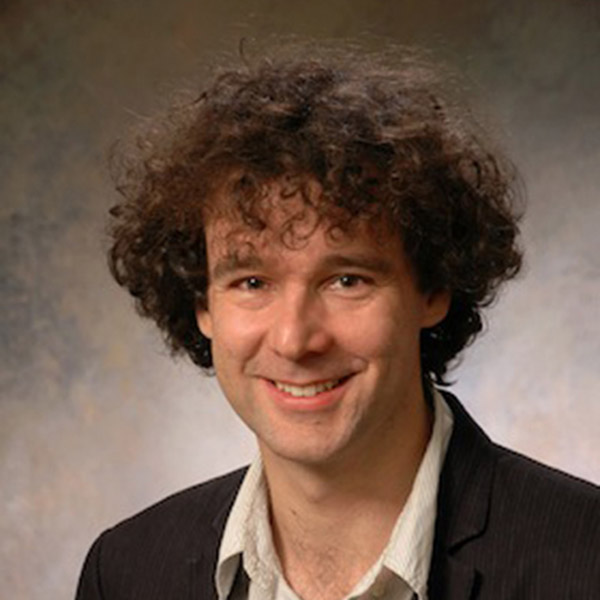
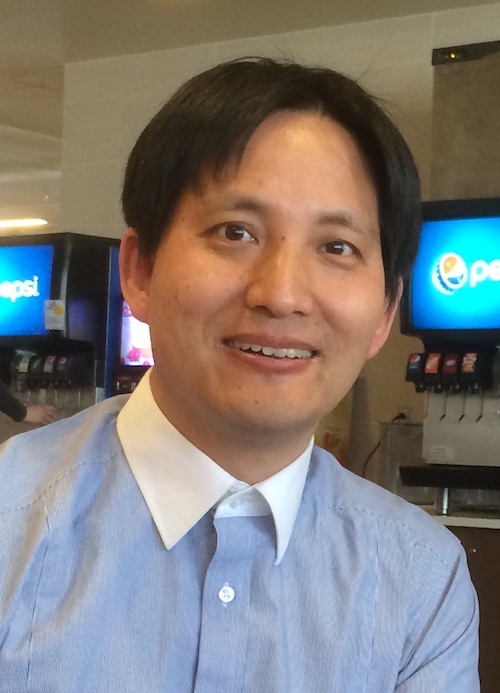
Marco Chiesa is an Associate Professor at the KTH Royal Institute of Technology in the Intelligent Network System Lab (INSight) group under the Division of Software and Computer Systems . His research focuses on computer networking, particularly Internet protocols and architectures, with emphasis on security, privacy, network design optimization, and Software Defined Networking (SDN) approaches. Current research areas: SDN, IXPs, stateful packet processing, network monitoring Teaching roles: Advanced Internetworking (IK2215), Computer Hardware Engineering (IS1200), Network Systems with Edge or Cloud Datacenters (IK2227) Email: mchiesa@kth.se Recent publications highlight advancements in high-speed packet processing, network security, and SDN applications. Key trends include leveraging programmable switches for stateful operations, improving BGP hijacking detection, and optimizing network monitoring on multi-pipeline architectures.
Michael D. Byrne is a Professor in both the Department of Psychological Sciences and the Department of Computer Science at Rice University. His interdisciplinary work bridges cognitive psychology, human-computer interaction, and computational modeling. Ph.D. in Experimental Psychology, Georgia Institute of Technology, 1996 M.S. in Computer Science, Georgia Institute of Technology, 1995 M.S. in Experimental Psychology, Georgia Institute of Technology, 1993 B.S. in Engineering (Magna Cum Laude), University of Michigan, 1991 B.A. in Psychology (High Distinction), University of Michigan, 1991 Byrne's research focuses on human factors and human-computer interaction, with particular emphasis on cognitive modeling, visual attention, decision-making, and human performance modeling. His work applies computational cognitive architectures like ACT-R to understand human behavior in complex interactive systems. He has made significant contributions to understanding procedural errors, visual search behavior, and usability of complex systems including voting technologies. His interdisciplinary approach combines rigorous experimental methods with sophisticated computational modeling techniques to predict and explain human performance. His recent publications reveal a strong focus on human error prevention, particularly in routine procedural tasks and voting systems. The research demonstrates consistent application of cognitive modeling approaches to practical human-computer interaction problems, with particular attention to visual attention mechanisms, error patterns, and usability assessment. His work spans theoretical cognitive science and applied human factors research, often addressing real-world challenges in system design and evaluation. Kavli Fellow, National Academy of Science, Fall 2009 Outstanding Associate for 2001-2002, Mary Gibbs Jones residential college, Rice University Distinguished Faculty Associate for multiple years at Rice University NIMH Postdoctoral Fellow National Science Foundation Graduate Fellow Georgia Institute of Technology President's Fellow Byrne has successfully secured substantial external funding from NASA, NSF, NIST, and ONR for research on human performance modeling, cognitive architecture, and human-computer interaction. His grants portfolio demonstrates strong interdisciplinary collaboration across computer science, psychology, and engineering domains. He has advised numerous graduate students and mentored undergraduate researchers in his lab. Beyond research, Byrne has served prominently on editorial boards for major journals including Human Factors, Cognitive Science, and Journal of Experimental Psychology: Applied. Byrne directs the Computer-Human Interaction Laboratory (CHIL) at Rice University, where his team conducts cutting-edge research on human performance modeling, cognitive architectures, and human-computer interaction. His lab has been particularly active in applying computational cognitive models to practical problems in system design, voting technology, and aviation human factors. The laboratory environment fosters interdisciplinary collaboration between psychology, computer science, and engineering students and researchers.
Mario Baldi is a researcher affiliated with the Polytechnic University of Turin, Italy , with significant contributions to computer networking , distributed systems , and software-defined networking . Key research themes: network function virtualization , programmable dataplanes , time-driven scheduling , and traffic analysis . Recent work focuses on RDMA-enabled compute offloading (2023) and DNN inference in network data planes (2023). Longstanding expertise in multicast routing , voice/data packet efficiency , and XML-based protocol parsing (2000–2006). Collaboration network includes Yoram Ofek , Fulvio Risso , and Han Hee Song , with 99+ publications spanning 1994–2023.
Ariful Azad serves as an Associate Professor in the Department of Computer Science & Engineering at Texas A&M University, where he leads research at the intersection of high-performance computing and graph analytics. His work focuses on developing scalable algorithms for graph machine learning with applications in bioinformatics and security informatics. Educational Background: Ph.D. in Computer Science, Purdue University (2014) B.S. in Computer Science and Engineering, Bangladesh University of Engineering and Technology (2006) Research Focus: Dr. Azad specializes in high-performance graph algorithms , particularly for distributed-memory systems. His pioneering work includes the Combinatorial BLAS library and novel approaches for graph neural networks (GNNs), with emphasis on explainability through Shapley values and optimization of sparse matrix operations. His bioinformatics research tackles large-scale metagenomics challenges through projects like Exabiome. Publication Trends: Recent publications (2023-2025) reveal three dominant themes: (1) Scalable GNN explanation frameworks using distributed Shapley values, (2) High-performance sparse linear algebra for graph embeddings and knowledge graphs, and (3) Bioinformatics applications in metagenomics and network alignment. His work consistently bridges theoretical algorithm development with practical implementations for exascale systems. Scientific Recognition: NSF CAREER Award (2024) for foundational contributions to scalable graph algorithms Indiana University Trustee's Teaching Award (2024) U.S. Department of Energy Early Career Award (2021) Research Leadership: As principal investigator for multiple federal grants, Dr. Azad directs projects advancing graph analytics at extreme scales. His work on Weapons of Mass Destruction knowledge graphs demonstrates applied security research, while Exabiome represents significant contributions to computational biology. He actively develops open-source tools like PLANETALIGN for network analysis benchmarking, fostering reproducibility in computational science.
Tyler Bletsch is an Associate Professor of the Practice in the Department of Electrical and Computer Engineering at Duke University's Pratt School of Engineering. He joined the Duke faculty in November 2015 after several years of work in industry with NetApp, bringing practical industry experience to his academic role. His teaching focuses on practical aspects of computer engineering and systems programming. Dr. Bletsch received his B.S. from North Carolina State University in 2004, followed by his D.Phil. from the same institution in 2011. His doctoral research focused on software security, particularly addressing code-reuse attacks. His research interests span hardware and software security, with a particular focus on Rowhammer vulnerabilities and mitigation techniques. He also explores power-aware computing for high-performance systems and has interests in robotics and technology education with an emphasis on project-oriented learning. Dr. Bletsch's publication record shows a consistent focus on computer security, particularly Rowhammer attacks and mitigation strategies in recent years. His earlier work addressed code-reuse attacks like Jump-oriented Programming and Return-oriented Programming. He has also contributed to power management research for high-performance computing systems. Dr. Bletsch is actively involved in mentoring students through the Duke Combat Robotics club and FIRST robotics teams. He teaches a variety of courses including Computer Architecture, Digital Systems, Computer and Information Security, and Engineering Software for Maintainability. His teaching philosophy emphasizes hands-on, project-based learning. He maintains an active research laboratory focused on computer security and has been featured in Duke Today for his educational video "Tyler Bletsch Takes You on a Tour of the Insides of a Computer," which demystifies computer hardware for general audiences.
Amanda Bienz serves as an Assistant Professor in the Department of Computer Science at the University of New Mexico (UNM), where she leads the Scalable Solvers Lab and acts as faculty advisor for Women in Computing. Her academic roles include teaching operating systems and parallel computing courses while spearheading efforts to restructure New Mexico's CS4ALL curriculum for statewide computer science education expansion. Her research centers on overcoming communication bottlenecks in high-performance computing systems, specifically targeting the performance gap between emerging exascale hardware and real-world applications. Key focus areas include developing portable communication optimizations, enhancing MPI collective operations, creating topology-aware message passing extensions, and benchmarking heterogeneous architectures. Her work directly addresses critical challenges in scaling parallel applications through innovations in sparse solvers, neighborhood collectives, and node-aware communication strategies for GPU-accelerated systems. Analysis of her 2022-2024 publications reveals consistent emphasis on communication optimization across diverse HPC domains. Her research demonstrates particular expertise in irregular communication patterns, locality-aware algorithms, and performance modeling for heterogeneous architectures. Significant contributions include novel approaches to sparse dynamic data exchange, compressed linear algebra algorithms, and persistent communication techniques that reduce synchronization overhead in large-scale simulations. Scientific Awards: NSF CAREER Award for "Towards Exascale Performance of Parallel Applications" Dr. Bienz actively mentors students through the Scalable Solvers Lab, welcoming new researchers interested in high-performance computing. Her NSF CAREER grant provides substantial research funding supporting both technical innovation and educational initiatives. The CS4ALL curriculum restructuring project demonstrates her commitment to broadening computer science access throughout New Mexico's K-12 education system. The Scalable Solvers Lab develops open-source tools including the Raptor algebraic multigrid solver and MPI-Advance communication library. Current projects focus on benchmarking heterogeneous architectures (Summit/Lassen supercomputers), optimizing FFT implementations, and creating node-aware communication strategies for conjugate gradient methods. The lab maintains active GitHub repositories with substantial community engagement, including contributions to CUDA-aware MPI implementations and halo exchange libraries for multi-GPU systems.
Professor Gareth Taylor is a Professor of Power Systems and Director of the Brunel Interdisciplinary Power Systems (BIPS) Research Centre at Brunel University London's College of Engineering, Design and Physical Sciences. He serves as Module Leader for the MSc Sustainable Electrical Power program and has been actively involved with the university since May 2000, progressing from National Grid Post-doctoral Scholar to his current position as Professor (appointed in 2012). He previously served as Head of the Department of Electronic and Electrical Engineering from May 2019 to June 2023 and holds a Visiting Professor position at Imperial College London (2023-2026). Professor Taylor earned his BSc in Applied Physics from Royal Holloway College, University of London (1987), followed by an MSc in Scientific and Engineering Software Technology from the University of Greenwich (1992), and completed his PhD in Computational Solid Mechanics at the University of Greenwich in March 1997. His doctoral research focused on finite volume methods for material non-linearity within multi-physics frameworks. His research spans power systems engineering with particular emphasis on smart grid technologies, renewable energy integration, and advanced computational methods. Professor Taylor has contributed to over 250 research publications in areas including power system operation and management, reactive power control, voltage regulation, and high-performance computing applications in electrical power systems. His work addresses critical challenges in modern power systems, particularly those related to the integration of renewable energy sources and the development of more resilient grid infrastructure. Analysis of his recent publications reveals a strong focus on addressing contemporary power system challenges, particularly the integration of renewable energy sources, smart grid technologies, and advanced computational methods. His work spans from fundamental power system analysis to practical applications in grid operation, with increasing emphasis on cybersecurity aspects of power system monitoring and the challenges posed by reduced system inertia in grids with high renewable penetration. Senior Member of IEEE Fellow of the Institute of Engineering and Technology (FIET) Chartered Engineer Fellow of the Higher Education Academy (FHEA) UK Regular Member for CIGRE Study Committee D2 (2016-2022) Member of Strategic Advisory Group for CIGRE Study Committee D2 (2023) Professor Taylor has led numerous significant research projects including TDX-ASSIST (€5.2M), e-HIGHWAY2050 (€8.2M), and HiPerDNO (€5.4M), with funding from EPSRC, European Commission, National Grid, and other major organizations. His current research portfolio includes projects on novel decoupled active/reactive power oscillation response, digitalization of power systems operation, and examining net zero policy in European energy markets. He also directs the BIPS Research Centre, which focuses on interdisciplinary power systems research with strong industry connections.
Ramon Canal is a Professor at the Universitat Politècnica de Catalunya (UPC), affiliated with the Barcelona School of Informatics and the Computer Architecture Department. He has served as Vice Dean of postgraduate studies and leads the VirtuOS (Virtualization and Operating Systems) research group. His academic background includes BSc, MSc, and PhD from UPC, with thesis supervision by Antonio González (UPC) and James E. Smith (University of Wisconsin-Madison). He completed sabbaticals at Harvard University (2006-2007) and University of Cyprus (2019-2020). Education: PhD, MSc, BSc in Computer Engineering (UPC) Research focus: Microarchitecture security, reliability across circuit/system levels, cloud optimization Recent publications address privacy in IoT, secure hardware accelerators, and safety-critical systems. His work contributes to the DRAC project (2019-2022), Red-RISCV network, and Horizon's Vitamin-V project. Awards include HiPEAC Paper Awards, IEEE Senior Member status, Fulbright recognition, and multiple education excellence accolades. Scientific Honors HiPEAC Paper Award (ISCA-44, 2017) IEEE Senior Member (2016) Best Paper Nominee (ICCD-32, 2014) UPC Outstanding PhD Award supervision (2011) He advises current MSc students and has mentored multiple PhD graduates. Professional activities span academic leadership, research collaborations with Barcelona Supercomputing Center (BSC), and technical contributions to reliability analysis frameworks like RECIPE and FRACTAL.
Ana Lucic is an Assistant Professor in Artificial Intelligence at the University of Amsterdam , with a joint appointment between the Institute for Logic, Language and Computation and the Informatics Institute . Her research focuses on interpretable machine learning applications for scientific discovery and societal impact. Formerly at Microsoft Research AI for Science and Partnership on AI PhD in Explainable Machine Learning from University of Amsterdam (2022) BSc/MSc in Mathematics from McMaster University Research Highlights: Develops mechanistic interpretability methods for deep learning architectures. Created Aurora , a foundation model for Earth system forecasting outperforming traditional operational models in air quality prediction and tropical cyclone tracking. Pioneers Clifford-Steerable CNNs for geophysical data analysis. Actively hiring PhD students for AI transparency research . Collaborative Networks: Contributions to ELLIS Summer School and ICML workshops . Collaborates with Microsoft Research AI for Science team on climate-related ML projects. Involved in organizing TerraBytes workshop at ICML 2025. Recent Advancements: Key role in publishing Aurora model in Nature (2025), demonstrating superior performance in Earth system forecasting. Supervises Ege Erdogan , new PhD student focused on mechanistic interpretability. Actively contributes to open-source AI development through GitHub repositories and technical discussions.
Ben Hodges is a Professor in the Civil, Architectural and Environmental Engineering (CAEE) Department at the University of Texas at Austin, holding the Marion E. Forsman Centennial Professorship in Engineering. He specializes in environmental and water resources engineering, with a focus on computational fluid dynamics (CFD), urban stormwater drainage modeling, and river dynamics. His research bridges hydraulics, geospatial analysis, and environmental fluid mechanics, addressing challenges like flood modeling, water distribution systems, and supersaturated dissolved gas management. Education: Ph.D., Civil Engineering, Stanford University (1997) M.S., Mechanical Engineering, George Washington University (1991) B.S., Marine Engineering/Nautical Science, U.S. Merchant Marine Academy (1984) Research Interests: Development of computational models (e.g., SPRNT, Frehd, SUNTANS) Oil spill transport modeling, saltwater intrusion, and continental river networks High-performance parallel algorithms and hydraulic simulation tools His work emphasizes practical applications, such as designing stormwater systems and predicting environmental impacts like oil spill trajectories. He collaborates on projects with organizations like IBM Research Austin and the U.S. EPA, contributing to tools like the SWMM5+ and PTSNet simulators. Hodges advises a dynamic graduate research group (JETlab) and maintains active involvement in academic conferences and international collaborations.
Kate Smith is an Assistant Professor of Computer Science at Northwestern University, affiliated with the McCormick School of Engineering. She holds a PhD in Electrical Engineering from Southern Methodist University (SMU), along with MS and BS degrees in Electrical Engineering and Mathematics from the same institution. Her research focuses on quantum computing, specifically in system architecture, optimized compilation, error mitigation, and security. Prior to joining Northwestern in 2024, she worked at Infleqtion managing the Superstaq compiler team and as a postdoctoral scholar at the University of Chicago under the CQE/IBM program. She has contributed to over 25 peer-reviewed publications and served on technical committees for major conferences like MICRO, ISCA, and DAC. Education: SMU (PhD 2019, MS 2015, BS in EE/Math 2014). Professional experience includes roles at EPFL (Switzerland), Texas Instruments, and the Darwin Deason Institute for Cyber Security. Her honors include the 2022 HPCA Best Paper Award, MIT EECS Rising Star (2021), and the IEEE TC-MVL Early Career Award (2021). Research interests span quantum compilation, distributed systems, qudit processing, and quantum security. She co-organized the 2023 CCC Workshop on Next Steps in Quantum Computing and chaired the 2022 ISMVL conference. Her work emphasizes bridging hardware-software gaps to enable scalable quantum systems. Grants and collaborations include the EPiQC group at the University of Chicago and projects funded by the Swiss NSF. Teaching experience includes courses on quantum computing fundamentals and digital design at SMU, University of Chicago, and adjunct roles.
David P. Arnold is the George Kirkland Engineering Leadership Professor and Associate Chair for Faculty Affairs in the Department of Electrical and Computer Engineering at the University of Florida. He also serves as the Director of the Florida Semiconductor Institute and is a member of the Interdisciplinary Microsystems Group (IMG). His research focuses on magnetic materials, microsystems, and energy systems, with notable contributions in wireless power transmission, nanocomposites, and MEMS devices. Arnold holds degrees from the University of Florida (B.S., M.S.) and Georgia Tech (Ph.D.). He has led significant projects, including the NSF IoT4Ag Engineering Research Center for smart agriculture and advanced magnetic materials for millimeter-wave applications. His work spans academic leadership, with recognitions like the PECASE (2008) and DARPA Young Faculty Award (2009). Research interests include magnetic microdiscs for pathogen detection, electrodynamic wireless power systems, and high-performance CoPt magnets. His group collaborates on innovations like miniaturized antennas and energy-efficient sensors. Arnold has advised numerous students, many of whom have won awards for their contributions in MEMS, materials science, and biomedical applications. Awards include the HWCOE Leadership Award (2024), Fellow of the National Academy of Inventors, and multiple teaching/service distinctions. His labs and teams emphasize interdisciplinary approaches to address challenges in energy, healthcare, and precision agriculture.
Risi Kondor is an Associate Professor in the Departments of Statistics and Computer Science at the University of Chicago. His research focuses on machine learning, group theory applications, and equivariant neural networks. He develops algorithms respecting geometric and physical symmetries, with contributions to graph learning, quantum mechanics modeling, and multiresolution matrix factorization. Key projects include the development of Covariant Compositional Networks (CCNs) for graph-structured data and N-body networks for molecular simulations. He has created software tools like GraphFlow, SnOB (FFT for symmetric groups), and Mondrian for high-performance computing. His work bridges algebraic methods (e.g., Fourier analysis on permutation groups) with machine learning, addressing challenges in multi-object tracking, computer vision, and materials science. Risi Kondor holds grants including a DARPA Young Faculty Award ($500K, 2016–2018) and NSF funding for non-commutative harmonic analysis in machine learning. His research emphasizes theoretical foundations and practical applications, advancing areas like equivariant architectures, multiscale analysis, and symmetry-aware machine learning systems.
Dr. Shiyong Lu is Professor of Computer Science at Wayne State University and Director of the Big Data Research Laboratory. He holds a PhD from State University of New York at Stony Brook and has published over 140 papers in venues including IEEE Transactions on Services Computing and IEEE Transactions on Knowledge and Data Engineering. Research focuses on: Architecture of big data workflow systems Secure execution in cloud environments Optimization algorithms for distributed computing Provenance management for scientific workflows Recent work demonstrates strong emphasis on secure workflow execution, with 80% of last 15 publications addressing trusted computing environments. Leads NSF-funded DATAVIEW project for cloud-based big data analytics. Awarded IEEE TCSVC Outstanding Service Award (2023). Teaches core courses in Database Management Systems and Data Modeling. Supervised 17 PhD graduates, 10 of whom hold faculty positions. Editorial board member for International Journal of Big Data and International Journal of Big Data Intelligence.
Johnny Li is an Assistant Professor in the Department of Soil and Water Systems at the University of Idaho, affiliated with the College of Agricultural & Life Sciences. He leads the Precision Agriculture and Intelligent Robotics Laboratory (PAIR) and is an affiliate professor at the Center for Intelligent Industry Robot (CI2R). Education: PhD in Mechatronics (Central South University, 2012), M.S. in Material Science (Central South University, 2005), B.S. in Agricultural Engineering (Hunan Agricultural University, 2002). Research focuses on IoT/robotics sensing, control systems, and AI integration for precision agriculture, environmental management, and infrastructure monitoring. Key areas include autonomous robotics, remote sensing, crop modeling, and explainable AI for decision support systems. Publications emphasize machine learning applications in disease detection (citrus, tomatoes, grapes), wildfire monitoring, and infrastructure health assessment. Over 40 peer-reviewed papers and $1.5M in grants secured since 2019. Awards include NSF CGCA Panel Fellow (2022) and editorial role at Agricultural Engineering International: CIGR Journal (2013). Labs/Teams: PAIR Lab (founded 2022), CI2R collaboration, interdisciplinary partnerships with soil scientists, engineers, and computer scientists.


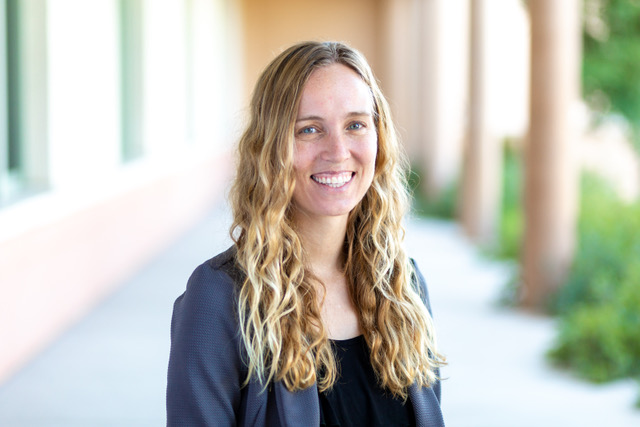

.JPG)