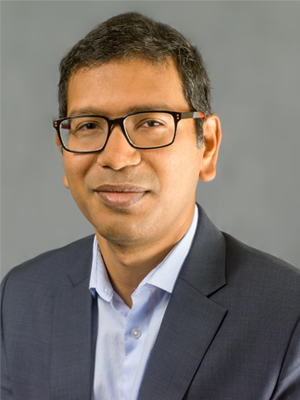
Srikanth Saripalli is Professor and Director of the Center for Autonomous Vehicles and Sensor Systems at Texas A&M. His research develops autonomous navigation systems for UAVs and ground vehicles, specializing in vision-based control, sensor calibration, and path planning algorithms for GPS-denied environments.

Santiago Paternain is an Assistant Professor in the Department of Electrical, Computer and Systems Engineering at Rensselaer Polytechnic Institute's School of Engineering. He joined RPI in 2020 after completing his Ph.D. and postdoctoral work at the University of Pennsylvania, where he developed foundational algorithms at the intersection of machine learning and control theory. His research bridges theoretical rigor with practical applications in robotics, power systems, and autonomous vehicles. His academic credentials include: B.Sc. in Electrical Engineering, Universidad de la República, Uruguay (2012) M.Sc. in Statistics, The Wharton School, University of Pennsylvania (2018) Ph.D. in Electrical and Systems Engineering, University of Pennsylvania (2018) Paternain's research centers on reinforcement learning and control of dynamical systems, with emphasis on safety guarantees, optimization, and real-world deployment. He develops algorithms that integrate model-based control with data-driven methods to overcome limitations of pure reinforcement learning, particularly for constrained and safety-critical applications. Current projects explore in-context learning for robotics, physics-guided AI for power grids, and multi-agent coordination in uncertain environments, always prioritizing theoretical soundness and practical viability. Analysis of his 15 most recent publications reveals a dominant focus on constrained reinforcement learning (60% of works), with growing applications in power systems (20%) and robotics (15%). A clear trend shows increasing integration of foundation models with control theory, particularly for safety-critical decision making. His work consistently addresses scalability challenges while maintaining rigorous safety guarantees, reflecting his commitment to bridging theoretical and applied research. His scientific contributions have earned significant recognition: Best Student Paper Award at ICASSP 2020 Joseph and Rosaline Wolfe Best Doctoral Dissertation Award (2019) Best Student Paper Award at CDC 2017 Best Student Paper Award at I2MTC 2014 Best Teaching Assistant at University of Pennsylvania (2017) CTL's Graduate Fellowship for Teaching Excellence (2018) Paternain actively mentors six doctoral students across diverse research areas including safe reinforcement learning, multi-robot systems, and power grid applications. His research is supported by substantial funding including multiple RPI-IBM Future of Computing Research Collaboration grants (quantum computing and LLM reasoning), a DOE grant for EV battery assessment, an ONR grant for autonomous helicopter refueling, and industry partnerships with Boeing and ARM. He leads a high-impact research group that organizes influential workshops like "Learning under Requirements" at premier conferences including AAAI and L4DC. His laboratory focuses on translating theoretical advances into industrial applications through partnerships with GE Research, The Boeing Company, and national laboratories. Current projects include autonomous helicopter aerial refueling systems, real-time power grid stability assessment tools using graph neural networks, and safety-certified multi-robot coordination frameworks, all emphasizing deployable solutions for critical infrastructure challenges.
Dr. Sreenatha Anavatti is a Senior Lecturer at the School of Engineering and Information Technology at the University of New South Wales (UNSW), Canberra campus (Australian Defence Force Academy). With over three decades of academic experience, he has held positions at prestigious institutions including the Indian Institute of Technology, Bombay, where he served as Assistant Professor (1991-1997) and Associate Professor (1997-1998), before joining UNSW ADFA as Lecturer (1998-2001) and subsequently Senior Lecturer (2001-present). Dr. Anavatti's research spans the interdisciplinary fields of aerospace engineering, control systems, and artificial intelligence. His work primarily focuses on the application of fuzzy logic and neural networks to aerospace applications, including wing rock attitude control for flexible spacecraft, control of flexible robotic arms, and design and analysis of robust autopilots for aircraft and missiles. His research interests also encompass flight dynamics, flexible spacecraft dynamics and control, active vibration control, and practical applications of fuzzy and neural network systems. His expertise bridges theoretical control systems with practical aerospace applications, making significant contributions to both academic knowledge and real-world engineering solutions. His extensive publication record demonstrates significant contributions to the fields of UAV control systems, swarm robotics, and neuro-fuzzy applications. His recent work shows a strong trend toward integrating machine learning techniques with traditional control systems, particularly in the areas of autonomous vehicle navigation, source localization, and robust control under uncertainty. His research has evolved from foundational work in classical control systems to cutting-edge applications of deep learning and reinforcement learning in robotics and aerospace systems, with publications spanning from 1990 to the present, including numerous book chapters, journal articles, and conference papers. Dr. Anavatti has taught a wide range of courses including Flight Mechanics, Flight Control Systems, Missile Guidance, Spacecraft Dynamics, Orbital Mechanics, and Classical and Modern Control Theory. His academic journey reflects a consistent focus on advancing control system methodologies while adapting to emerging technologies in artificial intelligence and robotics.
Dr. Vu Phi Tran is a Researcher at the University of New South Wales (UNSW) Canberra, affiliated with the School of Engineering and Technology. He serves as a Research Assistant, Teaching Staff member, and Casual Professional staff within the Trusted Autonomy research group since 2020, contributing to high-impact publications in IEEE Transactions and Elsevier journals. His educational background includes a B.E. in Automation and Control Engineering from HCMC University of Technology and Education (2010), an M.S. in Mechatronics Engineering from Asian Institute of Technology (2015), and a Ph.D. in Aerospace Engineering from UNSW Canberra (2019). He previously served as a Lecturer at HCMC University from 2010-2012. Tran’s research spans adaptive and robust control , non-linear systems , UAV swarm coordination , and neural-fuzzy control architectures . His work focuses on real-world applications including gas source localization, resilient flight control for nano-drones, and formation control under disturbances, leveraging negative-imaginary systems theory and machine learning. Recent publications demonstrate a strong trend toward multi-robot environmental monitoring and adaptive learning-based controllers for uncertain environments. His scientific achievements include: Rockwell Automation Scholarship for Engineering Excellence THE HISAMATSU PRIZE for outstanding Mechatronics performance UNSW Tuition Fee Scholarship Dean’s Award for Outstanding PhD Theses T.F.C Lawrence Prize for Aeronautical Science Tran actively serves as a reviewer for IEEE Transactions on Robotics and Vehicular Technology, while leading projects funded by DST and AFOSR grants. His current work focuses on machine learning for obstacle avoidance in robot swarms and robust flight control systems. He operates from the Autonomous System Laboratory (Building 17, Room 131) at UNSW Canberra, collaborating with international researchers on UAV-UGV interaction systems.
Douglas G Thomson is a Senior Lecturer in Autonomous Systems & Connectivity at the University of Glasgow's School of Engineering, specifically within the Aerospace Sciences department. He has held various leadership positions including Head of the Department of Aerospace Engineering (2000-2007) and Head of the Aerospace Sciences Research Division since 2010. Currently, he also serves as the Chief Adviser of Studies for Engineering within the School. Dr Thomson's research primarily focuses on rotorcraft flight dynamics, with notable contributions in inverse simulation techniques applied to rotorcraft. His work spans several specialized areas including evasion strategies for helicopter avoidance of RPG threats, guidance and control of underwater vehicles, and autogyro flight dynamics. Recent research has expanded into planetary exploration rovers, autonomous search and rescue systems, and reinforcement learning applications for drone navigation. His publication record shows a clear evolution from traditional helicopter and rotorcraft dynamics toward autonomous systems and planetary exploration. The most recent publications (2023-2025) demonstrate a strong focus on robotics, AI applications in search and rescue, and planetary exploration technologies, while maintaining his foundational expertise in flight dynamics and inverse simulation. Scientific Awards: Royal Society University Research Fellowship Dr Thomson has supervised numerous PhD and Master's students, with recent collaborations indicating active mentoring in robotics, aerospace engineering, and autonomous systems. His research has been supported by various grants focused on aerospace innovation, autonomous systems, and space exploration technologies. He leads a research team working on fixed-base flight simulators for rotorcraft piloted simulation studies and has developed important understanding of autogyro flight characteristics through simulation and flight testing.
Anders la Cour-Harbo serves as an Associate Professor in the Department of Electronic Systems at Aalborg University's Technical Faculty of IT and Design. His academic career spans over two decades with consistent publication output since 2000, demonstrating sustained research activity in unmanned aircraft systems and related technologies. His institutional affiliation places him within Denmark's prominent engineering research environment focused on practical technological applications. Professor la Cour-Harbo's research interests center on unmanned aircraft systems engineering, with particular expertise in drone applications for industrial settings. His work spans drone load systems, emergency landing technologies, predictive maintenance, and offshore operations. The research fingerprint shows strong emphasis on Unmanned Aircraft Engineering (100%), Load System Engineering (87%), and Unmanned Aircraft System Engineering (46%), reflecting his specialized focus areas. His projects consistently address real-world applications of drone technology, particularly in challenging environments like offshore wind farms. Analysis of his publication trends reveals a strategic focus on practical drone applications with increasing emphasis on safety systems, regulatory compliance, and industrial implementation. Recent publications (2023-2024) show strong industry relevance with applications in offshore wind turbine maintenance, predictive maintenance systems, and vision-based control technologies. His research bridges theoretical control systems with practical implementation challenges in drone operations. Teacher of the Year 2015 Teacher of the Year 2006 Professor la Cour-Harbo leads multiple significant research projects including SafeEye (Automated emergency landing for small unmanned aircraft), UAS-ability (research infrastructure for drone development), and OPAL (Offshore Delivery of Packages). He serves as chair for JARUS (Joint Authority for Rulemaking of Unmanned Systems), significantly influencing European drone legislation. His spin-off company Vixos demonstrates successful technology transfer from academic research to commercial application. The Harm threshold for unmanned aircraft in European legislation impact shows his direct contribution to shaping regulatory frameworks. His laboratory and research team focus on practical drone applications with infrastructure supporting airborne data collection and drone development. The UAS-ability project specifically created research infrastructure for drone development and airborne data collection. His collaboration network spans multiple countries, with significant European partnerships focused on advancing drone technology standards and applications. His work with JARUS places him at the forefront of international drone regulation development.