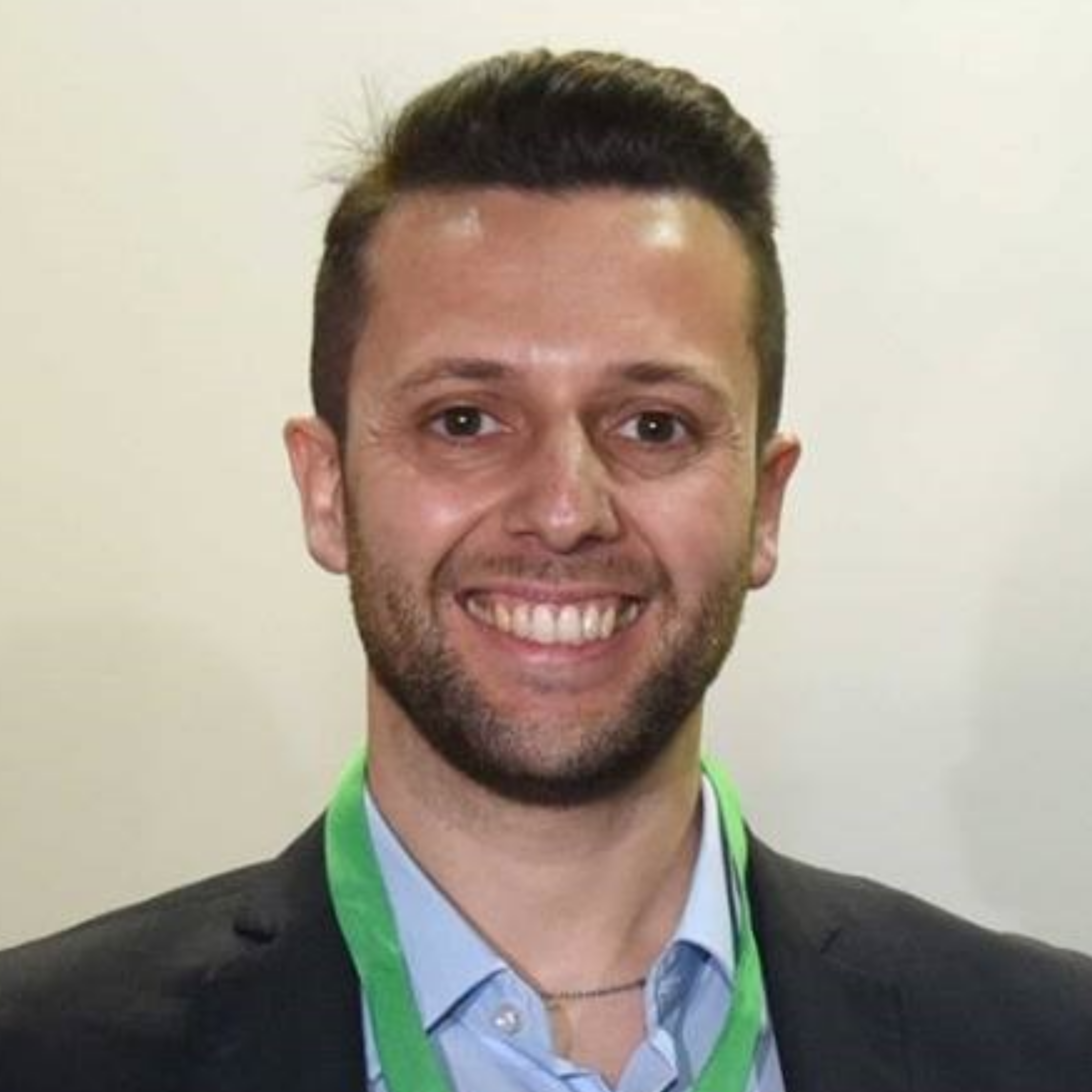
Tobias Welti is a Senior Lecturer at the Zurich University of Applied Sciences (ZHAW) School of Engineering, specializing in System on Chip Design and Computer Engineering . He leads the research focus area on System on Chip – Embedded AI and Edge Processing and serves as Deputy Programme Director for Electrical Engineering. Education: CAS in Didactics of Higher Education (PHZH, 2019–2020) BSc in Computer Science (UAS Zurich, 2010–2015) MSc in Chemistry (ETH Zurich, 1998–2003) His research spans System-on-Chip design , FPGA-based AI acceleration , and low-latency wireless video transfer for applications including medical endoscopes. Recent work includes the MAX78002 CNN accelerator and EdgeAI-Trust EU project. Key trends in his publications include heterogeneous computing (FPGA-CPU integration), real-time neural network deployment , and wireless system reliability . These appear in venues like the Embedded World Conference and Embedded Computing Conference (ECC).
Stanislao Grazioso serves as Assistant Professor in the Department of Industrial Engineering at the University of Naples Federico II (UNINA), where he leads the BIOIC (Bioinspired soft robotic systems for cognitive production) project. His work focuses on transforming manufacturing through soft robotic technologies, with expertise spanning design, modeling, and control of compliant robotic systems for industrial and biomedical applications. Education: Bachelor of Science in Mechanical Engineering, University of Naples Federico II Master of Science in Mechanical Engineering, University of Naples Federico II Ph.D. in Industrial Engineering, University of Naples Federico II (2018), specializing in soft robotics Research Focus: Dr. Grazioso investigates the entire soft robot development lifecycle, emphasizing innovative design concepts for variable-stiffness actuators, advanced modeling using Cosserat rod theory and finite element methods, and human-robot interaction for safe collaboration. His research platforms include soft grippers for agrifood automation, continuum manipulators for confined spaces, and exoskeletons for industrial assistance. Key applications target nuclear remote handling (DTT fusion reactor), biomechanical analysis, and cognitive manufacturing systems. Publication Trends (2022-2024): Recent work demonstrates accelerating innovation in soft growing robots for remote sensing, bioinspired grippers with embedded adhesion mechanisms, and wearable biomechanics for athlete monitoring. His publications bridge theoretical modeling (e.g., screw theory for continuum robots) with industrial implementation, particularly in fusion reactor maintenance and agrifood automation, reflecting strong technology transfer orientation. Project Leadership: As BIOIC project lead, he drives integration of biological principles into manufacturing robotics. His involvement in DTT remote handling and NEFERTARI projects highlights expertise in nuclear robotics, while collaborations with clinicians demonstrate commitment to medical applications like soft exoskeletons for rehabilitation. Current efforts focus on virtual reality integration for ergonomic workplace assessment and EMG-based wearable systems.
Maron Schlemon is a Ph.D. candidate and Researcher at the Technical University of Munich (TUM), affiliated with the Chair of Computer Architecture and Parallel Systems . He also serves as the CEO of IT4Medic since January 2023, leading embedded software projects and IT infrastructure development. Education: M.Sc. in Industrial Engineering / Computer Science (April 2016 – September 2017), Braunschweig University of Technology , Final Grade: Excellent (GER: 1.5) Maron’s research focuses on High-Performance Computing (HPC) , Parallel Programming , and Synthetic Aperture Radar (SAR) processing, particularly optimizing algorithms for embedded and resource-constrained systems. His work bridges Hardware-Software Co-Design , LoRaWAN Applications , and STM32 Micro-Controller Programming . Recent publications highlight trends in FPGA Acceleration , On-Board SAR Image Processing , and Real-Time Systems for aerospace applications, reflecting expertise in integrating Embedded Systems with HPC Architectures . He received the Outstanding Paper Award from IEEE HPEC in 2022 for SAR optimization work. Awards & Honors: Outstanding Paper Award, IEEE High Performance Extreme Computing Conference, 2022 Projects & Software: Maron contributes to ongoing initiatives like SEANERGYS (EuroHPC) , PlasmaPEPS , and Q-DESSI (MQV) , while developing tools such as autopin , QMPI , and SWEET . His work extends to HPC assessments at the Munich Supercomputing Center (LRZ) and collaboration with the German Aerospace Center (DLR) since 2018.
Michael Tempelmeier is a researcher at the Chair of Information Security, Technical University of Munich (TUM), specializing in hardware security and cryptographic implementations. His work focuses on authenticated encryption, lightweight cryptography (NIST LWC/CAESAR), and the development of evaluation frameworks for cryptographic hardware. He actively contributes to teaching, holding the Zertifikat Hochschullehre der Bayerischen Universitäten and leading courses like Angewandte Kryptologie and SmartCard Projektpraktikum . Tempelmeier's research centers on optimizing and securing cryptographic implementations for embedded systems. Key areas include: Design of hardware APIs for lightweight cryptography Side-channel and fault-attack countermeasures Trusted hardware gateways for IoT devices Efficient benchmarking methodologies for cryptographic hardware His publications demonstrate consistent focus on hardware vulnerabilities, cryptographic efficiency, and standardized evaluation frameworks. He maintains active involvement in tool development (e.g., MaskVer for detecting flawed masking implementations) and contributes to major projects like the Hardware API for Lightweight Cryptography. No awards or direct student supervision are mentioned in the provided text.
Allison Berkoy serves as an Assistant Professor of Emerging Media Technology within the Entertainment Technology Department at the School of Technology & Design, New York City College of Technology. She leads the Physical Computing concentration, which integrates software, hardware, and media to develop tangible interfaces and interactive experiences that bridge digital and physical realms. Her academic foundation spans the arts and technology: MFA in Electronic Arts, Rensselaer Polytechnic Institute (focus: interactive and immersive time-based media) MA in Performance Studies, New York University BA in Theatre, Northwestern University Dr. Berkoy's practice-based research investigates how physical-digital environments, when combined with mutable storytelling, can communicate meaning. Her creative works—ranging from interactive installations to electronic sculptures and networked audiovisuals—leverage code, sensors, and human movement to create participatory experiences. These projects often employ absurd narratives to challenge conventions of human-machine interaction and social dynamics, positioning installations as performative stages that explore the etiquette of technology-mediated relationships. As head of the Physical Computing concentration, she shapes curriculum and research initiatives focused on embodied interaction. Her professional design work extends to interactive audiovisual installations for museums, architectural spaces, live events, and gaming projects, demonstrating applied translation of academic research into real-world contexts.
Jan de Muijnck-Hughes is a Lecturer in the Department of Computer and Information Sciences at the University of Strathclyde, where he is a member of both StrathCyber and the Mathematically Structured Programming groups. He also participates in the Scottish Programming Languages Institute and SICSA (Scottish Informatics & Computer Science Alliance), contributing to the broader academic community in Scotland. His educational background includes a PhD in Machine Checkable Design Patterns using Dependent Types and Domain Specific Goal-Oriented Modelling Languages from the University of St Andrews (2016), an MSc in Data Protection and the Cloud from Radboud Universiteit Nijmegen (2011), and a BSc in Searching for Efficient Permutation Codes from the University of St Andrews (2008). He also holds a PGCert in Learning and Teaching from the University of Strathclyde (2024) and is a Fellow of Advance HE. Dr. de Muijnck-Hughes' research centers on making system engineering more trustworthy through Type-Driven Engineering (TyDe). His work investigates how cutting-edge programming language theory—particularly type systems, dependent types, and functional programming—can fundamentally change how we engineer systems by interlinking specifications and implementations. He believes that building trustworthy systems requires making machine-checkable specifications an intrinsic aspect of system development. His research spans functional programming as a foundation for code and specification structure, novel type systems for hardware design and program behavior, behavioral types for program correctness, and the application of dependent types through the Idris programming language. His recent publications demonstrate a consistent focus on applying type theory to practical system engineering challenges. The research shows a progression from theoretical foundations of dependent types to practical applications in hardware design, security protocols, and language workbenches. A notable trend is the application of formal methods to ensure correctness in cyber security contexts, reflecting his dual expertise in programming languages and security. Fellow of the Advance HE (2024) Dr. de Muijnck-Hughes teaches advanced topics in functional programming, formal verification, and Cyber Security at the Masters level, including CS813: Advanced Information Security and CS886: Advanced Security-by-Design. He actively supervises undergraduate and Masters students through various dissertation projects. His professional activities include speaking engagements at major conferences such as the Conference on Types for Proofs and Programs and organizing the Scottish Programming Languages and Verification Summer School. As a member of StrathCyber and the Mathematically Structured Programming group, he contributes to research initiatives focused on secure and reliable systems development. His work bridges theoretical programming language concepts with practical security applications, positioning him at the intersection of two critical computing disciplines.
Anton Dahbura is an Associate Professor at the Johns Hopkins University , affiliated with the Whiting School of Engineering and the Department of Computer Science . He serves as Executive Director of the Johns Hopkins University Information Security Institute , Co-director of the Institute of Assured Autonomy , and leads the Sports Analytics Research Group . He is also affiliated with the Malone Center for Engineering in Healthcare and the Laboratory for Computational Sensing and Robotics . Research Interests Information Security Fault-tolerant Computing Distributed Systems Protocol Conformance Testing Sports Analytics Scheduling Optimization Publications span IoT/CPS integration, protocol testing, fault-tolerant mobile networks, and ASIC array optimization. His work emphasizes algorithm development for system reliability and security, with historical contributions to multiprocessor fault diagnosis and protocol verification. Scientific Awards IEEE Fellow IEEE Browder J. Thompson Memorial Prize Paper Award Johns Hopkins Heritage Award (2004) He has held leadership roles at AT&T Bell Laboratories, Motorola Cambridge Research Center, and Princeton University. His academic career reflects deep engagement with systems engineering, security, and interdisciplinary sports analytics.
Peter Puschner is an Associate Professor at Vienna University of Technology (TU Wien), affiliated with the Cyber-Physical Systems Research Area. His work focuses on real-time systems, worst-case execution time (WCET) analysis, and time-predictable code execution. Key research areas: Real-Time Systems, Single-Path Code, Time-Triggered Networks, Cache Architectures Advisor to multiple thesis students including Michael Platzer and Bekim Cilku Co-developer of tools like the platin Toolkit for WCET analysis Recipient of Best Paper Award at ECRTS 2015 for Requirement Semi-formalization Methodology for SoC Design
Mladen Knežić is an Associate Professor at the Faculty of Electrical Engineering, University of Banja Luka. He actively contributes to research in Power Electronics , Industrial Networking , and Embedded Systems with a focus on renewable energy and real-time communication protocols. Current Role: Associate Professor (since 2023) Key Collaborations: Partnerships with IEEE, international conferences, and institutions in Serbia and Germany His research emphasizes boost converter optimization , EtherCAT/Ethernet Powerlink protocols , and TSN (Time-Sensitive Networking) . Recent projects include "Sistem automatske regulacije i kontrole navodnjavanja" (2023-2024) and "Implementacija FTT paradigme u TSN standarda" (2019-2020). Key publication trends include energy efficiency in power electronics, deterministic networking solutions, and FPGA-based system designs. He has contributed to over 15 peer-reviewed articles and conference papers between 2006-2022. He collaborates with researchers such as Željko Ivanović and Branko Dokić , and has participated in projects funded by the Ministry of Science and Technology of Republika Srpska and the Ministry of Agriculture, Forestry, and Water Management (total funding exceeding 50,000 BAM). As co-author of the textbook Mikrokontroleri: arhitektura i projektovanje (2022), he contributes to academic education in microcontroller systems. His ORCID is 0000-0003-3240-9110 .
Viktor Vafeiadis is a tenured researcher at the Max Planck Institute for Software Systems (MPI-SWS) in Germany. He received his BA and PhD from the University of Cambridge (2004, 2008) and worked as a postdoctoral researcher at Microsoft Research Cambridge and the University of Cambridge before joining MPI-SWS in 2010. His research focuses on concurrency , verification of concurrent programs, weak memory consistency , weak persistency , and formal semantics of programming languages. Research Areas: Weak Memory Models, Program Verification, Persistent Programming, Automated Model Checking Key Tools: Cave (automated verification tool), GenMC (model checker), Kater (consistency checker) His recent work explores linearizability under relaxed memory , mixed-size memory accesses , and formalizing ARMv8 persistency . Awards include the ACM SIGPLAN John C. Reynolds Award (2008), ERC Consolidator Grant (2020), and Robin Milner Young Researcher Award (2022). Selected Awards: ACM SIGPLAN John C. Reynolds Doctoral Dissertation Award (2008) ERC Consolidator Grant (2020) ACM SIGPLAN Robin Milner Young Researcher Award (2022) Distinguished Paper Awards: PLDI'17, OOPSLA'21, ECOOP'17 He has mentored numerous PhD students including Ellen Arlt , Pavel Golovin , and Aristotelis Koutsouridis , while alumni advisees include Soham Chakraborty and Michalis Kokologiannakis . His collaborative work spans institutions like University of Cambridge , Microsoft Research , and ETH Zürich .
Christopher Joseph Carmona del Jesus serves as a University Professor in the Department of Computer Science at the University of Jaén, Spain, affiliated with the Andalusian Interuniversity Institute for Data Science and Computational Intelligence and leading the Intelligent Systems and Data Mining research group. His work bridges theoretical computational intelligence with practical applications across diverse domains. His academic credentials include: PhD in Computer Science, University of Jaén (2011) Master's in Computer Science, University of Jaén (2007) Dr. Carmona specializes in Data Science, Big Data, and Subgroup Discovery using evolutionary fuzzy systems for descriptive rule extraction. His research particularly emphasizes Supervised Descriptive Rule Discovery and Emerging Patterns in dynamic data streaming environments, developing algorithms that balance interpretability with predictive power for real-world datasets. Recent work extends these methods to healthcare diagnostics and renewable energy forecasting. Analysis of his 15 most recent publications (2022-2025) reveals a strong focus on data streaming algorithms (60% of works), explainable AI systems (30%), and cross-domain applications in healthcare (20%) and cybersecurity (15%). Key technical contributions include evolutionary fuzzy frameworks for multiclustering, federated descriptive rule extraction, and spiking neural networks for energy-efficient computing. No scientific awards are documented in the provided materials. While his research leadership is evident through the Intelligent Systems and Data Mining group, specific details regarding student supervision or grant funding are not included in the available information. His methodological innovations in subgroup discovery and data streaming continue to drive practical implementations through tools like SDRDPy and the Clustering R library. He actively contributes to the Andalusian Interuniversity Institute for Data Science and Computational Intelligence, fostering collaborations that integrate computational intelligence with domain-specific challenges in energy, healthcare, and education.
Charlotte Frenkel is a Tenure-Track Assistant Professor in the Microelectronics Department at Delft University of Technology (TU Delft), where she leads research in neuromorphic engineering and low-power AI hardware. Her work bridges the gap between biological intelligence and artificial neural networks, focusing on energy-efficient computing at the edge. Dr. Frenkel's research spans digital and mixed-signal IC design, computer architecture, learning algorithms, and neuroscience. She directs the Cognitive Sensor Nodes and Systems (CogSys) lab, which develops neuromorphic processors like ODIN, MorphIC, SPOON, and ReckOn that demonstrate competitive advantages over conventional neural network accelerators. Her publications reveal a strong focus on spiking neural networks, event-based processing, and on-chip learning. Key trends include developing hardware that leverages sparsity for energy efficiency, creating bio-inspired learning algorithms that solve weight transport and update locking problems, and establishing frameworks for benchmarking neuromorphic systems through initiatives like NeuroBench. Scientific Awards: IBM Innovation Award 2021 Nokia Bell Labs Scientific Award 2021 IEEE ISCAS 2020 Best Paper Award NEUROTECH/NICE Best Early Researcher Presentation 2021 AiNed Fellowship Grant Dr. Frenkel is actively expanding her research group through PhD and postdoc positions. She serves as Associate Editor for IEEE Transactions on Biomedical Circuits and Systems and Frontiers in Neuroscience, and has held numerous leadership roles in conference organization including Program Chair for tinyML Research Symposium 2024 and Neuro-Inspired Computational Elements conference 2023-2024. Her service includes extensive reviewing activities for top IEEE journals and conferences in her field.
Tom Igoe serves as an Arts Professor at the Interactive Telecommunications Program (ITP) within New York University's Tisch School of the Arts, where he pioneers experimental approaches to time-based interactive systems. His research explores the intersection of physical computing and creative technology through unconventional clock designs, focusing on hardware fabrication, microcontroller programming, and tangible interfaces that challenge traditional timekeeping. Notable projects include the Email Clock (2002, 2005), which advances based on incoming email volume, and an extensive educational repository providing software examples, hardware schematics, and fabrication techniques for kinetic art installations. No scientific awards were documented in the source material. Igoe actively mentors students in the ITP program through collaborative development of interactive projects, though specific advisees and grant funding details were not disclosed. His work emphasizes pedagogical resource creation for the broader interactive design community. He maintains a specialized clock repository developed with students, featuring microcontroller-driven hardware examples and fabrication guides that serve as foundational resources for scholars exploring time as a creative medium.
Christian Derksen is a scientific assistant at the Faculty of Computer Science , University of Duisburg-Essen. He is affiliated with the ICB/Informatik department and actively involved in the SOFTEC team and IoT Lab cooperation. His research focuses on smart energy systems , multi-agent based simulation , and hybrid energy infrastructures , integrating engineering, economics, and computer science. Research Trends: Derksen's work emphasizes agent-based modeling for energy systems, smart grid development, and hybrid network simulation. His recent articles explore topics like energy conservation law applications, cross-domain resource allocation , and standardized control frameworks for decentralized energy networks. Advising: Supervised two theses in 2024: one on machine learning for energy models and another on cross-platform user interfaces for decentralized energy management systems. His methodological contributions include the Energy Option Model (EOM) and Agent.GUI simulation framework for hybrid energy systems and networks.
Jeff Shafer serves as an Associate Professor at the University of the Pacific, specializing in network systems architecture and cloud computing infrastructure. His research directly addresses performance challenges in data-intensive environments through innovative virtualization and distributed systems approaches. His academic credentials include: PhD in Electrical and Computer Engineering from Rice University (2010) MS in Electrical Engineering from University of Dayton (2004) BS in Computer Engineering from University of Dayton (2002) Shafer's research program focuses on optimizing network architectures for cloud environments, with particular emphasis on virtualization efficiency and distributed file system performance. His work bridges theoretical computer architecture with practical implementation constraints in modern data centers. Analysis of his publications from 2007-2010 reveals consistent exploration of hardware-software co-design for network virtualization. Key themes include I/O bottleneck mitigation in virtualized systems, reconfigurable network interface development, and performance-portability tradeoffs in distributed storage solutions across cloud platforms. His teaching portfolio encompasses core computer engineering disciplines including Computer Architecture, Networking, Digital Systems, and Embedded Systems, reflecting the integration of his research expertise into curriculum development.