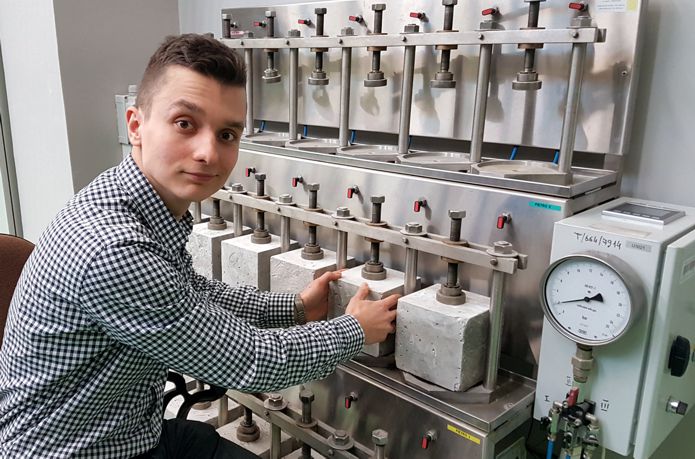
Michał Budka is a researcher at the Lublin University of Technology's Faculty of Civil Engineering, affiliated with the Department of Building Materials Engineering and Geoengineering and the Laboratory of Civil Engineering. His work focuses on composite materials, structural mechanics, and thermal degradation effects. He has authored/co-authored studies on CFRP composites' mechanical behavior under thermal aging and erosion, as well as a patented clamp design for lens housing fixation. Research Interests: Advanced composite materials Non-destructive testing techniques Thermal and mechanical degradation analysis Key Contributions: His 2024 Materials paper investigates protective coating efficacy under flame exposure, while the 2023 Polymer Testing study employs DIC systems to assess CFRP aging. The 2022 patent (B1 241629) addresses innovative optical lens mounting solutions. Award-winning achievements: No scientific awards explicitly mentioned in records. Lab Affiliations: Active in multiple labs including Building Physics, Geotechnics, and Road Engineering divisions.
Robert René Maria Birke is a tenured assistant professor in the Department of Computer Science at the University of Turin, leading research in the Parallel Computing group. His expertise spans virtual resource management, network design, workload characterization, and optimization of AI/big-data applications. Previously, he served as a visiting researcher at IBM Research Zurich and Principal Scientist at ABB Corporate Research, combining industry experience with academic rigor since earning his Ph.D. from Politecnico di Torino in 2009. His educational background includes: Ph.D. in Electronics and Communications Engineering, Politecnico di Torino (2009) Dr. Birke's research centers on systems-level challenges in distributed AI, with current projects investigating federated learning architectures, confidential computing via Trusted Execution Environments, and RISC-V processor optimizations for decentralized machine learning. His work bridges theoretical foundations with practical deployments, particularly in edge computing scenarios and high-performance data synthesis applications. Recent publications reveal growing emphasis on securing generative models against forgery attacks and optimizing tabular data synthesis techniques. Analysis of his 15 most recent publications (2024-2026) shows dominant themes in confidential federated learning (33% of works), RISC-V system optimizations (27%), and generative model security/synthesis (40%). This output spans premier venues including IEEE Transactions, ACM Computing Surveys, and SIGCOMM-affiliated conferences, demonstrating consistent contributions to systems-AI intersection research. Professional recognition includes: IEEE Senior Member While the text confirms extensive collaboration through co-authorships (notably with Marco Aldinucci, Lydia Chen, and Giulio Malenza), no specific student advisees or grant details are provided. His work appears embedded within European initiatives like ICS and EUPilot projects, focusing on compute continuum challenges. Dr. Birke actively contributes to the Parallel Computing group's mission through projects including HPC4AI@UNITO (datacenter digital twins) and Cross-Facility Federated Learning frameworks. His research ecosystem involves multi-institutional teams across Italy, Switzerland, and the EU, with recent talks addressing FLaaS implementations and generative model impacts on system design.
Robert J. Walls is an Associate Professor in the Department of Computer Science at Worcester Polytechnic Institute (WPI) where he also serves as the Director of the Cybersecurity Program. He is a prominent member of The Cake Lab and the Applied Logic and Security Group at WPI, focusing his research at the intersection of software and hardware systems. Dr. Walls earned his PhD in Computer Science from the University of Massachusetts Amherst in 2014. Prior to joining WPI, he was a postdoctoral scholar in the Department of Electrical Engineering and Computer Science at The Pennsylvania State University working with Professor Patrick McDaniel. His doctoral work was conducted at the University of Massachusetts under the advisement of Professor Brian Levine. Dr. Walls' research spans several critical areas in computer security and systems, with primary focus on systems security and performance. His work encompasses embedded systems security, secure deep learning, GPU performance optimization, digital forensics, and web security. His research often addresses unique challenges in security for resource-constrained environments and proprietary hardware systems. Analysis of his recent publications reveals a consistent trajectory bridging hardware and software security concerns. His work demonstrates growing sophistication in addressing security challenges in embedded systems, deep learning infrastructure, and GPU architectures. A notable trend is his focus on practical security solutions that work within the constraints of real-world systems rather than theoretical approaches. Director of the Cybersecurity Program at WPI Member of The Cake Lab research group Active participant in the Applied Logic and Security Group Dr. Walls actively mentors students and seeks motivated researchers for his projects. His work has been supported by significant research initiatives including the 10-year Cyber-Security Collaborative Research Alliance with the Army Research Laboratory and multiple universities. His research has applications in critical infrastructure protection, mobile security, and secure machine learning systems. Dr. Walls maintains active research laboratories including The Cake Lab, which focuses on cutting-edge security research spanning embedded systems, deep learning security, and GPU performance optimization. His team develops practical security solutions that address real-world constraints in resource-limited environments.
Dr. Mostafizur Rahman is an Assistant Professor of Computer Science at the University of West Georgia, affiliated with the School of Computing, Analytics, and Modeling within the Dr. Perry College of Mathematics, Computing, and Sciences. He holds a B.S. in Computer Science & Engineering from Bangladesh University of Engineering & Technology (2012), and an M.S. and Ph.D. in Computer Engineering from the University of Central Florida (2018 and 2020, respectively). His research focuses on cybersecurity, telecommunications, and networking, with particular emphasis on spectrum management, AI-driven cybersecurity solutions, and collaborative network architectures. Recent work includes studies on spectrum-sharing markets, UAV delivery networks, and decentralized decision-making frameworks. Rahman teaches courses such as Cybersecurity, Computer Forensics, Systems Programming, and Generative AI Networks & Security. He has consistently taught courses in computer security, networking, and internship programs since 2021, reflecting his expertise in both theoretical and applied computing domains. His publications span topics like settlement-free cellular peering, UAV network optimization, and game-theoretic approaches to spectrum sharing, showcasing contributions to both academic and industry-relevant challenges in telecommunications.
Markus Kuhn is an Associate Professor at the University of Cambridge's Department of Computer Science and Technology (formerly Computer Laboratory) and a Fellow of Wolfson College. His work bridges hardware security, signal processing, and cryptographic protocols. PhD, University of Cambridge (2002) MSc, Purdue University (1997) - Fulbright Scholarship Diplom-Informatiker, University of Erlangen (1996) - Studienstiftung des deutschen Volkes Research Interests focus on computer security and hardware vulnerabilities , particularly: Exploiting compromising emanations from displays and digital interfaces Securing RFID and positioning systems against distance-bounding attacks Hardware tamper resistance and smartcard security Scientific Awards include the Marie Curie Scholarship and Fulbright Scholarship. His publications span IEEE Transactions , IACR TCHES , and LNCS proceedings , with recent work on post-quantum cryptography and HDMI signal analysis. He teaches Cryptography and Digital Signal Processing at the undergraduate and Masters levels. Former PhD students include Eric Peng , Shih-Chun You , and Dimitrije Erdeljan . He co-organizes the department's Security Seminar Series and holds patents in EMC countermeasures and network protection technologies.
Farinaz Koushanfar is a Professor at the University of California, San Diego (UCSD), with a former affiliation at the University of California, Berkeley. Her research focuses on advancing security, machine learning, and hardware design through interdisciplinary approaches. Key areas include adversarial defense mechanisms, cryptographic systems, federated learning, and zero-knowledge proofs. She has collaborated extensively with institutions and researchers globally, contributing to over 360 publications. Her work emphasizes practical security solutions, such as watermarking for intellectual property protection and methods to counteract adversarial attacks in neural networks. Recent trends in her publications highlight innovations in cache compression, robust watermarking for large language models, and securing wireless communication systems against modality-agnostic attacks. Collaborations with industry and academia underscore her commitment to real-world applications of theoretical advancements. Awards and grants are not explicitly listed here, but her prolific publication record and leadership in high-impact projects indicate significant recognition in her field. Advising and mentoring students and junior researchers are central to her academic contributions, though specific student names are not detailed in the provided text. Her lab’s work often intersects with emerging technologies like blockchain, edge computing, and privacy-preserving machine learning.
Marcos Kauffman is a Professor and Director of the Institute for Advanced Manufacturing and Engineering (AME) at Coventry University. He leads the Research Centre for Manufacturing and Materials, focusing on innovation strategies, digital manufacturing, and intellectual property (IP) frameworks. With over 10 years in UK manufacturing industry roles, he specializes in cross-disciplinary R&D projects integrating technology and business models. Education: LLB Honours in Law, University of Buckingham PhD from Coventry University’s Centre for Business in Society Research Interests: Intellectual Property strategies in Industry 4.0 Augmented Reality (AR) applications in manufacturing Net Zero decarbonization for SMEs Digital Twin technology Horizontal integration in manufacturing ecosystems Key Projects (2021–2027): Clean Futures - West Midlands Innovation Accelerator (2023–2025) CLEAN: Clean Logistics for Emerging African Nations (2022–2024) Power Electronics Upscale for Localisation and Sustainable Electrification (2024–2027) Labs/Teams: Leading the AME’s cross-disciplinary research teams Collaborating with industry partners on digital twin and AR initiatives
Tim van Zuijlen is a Lecturer and PhD Candidate in IT Law at the Faculty of Law, University of Groningen. His research focuses on intersections of law, technology, and sustainability, particularly in areas like AI oversight, consumer protection against planned obsolescence, and legal frameworks for digital platforms. He is a member of the editorial board for the IT Law paper series, the faculty council, and the standard committee for AI & Big Data at the Royal Netherlands Standardization Institute. His expertise includes IT law (AI human oversight, legal knowledge systems), private law (circular business models, consumer law), and educational innovation (active learning, e-learning). Key awards include the European Sustainable Society PhD Grant (2020). Recent activities include organizing conferences on AI ethics and presenting on topics like responsible AI use in legal professions. Van Zuijlen has published widely on smart contract platforms, automation bias in legal AI, and legal tech solutions for sustainability. His work often bridges technical challenges with legal and ethical considerations, contributing to both academic discourse and policy-making initiatives.
Kaveh Shamsi is an Assistant Professor in the Department of Electrical & Computer Engineering at the Erik Jonsson School of Engineering and Computer Science, University of Texas at Dallas. His work bridges hardware design and cybersecurity, with a focus on ensuring trustworthiness in integrated circuits. His research interests include: IP protection through circuit obfuscation Side-channel-resilient hardware design Computer-aided design (CAD) for secure hardware CMOS and beyond-CMOS circuit design The trends in his research indicate a strong emphasis on hardware security and trustworthy computing, particularly at the physical and circuit levels. He contributes to the development of defensive techniques against hardware-level threats and intellectual property piracy. Kaveh Shamsi has not listed any scientific awards in the provided profile. He has not listed any advisees or grants in the provided information. His academic journey reflects a strong foundation in electrical and computer engineering through degrees from reputable institutions in the United States and Iran. No lab or research team information is explicitly mentioned in the current profile.
Felipe Gohring de Magalhaes is an Assistant Professor in the Department of Computer Engineering and Software Engineering at Polytechnique Montréal, where he has been working since July 2018 and assumed his current position in October 2024. He holds a dual doctorate from PUC-RS (Brazil) and Polytechnique Montréal (2016), with degrees in both computer science and computer engineering. His research spans embedded system architectures, real-time systems, avionics, and cybersecurity for emerging technologies. He is affiliated with the Microelectronics and Microsystems Research Group and the Multidisciplinary Institute for Cybersecurity and Cyber Resilience, reflecting his focus on integrated circuits, microelectronics, and system security. Professor Gohring de Magalhaes has published over 40 articles in international journals and conferences, with recent work focusing on photonic integrated circuits security, optical neural networks, and post-quantum cryptography for avionic systems. His publication trend shows consistent output with increasing focus on security aspects of emerging computing technologies. He has supervised at least one PhD student to completion and teaches courses including Introduction to Programming and Operating System Kernel. His research interests align with NSERC topics in integrated circuits, microelectronics, computer systems organization, and VLSI systems.
Professor Christof Paar is a Research Professor at Ruhr University Bochum, Faculty of Computer Science, where he leads the Embedded Security group. His work bridges theoretical cryptography with practical implementation security for embedded systems, with a strong emphasis on real-world security challenges. Professor Paar's research focuses on multiple critical areas of security including hardware security, side-channel attacks, hardware trojans, physical-layer security, wireless security, and reverse engineering. His work is characterized by a strong practical orientation, often demonstrating real-world vulnerabilities and developing practical countermeasures. He has made significant contributions to understanding and improving the security of cryptographic implementations in resource-constrained environments. His publication record shows a consistent output of high-quality research, with particular emphasis in recent years on physical-layer security, wireless security, hardware reverse engineering, and hardware trojan detection. His work spans both theoretical contributions to cryptographic engineering and practical demonstrations of security vulnerabilities in real systems. Professor Paar's educational impact is substantial, having co-authored the widely used textbook 'Understanding Cryptography' and offering numerous courses at both undergraduate and graduate levels. His group actively engages students through Bachelor and Master projects, providing hands-on experience with cutting-edge security research topics. His lab, the Embedded Security group, appears to maintain an active research program with multiple ongoing projects in hardware and embedded systems security. The group collaborates internationally and publishes regularly in top security venues, maintaining a strong presence in the cryptographic engineering community.
Dr. Levent Aksoy is a Senior Research Fellow at Tallinn University of Technology, School of Information Technologies, Department of Computer Systems, where he has been working since 2020 (initially as a Post-Doc and since November 2023 as Senior Research Fellow). His academic journey began with a BSc from Yildiz Technical University, followed by MSc and PhD degrees from Istanbul Technical University in Electronics and Communication Engineering. Dr. Aksoy's research primarily focuses on electronic design automation, hardware security, and optimization techniques. His work spans several key areas including logic locking, circuit obfuscation, multiplierless design methods for constant multiplications, and switching lattices for efficient logic implementation. He has published extensively in top-tier IEEE journals and conferences, with a strong emphasis on hardware security mechanisms and efficient circuit design. His recent publications (2020-2025) demonstrate a clear research trajectory toward hardware security, with numerous papers on logic locking techniques, structural analysis attacks, and hardware obfuscation methods. This research direction aligns with his current leadership of the EAGER project on 'Hardware-Efficient Realization of UA Cryptographic Standards' and his involvement in the European Space Agency project on 'End-to-End Supply Chain Protection'. Dr. Aksoy has received multiple awards for his research contributions, including: First place in HELLO: CTF 2022 (2023) Best paper award at DDECS (2022) Best paper award at EUC (2015) As a supervisor, Dr. Aksoy currently guides three students working on hardware security topics, including lightweight cryptography implementations and advanced hardware protection mechanisms. He also serves on PhD and MSc defense committees at Tallinn University of Technology and Linköping University. His professional service includes IEEE membership and reviewing for prestigious IEEE transactions and conferences such as DATE, ICCAD, and ISCAS.
Prof. Kai Erenli serves as a Professor at the University of Applied Sciences BFI Vienna, where he heads the bachelor's program "Interactive Media & Games Business". Additionally, since 2013, he has directed the legal department of a Viennese animation company, specializing in gaming law and contract law. His career uniquely bridges academic scholarship and industry practice, with deep expertise in IT law dating back to 2003, certified project management credentials, and prior experience managing an advertising agency. Erenli's research centers on the legal frontiers of digital innovation, with primary emphases on IT law, gaming law, and the regulatory challenges of virtual/augmented reality environments. His scholarship critically examines intellectual property frameworks in virtual worlds, cryptocurrency regulation, and the application of gamification principles in educational contexts. He consistently explores tensions between technological advancement and existing legal structures, advocating for adaptive jurisprudence that accommodates immersive technologies while protecting user rights and commercial interests. Analysis of his 2012-2019 publications reveals a sustained focus on practical legal implications of emerging technologies. His work demonstrates increasing sophistication in addressing virtual asset ownership, location-based gaming compliance, and VR/AR content regulation, with notable contributions to educational technology law and cryptocurrency governance. The interdisciplinary nature of his research bridges computer science, legal theory, and media studies. Scientific recognition includes: ars docendi state prize in "Economics and Law" category (Austrian Federal Ministry of Science, Research and Economy, 2015) As academic program head, Erenli provides institutional leadership and mentorship for bachelor's students in interactive media and gaming business. His role involves curriculum development, industry partnership cultivation, and academic oversight, though specific doctoral advisees or research grants aren't documented in available sources. His industry legal consultancy demonstrates applied scholarship beyond traditional academia. Prof. Erenli has pioneered the VICERO virtual world education platform and contributed to establishing a major German-speaking e-learning infrastructure. His collaborative projects frequently involve cross-disciplinary teams integrating legal experts, technologists, and educators to develop compliant immersive experiences. Current work continues through his blog Virtuellewelten.at and ongoing industry consultancy.