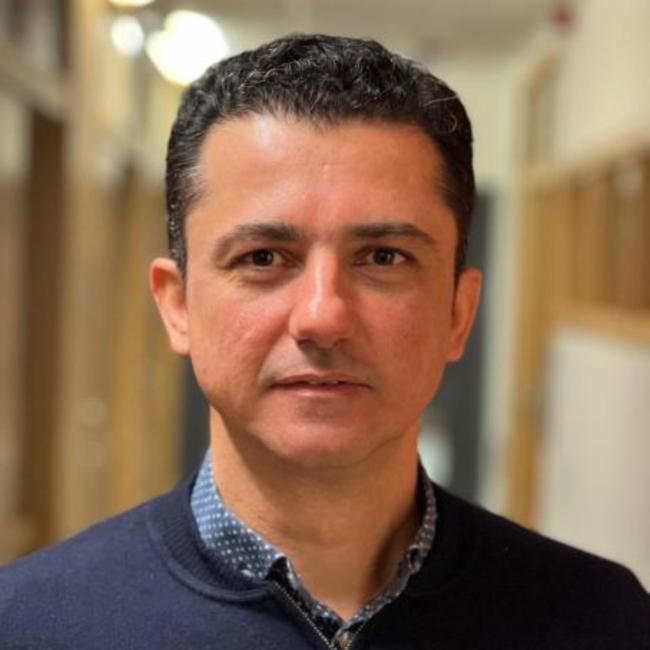
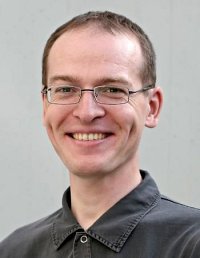
José Herrera Sanz is an Assistant Professor at the Department of Automation, University of Alcalá (Spain). He holds a Doctorate from Universidad Complutense de Madrid (2008) with a thesis titled Modelo de programación para infraestructuras Grid computacionales , supervised by Dr. Rubén Manuel Santiago Montero and Dr. Ignacio Martín Llorente. His research focuses on Grid computing, distributed systems, and sustainability in programming models. He is affiliated with the PROGRESSUS research group (Programming & Sustainability), exploring topics like distributed task scheduling, grid middleware, and high-performance computing applications. His work spans over 15 peer-reviewed articles since 2003, addressing challenges in virtual machine placement, genetic algorithms, and bioinformatics grid benchmarking. Key contributions include the GridWay DRMAA implementation, optimization of fusion physics workflows, and distributed loop execution frameworks. His research emphasizes sustainable computing practices and scalability in grid environments.
Elena Katia Leal Algara is an Associate Professor at Universidad Rey Juan Carlos, affiliated with the Department of Telematic and Computing Systems. She holds a PhD from Universidad Complutense de Madrid (2010) with a thesis on federated grid scheduling. Her research focuses on Grid Computing, Ubiquitous/Pervasive Systems, and Distributed Scheduling. She contributed to projects like Plan B OS, a middleware-free environment for pervasive computing. Notable research groups include PROGRESSUS (Programming & Sustainability) and PMI (Intelligent Mobile Platforms). Her work emphasizes energy-efficient resource allocation, adaptive scheduling in federated grids, and security protocols in ubiquitous environments. Key achievements include proposals for self-adjusting resource sharing policies and reallocation strategies in dynamic systems. Over 20 peer-reviewed articles span scheduling algorithms, grid infrastructure optimization, and pervasive computing design. Leal Algara's academic career involves advancing decentralized scheduling frameworks and exploring middleware alternatives for distributed systems. Current research interests include sustainable computing and autonomous resource management in federated environments.
Professor Michel MAROT is affiliated with Telecom SudParis, where he holds the position of Professor in the NeSS department. His research focuses on networking, wireless communication systems, performance evaluation, smart grids, and machine learning applications in telecommunications. MAROT has contributed to advancements in vehicular networks (VANETs/V2V), IoT architectures (LoRaWAN), and energy-efficient protocols for wireless sensor networks (WSNs). He has led studies on coalition formation in smart grids, reinforcement learning for policy optimization, and network resource management in 6G systems. Key research areas include optimizing network performance through cross-layer design, improving QoS in mobile and vehicular environments, and deploying intelligent reflecting surfaces (IRS) for 6G. His work frequently addresses challenges in mobility management, collision avoidance, and energy efficiency in distributed systems. MAROT has co-authored influential papers in journals like Neurocomputing, IEEE Transactions on Smart Grid, and IEEE Open Journal of the Communications Society. His research group (SAMOVAR/NeSS) develops practical solutions for real-world networks, including cold chain monitoring systems using sensor networks and DNS-based optimizations for SCHC protocols. MAROT’s recent work explores machine learning embedded in LPWAN sensors and mobility-aware resource allocation in LoRaWAN.
Andreas Theocharis is an Assistant Professor in Electrical Engineering at Karlstad University, specializing in Electrical Power Systems and Renewable Energy Systems Research. His research focuses on renewable energy integration, smart grid technologies, and advanced modelling of electrical components like transformers and photovoltaic systems. He collaborates with institutions such as Ellevio, KTH, Delft University of Technology, and industry partners like Siemens and Vestas. Teaching responsibilities include courses on electric circuits, power systems operation, renewable energy applications, and grid integration. His work bridges academia and industry, addressing challenges in sustainable energy systems through advancements in AI, machine learning, and IoT. Research contributions span photovoltaic generator modelling, battery storage optimization, and electromagnetic compatibility. Key publications address generative AI for renewable energy communities, uncertainty quantification in solar forecasting, and robust energy management strategies. Collaborations involve global networks with universities in the Netherlands, Norway, Greece, and industry leaders in energy sectors. His expertise in transformer dynamics and smart grid solutions supports practical implementations of sustainable energy frameworks.
Madhav Marathe is a tenured Professor of Computer Science and the Distinguished Professor in Biocomplexity at the University of Virginia, where he also serves as Executive Director of the Biocomplexity Institute. He has held leadership roles at Virginia Tech and Los Alamos National Laboratory, and his work is deeply rooted in transdisciplinary team science. His research spans a wide range of domains including network science, artificial intelligence, computational epidemiology, high-performance computing, and complex systems. He develops foundational methods to model, analyze, and control large-scale biological, information, social, and technical (BIST) systems. His work integrates theoretical computer science with practical applications in public health, disaster response, and infrastructure resilience. The recent publications reflect a strong trend toward data-driven modeling of societal challenges—especially in pandemic response, forced migration, and energy systems. His team leverages agent-based simulations, machine learning, and high-performance computing to create scalable, policy-relevant models that support real-world decision-making. Fellow, American Association for the Advancement of Science (AAAS) Fellow, Association for Computing Machinery (ACM) Fellow, Institute of Electrical and Electronics Engineers (IEEE) Fellow, Society for Industrial and Applied Mathematics (SIAM) Distinguished Researcher Award, University of Virginia (2023) Honorary Doctoral Degree, Chalmers University (2023) Best Paper Award, SIGKDD 2021 (Applied Data Science) Endowed Distinguished Professor of Biocomplexity (2019) Dean’s Award for Excellence in Research, Virginia Tech (2018) Constellation Group’s Supernova Award (2016) Dr. Marathe has mentored over 30 doctoral students, 20+ MS students, and 15 postdoctoral fellows, and has led major federally funded projects including those related to computational epidemiology and national security. His lab, the Biocomplexity Institute, develops high-performance computing services and data analytics platforms for policymakers and emergency planners. He is also involved in initiatives such as the National Security Data and Policy Institute and the Expeditions in Global Pervasive Computational Epidemiology.
Mohammad Derawi is a Professor in the Department of Electronic Systems at the Faculty of Information Technology and Electrical Engineering, Norwegian University of Science and Technology (NTNU), Gjøvik campus. He leads the Smart Wireless Systems (SWS) research group and serves as the scientific leader of the IoT Lab at NTNU Gjøvik. Educational Background: PhD in Information Security from NISLab (Norway) and CASED (Germany) BSc and MSc in Informatics from DTU (Denmark) His research interests span smart wireless systems, Internet of Things (IoT), information security with a focus on biometric authentication, digital electronics, applied machine learning for activity recognition, and e-learning technologies. His work integrates cybersecurity, embedded systems, and data science to develop secure and intelligent IoT solutions for real-world applications. The recent publications highlight a strong trend in mmWave-based sensing for unmanned aerial systems, RF fingerprinting for secure identification, IoT security frameworks, and machine learning applications in education and human resource analytics. His research bridges theoretical innovation with practical implementation, particularly in smart cities, healthcare, and transportation. Scientific Awards and Recognition: Invitation to the Crown Prince and Princess's 50th birthday celebration, 2023 Study Quality Award, NTNU, 2017 Norway’s Youngest Professor Award, 2016 Denmark’s youngest M.Sc. engineering award, 2009 IEEE Commendation for Young Professionals Volunteer, 2011 Multiple best paper awards from IEEE, ACM, and Springer Mohammad Derawi has been involved in several funded research and development projects, including IoT Safetraffic (RFF Inland), Ambulance Drone (NTNU Vice-Rector), Wireless ECG (Innovation Norway), biometric handgun security (RFF Innlandet), and the EU Framework 7 TURBINE project. He mentors students and collaborates with international researchers, contributing significantly to both academic and applied domains. His leadership in the SWS group and IoT Lab fosters innovation in wireless and secure embedded systems. He is actively engaged in laboratory and team-based research, particularly through the Smart Wireless Systems group and the IoT Lab, focusing on developing secure, intelligent, and scalable solutions for next-generation wireless applications.
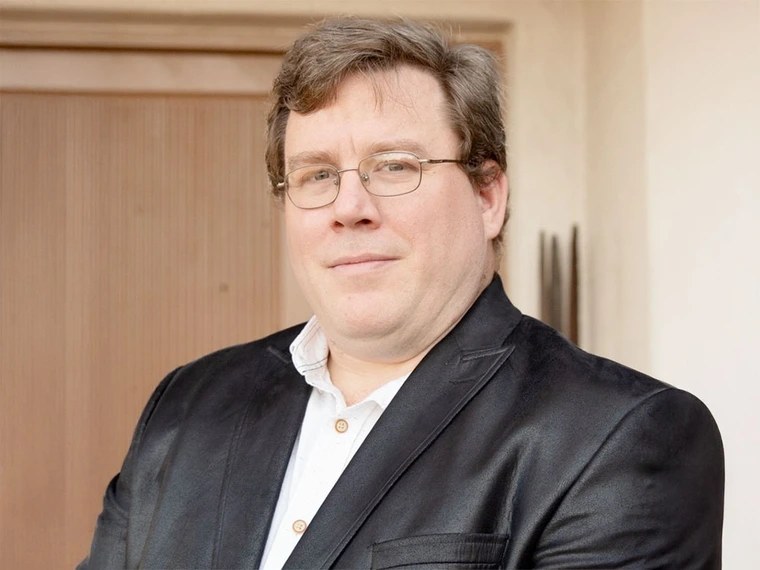
Michael Galde is an Assistant Professor at the University of Arizona's College of Engineering, Department of Electrical and Computer Engineering, where he specializes in cybersecurity education and research. He holds a Master's in Cybersecurity and a Bachelor's in Political Science from the University of Nebraska and brings over a decade of experience from defense intelligence, industrial cybersecurity, and academic instruction. MS in Cybersecurity, University of Nebraska BA in Political Science, University of Nebraska His research and teaching focus on malware analysis , Industrial Control Systems (ICS) security , reverse engineering , and hands-on cyber operations training . He develops advanced courses and practical tools to strengthen cybersecurity resilience in critical infrastructure. His work bridges technical depth with educational accessibility, empowering the next generation of cyber professionals. His recent technical projects reflect a strong trend in applied cybersecurity research , especially in OT/ICS monitoring , network visualization , and the integration of AI and NLP into security operations . Projects like GRID-LM, IAES-SOC, and PCAPMap demonstrate innovation in real-time threat detection, large-scale data analysis, and user-friendly tooling for cyber defense. Notable scientific credentials include: Global Industrial Cyber Security Professional (GICSP) GIAC Response and Industrial Defense (GRID) Michael Galde actively contributes to cybersecurity through teaching (80% responsibility), university service (20%), research (2024–present), and external consulting (15%). He mentors students through project-based learning and leads initiatives in developing robust educational and technical frameworks. His research team works on projects including SPINE, DaRIA, and IAES-SOC, focusing on scalable NLP ecosystems and intelligent network monitoring. He leads multiple research and development efforts, including the IAES-SOC for OT network monitoring, PCAPMap for traffic visualization, and SPINE for NLP infrastructure. These projects are supported by hands-on development and integration with tools like Wazuh, ELK stack, Scapy, and Bokeh.
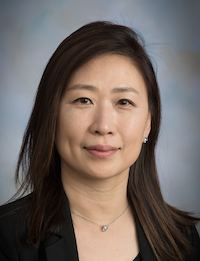
Sangmi Lee Pallickara is a Professor of Computer Science and the Clare Booth Luce Professor at Colorado State University. She is affiliated with the Department of Computer Science in the College of Natural Sciences. Her research is supported by major agencies including the National Science Foundation, Department of Homeland Security, ARPA-E, and NIFA, with ongoing projects in AI Institutes, Cyberinfrastructure, and CyberPhysical Systems. Research Interests: Her work focuses on Big Data systems for scientific applications, including scalable storage, retrieval, metadata management, predictive analytics, and interactive visualization. She applies these to domains such as agriculture, atmospheric science, environmental monitoring, and epidemiology. Her research integrates data science, distributed systems, and deep learning to enable scalable knowledge extraction from high-velocity, voluminous datasets. Publication Trends: Her recent publications emphasize scalable solutions for geospatial and spatiotemporal data, including efficient storage (e.g., ATLAS), visualization (e.g., Glance, Iris), and deep learning (e.g., Argus, CloudNet). There is a strong focus on real-world applications such as wildfire prediction, satellite data imputation, and precision agriculture, leveraging generative models, embeddings, and ensemble methods. Scientific Awards: NSF CAREER Award IEEE TCSC Award for Excellence in Scalable Computing Best Paper Award at IEEE/ACM UCC 2019 Best Paper Award at IEEE CLUSTER 2019 Best Paper Award at IEEE/ACM UCC 2014 Finalist for Best Paper Award at IEEE BDCloud 2018 Advising and Grants: She advises numerous Ph.D. and Master’s students, many of whom have gone on to careers in industry and academia. Her research is funded by the NSF (AI Institutes, CPS), DHS, ARPA-E, NIFA, and the Environmental Defense Fund. She also leads the SWiFT outreach program for K–12 STEM education. Labs and Teams: She leads a vibrant research group focused on Big Data systems, with students working on distributed storage, deep learning for satellite imagery, spatiotemporal analytics, and interactive visualization. The team collaborates with domain scientists in agriculture, climate, and public health.
Professor Barrie Mecrow is a distinguished academic at Newcastle University's School of Engineering, Department of Electrical and Electronic Engineering. With over two decades of research experience, he has established himself as a leading expert in electrical machines, motor drives, and fault-tolerant systems. His work spans multiple application domains including aerospace, electric vehicles, and renewable energy systems. Professor Mecrow's research primarily focuses on the design, analysis, and control of advanced electrical machines. His expertise encompasses permanent magnet machines, switched reluctance motors, thermal management of electrical machines, and fault-tolerant drive systems. He has made significant contributions to understanding electromagnetic losses, improving torque density, and enhancing the reliability of electric drives in safety-critical applications. His recent work has particularly emphasized thermal management solutions for high-power density machines and advanced control strategies for multi-phase motor drives. Analysis of Professor Mecrow's publication record reveals a consistent focus on practical engineering solutions with strong industrial relevance. His research has evolved from fundamental machine design and analysis to integrated drive systems with particular emphasis on reliability, thermal management, and fault tolerance. The trend in his recent publications shows increasing attention to thermal challenges in high-power density machines, advanced control strategies for multi-phase drives, and innovative winding configurations for specialized applications. Professor Mecrow has supervised numerous PhD students who have gone on to become established researchers in their own right. His research has strong industry connections, particularly with aerospace and automotive sectors, as evidenced by the applied nature of his publications focusing on fault-tolerant systems for aircraft applications and electric vehicle traction motors.
Olivier Verscheure serves as the Executive Director of the Swiss Data Science Center (SDSC), a national R&D center organizationally hosted by both École Polytechnique Fédérale de Lausanne (EPFL) and ETH Zurich. He also holds multiple Adjunct Professor appointments at EPFL, specifically within the School of Computer and Communication Sciences (SIN and SSC) and the School of Engineering (SEL). His educational background includes: Ph.D. in Computer Science from École Polytechnique Fédérale de Lausanne (EPFL), June 1999 Verscheure's research focuses on the intersection of data science and real-world applications. His work centers on stream and big data mining, geospatial analysis, and large-scale data management. These technical capabilities are applied across diverse domains including personalized health and medicine, Intelligent Transportation Systems, telecommunications, smart building technologies, Smart Grid infrastructure, healthcare analytics, and waste water management systems. His approach emphasizes creating practical data science solutions that address complex challenges in these sectors while considering the constraints of real-world deployment. An analysis of his recent publication record reveals a strong focus on real-time data processing and analytics, particularly for transportation and urban systems. His work frequently addresses challenges in handling massive time series data, developing efficient architectures for low-latency analytics, and creating practical applications for smart city infrastructure. There's a clear progression from theoretical data science contributions to production-ready systems that can process billions of data points daily, demonstrating his ability to bridge research and practical implementation. His notable achievements include: Two IBM Outstanding Technical Achievement Awards Best Paper Award for his research Student Best Paper Award Verscheure has substantial experience in research leadership and mentoring. During his tenure at IBM, he managed the Exploratory Stream Analytics research group and led a technical and management team of approximately 40 people at the IBM Research lab in Ireland. He has served on PhD committees at major universities and published nearly 100 research papers that have garnered over 2,400 citations. His work has resulted in more than 40 US and international patents, demonstrating both academic and practical impact. As Executive Director of the Swiss Data Science Center, Verscheure oversees a distributed multi-disciplinary team working across domains including personalized health, transportation, earth and environmental science, social science and digital humanities, and economics. The center aims to federate data providers, data and computer scientists, and subject-matter experts around a cutting-edge analytics platform while addressing security and privacy issues. Under his leadership, the SDSC develops embedded data science support, offers end-to-end data science services, and fosters a community to share tools and knowledge in data science.
Cristina Emma Margherita Rottondi is an Associate Professor at the Department of Electronics and Telecommunications (DET) of Politecnico di Torino . She is a member of the Photonext Interdepartmental Center and contributes to research in telecommunications, computer music, and network optimization. Her work spans privacy-preserving protocols, smart grid communication, and low-latency audio streaming. Research Interests : Networked Music Performance, Optical Networks, Smart Grid Privacy, Machine Learning. Education : Not explicitly listed. Research Areas include: Smart Grid Privacy : Developing secure protocols for data aggregation and distributed energy optimization. Optical Network Design : Investigating machine learning-driven solutions and spatial division multiplexing. Networked Music Performance : Addressing latency and inclusivity in remote musical collaboration. Publication Trends highlight interdisciplinary work at the intersection of telecommunications , machine learning , and music technology . Recent articles focus on privacy-preserving smart grids , 5G-enabled musical IoT , and UDP packet trace datasets . Scientific Awards : 2020 Charles Kao Award Best Paper Awards at IEEE Online Greencomm (2014), DRCN (2017), and others N2Women Rising Star (2020) Advising includes PhD candidates working on networked music performance , accessible musical education , and medical wearable devices . She has contributed to national patents for inclusive audio hardware.
Maryam Kamgarpour is a Tenure Track Assistant Professor at École Polytechnique Fédérale de Lausanne (EPFL), School of Engineering. She previously held faculty positions at the University of British Columbia and ETH Zürich. Her work bridges stochastic control , multiagent learning , and game theory , focusing on safety-critical systems. Education: PhD in Engineering from UC Berkeley, BSc in Applied Science from University of Waterloo. Research Interests: Control under uncertainty, game theory, mechanism design, mixed-integer optimization, and applications to transportation, robotics, power grids, and healthcare. Her recent publications emphasize safe reinforcement learning , multirobot coordination , and stochastic trajectory planning , with applications to aircraft navigation and energy systems. She has received the European Union ERC Starting Grant, NASA High Potential Individual Award, and IEEE Transactions on Control of Network Systems Outstanding Paper Award. Scientific Awards: ERC Starting Grant (2016-2021) NASA High Potential Individual Award (2010) NASA Excellence in Publication Award IEEE Outstanding Paper Award (2022) PhD Students: Jordan Philip Christopher Maddux Anna Maria Ni Tingting Ren Kai Salizzoni Giulio Schlaginhaufen Andreas Vaishampayan Saurabh Dilip Vallat Gabriel Rémi Former EPFL student: Guo Baiwei
Öznur Özkasap is a Professor in the Department of Computer Engineering at Koc University's Graduate School of Sciences and Engineering. She serves as Head of Department and has research interests spanning distributed systems, computer networks, and energy-efficient networking protocols. Her work integrates artificial intelligence into distributed computing frameworks and explores security in peer-to-peer systems. Education: PhD (2000), MSc (1994), and BS (1992) from Ege University Research Areas: Distributed Systems, Cloud/Edge Computing, Network Security, and AI applications in distributed environments Her recent publications focus on blockchain-assisted distributed systems, federated learning optimization, and energy-efficient frameworks for software-defined networks. She explores multi-objective load balancing, decentralized energy trading, and secure P2P architectures. Key trends include cross-disciplinary applications of distributed computing in healthcare and energy systems. Professor Özkasap contributes to advancing edge computing, IoT-based sensor systems, and privacy-preserving mechanisms in decentralized environments. Her work addresses challenges in reliable network protocols, microgrid energy sharing, and security vulnerabilities in autonomous systems.
Dr.-Ing. Erik Buchmann is a leading researcher at the Institute für Programmstrukturen und Datenorganisation (IPD) of the Karlsruhe Institute of Technology (KIT) . He heads the Young Investigator Group Privacy Awareness in Information Systems and its Implications on Society , focusing on interdisciplinary research at the intersection of data privacy, sensor networks, and smart environments. Education : Diploma in Business Informatics (2002), Ph.D. in Computer Science (2006) from Otto-von-Guericke-University Magdeburg His research spans privacy-aware data management, query optimization in distributed systems, and societal implications of data protection. He has published extensively in top venues like VLDB, SIGMOD, and journals such as International Journal on Very Large Data Bases . Key contributions include frameworks for smart grid privacy (e.g., Pufferfish, FRESCO) and anonymization techniques for time-series data. Notable trends in his publications include innovations in sensor network query processing , RFID compliance , and energy-efficient data architectures . Awards include the 2012 Multidisciplinary Privacy Award and the 2006 Otto-von-Guericke-University Dissertation Prize. Erik Buchmann is actively involved in teaching courses on data protection at KIT and has organized workshops like DISN'07. He serves as an editor for journals including Distributed and Parallel Databases and participates in conference program committees. His work addresses both technical and legal dimensions of privacy, emphasizing user collaboration and transparency.
Petronilla Fragiacomo is a Full Professor in Energy Systems and Power Generation at the University of Calabria, where she directs the Hydrogen and Fuel Cells Laboratory and chairs the Graduate Commission in Mechanical Engineering. She has been affiliated with the Department of Mechanical, Energetic and Management Engineering since 1987, progressing from researcher to full professor. Her research focuses on hydrogen production/storage, fuel cell technologies (SOFC, PEMWE, AEMFC), and renewable energy integration for stationary/mobile applications. Key innovations include multi-physics modeling of electrolyzer systems, hybrid propulsion for marine/terrestrial vehicles, and techno-economic analysis of hydrogen infrastructures. She pioneers Industry 4.0 applications in hydrogen economy frameworks. Recent publications (2024-2025) emphasize hydrogen refueling optimization, heavy-duty transportation, biomass gasification hybrids, and international supply chain analysis. Over 70% of works involve computational modeling of energy systems. Research Leadership: Director of PON COMESTO project (2018): Integrated PEMFC/PEMEC systems Scientific lead for Trenitalia-DIMEG collaboration (2020) PRIN project director: Intermediate Temperature SOFCs (2012) She oversees the Hydrogen and Fuel Cells Laboratory, collaborating with ENEA, CNR, and international universities (Esslingen, Warsaw, Los Angeles). Current industrial partnership: AVL University Program.