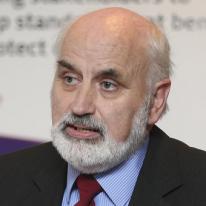
John Cotter is a Full Professor of Finance and Chair in Quantitative Finance at University College Dublin's Smurfit School of Business. He holds a PhD from Queen's University Belfast and prior academic roles include Associate Professor (2006-2012) and Senior Lecturer (2004-2006). His research focuses on volatility modeling, risk management, and asset pricing with applications in equity, real estate, and derivative markets. Cotter directs the Centre for Financial Markets and the Financial Mathematics Computation Cluster (FMC2), a multi-university research initiative funded by Science Foundation Ireland. Education: BComm and MEconSc from University College Cork, PhD in Finance from Queen's University Belfast. Research interests span asset pricing, volatility modeling, risk management, and financial market integration. His work has been published in top journals like Journal of Banking and Finance and Journal of International Money and Finance . He has secured grants including the ADAPT Phase 2 project (2021-2026). Cotter advises the European Securities Markets Authority (ESMA) and has consulted for numerous organizations globally. Notable awards include the UCD Outstanding Educator Teaching Award and UCD School of Business Research Contribution Award. He serves as Associate Editor for three journals and has supervised numerous PhD students through FMC2.
Upaka Rathnayake is a Professor of Civil Engineering and Principal Investigator at the Mathematical Modelling and Intelligent Systems for Health and Environment (MISHE) research unit at Atlantic Technological University Sligo, Ireland. He has held academic and research roles globally, including in Sri Lanka, Japan, the UK, New Zealand, Australia, and Fiji. His research focuses on water resources management, hydrological modeling, climate analysis, and AI-driven solutions for environmental challenges. He holds a PhD from the University of Strathclyde and advanced certifications from Hokkaido University. Education: PhD in Optimal Management of Urban Sewer Systems (University of Strathclyde, 2013) Professional Memberships: Institution of Engineers Sri Lanka, Engineers New Zealand, International Association of Hydrological Sciences Research interests include: Hydrological modeling and climate change adaptation Multi-objective optimization and soft computing techniques Explainable AI applications in environmental systems Remote sensing and GIS for water resource management Recent articles highlight AI-driven solutions for air quality prediction, soil nutrient analysis, and flood risk assessment. Awards include the 2023 Presidential Award for Scientific Publications and multiple university excellence awards. He actively advises PhD students on projects like urban water systems optimization and climatic trends analysis. Rathnayake is an editorial board member of journals like Scientific Reports and PLoS ONE , contributing to peer review and policy-oriented research. His work bridges data-driven methods with traditional hydrological practices to address global environmental challenges.
John Breslin is a Personal Professor in Electronic Engineering at the College of Science and Engineering, University of Galway, serving as Director of the TechInnovate and AgInnovate programmes. Associated with two Taighde Éireann – Research Ireland Centres, he is a Principal Investigator at Insight Centre for Data Analytics (specializing in data analytics) and a Funded Investigator at VistaMilk (Agri-Technology), while also leading the EDIH Data2Sustain project. With an h-index of 50, over 12,000 citations, and 300+ peer-reviewed publications including seminal books on the Social Semantic Web, he ranks among Ireland's most influential researchers in digital technologies. Breslin's research fundamentally bridges Semantic Web technologies, AI-driven data analytics, and practical innovation. His co-creation of the SIOC framework—implemented across 65,000+ websites by entities like Yahoo and Boeing—demonstrates real-world impact in social data interoperability. Current work leverages blockchain and federated learning for sustainable Agri-Technology through VistaMilk, while his TechInnovate programmes translate academic research into commercial ventures across healthcare, smart manufacturing, and energy systems. Analysis of his 15 most recent publications reveals dominant themes in AI-enhanced security (35% of works), blockchain applications for sustainability (27%), and multimodal AI for healthcare (20%). His team pioneers privacy-preserving techniques for IoT and medical devices, neurosymbolic visual reasoning frameworks, and federated learning architectures addressing data heterogeneity—directly supporting his roles in national research infrastructures like Insight and VistaMilk. John has received several prestigious awards: IIA Net Visionary Award (twice) ITAG Outstanding Contribution to the ICT Sector Award Galway Chamber President’s Award Best Irish-Published Book Award (2020 for Old Ireland in Colour) Multiple Best Paper Awards He leads major research initiatives funded by Taighde Éireann – Research Ireland: Insight Centre for Data Analytics (as Principal Investigator) VistaMilk SFI Research Centre (as Funded Investigator) EDIH Data2Sustain (as Principal Investigator) His entrepreneurial programs TechInnovate and AgInnovate have mentored 200+ startups, securing €50M+ in follow-on funding. Breslin co-founded PorterShed (Galway City Innovation District) and serves on Scale Ireland's Steering Group, creating Ireland's most active regional innovation ecosystem outside Dublin. He maintains active industry partnerships with Vodafone, Boeing, and agricultural cooperatives through VistaMilk's testbed facilities.
Dr. Le-Nam Tran is a researcher at the UCD School of Electrical & Electronic Engineering , University College Dublin. His work focuses on optimizing the last hop of 5G/6G wireless networks through mathematical programming, with emphasis on energy efficiency, interference management, and security against eavesdropping. Develops low-cost, low-complexity transmission techniques Projects supported by Science Foundation Ireland Career Development Award Author of over 80 peer-reviewed publications Research Keywords: Wireless Communications Network Security Signal Processing Energy-Efficient Systems Beamforming Optimization Interference Mitigation
Dr. Gavin McArdle is an Associate Professor at the University College Dublin (UCD) School of Computer Science, specializing in spatial data analysis and smart cities. He holds academic affiliations with the National Centre for Geocomputation (Maynooth University) and CeADAR (Data Analytics Centre). His research focuses on urban dynamics, geovisual analytics, smart transportation, and remote sensing applications. He has received a College of Science Teaching Excellence Award for his contributions to education. McArdle earned his BSc, PhD, and a Prof Dip in University Teaching & Learning from UCD. His work bridges academia and industry through collaborative grants, including those from Science Foundation Ireland and EU funding. Notable projects include the Dublin Dashboard (urban analytics platform) and DubSim (traffic simulation using digital footprints). His research outputs span over 147 publications, with recent work addressing Airbnb's impact on urban gentrification, sustainable mobility, and environmental monitoring via satellite data. He actively contributes to professional committees, including roles in the UCD Data Protection Impact Assessment Committee and international conferences like Web and Wireless GIS. McArdle coordinates courses such as Research Practicum and Computer Programming II, emphasizing practical research and technical skills. His interdisciplinary approach integrates machine learning, spatial statistics, and urban informatics to address real-world challenges in smart cities and environmental sustainability.
Professor Da-Wen Sun is a globally recognized authority in food and biosystems engineering at the UCD School of Biosystems & Food Engineering , University College Dublin. His research focuses on enhancing food preservation through innovative technologies like ultrasound-assisted freezing to minimize nutrient loss and structural damage in frozen foods. Key contributions: Developed ultrasound freezing methods to reduce ice crystal damage Editor of seminal texts including Handbook of Frozen Food Processing Founded the journal Food and Bioprocess Technology His work bridges computational modeling (e.g., CFD simulations , machine learning ) with industrial applications, particularly in freezing, drying, and vacuum cooling. Recent studies explore terahertz imaging for pest detection, deep eutectic solvents for moisture control, and cold plasma for allergen reduction. Scientific awards include: Frozen Food Foundation Freezing Research Award (2013) - First non-US recipient CIGR Honorary President title (2016) for leadership in agricultural engineering He leads the UCD Food Refrigeration & Computerised Food Technology group , collaborating internationally on technologies like nanosensors and green cryoprotectants to advance sustainable food systems.
Dr. John J. Fitzpatrick is a Senior Lecturer in Process & Chemical Engineering at University College Cork (UCC) since 2008. He holds a PhD in Agricultural Engineering (Bioprocess Engineering) from Texas A&M University and has extensive industry experience, including roles at the National Dairy Products Research Centre and University College Dublin. His research focuses on Particle and Powder Technology, Sustainability, and Bioprocess Engineering, with notable contributions to dairy powder breakage mechanisms, sustainable process design, and engineering education reform. Education: PhD, Agricultural Engineering (Texas A&M, 1992) MSc, Food Engineering (University of Massachusetts, 1988) MSc, Teaching & Learning in Higher Education (UCC, 2008) Additional qualifications in Environmental Management and Sustainability. Research Interests: His work spans particle technology (food/dairy powders), sustainable energy systems, bioreactor optimization, and integrating ecological economics into engineering curricula. Recent projects include modeling oxygen transfer in bioreactors and analyzing carbon footprints of energy systems. Dr. Fitzpatrick has secured over €300k in research grants, including EU-funded projects on powder technology and Teagasc-supported studies on infant milk formula. He received the President’s Award for Excellence in Teaching (2006/7) and pioneered sustainability-focused educational initiatives at UCC. His 150+ peer-reviewed publications highlight interdisciplinary approaches to engineering challenges, emphasizing real-world applications and environmental stewardship. Grants & Awards: Walsh Fellowship (2018–2022) EU Research Training Network BIOPOWDERS (2004–2008) Teagasc-funded project on dairy powder breakage (2018–2022) Labs/Teams: Leads the Particle and Powder Science group at UCC, collaborating with industry partners like Teagasc and international universities. Active in curriculum development for sustainable engineering education programs.
Dr. Mathieu Mercadier is an Assistant Professor of Business Analytics at Dublin City University Business School, Ireland. He serves as Programme Chair for the MSc and Graduate Diploma in Business Analytics. His research focuses on Business Analytics, Machine Learning, Financial Risk Management, and Sustainable Finance. Education: PhD in Economics from Université de Limoges, France, specializing in Machine Learning applied to Banking and Finance. He has ten years of industry experience as a Market Finance Consultant. Research interests include applying Machine Learning to banking risk, sustainable finance, and quantitative finance. His work spans statistical modeling for financial stability, algorithmic risk assessment, and ESG fund evaluation. Key trends in his articles involve quantum-enhanced machine learning for stock forecasting, systemic risk measurement, and pandemic impact analysis. No scientific awards listed. Advising and grants: No formal grants or student advisees mentioned. Active in curriculum development for business analytics programs. Engaged in international conferences and seminars. Labs/Teams: Not explicitly stated in provided data.
Professor Brian Donnellan is Vice President of Engagement and Innovation at Maynooth University, where he also serves as Professor of Management Information Systems. He leads enterprise and regional engagement initiatives and contributes to research and teaching in IT-enabled innovation and Technology Management. Affiliations: Chairman of All-Ireland Smart Cities Forum, Board Member of Irish Centre for Local and Regional Development (ICLRD), Co-Principal Investigator at LERO (Irish Software Research Centre) and ENABLE (Smart Cities Research Centre), Funded Investigator at CONFIRM (Advanced Manufacturing) and CONNECT (Future Networks and Communications). His research focuses on Technology Adoption, Innovation Management, and Data Governance, particularly in Smart Cities. He has authored publications analyzing IT governance frameworks, urban data business models, and the impact of Green IS projects on sustainable development. Recent publications highlight interdisciplinary work bridging Information Systems, Urban Planning, and Sustainability. Key themes include IT governance in smart cities, data-driven urban business models, and the role of social capital in digital environments. Professor Donnellan has 19 years of prior experience in the ICT industry, informing his academic work with practical insights into enterprise innovation and regional development.
Dr. Mel Ó Cinnéide is an Associate Professor at the School of Computer Science, University College Dublin. He holds a PhD from Trinity College Dublin (2001) and has over three decades of experience in academia and industry. His research focuses on automated refactoring, search-based software engineering, design patterns, and energy-efficient software development. He leads the Masters in Advanced Software Engineering program at UCD and has received multiple research grants and best paper awards. Prior to academia, he worked as a software engineer at Philips (Netherlands) and Motorola (Cork). Education: BSc in Computer Science, University College Cork MSc in Computer Science, University College Cork PhD in Computer Science, Trinity College Dublin Diploma in Gaeilge Fheidhmeach (Computing Irish), UCD Research interests emphasize practical applications of refactoring techniques to improve software quality and energy efficiency. He pioneers tools like Code-Imp and RefDetect for automated refactoring, integrating multi-objective optimization and interactive systems. His work bridges theoretical software engineering principles with real-world industry challenges. Awards and Grants: - Best Paper Awards in peer-reviewed conferences - Competitive research grants supporting software engineering projects Advising & Leadership: - Director of UCD's Masters in Advanced Software Engineering - Supervisor of numerous academic and industrial projects Labs & Projects: - Co-lead of the CodeImp Project (automated search-based refactoring) - Involved in international workshops on refactoring and software engineering
Paul Evans is an Associate Professor in the School of Chemistry at University College Dublin, where he has been a faculty member since 2006. His research focuses on organic synthesis with applications in medicinal chemistry and drug discovery. He maintains an active research program with numerous publications and research grants spanning over two decades. His educational background includes: B.Sc. in Chemistry from the University of East Anglia (1994) D. Phil. in Synthetic Organic Chemistry from the University of York (1998), supervised by Prof. R. J. K. Taylor Professor Evans' research program centers on the development of novel synthetic methodologies with biological applications. His primary research interests include the synthesis of cyclopentenone derivatives related to prostaglandins, fluorinated analogs of natural alkaloids, and antifungal compounds. His work often bridges organic synthesis with medicinal chemistry, focusing on compounds that interact with biological targets such as NF-κB and PPAR-gamma. A significant portion of his research involves asymmetric synthesis techniques, including enzymatic methods using lipase enzymes. His laboratory employs both traditional synthetic organic chemistry approaches and modern techniques like solid-phase peptide synthesis for complex molecule construction. Analysis of his recent publications (2020-2025) reveals a consistent focus on synthetic methodology development with medicinal applications. His work shows increasing emphasis on fluorinated compounds, antifungal agents, and the synthesis of complex alkaloid structures. There is a clear trend toward interdisciplinary research that combines organic synthesis with biochemical evaluation, particularly in the areas of antifibrotic agents and antiparasitic compounds. His group has made significant contributions to vinyl sulfone chemistry, cyclopentenone synthesis, and the development of novel reduction methodologies. Professor Evans has secured multiple research grants, including: Science Foundation Ireland grants for drug discovery programs (2007, 2019-2027) A Start-Up Grant (2002-2003) He actively mentors graduate students through the Chemistry MSc Internship program and coordinates several advanced chemistry courses including 'Advanced Synthetic Chemistry' and 'Organic Synthesis'. His research group appears to focus on synthetic organic chemistry with applications in medicinal chemistry and drug discovery, with particular expertise in cyclopentenone chemistry, alkaloid synthesis, and the development of novel synthetic methodologies.
Professor Francesco Pilla is a Full Professor of Smart and Sustainable Cities at University College Dublin's School of Architecture, Planning and Environmental Policy, where he also serves as Co-Director of the Spatial Dynamics Lab. Previously, he held positions as MSc Director (2018-2019) and Undergraduate Director for the School of Architecture. With over 15 years of experience in GIS modeling and spatial data analysis, Professor Pilla's work bridges technology, urban planning, and community engagement to create more sustainable cities. Professor Pilla's research focuses on developing geospatial analysis tools and environmental pollution models (air, noise, water) using GIS platforms to facilitate interoperability between research teams and end users. His approach integrates environmental pollution models with pervasive and community sensing applications for calibration and validation. A key innovation in his work is the integration of co-design principles through Living Labs in urban planning and citizen science initiatives to improve city life from an environmental perspective. His recent publications reveal a strong focus on urban sustainability challenges, with significant contributions to air quality monitoring, sustainable transportation, climate adaptation, and citizen science methodologies. His work increasingly incorporates advanced AI techniques, including large language models and machine learning algorithms, to analyze urban systems and develop data-driven solutions for complex environmental problems. The research demonstrates a clear trend toward integrating diverse data sources and developing practical tools for urban governance and planning. Haagen-Smit Prize (2024) - Recognizing outstanding papers published in Atmospheric Environment Best eMobility Project - Electric Vehicle Awards 2024 All Ireland community & council awards - Best Community Transport Initiative 2024 Academic research award: tipping point for action from Financial Times (2023) Professor Pilla leads numerous significant research projects including iSCAPE (H2020-SC5) as Coordinator, OPERANDUM (Principal Investigator for UCD) focusing on flood risk reduction with nature-based solutions, WeCount (Principal Investigator for UCD), and Connecting Nature (Principal Investigator for UCD). He has also secured funding through SFI Investigator grants for 'Scalable, Privacy-Enhanced Analytics for sharing mobility systems' and several Environmental Protection Agency projects. His collaborative work extends to partnerships with MIT through Fulbright/EPA TechImpact awards and IBM through Faculty Awards. At the Spatial Dynamics Lab, Professor Pilla oversees research that combines geospatial analysis, environmental monitoring, and community engagement. His innovative 'Bike Library' initiative, which has expanded to multiple schools in Dublin, exemplifies his commitment to translating research into practical community solutions. The lab's work integrates advanced sensing technologies, GIS platforms, and citizen science to address urban environmental challenges through collaborative approaches.
Christine O'Meara serves as a Part Time Lecturer at Technological University of the Shannon while holding a Commercialisation Specialist position at Walton Institute for Information and Communications Systems Science (Department of Computing and Mathematics, South East Technological University). Her interdisciplinary work bridges agricultural technology and data-driven business innovation, with emphasis on user-centric solutions for farming communities and privacy-aware platforms. Her educational background includes: Masters Degree in Analysis of The Translation of Wordplay in Asterix from Dublin City University (awarded January 1996) Bachelors Degree in The Advertising Industry in Ireland from Dublin City University (awarded September 1993) Research interests focus on sustainable technology adoption in agriculture, evidenced by her fingerprint analysis showing strong engagement with Business Models (100%), Mobile Applications (100%), Farming Communities (100%), and Agriculture Engineering (50%). Her work directly contributes to UN Sustainable Development Goals through digitization initiatives in biodiversity and green deal frameworks, particularly exploring how contextual data and smart devices can transform traditional farming practices while addressing privacy concerns. Publication trends reveal an evolution from foundational work on privacy-aware business ecosystems (2015) toward human-centered agricultural technology development (2021), demonstrating consistent focus on user experience in data-driven environments. Her 2021 article on geotagged photo apps for farming communities has garnered significant attention with 31 Scopus citations. No scientific awards were documented in the source material. Professional activities show no formal student advisement roles referenced, though her design-thinking methodology suggests mentorship in collaborative research. The Commercialisation Specialist role implies involvement in grant-funded technology transfer initiatives, though specific projects aren't detailed. She operates within Walton Institute's research ecosystem, contributing to their focus on information and communications systems. Her network analysis indicates active collaboration across business model innovation and agricultural technology domains, with connections spanning mobile application development and sustainable farming communities.
Dr. Monica Ward is a Teaching Professor at Dublin City University, currently serving as the Dean of Teaching and Learning within the Office of the Vice-President for Academic Affairs. Her work bridges technology and pedagogy, focusing on innovative educational tools. Office of the Vice-President for Academic Affairs Glasnevin Campus, Room D114 Monica's research interests revolve around Computer-Assisted Language Learning (CALL) , educational technology , and game-based learning . She has contributed significantly to inclusive education, language revitalization (e.g., Irish and Nawat), and formative assessment in both language learning and introductory programming. Her projects often leverage Artificial Intelligence , Virtual Reality , and gamification to create engaging, accessible learning environments. Her recent publications highlight trends in adaptive learning technologies , socio-cultural immersion , and student-centered CALL design . Notable works include studies on educational robotics for dyslexic learners, AI-driven text analysis in game-based language learning, and the impact of interactive oral assessments. Monica has developed educational games like Cipher: Faoi Gheasa and Cipher VR , which integrate mythology and technology to enhance language reconnection. She also explores peer observation, collaborative modules, and green approaches in educational app development, reflecting her commitment to sustainable and culturally relevant teaching strategies.
Saim Ghafoor is a Lecturer in the Department of Computing at Atlantic Technological University, Ireland. He holds a PhD in Engineering and Technology from University College Cork (2018), an MEng from Hanyang University (2010), and a BEng in Computer Systems Engineering from Mehran University (2005). His research focuses on advanced wireless communications, including Terahertz networks, green machine learning, and emergency communication systems. He is actively involved in the review process of top-tier journals and conferences. Education: PhD, University College Cork, 2018 MEng, Hanyang University, 2010 BEng, Mehran University, 2005 His work spans Terahertz communications , intelligent radio systems , and 5G/6G network protocols , with contributions to cybersecurity and automation. Notable outputs include a 2023 book on Green Machine Learning Protocols and a 2020 IEEE Communications Surveys review on Terahertz MAC protocols. He leads the WiSAR research group and serves as Associate Editor for Elsevier's Computers & Electrical Engineering . Grants & Labs: Active in the WiSAR (Wireless Sensor Applied Research Gateway) unit at ATU. Collaborates on projects involving THz networks and disaster response systems.