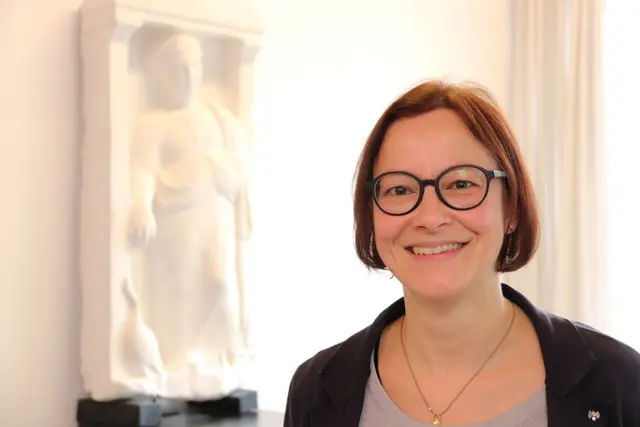
Eliese-Sophia Lincke is a Junior Professor at the Department of History and Cultural Studies, Freie Universität Berlin, since May 2022. Her work bridges computational methods with Egyptology, focusing on digital tools for studying ancient texts. Bachelor's and Master's in Egyptology, Humboldt-Universität zu Berlin (2007) PhD in "The Conception of Spaces in Language" (TOPOI Cluster, 2012) Research interests include: Digital Humanities : Developing machine learning models for Hieroglyphic, Demotic, and Coptic text processing Linguistic Typology : Analyzing classifier systems in Ancient Egyptian and Sign Languages Spatial Linguistics : Investigating prepositions and spatial adverbs in Egyptian-Coptic Recent publications focus on Neural Lemmatization , OCR for Coptic , and Classifier Semantics , demonstrating her commitment to computational Egyptology. Scientific awards include the Humboldt-Preis 2008 for best Master's thesis and the Prize for Good Teaching 2014 . She has co-organized workshops like "Wege zum Ägyptischen" and served as Co-Editor for Lingua Aegyptia . Her teaching contributes to the Digital Studies of Ancient Texts Master's program.
Prof. Dr. Frank Kammerzell is a Professor at the Department of Archaeology and Cultural History of Northeast Africa within Humboldt University of Berlin since May 2003. His academic career includes habilitation at the University of Göttingen (1999) and extensive research collaborations with Hebrew University of Jerusalem and University of Vienna. His educational background encompasses Medieval and Modern History (major 1980), Egyptology (major), Coptic Studies, General and Indo-European Linguistics, and Assyriology. He earned his Dr. phil. from Göttingen with a dissertation on 'Studies on the Language and History of the Carians in Egypt' (1990) and completed habilitation with 'Language contact and language change in ancient Egypt' (1999). Kammerzell's research spans Egyptian phonology, morphology, syntax, lexis, language history, diachronic typology, language contact, writing systems, and Carian history in Egypt. His work integrates linguistic analysis with archaeological contexts, examining language evolution through contact and typological shifts. Notable projects include studies on Egyptian-Akkadian typological developments and classifiers in ancient Egypt. His publications since 2000 demonstrate sustained focus on Egyptian linguistic structures, writing systems, and cross-linguistic influences. Key themes include verb classifiers, glossing rules for Ancient Egyptian, and lexical semantics-pragmatics interfaces, bridging Egyptology with broader linguistic theory. Graduate Scholarship from the State of Lower Saxony (Doctoral Scholarship) 1987-1989 Kammerzell has led significant research projects funded by the DFG, Fritz Thyssen Foundation, and Volkswagen Foundation. His collaborative work with institutions in Jerusalem and Göttingen highlights international partnerships. While specific advisees aren't listed, his editorial roles suggest mentorship in academic publishing. He co-founded research groups on multilingualism and script systems, contributing to journals like Lingua Aegyptia and Ägypten und Levante , underscoring team-based archaeological-linguistic research.
Robert Ziegler serves as Associate Professor at the Institute of Philosophy within the Faculty of Human Sciences at the University of Würzburg, Germany. His academic career spans over 20 years with significant contributions to continental philosophy, evidenced by numerous monographs and peer-reviewed publications. He maintains active research leadership in three university research clusters while teaching courses such as War and Peace (Winter Semester 2025/26). His educational trajectory includes: Philosophy, Classical Philology (Latin), and History studies at Würzburg (2000-2003) Advanced philosophy studies at Sorbonne University (2003-2005) Master's thesis on Husserl and Cavaillès (2004) Doctorate on Pascal from Würzburg/Paris IV-Sorbonne (2009) Habilitation at Würzburg (2015) Ziegler's research centers on metaphysical immanence, early modern rationalism, and 20th-century phenomenology. His work critically engages Pascal's religious philosophy, Spinoza's ontology, and Levinas' ethics while bridging psychoanalysis and political theory. Recent scholarship examines reactionary political strategies, affective structures in social crises, and the emergence of novelty through materialist frameworks. His interdisciplinary approach connects historical analysis with contemporary philosophical challenges. Analysis of his 15 most recent publications reveals consistent thematic threads: the phenomenology of affect in political contexts, reconceptualizations of rationality through embodied practices, and critical examinations of reactionary thought. His publications demonstrate methodological diversity—integrating textual analysis of historical figures with original contributions to ontology, political philosophy, and the philosophy of science—while maintaining focus on immanence as a unifying metaphysical framework. His scientific recognition includes: Research Prize of the Faculty of Human Sciences (2019) Bavarian Elite Fund Doctoral Scholarship (2005/6) DAAD Scholarship (2003/4) Professor Ziegler has secured substantial research funding including multiple DFG projects on Cicero's Tusculanae disputationes , non-object-directed intentionality, and practical reasons before Kant, plus a Fritz Thyssen Foundation project on intention formation. As a lecturer since 2005, he has supervised numerous doctoral and master's students, contributing to graduate education through seminars on political philosophy and metaphysics. His editorial work includes co-editing The Inner Logic of Creativity (2013). He actively participates in the Institute's Research Focus on Phenomenology, Research Focus on the Greek-Arabic-Latin Tradition, and Research Focus on Social Philosophy and Ethics. These groups organize the Phenomenological Colloquium, lecture series on philosophical research, and interdisciplinary workshops that foster cross-traditional dialogue in contemporary philosophy.
Dr. Luke Adamson is a tenure-track Researcher in Research Area 3 'Syntax and Lexicon' at the Leibniz-Zentrum Allgemeine Sprachwissenschaft (ZAS), Berlin. Previously, he held a Postdoctoral Fellowship at Harvard University (2020–2022) and served as Lecturer at Rutgers University (2022–2023). He earned his PhD in Linguistics from the University of Pennsylvania (2019) and holds dual degrees from Oberlin College: a Bachelor of Arts in Psychology and a Bachelor of Music in Cello Performance (2010–2014). His research focuses on nominal features, grammatical gender, and syntactic modularity, with notable projects exploring gender locality hypotheses, coordination resolution in three-gendered languages, and suppletion phenomena. Collaborators include prominent linguists such as Elena Anagnostopoulou (University of Crete), Ruth Kramer (Georgetown University), and Stanislao Zompì (Universität Potsdam). Key contributions include work on gender assignment constraints in languages like Greek, Swedish, and Lithuanian, as well as syntactic interfaces in Jarawara and Italian. Recent presentations include invited talks at the University of Geneva (June 2025), Yale University (October 2024), and the Brussels Conference on Generative Linguistics (December 2024). He co-edits Linguistic Inquiry Squibs & Discussion and organizes the ZAS Brown Bag Lunches. His work has been supported by grants from the National Science Foundation and the European Research Council. Adamson’s academic networks span formal linguistics and typological studies, with ongoing projects addressing politeness pronouns in Romance languages, emotive predicates in clausal complements, and allosemy in Greek gender systems.
Florian Haas is a Senior Lecturer in Linguistics at the Institute for English and American Studies , Friedrich Schiller University Jena , where he has taught since 2009 across BA, MA, and teacher training programs. His research focuses on recent morphosyntactic changes in English , contrastive linguistics , typology , and usage-based construction grammar , with a notable Habilitation thesis on the history of human impersonal pronouns in English. Education : PhD in Linguistics (2008, Free University of Berlin, summa cum laude), MA in European Master's Degree in Linguistics (2002), MA in English Studies (2002). His research interests span corpus-driven analysis of language change, cross-linguistic contrasts (particularly English-German), and cognitive approaches to grammar. His publications emphasize diachronic shifts in pronouns, genre-specific linguistic patterns, and constructionist analyses of syntax. He has supervised numerous student theses on topics like political framing, bilingualism, and sociolinguistic variation in English. Academic service includes roles as Erasmus coordinator, reviewer for journals like Journal of Pragmatics , and memberships in societies such as the Association for Linguistic Typology .
Dr. Anna Marie Sitz is a Research Fellow at the University of Tübingen's Faculty of Humanities, Department of History. She specializes in Late Antique archaeology and epigraphy in the eastern Mediterranean, with a focus on Anatolia and Cyprus. Current affiliations: Wissenschaftliche Mitarbeiterin (Project Staff), Teilprojektleiterin (Phoenix Survey, Turkey) Research interests: Material text cultures, inscription reuse, reception of antiquity, Byzantine provincial life Her recent work analyzes the spatial dynamics of inscriptions in post-Roman contexts, examining how ancient texts were repurposed in Christian environments. This includes studies on spoliation practices, epigraphic erasures, and the materiality of commemorative traditions. Scientific contributions include a 2023 monograph on pagan inscriptions in Christian viewership, multiple peer-reviewed articles on Late Antique Anatolia, and fieldwork leadership in Labraunda and Phoenix excavations. Her 2024 First Book Award from the Classical Association of the Middle West and South (USA) recognizes her groundbreaking research. Major grants: Dumbarton Oaks (2023), Mary Jaharis Center (2022), American Philosophical Society (2020/21) Academic background: Ph.D. (2012-2017) and M.A. (2010-2012) from University of Pennsylvania; B.A. (2006-2010) from Baylor University. Active fieldwork in Turkey (Labraunda, Alabanda) and Sicily (Philosophiana) complements her epigraphic studies.
Dr. Giouli Korobili is a former academic staff member at the Humboldt-Universität zu Berlin, affiliated with the Faculty of Language, Literature and Humanities and the Department of Classics . Her research focuses on ancient philosophy, particularly Aristotle's works on natural philosophy, medicine, and biological theories. She has contributed significantly to the analysis of classical texts such as De Juventute et Senectute and their relationship with Hippocratic medical writings. Research Interests: Aristotle's methodology, ancient medical theories, philosophical analysis of vitality, and interdisciplinary approaches to classical texts. Publications: Authored/co-edited volumes on Aristotle's biological and medical thought, including a monograph on Youth and Old Age and co-edited The Nutritive Soul in Ancient and Medieval Philosophy and Medicine . Dr. Korobili’s work bridges ancient philosophy, medicine, and natural science, with notable contributions to understanding Aristotle's engagement with empirical evidence and his integration of philosophical inquiry with physiological observation. She has also collaborated on exhibitions like The Soul is an Octopus , exploring ancient concepts of life and the body. Contact: gkorobili@hotmail.com
Dr. Thomas Jurczyk is a Research Software Engineer at the CRC 1475 "Metaphors of Religion" at Ruhr-Universität Bochum, where he conducts computer-driven analyses of the A01 tafsir corpus and develops web applications. He holds a PhD in Religious Studies from Ruhr-Universität Bochum (2020), an MA in History and Religious Studies (2014), and a BA in Computer Science from FernUniversität Hagen (2024). His interdisciplinary background bridges humanities scholarship with computational expertise. PhD, Ruhr-Universität Bochum (2020): "The Notion of surb in Ancient Armenian Texts from the Fifth Century CE" (summa cum laude) MA, History and Religious Studies, Ruhr-Universität Bochum (2014): Grade 1.0 BA, Computer Science, FernUniversität Hagen (2024): Grade 1.6 BA, History and Religious Studies, Ruhr-Universität Bochum (2011): Grade 1.0 Dr. Jurczyk's research sits at the intersection of digital methods and religious studies, with particular focus on computational approaches to ancient religious texts, an/iconism, and the application of data science in humanities research. His work demonstrates how quantitative methods can illuminate patterns in religious discourse, textual traditions, and visual culture that might otherwise remain obscured in traditional qualitative analysis. He has developed expertise in Python programming, text mining, and digital publishing workflows. His scholarly output reveals a consistent trajectory of applying computational methods to religious studies questions, moving from specific case studies of ancient texts to broader methodological reflections on data science in the humanities. Recent publications show increasing sophistication in text mining techniques applied to religious corpora, particularly Qur'anic commentaries. Preis an Studierende (Award for best MA dissertation), Ruhr-Universität Bochum (2014) International Realisation Budget Grant (7,500 €) from Research School PLUS Dr. Jurczyk has served as Managing Editor of Entangled Religions and Editor of Philosophy and the Mind Sciences, demonstrating his commitment to scholarly communication. He has taught Python and data science classes at the University of Tübingen and developed automated publishing workflows like the Magic Manuscript Maker. His technical skills span Python, Go, Java, Docker, and web development, making him a valuable bridge between humanities scholarship and computational approaches. He is actively involved in the Digital Humanities community through membership in the Netzwerk Digital Humanities at Ruhr-Universität Bochum, the DHd AG "Digitales Publizieren," and CRETA "Centrum für Reflektierte Textanalyse." His work on the Religion Classification Web interface/API demonstrates practical applications of his research interests.
Heiner Böttger is a Full Professor of English Didactics and EFL (English as a Foreign Language) at the Catholic University of Eichstätt-Ingolstadt, Germany, where he has served since 2007. He holds the Professorship for Didactics of English Language and Literature within the Faculty of Languages and Literature. His academic journey includes positions at the University of Erlangen-Nuremberg and visiting professorships at institutions including Akdeniz University in Turkey, Aristotle University in Greece, and Long Island University in New York. Professor Böttger's research focuses on the intersection of language education and neuroscience, with particular expertise in foreign language anxiety (xenoglossophobia), sensitive phases of language development, multilingual didactics, and evidence-based foreign language teaching. His work bridges theoretical knowledge with practical classroom applications, emphasizing how insights from neuroscience can transform language teaching methodologies. He has pioneered approaches to early foreign language learning, corporate language instruction, and the psychological aspects of language acquisition including memory, resilience, and mindfulness. His extensive publication record demonstrates a clear trajectory toward integrating neuroscientific findings with language education. Recent works focus on language educational neurosciences (LEN), outdoor language learning, storytelling techniques, and the neuromotor foundations of speaking skills. Böttger's research shows increasing sophistication in connecting brain-based learning principles with practical language teaching strategies across diverse contexts from primary education to corporate settings. As an active academic, Böttger serves as Chairman of the Early language learning advisory board BIG (foundation Lernen, Munich) and as an External Academic Reviewer to the Greek state. His professional activities demonstrate a commitment to advancing evidence-based language education through both theoretical contributions and practical implementation.
Dr. James M. Burgin is a researcher at the University of Würzburg, where he serves as Head of the DFG Emmy Noether Junior Research Group 'The Hittite Annals: Origins, Purpose, and Afterlife' since 2021. He is affiliated with the Chair of Ancient Near Eastern Studies within the Institute of Classical Studies in the Faculty of Philosophy. Previously, he worked as a Research Assistant (leader) from 2017-2021 on the philological processing and analysis of the Hittite palace administration corpus. Born on October 9, 1984, Burgin earned his BA in South Asian Language and Civilization with a focus on Sanskrit from the University of Chicago (2002-2006), followed by an MA in Ancient Near Eastern Studies with a focus on Hittite studies (2008-2010). He completed his doctorate at the University of Chicago in 2016 with a dissertation titled 'Aspects of Religious Administration in the Hittite Late New Kingdom.' Burgin's research spans multiple dimensions of Hittite and Ancient Near Eastern studies, with particular expertise in Hittitology, the history of the Hittites, economic and administrative history, and Hieroglyphic Luwian. His work demonstrates a sophisticated understanding of the interplay between linguistic, historical, and archaeological evidence. He has made significant contributions to understanding Hittite festival texts, economic administration, textile production, and linguistic phenomena such as the 'Initial-A-Final' in Hieroglyphic Luwian. His research often bridges disciplines, connecting linguistic analysis with historical context and material culture. His recent publications reveal a trajectory of increasingly sophisticated analysis of Hittite textual corpora, with a growing emphasis on interdisciplinary approaches that incorporate linguistic, historical, and archaeological perspectives. Burgin's work on the Hittite palace-temple administrative corpus has challenged conventional understandings of royal administration, while his linguistic studies have illuminated previously obscure aspects of Anatolian languages. Röntgen Prize of the University of Würzburg (2022) Burgin has been involved in significant research projects including the Corpus of Hittite Festival Rituals (2016-17) and the DFG-funded project on the Hittite palace administration corpus (2017-21). As leader of his Emmy Noether Research Group, he directs a major investigation into the Hittite Annals, examining their origins, purpose, and historical legacy. His work has been supported by prestigious funding mechanisms including the DFG Emmy Noether Program, which targets exceptional early-career researchers. As head of his research group, Burgin leads a team investigating the complex textual tradition of the Hittite Annals, which document the military campaigns and political activities of Hittite kings. His research environment combines philological expertise with interdisciplinary approaches to understanding Bronze Age Anatolian civilization.
Nadin Burkhardt serves as Junior Professor and Chair of Classical Archaeology at the Catholic University of Eichstätt-Ingolstadt (KU), having received a positive interim evaluation in 2019. She has held this position since March 2017, following a deputy junior professorship at the same institution from October 2016 to February 2017. Her academic journey includes significant research positions at the German Archaeological Institute in Athens, Johann Wolfgang Goethe University in Frankfurt am Main, and TU Darmstadt. Doctorate from University of Cologne (2008) Master's degree from University of Cologne (2004) Studies in Berlin, Paris, and Cologne Professor Burkhardt's research focuses on Late Antique Urban Development with particular emphasis on Greece, settlement and urban development patterns, diaspora synagogues in Asia Minor, Italian cultures, colonization in Magna Grecia, acculturation phenomena, and funeral customs. Her work bridges archaeological field research with theoretical approaches to cultural exchange and urban transformation. She has conducted extensive research on Jewish communities in antiquity, particularly through her work on the synagogue at Priene, and has contributed significantly to understanding Greek colonization processes in the western Mediterranean. Her publication record demonstrates a consistent focus on urban space in Late Antiquity, Greek colonial settlements, and religious architecture. Burkhardt's recent work shows increasing attention to material culture studies, particularly in analyzing ritual objects and funerary practices. She frequently collaborates with international colleagues on excavations and research projects, especially in Italy and Greece. Professor Burkhardt actively contributes to academic governance, serving as a voting member of the university lecturers' group in the Faculty Council since October 2023, and as spokesperson for the KU Research College 'Dialogue Cultures' since June 2023. She has held various committee positions including membership on the Study Grants Commission and doctoral committee at KU. Her current research projects include habilitation work on late antique city development in Greece, ongoing excavation at Pithekoussai (the earliest Greek colony in the West), and collaborative projects examining competition behaviors and institutionalization processes among western Greek colonists. She also leads cooperative projects with local heritage organizations, including geophysical measurements around the Böhming fort and archaeological exhibitions in Nassenfels and Eichstätt.
Dr. Daria Kohler is a postdoctoral researcher and research manager at KU Leuven, Belgium, and a J.P. Gumbert Fellow at the Cluster of Excellence "Scripture Immanence" (CSMC) at the University of Hamburg (June–July 2024). She holds a doctorate in Greek and Latin Languages and Literature from the University of Oxford (2022), awarded the J.P. Gumbert Dissertation Prize (2023) for her thesis on literary publication in the Greek and Roman world. Her research focuses on the materiality of ancient books, paratexts, and publishing processes, combining literary analysis with insights from papyri. She co-edited Unprinted: Publication Beyond the Press (Cambridge Elements, 2024) with Prof. Daniel Wakelin. At CSMC, she is developing a monograph exploring the material aspects of ancient Greek and Roman book production, enriched by comparative studies of other writing cultures. Key interests include the interplay of literary representation and production processes, the role of paratexts in shaping texts, and interdisciplinary approaches to manuscript and papyrological evidence.
Prof. Theodoros Marinis is a Professor of Multilingualism at the University of Konstanz's Department of Linguistics. He directs the Center for Multilingualism and leads the EU 'MultiMind' project training early-stage researchers in multilingualism. His research focuses on language acquisition and processing in typically/atypically developing bilinguals, funded by DFG, ESRC, NWO, and others. He co-developed the LITMUS Sentence Repetition Tasks for multilingual children and serves on editorial boards of journals like Journal of Child Language and Applied Psycholinguistics . Research interests include bilingual syntax, heritage language maintenance, figurative language processing in ASD, and multilingual literacy. He investigates cross-linguistic effects in grammatical morphemes, rhetorical questions, and code-switching impacts on cognitive control. His work bridges psycholinguistics with education policy, addressing multilingualism benefits in diverse populations. Grants: DFG (Non-Canonical Questions in Bilingual Acquisition), ESRC (SLI in Bilingual Children), NWO (L2 Children vs. SLI) Projects: COST Action IS0804, EU MultiMind (2024), India literacy studies (2020) Labs/Teams: Center for Multilingualism (Konstanz), LITMUS Task Development Consortium Publications examine metaphor comprehension in ASD, attention networks in stuttering multilinguals, and longitudinal literacy development. He advocates for evidence-based multilingual education policies and has published over 100 peer-reviewed articles since 2017.
Dr. Julien Devinant is an Associate Professor in the Department of Medical Humanities at the University of Lille, affiliated with UMR 8163 (Laboratory for Knowledge, Language, and Texts). He holds a PhD in Ancient Philosophy and Greek Philology from Paris-Sorbonne and Humboldt University Berlin (2016). His research focuses on Hellenistic and Roman scientific thought, particularly Galen's contributions to medicine and philosophy, blending history of philosophy, philology, and medical history. Research interests include: theories of life, Aristotelianism reception, medical causality, and physiological functions. Key themes are the concept of δύναμις (natural faculties) and their role in physiological thought, as well as the evolution of medical concepts from Aristotle to Galen. Publications emphasize Galen's work on mental disorders, medical explanations, and the intersection of philosophy and medicine. He contributes to critical editions of medical texts and explores ancient medical practices through a multidisciplinary approach.
Ion Androutsopoulos is a Professor in the Department of Informatics at Athens University of Economics and Business (AUEB), where he leads the AUEB NLP Group. With over 180 publications spanning three decades, he is a prominent figure in Natural Language Processing research, particularly known for his work bridging NLP with legal informatics, Greek language processing, and biomedical applications. His research interests focus on several interconnected areas of Natural Language Processing: Legal Informatics : developing NLP systems for legal document analysis, legal judgment prediction, and legal reasoning, with recent work including GreekBarBench and Archimedes-AUEB systems Greek Language Technology : creating specialized tools for Modern Greek processing, including GR-NLP-TOOLKIT and Greeklish transliteration systems Biomedical Text Mining : working on diagnostic captioning and medical image analysis through participation in ImageCLEFmedical challenges Financial NLP : developing systems like EDGAR-CRAWLER for financial document analysis and XBRL tagging His recent publications (2023-2025) show an increasing focus on Greek-specific NLP resources and practical applications of large language models in legal reasoning. His work often combines theoretical NLP advances with practical implementations, particularly through his leadership of the AUEB NLP Group which regularly participates in international evaluation campaigns. Professor Androutsopoulos has supervised numerous PhD students who have become active researchers in their own right, including John Pavlopoulos, Prodromos Malakasiotis, and Ilias Chalkidis. His collaborative network spans multiple institutions and disciplines, reflecting the interdisciplinary nature of modern NLP research.