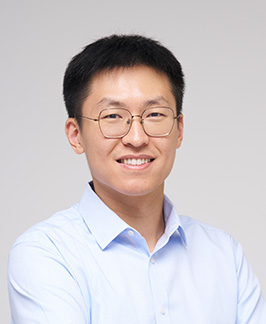
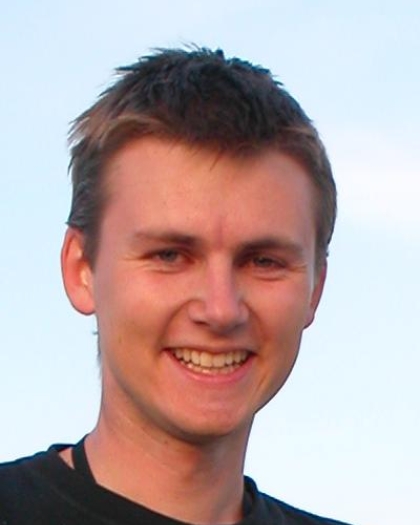
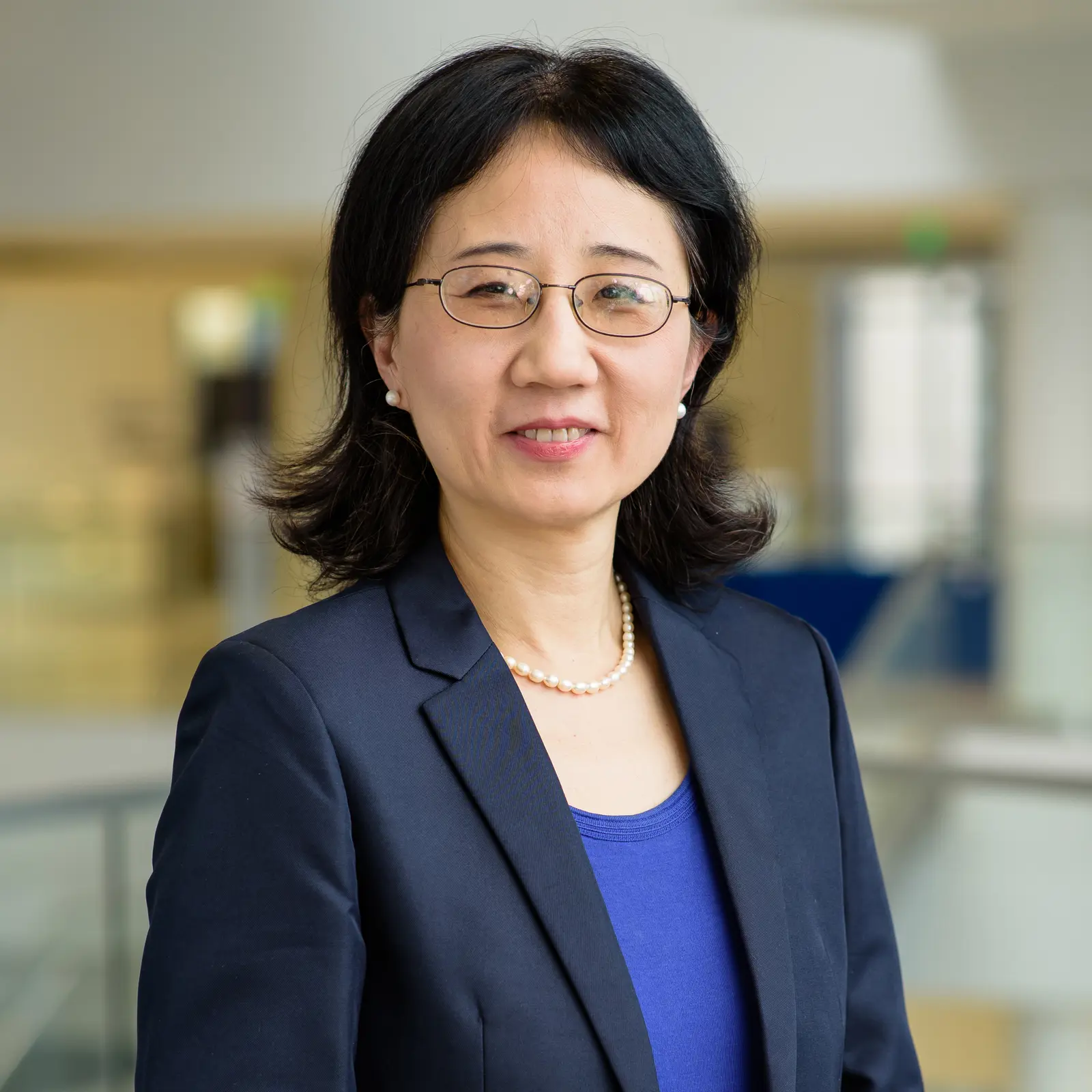
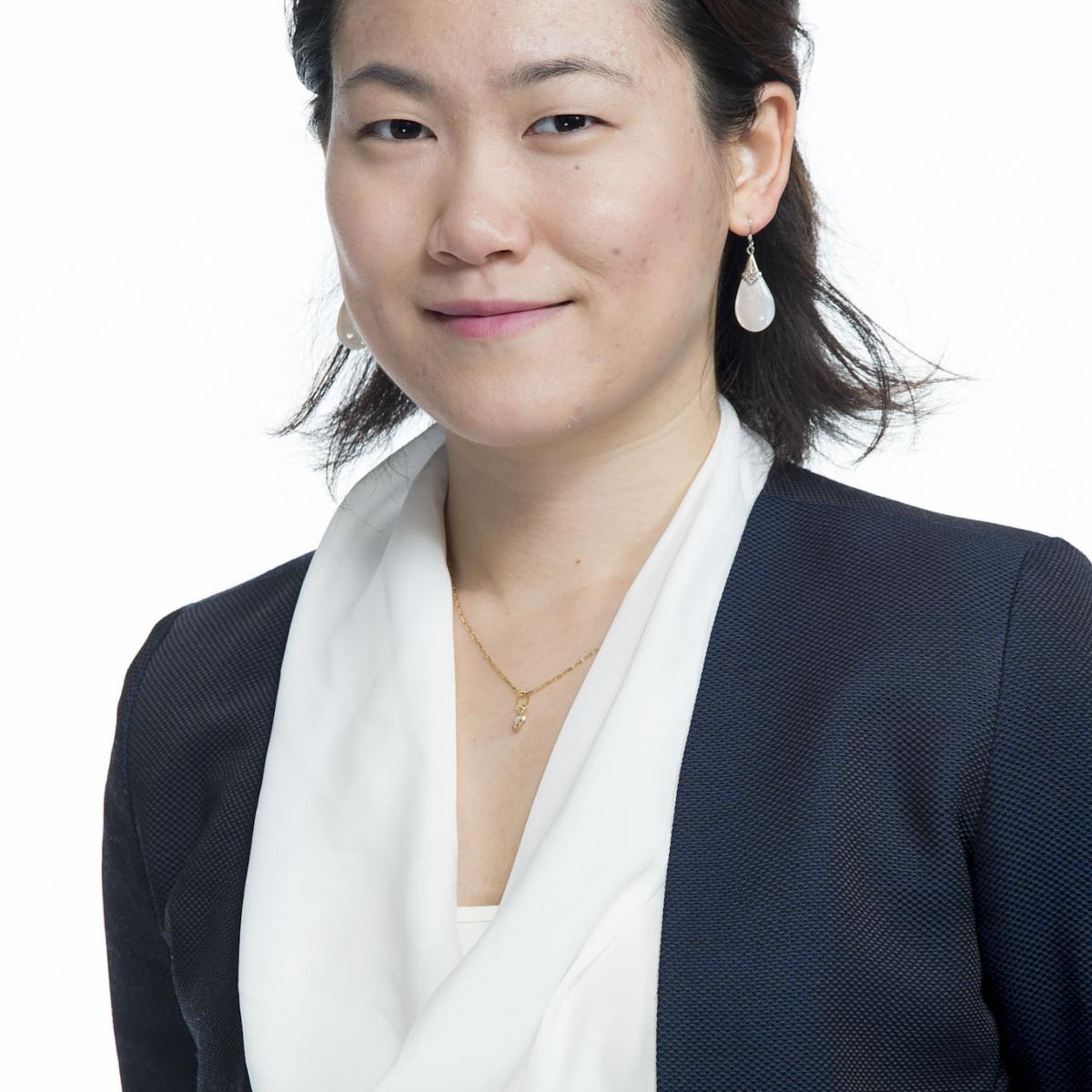
Zhenqin Wu is an Assistant Professor at the Department of Computer Science, University of Hong Kong. He holds a PhD from Stanford University (2016–2022) under advisors Prof. James Zou and Dr. Vijay Pande, with research focused on applying AI/ML to computational biology and spatial omics. His work bridges machine learning and spatial biology, developing tools for analyzing spatial proteomics, transcriptomics, and histopathological imaging. Education: PhD in Computer Science, Stanford University (2016–2022) BSc in Chemistry, Peking University Research Interests: AI-driven spatial omics analysis Multimodal data integration in biology Machine learning for medical imaging Computational modeling of cellular microenvironments His recent work highlights include developing the ROSIE AI framework for immunofluorescence generation and the CORAL method for spatial multiomics integration. Articles focus on immunotherapy response prediction, disease biomarker discovery, and interpretable models for tissue structure analysis. Professional Affiliations: Scientific Advisor, Enable Medicine (biotechnology startup) AI Fellow, Genesis Therapeutics He actively mentors PhD/postdoc researchers and collaborates on AI-driven drug discovery projects. His lab focuses on translating spatial omics insights into clinical applications.
Huijuan Wang serves as Associate Professor in the Multimedia Computing Group within the Department of Intelligent Systems at Delft University of Technology's Faculty of Electrical Engineering, Mathematics and Computer Science. With over 20 years of affiliation at TU Delft, she completed both her Master's degree and PhD at this institution before rising to her current faculty position. Her research focuses on temporal network analysis, higher-order network modeling, and information diffusion dynamics. Professor Wang investigates epidemic spreading models, network prediction algorithms, and complex system behaviors through both theoretical frameworks and practical applications. Her work bridges computer science, mathematics, and real-world network phenomena including urban systems and social dynamics. Analysis of her recent publications reveals a strong emphasis on temporal network properties, higher-order dependencies, and predictive modeling. Her research demonstrates consistent innovation in extracting diffusion backbones, measuring network dissimilarity, and developing memory-based prediction techniques for evolving networks. Co-founded Dutch Network Science Society (2018) Established Young Talent Prize recognizing emerging researchers Developed free community events fostering industry-academia collaboration Professor Wang actively mentors PhD candidates, emphasizing genuine interest in students' development as she experienced during her own doctoral studies. She champions initiatives promoting social safety, trust-building, and work-life balance within academic environments while leading efforts to establish processes addressing social safety concerns through cultural transformation.
Martin Vatshelle is an Associate Professor in the Department of Informatics at the University of Bergen (UiB) , Norway. He obtained his PhD from UiB in 2012 with a thesis titled New Width Parameters of Graphs . His research is centered on theoretical computer science, particularly in the design and analysis of graph algorithms. His main research interests include: Graph Algorithms Parameterized and Fixed-Parameter Tractable (FPT) Algorithms Algorithm Engineering Graph Theory, especially width parameters like boolean-width, clique-width, and branch decompositions Dynamic programming on structured graphs The recent publications of Martin Vatshelle reflect a strong focus on structural graph theory and algorithmic efficiency. His work frequently explores the computational complexity of graph problems, leveraging width parameters to design faster exact or parameterized algorithms. Themes such as boolean-width bounds, vertex partitioning, and satisfiability problems (#SAT, MaxSAT) are recurrent, indicating a deep engagement with both theoretical foundations and practical algorithmic improvements. There are no scientific awards mentioned in the provided texts. Martin Vatshelle has taught a variety of courses in algorithms, discrete mathematics, and complexity theory since 2004, including Algorithms, Data Structures and Programming , Complexity Theory , and Algorithm Engineering . There is no mention of research grants or supervised students in the provided materials. He collaborates extensively with researchers such as Jan Arne Telle and Sigve Hortemo Sæther. He is affiliated with the research group on Didactics within the Department of Informatics. No separate lab or research center is mentioned.
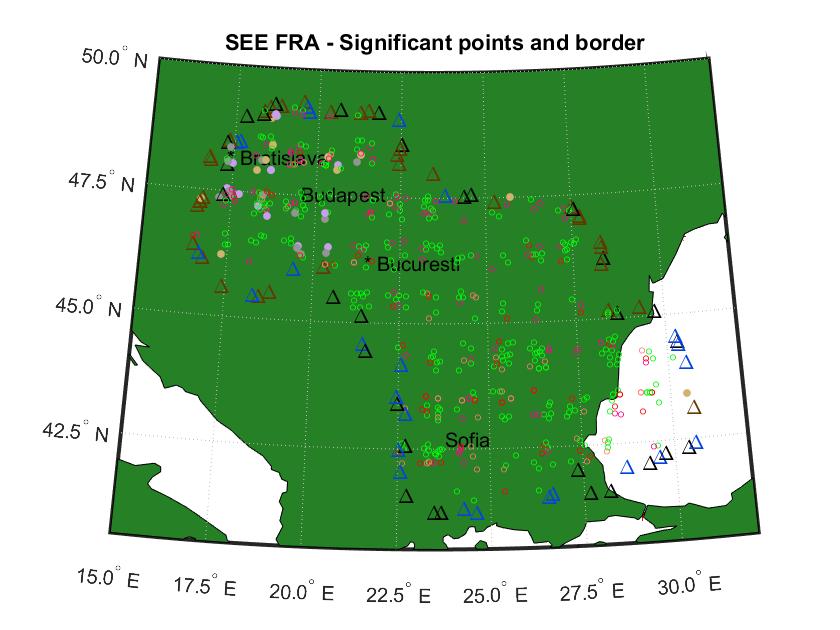
Peter Szabó is an Associate Professor at the Department of Aviation Technical Training , Faculty of Aeronautics , Technical University of Košice , Slovakia. He is actively involved in research at the intersection of mathematics, computer algebra, and aerospace engineering. Academic Affiliation: Technical University of Košice, Faculty of Aeronautics, Department of Aviation Technical Training Research Interests include: Mathematical modeling in aviation (Free Route Airspace, complex networks) Linear algebra and numerical methods with MATLAB/SageMath Calculus education and computational techniques Graph theory applications to air traffic systems Recent Article Trends highlight: Integration of calculus and numerical analysis for educational tools (2025) Mathematical axioms for airspace modeling (2022) Cloud computing in aviation research (2022) Linear algebra textbooks and computational exercises (2019) Advising : Mentored students on topics ranging from satellite stabilization to air traffic optimization.
Cindy Chen serves as Department Chair and Associate Professor at the Miner School of Computer and Information Sciences within the Kennedy College of Sciences at the University of Massachusetts Lowell. Her academic journey includes a Ph.D. in Computer Science with specialization in Database and Knowledge Base Management from UCLA (2001), an MS in Computer Science from UCLA, and a BS in Space Physics from Peking University. Ph.D.: Computer Science (Database and Knowledge Base Management), University of California at Los Angeles (2001) MS: Computer Science, University of California at Los Angeles BS: Space Physics, Peking University - Beijing, China Her research spans spatio-temporal databases, data mining, cloud computing, and social network analysis. Early work focused on spatio-temporal data models and query languages , evolving into cloud data warehouse optimization and social network mining (particularly online dating behavior), then advancing to high-dimensional indexing , knowledge graph querying , and recent innovations in temporal database granulation using Allan Variance techniques for CAV friction modeling. Current work integrates database systems with autonomous vehicle infrastructure and real-time urban analytics. Her publication timeline reveals a transition from foundational spatio-temporal database systems (1998-2008) to cloud/social applications (2008-2015), then to granulation techniques and CAV systems (2015-present). Key domains include XML databases, skyline queries, social trend discovery, and friction data modeling for autonomous vehicles. Dean's Fellowship (1998) Dean's Fellowship (1999) Dr. Chen has secured significant research funding including the UMASS Transportation Center grant for an Interactive TMC Decision Support Tool (2008) and a UML Healey Grant Award for Spatio-Temporal Knowledge Discovery in Nuclear Physics (2008). Her collaborative projects span transportation systems, nuclear physics applications, and autonomous vehicle infrastructure. She actively advises on database curriculum development and serves as department chair overseeing academic operations.
Boaz Barak is a Professor at the Weizmann Institute of Science in the Department of Computer Science, Faculty of Mathematics and Computer Science. With an h-index of 64 and over 17,301 citations, he is a leading researcher in theoretical computer science with significant contributions spanning computational complexity, cryptography, and machine learning theory. His research interests include: Computational Complexity Cryptography Zero-Knowledge Proofs Program Obfuscation Interactive Proofs Privacy-Preserving Computation Machine Learning Theory Barak's publication record reveals a trajectory from foundational work in theoretical computer science to contemporary research at the intersection of theory and practice. His early work established impossibility results for program obfuscation and advanced techniques for zero-knowledge proofs beyond black-box simulation. His influential textbook "Computational Complexity: A Modern Approach" has become a standard reference in the field. More recently, his research has expanded into machine learning phenomena like double descent and scaling laws for language models, demonstrating the evolving nature of his theoretical contributions. His work consistently bridges deep theoretical insights with practical implications for computing. His notable collaborations include extensive work with Sanjeev Arora (77 publications, 6,879 citations), David Steurer (95 publications, 4,945 citations), and Oded Goldreich, among others. Professor Barak leads a research group at the Weizmann Institute focused on theoretical aspects of computer security and complexity theory. His work has been consistently supported by major research funding, enabling significant contributions to the theoretical foundations of computer science. He maintains an active research program with publications spanning over two decades, demonstrating sustained impact in multiple subfields of theoretical computer science.
Dr. Krystal Guo is an Assistant Professor of Discrete Mathematics at the Korteweg-de Vries Institute for Mathematics , University of Amsterdam. Her research spans algebraic graph theory, quantum computing, and spectral graph theory, with a focus on eigenvalues of graphs and digraphs. She is also affiliated with QuSoft , the Dutch research center for quantum software. Education: PhD in Mathematics (2015) from Simon Fraser University under Bojan Mohar. Prior Positions: Postdoctoral stints at Université de Montréal (2019-2020), Université Libre de Bruxelles (2017-2019), and University of Waterloo (2015-2017). Her research bridges linear algebra and combinatorics, with applications to quantum information theory, directed graphs, and linear optimization. She actively explores connections between graph polynomials, association schemes, and quantum walks. Recent publications span graph isomorphism complexity, quantum error correction, and four-color theorem proofs using generating functions. She serves as Managing Editor of the Electronic Journal of Combinatorics since 2022 and organizes the General Mathematics Colloquium at UvA with Eni Musta and Jeroen Zuiddam. Key Scientific Awards: 2013 finalist in Simon Fraser University’s 3MT thesis competition. She maintains an active research blog, Graphs on Napkins , and contributes to open-source mathematics via GitHub repositories containing cubic graph census data and computational tools.
Vahab Mirrokni is a distinguished scientist and research director at Google Research (New York) , leading the market algorithms, graph mining, and large-scale optimization research groups . He also holds an adjunct associate professor appointment at the Courant Institute of Mathematical Sciences, New York University . Education: PhD in Computer Science, Massachusetts Institute of Technology, 2005 B.Sc. in Computer Engineering, Sharif University of Technology Research Interests: E-commerce and Market Algorithms Distributed Optimization Algorithmic Game Theory Computational Economics Approximation Algorithms Combinatorial Optimization Scientific Awards: Best Paper Award, ACM Conference on Electronic Commerce (EC), 2008 Best Student Paper Award, Symposium on Discrete Algorithms (SODA), 2005 Prior Academic Affiliations: Theory Group, Microsoft Research Theory of Computation Group, MIT CSAIL Strategic Planning and Optimization Group, Amazon.com Contact: mirrokni@google.com, mirrokni@gmail.com. Office: 212-565-8949. Address: 111 8th Ave, 4th floor, New York, NY 10011.
Dr. Thanh Tam Nguyen is a Lecturer at the School of Information and Communication Technology, Griffith University, Gold Coast Campus. He holds a PhD in Computer Science from École Polytechnique Fédérale de Lausanne (EPFL), Switzerland, and is a Fellow of the Higher Education Academy (FHEA). His academic and research profile is centered on advancing Big Data and Smart technologies through efficient and trustworthy AI systems. His educational background includes a Doctor of Science and a Master of Science, both from EPFL. He is actively involved in high-impact research and has published over 65 papers in top-tier venues such as SIGMOD, VLDB, SIGIR, ICDE, IJCAI, VLDBJ, TKDE, and Pattern Recognition, with over 35 in CORE A* journals and conferences. His work has attracted more than 4,200 citations (h-index 35+). Dr. Nguyen's research focuses on Big Data Analytics, Social Network Mining, Stream Processing, Privacy-Preserving Machine Learning, Recommender Systems, Explainable AI, and Graph Neural Networks . He aims to bridge human insights with data models to ensure transparency and trust in data-driven decisions. His recent work explores misinformation management, machine unlearning, and federated learning, with applications in social networks, healthcare, and sustainable agriculture. The 15 most recent publications reflect a strong trend in privacy-preserving AI, explainability, federated learning, and graph-based modeling . Key themes include machine unlearning, adversarial robustness in recommender systems, heterogeneous graph representations, and trustworthy AI deployment. His work is frequently published in ACM and IEEE venues, indicating sustained excellence in computer science and AI research. Fellow of the Higher Education Academy (FHEA) Dr. Nguyen has secured over $1 million in research funding from government (DFAT, A4I, AKF), industry (CSIRO, Ubitech, Johnson & Johnson), and international bodies (NAFOSTED, ETRI, KARI). He serves as a guest editor for IEEE Journal of Biomedical and Health Informatics, area chair for ACL and EMNLP, and reviewer for top journals like TKDE, JVLDB, and CSUR. He supervises multiple PhD students and collaborates with leading international researchers such as Prof. Karl Aberer (EPFL), Prof. Björn Schuller (Imperial College), and Prof. Hongzhi Yin (UQ). He is a key contributor to the Responsible Big Data Lab at Griffith University and leads projects on misinformation management, AI safety, and sustainable agriculture through AI-powered traceability. His impact extends to policy and industry, particularly in cybersecurity and trustworthy AI adoption.
William J. Keith is an Associate Professor in the Department of Mathematics at Michigan Tech University . He specializes in combinatorics with a focus on partition theory , q-series , and identities . His teaching includes courses like Introduction to Linear Algebra and Combinatorics and Graph Theory , though he is currently on sabbatical for Spring 2025. Office hours: Monday/Wednesday 3-4pm (Fisher 314) or via Zoom Research interests center on partition theory , including Schmidt-type theorems , unimodality of major index distributions, and congruences for regular partitions. His work frequently bridges combinatorics with algebraic structures and modular forms. Recent publications highlight his contributions to generalized partition bijections , q-series identities , and graph-theoretic extensions . He is actively involved in mentoring graduate students, including current doctoral advisees Hunter Waldron and Philip Cuthbertson , and has previously supervised master's theses by J. T. Davies and Emily Anible . Keith coordinates the Partitions Seminar (active since 2021) and serves on the Undergraduate Committee , while also acting as an alternate faculty Senator for the Math Department. He emphasizes collaboration, particularly in exploring open problems like refining Stanley's formula and studying overpartition analogues of Gaussian coefficients.
Dr. Zhiru Zhang is a Professor in the School of Electrical and Computer Engineering at Cornell University and a member of the Computer Systems Laboratory. His research focuses on new algorithms, methodologies, and design automation tools for heterogeneous computing systems, with recent publications centering on high-level synthesis (HLS), hardware specialization for machine learning, and programming models for software-defined FPGAs. Dr. Zhang earned his Ph.D. in Computer Science from UCLA, where he co-founded AutoESL based on his dissertation research on HLS. AutoESL was acquired by Xilinx (now AMD), and its HLS tool evolved into Vivado HLS (now Vitis HLS), which is widely used for designing FPGA-based hardware accelerators. He also holds a B.S. in Computer Science from Peking University and an M.S. in Computer Science from UCLA. Dr. Zhang's research interests span hardware design, high-level synthesis, FPGA acceleration, machine learning acceleration, heterogeneous computing systems, and computer architecture. His work bridges the gap between software algorithms and hardware implementation, focusing on creating efficient design automation tools that enable specialized hardware for emerging applications, particularly in AI and machine learning. His recent publications demonstrate strong trends in differentiable programming for hardware design, sparse computation optimization, and efficient implementation of large language models on FPGAs. Dr. Zhang has received numerous prestigious awards including being named an IEEE Fellow, the Intel Outstanding Researcher Award, AWS AI Amazon Research Award, Facebook Research Award, Google Faculty Research Award, DAC Under-40 Innovators Award, Rising Professional Achievement Award from UCLA, DARPA Young Faculty Award, IEEE CEDA Ernest S. Kuh Early Career Award, and NSF CAREER Award. His papers have won multiple Best Paper Awards from top conferences including ASPLOS (2025), ISPD (2025), FPGA (2024, 2022, 2021, 2019), AutoML (2024), FCCM (2018), ACM TODAES (2012), and Top Picks in Hardware and Embedded Security (2020). His papers on HLS scheduling and application-specific instruction-set processor (ASIP) compilation have been inducted into the ACM/SIGDA TCFPGA Hall of Fame for the classes of 2022 and 2023, respectively. On the teaching side, Dr. Zhang has received the Ruth and Joel Spira Award for Excellence in Teaching (2018) and twice the Michael Tien'72 Excellence in Teaching Award (2016, 2022), the highest recognition for teaching in the College of Engineering. He teaches courses including ECE 5775/6775: High-Level Digital Design Automation, ENGRD/ECE 2300: Digital Logic and Computer Organization, ECE 6980: Special Topics on Hardware Acceleration of Deep Learning, ENGRG 1050: Freshman Engineering Seminar, and ECE 5950: Special Topics on High-Level Digital Design Automation. Dr. Zhang leads an active research group with numerous PhD students and postdocs. His current students include Jordan Dotzel, Jie Liu, Zichao Yue, Yixiao Du, Yaohui Cai, Andrew Butt, Hongzheng Chen, Jiajie Li, Niansong Zhang, Matthew Hofmann, Zhanqiu Hu, Vesal Bakhtazad, and Grace Dinh. His alumni have gone on to successful careers at companies like NVIDIA, Google, AWS AI, Meta, Microsoft, and academic positions at universities including University of Illinois Chicago and Zhejiang University. The group has received multiple research grants from industry partners including AWS, Intel, and Google.
David Dakota Blair is an Associate Scientist in Computer Science and Machine Learning at Brookhaven National Laboratory's Computational Science Initiative. He holds a Ph.D. in Mathematics from the CUNY Graduate Center (2015) and a B.S. in Mathematics from Texas A&M University (2006). His research spans multiple interdisciplinary domains at the intersection of biology, data science, and national security. Blair contributes to several major projects including KBase (a collaborative platform for systems biology), Project Alexandria (enhancing nonproliferation research), SciDAC Oasis Chimbuko (real-time anomaly detection in HPC workflows), and AI Automation in the Cloud (evaluating secure AI solutions for the IAEA). His publication record demonstrates expertise in both theoretical mathematics (particularly number theory and combinatorics) and applied computational science. Recent work shows a clear trajectory from theoretical foundations in integer partitions and combinatorics toward practical applications in systems biology, national security, and machine learning. Blair's research interests encompass machine learning, data science, computational biology, systems biology, national security, and nonproliferation research. His work consistently bridges theoretical foundations with practical applications across diverse scientific domains. His professional activities support data-driven discovery, scientific collaboration, and informed decision-making across multiple disciplines, with a focus on advancing science in the public interest.
Mora Gine is a Professor in the Department of Mathematics at the Facultat d'Informàtica de Barcelona (FIB), Universitat Politècnica de Catalunya (UPC). She is a member of the DCCG (Discrete, Combinational, and Computational Geometry) research group, where her work primarily focuses on discrete mathematics and graph theory. Her research includes contributions to metric dimension, domination in graphs, graph coloring, and geometric graphs. Her research interests span Discrete Mathematics, Combinatorics, Computational Geometry, Graph Theory, Metric Dimension of Graphs, Dominating Sets, Graph Coloring, Geometric Graphs, Theoretical Computer Science, and Mathematics Education . She has co-authored numerous publications on topics such as resolving sets, fault-tolerant resolvability, antimagic labelings, and domination variants in specific graph classes including trees, outerplanar graphs, and grids. The recent publications show a strong trend in structural and metric graph theory, particularly in domination and location problems. Her work often involves extremal results, algorithmic implications, and applications in network design and monitoring. She also contributes to educational innovation projects in engineering mathematics, such as the EngiMath@UPC+ initiative, which promotes blended learning in linear algebra instruction. Premi o reconeixement (3 instances listed in record) Mora Gine actively collaborates with key researchers such as Carmen Hernando, Ignacio M. Pelayo, María Luz Puertas, and others in the discrete mathematics community. She has participated in multiple competitive R+D+i projects, including those funded under the Spanish State Research Plans and the HORIZON 2020 program. Her work appears in reputable journals such as Discrete Mathematics , Discussiones Mathematicae Graph Theory , Bulletin of the Malaysian Mathematical Sciences Society , and Applicable Analysis and Discrete Mathematics . She is involved in academic service, including editorial contributions to journals like Theoretical Computer Science , Electronic Notes in Discrete Mathematics , and Information Processing Letters . Her research is supported by long-standing affiliations with UPC’s Institute of Mathematics and the DCCG group, which fosters interdisciplinary work between discrete mathematics and computational geometry.
Associate Professor Ivan Lee is affiliated with the University of South Australia's STEM division at Mawson Lakes Campus. He actively supervises research degrees and contributes to interdisciplinary research intersecting computer science, food safety, and smart materials. Research Interests: Specializes in machine learning applications for hyperspectral imaging in food contamination detection Develops novel graph learning algorithms for real-time driver fatigue monitoring Investigates eco-friendly synthesis techniques for graphene-based nanomaterials Advances intelligent sensing systems for structural health monitoring Publications Trends: Recent work focuses on spatio-temporal graph modeling, multi-objective optimization algorithms, and applying deep learning to food safety challenges like aflatoxin detection. His research spans computer vision, IoT systems, and sustainable materials. Supervision: Currently serves as a research degree supervisor at University of South Australia. No scientific awards mentioned in available records.
Rodrigo I. Silveira is an Associate Professor in the Department of Mathematics at Universitat Politècnica de Catalunya (UPC), where he conducts research in computational and combinatorial geometry. He is a member of the UPC research group on Discrete, Combinatorial and Computational Geometry and has a strong academic background, having earned his PhD at Utrecht University under Marc van Kreveld and completed prior studies at the Universidad de Buenos Aires. His research focuses on Computational Geometry , particularly problems arising from Geographic Information Science (GIS) , such as map construction, trajectory analysis, and visibility. He also works on Graph Drawing and algorithms for geometric structures. His work combines theoretical algorithm design with practical applications in spatial data. His recent publications reflect a consistent trend in geometric algorithms, including shortest paths in complex environments (e.g., portalgons), Voronoi diagrams with color constraints, robot motion coordination, and map inference from GPS data. These works appear in top-tier journals and conferences such as Algorithmica , Computational Geometry: Theory and Applications , SoCG, WADS, and LATIN. He has received scientific recognition, including a Best Paper Award at AGILE 2009 and another at SpatialGems 2021. He has supervised several PhD students to completion, including Guilermo Esteban (2024) and Pilar Cano (2020), and continues to advise current students. Rodrigo has been deeply involved in the academic community, organizing major events such as the European Workshop on Computational Geometry (EuroCG 2023), Graph Drawing 2018, and the Intensive Research Program on Discrete Geometry (2018). He has served on the program committees of SoCG, WADS, LATIN, and CCCG, and has chaired tracks for EGC and CG:YRF. His work is supported by collaborations with leading researchers such as Kevin Buchin, Maarten Löffler, Prosenjit Bose, and Vera Sacristán, and he contributes to both theoretical advances and practical implementations in geometric computing.