C. Koutras is a researcher at the Data-Intensive Systems group within the School of Electrical Engineering, Mathematics and Computer Science at Delft University of Technology. His work focuses on data integration, schema matching, and machine learning applications in modern data systems. Research Areas: Data Integration, Schema Matching, Machine Learning, Data Lakes, Graph Neural Networks, Biomedical Data Systems Collaborations: Active collaborations with researchers including R. Hai, A. Katsifodimos, and M. Jarke. Recent work includes developing tools like Amalur and Valentine , which address challenges in data lake integration and scalable schema matching. His research leverages large language models and graph-based techniques for biomedical and distributed data environments. Despite significant contributions to data integration and machine learning, no explicit scientific awards or part-time status are documented in the provided materials. His 2024 dissertation at TU Delft highlights expertise in modern data challenges.
Balder ten Cate is an Associate Professor at the University of Amsterdam, where he leads the Theoretical Computer Science research unit within the Institute for Logic, Language and Computation (ILLC). His academic journey includes previous positions at INRIA, UC Santa Cruz, Stanford, LogicBlox, and Google. He maintains active collaborations across institutions including the University of Bergen (co-advising PhD students) and Tsinghua University. Primary Affiliation: Theoretical Computer Science (TCS) Secondary Affiliation: Mathematical & Computational Logic (MCL) Office: Room L6.38, LAB42, Science Park 900, Amsterdam Dr. ten Cate's research spans diverse applications of logic in computer science and AI, with particular emphasis on data management, knowledge representation, and machine learning. His work bridges theoretical foundations with practical applications, focusing on how logical frameworks can enhance data systems and AI capabilities. He has developed significant contributions in finite model theory, database theory, and computational learning theory, with recent work exploring connections between universal algebra and learning theory. His publication record shows a strong trajectory in theoretical computer science, with recent papers focusing on query algorithms, interpolation in logical fragments, and the learnability of database queries. The research demonstrates consistent contributions at top venues including PODS, ICDT, IJCAI, and ACM Transactions journals. His work on 'Extremal Fitting Problems for Conjunctive Queries' received the ACM PODS 2023 Best Paper Award, while 'SAT-Based PAC Learning of Description Logic Concepts' earned an IJCAI 2023 Distinguished Paper Award. 2024 ETAPS Best Paper Nomination 2023 ACM SIGMOD Research Highlights Award 2023 Alberto Mendelzon Test-of-Time Award ICDT 2012 Best Paper Award 2006 EACSL Ackermann Prize for best dissertation Dr. ten Cate actively supervises PhD and MSc students, with recent theses covering topics like modal formula characterization, conjunctive queries, and temporal logic. He serves on numerous program committees including PODS 2025 and ICALP 2024, and has organized workshops on learning and logic. His current MSCA European Re-Integration Fellowship 'LLAMA: Logic and Learning: an Algebra and Finite Model Theory Approach' (2021-2025) demonstrates ongoing research leadership. He also contributes to academic service through committee memberships including the ASL Committee on Education and the editorial board of the Journal of Logic, Language and Information.
Jörg Endrullis is an Associate Professor at the Faculty of Science, Department of Theoretical Computer Science at Vrije Universiteit Amsterdam. He also holds positions at the Network Institute. His research focuses on theoretical computer science, formal languages, automata theory, graph theory, and term rewriting systems. He contributes to the UN Sustainable Development Goals through his academic work. Contact: j.endrullis@vu.nl . His research interests include finite automata, Turing machines, subgraphs, transformation systems, polynomials, infinite sequences, and term rewriting systems. Recent work emphasizes graph transformation systems, formal verification, and category-theoretic approaches to computer science. Teaching includes courses on Automata and Complexity, Databases, and Term Rewriting Systems. He has supervised two PhD theses but no student names are listed here.
Yannis Velegrakis is a Professor in the Department of Information and Computing Sciences at Utrecht University, where he holds the chair of Very Large Data Management. He leads the Data Intensive Systems research group and is the program leader for the Master’s in Data Science . He is also a part-time faculty member at the University of Trento and a Principal Investigator at the Archimedes AI and Data Science hub, Athena Research Center . Education: PhD in Computer Science, University of Toronto MSc in Computer Science, University of Crete BSc in Computer Science, University of Crete His research focuses on Big Data Management & Analytics , Knowledge Discovery , Graph Management , Data Integration , and Data Quality . His work combines theoretical rigor with practical system development, emphasizing human-centered approaches to data exploration and analysis. He has pioneered methods in example-based search, entity resolution, and dynamic graph analysis. His recent publications reflect a strong trend in knowledge graph exploration , data quality assessment , and dynamic network mining . These works often integrate machine learning with database systems to support interactive and intelligent data discovery. His research bridges foundational data management with applied AI, particularly in the context of real-world data challenges. Scientific Leadership and Awards: PC Chair, ICDE 2024 General Chair, VLDB 2013 PC Chair, EDBT 2021 He has advised numerous researchers and contributed to major projects in data integration and semantic search. His secondary activities include visiting positions at IBM Almaden , AT&T Research Labs , UC Santa Cruz , and University of Paris-Saclay . He has secured funding through collaborative research initiatives and has served on program committees of top international conferences. He leads the Data Intensive Systems group, which develops innovative tools for managing and exploring large-scale, heterogeneous datasets. The group emphasizes systems that support intuitive, example-driven interaction with complex data, aligning with the principles of human-centered AI.
George Fletcher is a Full Professor at the Department of Mathematics and Computer Science at Eindhoven University of Technology (TU/e), where he chairs the Database Group in the Data and Artificial Intelligence Cluster. His research focuses on data systems, particularly the social aspects of data systems and the theoretical and engineering foundations of query and schema languages. He is currently investigating graph data management in domains such as social networks, knowledge graphs, biological networks, and communication networks, as well as data systems education. His academic training includes a PhD in Computer Science from Indiana University Bloomington and undergraduate studies in Mathematics and Cognitive Science at the University of North Florida. His research interests lie at the intersection of database systems, logic, and artificial intelligence, with a strong emphasis on the formal foundations of graph data querying. He explores expressiveness of navigational query languages, transitive closure, bisimulation, and synthetic workload generation for benchmarking graph databases. His recent publications demonstrate deep theoretical contributions to query language design and analysis. The trend in his recent articles (2015–2016) shows a concentrated effort on understanding the expressive power of query languages over graph-structured data, particularly through formal methods such as relation algebra and logical characterizations. These works contribute to both theoretical computer science and practical database system design, especially in the context of unlabeled graphs and Boolean queries. Executive Board Member, EDBT Association Associate Editor, ACM SIGMOD Record Associate Editor, Transactions on Graph Data and Knowledge He advises research within the Database Group and leads projects related to graph data systems. Though specific grants are not listed, his leadership in major research initiatives and editorial roles suggests active grant involvement and academic mentorship. He teaches courses such as Capita Selecta Databases, Seminar Datamanagement, Datamodeling and Databases, Knowledge Engineering, and Data Management for Data Analytics. He is a core member of the Database Group at TU/e and part of EAISI (Eindhoven Artificial Intelligence Systems Institute), contributing to foundational AI research with a focus on data infrastructure and intelligent data systems.
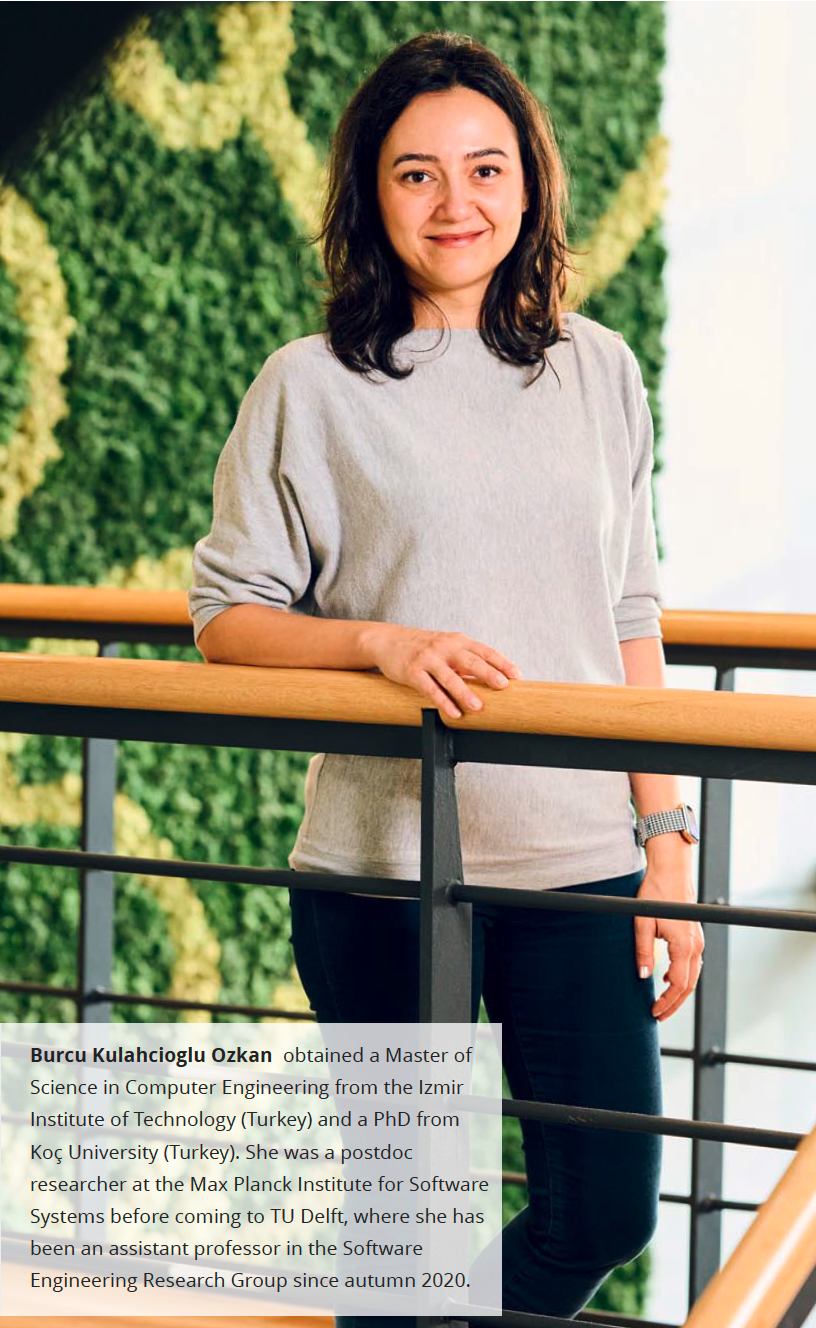
Burcu Kulahcioglu Ozkan is an Assistant Professor and Delft Technology Fellow at the Delft University of Technology (TU Delft) Software Engineering Research Group (SERG). Her research bridges formal methods with software engineering to enhance the reliability of concurrent and distributed systems , with applications in blockchain systems and graph databases . Recipient of Amazon Research Award (2022) and Stellar Academic Research Grant (2023) Founder of the FORSE Lab , focusing on lightweight formal methods for software engineering Co-PI of Ripple’s UBRI program at TU Delft, targeting blockchain testing Co-leader of the TU Delft-JetBrains AI4SE collaboration track Her research spans model checking , debugging , and fuzz testing , addressing challenges in event interleavings and network faults in distributed systems. She has received multiple best paper awards , including OOPSLA’23 Distinguished Paper and ICGT’25 Best Software Science Paper . She serves on program committees for major conferences like ICSE’26 , CAV’25 , and ECOOP’25 , and has delivered invited talks at VLDB Summer School (2025), Sabanci University (2024), and Dagstuhl Seminars (2023).
D.M. Groenewegen is a researcher at the Computer Science & Engineering department within the School of Electrical Engineering, Mathematics and Computer Science at Delft University of Technology. His work focuses on domain-specific languages, particularly WebDSL , for web application development and academic workflow optimization. Research interests include domain-specific languages (DSL) , web programming , conference management systems , and software engineering . He has contributed to improving the reliability and modularity of DSLs through case studies and runtime evolution. Recent publications explore the use of WebDSL to build systems like Conf Researchr for managing academic conferences, incremental computation in persistent object graphs (e.g., IceDust ), and the integration of validation and UI concerns in web applications. These works highlight trends in DSL design , linguistic abstractions , and software reliability . He collaborates with researchers such as Elmer van Chastelet and Eelco Visser, emphasizing peer-reviewed contributions to conferences like ECOOP and workshops under ACM and Dagstuhl Publishing. His work has been published in venues such as OpenAccess Series in Informatics and PervasiveHealth .
Dr. Michael Cochez is an Assistant Professor in the Department of Computer Science at Vrije Universiteit Amsterdam, with a secondary appointment in Artificial Intelligence. His research focuses on knowledge graph embeddings, graph neural networks, and neuro-symbolic systems. He has published over 70 works and contributed to datasets like KGloVe and Inductive WN18RR. Research Interests: Machine Learning, Knowledge Representation, Graph Theory Applications, Explainable AI, and Bioinformatics Integration. His work bridges theoretical advancements with practical applications in industry and healthcare. Recent Trends in Publications: Emphasis on scalable knowledge graph systems, causal reasoning in economic forecasting, and neuro-symbolic frameworks for complex queries. Active in organizing workshops on DL4KG and industry knowledge graph scaling. Awards: None listed. Grants: Not specified. Advising: No students listed but contributes to courses like Deep Learning and Machine Learning for Graphs. Labs/Teams: Involved in projects like Graph-Massivizer (sustainable data center modeling) and Graph-Scrutinizer (massive analytics tools). Ancillary Activity: Consultancy in Abcoude since 2022.
Dr. Tobias Kuhn is an Assistant Professor at the Faculty of Science, Vrije Universiteit Amsterdam, affiliated with the Network Institute and Intelligent Information Systems department. His work focuses on semantic web technologies, FAIR principles, nanopublications, and data interoperability. He contributes to projects like Open Data Infrastructure for Social Science and ODISSEI, addressing challenges in data management and knowledge graph construction. Research Interests: Tobias Kuhn advances semantic publishing frameworks, nanopublication standards, and FAIR implementation profiles for enhancing data reuse and interoperability across scientific disciplines. His work bridges formal ontologies with practical applications in biodiversity, healthcare, and social sciences. Collaborations: Active in international initiatives like the FAIR Funder Pilot Programme and the Biodiversity Supergraph project, collaborating with institutions globally. His research emphasizes provenance tracking, decentralized knowledge management, and semantic annotation techniques. Key Contributions: Developed the DataSet-Variable Ontology for restricted access data integration, pioneered nanopublication-based peer review systems, and contributed to FAIR convergence frameworks. His work is published in leading venues like ISWC and Semantic Web Challenge proceedings.
Jacopo Urbani is an Associate Professor at Vrije Universiteit Amsterdam, affiliated with the Faculty of Science, Computer Systems department, and the Network Institute. His research focuses on Knowledge Graphs, Stream Reasoning, and Distributed Computing. He explores scalable reasoning techniques for large-scale datasets, integrating semantic technologies with real-time data processing. His work emphasizes practical applications of logic-based systems, including existential rules, probabilistic reasoning, and trigger graphs for efficient knowledge base materialization. Recent contributions address challenges in handling dynamic data streams and enhancing the scalability of semantic web technologies. Urbani has published extensively in top venues like the Semantic Web Conference (ESWC) and the International Conference on Principles of Knowledge Representation and Reasoning (KR). Notable projects include the VLog rule engine for knowledge graphs and the Tab2Know platform for extracting structured data from scientific tables. He supervises PhD theses in areas like stream reasoning and knowledge graph embeddings. His research also involves collaborative efforts with institutions worldwide, addressing topics such as data compression, distributed computing architectures, and hybrid reasoning systems.
Dr. Daniel Probst is an Assistant Professor at Wageningen University & Research (WUR), where he leads research in machine learning applied to interdisciplinary problems at the intersection of chemistry and biology. His work focuses on scalable methods for data visualization and analysis, with contributions to drug discovery, molecular modeling, and cheminformatics. He holds a PhD in Chemistry and Molecular Sciences (2020) from the University of Bern, under Prof. Jean-Louis Reymond, and completed postdoctoral research with Prof. Pierre Vandergheynst at École Polytechnique Fédérale de Lausanne (EPFL), followed by a two-year tenure at IBM Research in biocatalysis. He is a recipient of the 2022 Sandmeyer Award for contributions to computational chemistry. Education : BSc in Computer Science (2013), Bern University of Applied Sciences MSc in Bioinformatics & Computational Biology (2016), University of Bern PhD in Chemistry & Molecular Sciences (2020), University of Bern Research Interests : Dr. Probst develops machine learning frameworks for molecular representation learning, generative modeling of protein conformations, and large-scale chemical space exploration. His methods address challenges in drug discovery, enzymatic reaction prediction, and sustainable biocatalysis. He emphasizes ethical AI practices and open science. Awards : Sandmeyer Award 2022 (Recognized for contributions to digital chemistry via language models) Teaching & Availability : Teaches courses on machine learning, data visualization, and bioinformatics research practice at WUR. Office hours are available daily at Radix Westvleugel (Wageningen), with contact details at Droevendaalsesteeg 1. Labs & Teams : Heads the Probst Lab (probstlab.science), focused on computational tools for chemistry and biology.
Marcel J.M. Roeloffzen serves as University Lecturer in the Applied Geometric Algorithms group within the Department of Mathematics and Computer Science at Eindhoven University of Technology (TU/e). His prior academic appointments include Assistant Professor roles at Japan's National Institute of Informatics (2016-2018) and Tohoku University (2014-2015), plus a Postdoc position at the National Institute of Informatics (2015-2016). His research centers on computational geometry and algorithm design, with specialized expertise in geometric data structures under uncertainty, dynamic graph algorithms, and spatial data processing. Key contributions address Fréchet distance computations for uncertain curves, physically constrained map matching, and dynamic graph coloring optimization. His methodological approach combines theoretical analysis with experimental validation of algorithmic performance. Analysis of recent publications (2022-2024) reveals consistent focus on developing practical geometric algorithms that handle real-world constraints like input uncertainty and dynamic updates. His work bridges theoretical computer science with applications in geographic information systems and data analysis, emphasizing both computational efficiency and physical plausibility. Roeloffzen teaches core computer science courses including Advanced Algorithms, Data Structures, Discrete Structures, and Logic and Set Theory. He has supervised 18 graduate students and maintains active collaboration within the computational geometry research community. His research operates within TU/e's Applied Geometric Algorithms group, which specializes in developing algorithmic solutions for geometric data processing challenges across scientific and industrial domains.
Aleksandr Popov is a researcher in computational geometry currently affiliated with the ALGO cluster at Eindhoven University of Technology. He completed his PhD in 2023 focusing on algorithms for uncertain trajectories and continues active research in this domain. Education: PhD in Algorithms for Imprecise Trajectories, Eindhoven University of Technology, 2023 Master's in Similarity of Uncertain Trajectories, Eindhoven University of Technology, 2019 Dr. Popov's research centers on computational geometry with emphasis on trajectory analysis under uncertainty . His work develops algorithms to quantify trajectory similarity using Fréchet distance, simplify complex paths while preserving essential features, and handle imprecise spatial data. His research bridges theoretical computer science with practical applications in movement pattern analysis and spatial databases, addressing fundamental challenges in how uncertainty affects geometric computations. Analysis of his publication record reveals a systematic progression from theoretical foundations of uncertain curve analysis to more applied problems like map-matching and trajectory clustering. His work consistently explores how measurement uncertainty impacts geometric algorithms, developing specialized methods that maintain computational efficiency while accounting for data imprecision. A distinctive feature of his research is the adaptation of classical geometric measures like Fréchet distance to probabilistic and uncertain settings. Dr. Popov has substantial teaching experience, having assisted with bachelor courses on data structures and algorithms (2021-2023), supported master seminars on algorithms (2019-2021), and served as a student assistant for various courses during his bachelor and master studies (2014-2019). He also contributed as an editorial assistant for Dagstuhl Seminar reports on computational geometry, demonstrating engagement with the broader academic community. As an active member of the ALGO cluster at Eindhoven University of Technology, Dr. Popov collaborates with leading researchers including Kevin Buchin, Maarten Löffler, and Marcel Roeloffzen, contributing to a vibrant research environment focused on theoretical and applied aspects of algorithm design for geometric problems.
Solon P. Pissis is a Senior Researcher at the Networks and Optimization group at Centrum Wiskunde & Informatica (CWI) in Amsterdam, leading the Algorithms and Data Structures for Sequence Analysis team. He also holds a part-time position as Visiting Associate Professor in the Department of Computer Science at Vrije Universiteit (VU) Amsterdam. He earned his PhD in Computer Science from King's College London, following M.Sc. in High-Performance Computing (University of Edinburgh) and B.Sc. in Computer Science (University of Athens). Research Focus: Algorithms and data structures for strings and graphs, with applications in bioinformatics, data mining, and information retrieval. Key Contributions: Development of efficient algorithms for pattern matching, sequence analysis, and elastic-degenerate string processing. His work bridges theoretical computer science with practical applications in genomic data analysis and big data processing. Awards: Best Paper Award at SPIRE 2022. Teaching: Teaches graduate-level courses in Algorithms in Sequence Analysis and Fundamentals of Bioinformatics at VU Amsterdam. Supervises PhD students in algorithmic research and bioinformatics. He leads the Pan-genome Graph Algorithms & Data Integration (PANGAIA) project and actively contributes to the academic community through editorial roles (Algorithmica) and conference organization (e.g., ALGO 2023).
George H.L. Fletcher is a Full Professor at the Department of Mathematics and Computer Science , Eindhoven University of Technology . He chairs the Database Group within the Data and Artificial Intelligence Cluster and is a Board Member of the EDBT Association . He serves as an Associate Editor for ACM SIGMOD Record and Transactions on Graph Data and Knowledge . PhD in Computer Science from Indiana University Bloomington Undergraduate in Mathematics and Cognitive Science from University of North Florida His research focuses on data systems , particularly social aspects of data systems , theoretical and engineering foundations of query and schema languages , and graph data management (e.g., social networks, knowledge graphs, biological networks, communication networks). Recent work includes data systems education and graph database workload generation . His scientific contributions include publications in Proceedings of the VLDB Endowment , Journal of Logic and Computation , Annals of Mathematics and Artificial Intelligence , and Information Sciences . His work addresses query language expressiveness , navigational querying , and transitive closure in graph databases. ICER 2021 Honorable Mention Active projects include MATTER (TKI-HTSM/22.0024, 2021–2027) and Troubleshooting and Event Resolution (RVO referentienummer TKI2212P18, 2021–2027). He teaches courses like Capita Selecta Databases , Data Management for Data Analytics , and Datamodeling and Databases .