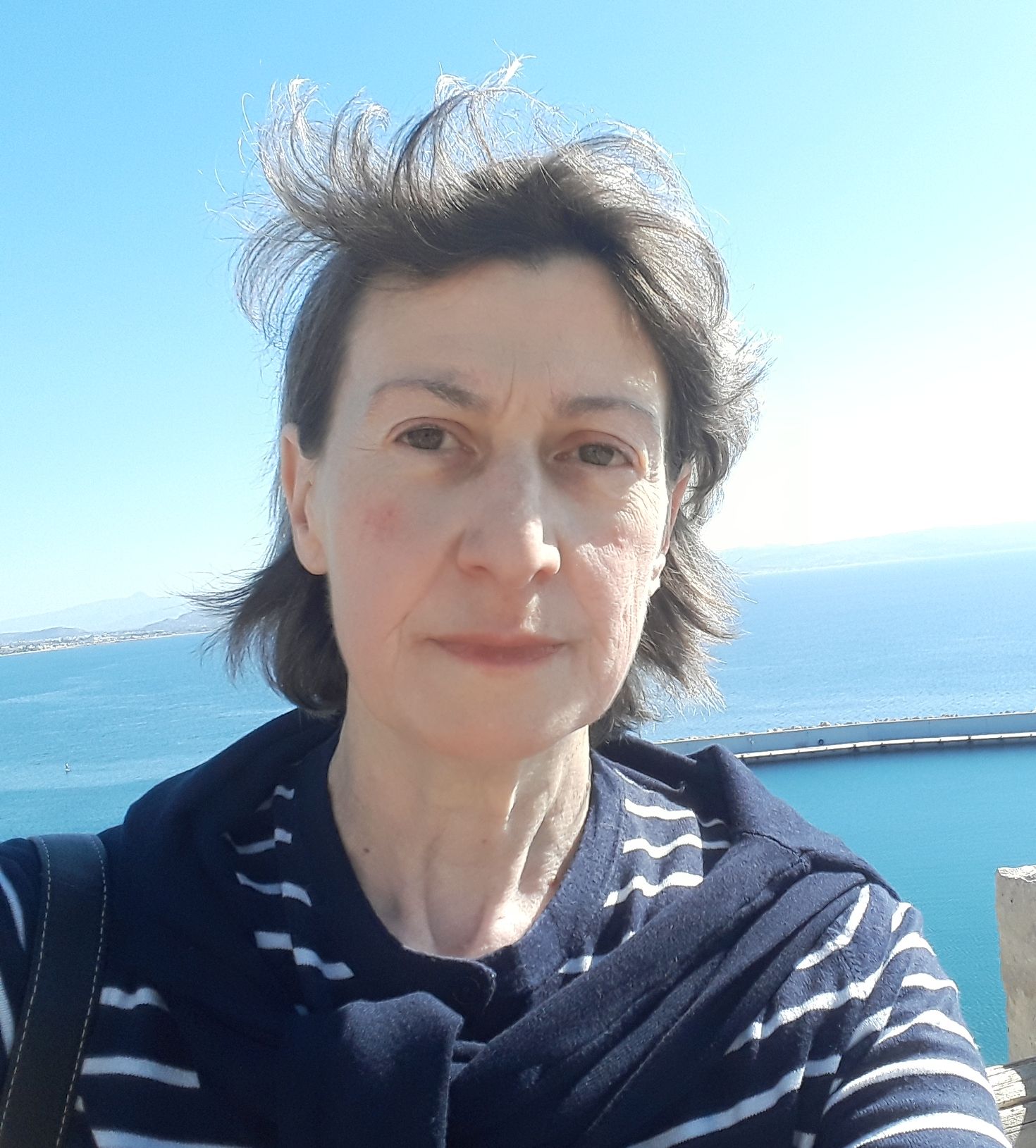
Angelos Alexopoulos is an Assistant Professor at the Department of Economics , Athens University of Economics and Business . He has held Research Associate positions at the University of Cambridge, University College London, and University of Exeter in the UK. PhD: Athens University of Economics and Business Research Focus: Computational Statistics, Econometrics, Bayesian Analysis, Network Modelling Publications span Bayesian inference, epidemic forecasting, machine learning for fraud detection, and econometric methodology. Key journals include Journal of the Royal Statistical Society , Journal of Computational and Graphical Statistics , and Statistics and Computing . 2024: Gaussian invariance in MCMC 2024: Epidemic nowcasting models 2023: VAT fraud detection with ML Awards include certifications in Deep Learning (Coursera), Blockchain (edX), and Object-Oriented R Programming (DataCamp).
Alexandri Christina is a Lecturer at the Faculty of German Language and Literature at the National and Kapodistrian University of Athens. Her research focuses on computational linguistics and natural language processing, with applications in sentiment analysis, machine translation, and human-computer interaction systems. Her work examines how implicit meaning and unspoken context in spoken interactions can be computationally modeled, particularly in political, journalistic, and technical domains. Recent projects explore the integration of generative AI with traditional linguistic approaches to enhance human-machine communication across specialized fields including medical, engineering, and maintenance contexts. Research trends show consistent focus on multilingual processing challenges, with innovations in knowledge graph construction for bias detection and cross-domain adaptation techniques. Publications demonstrate strong interdisciplinary connections between linguistics, computer science, and social sciences.
Ioannis Milis is a Professor at the Department of Informatics, Athens University of Economics and Business (AUEB), part of the School of Information Sciences and Technology. He holds a BS in Electrical Engineering from Democritus University of Thrace (1983) and a PhD in Computer Science from AUEB (1989). His research focuses on algorithms, computational complexity, and optimization for computer/communication networks, combinatorial optimization, graph theory, and game theory. He has conducted postdoctoral research at LRI (1992-94), INRIA-Sophia Antipolis (1994-95), and NTUA as a Marie Curie fellow (1995-96). His teaching includes courses on Algorithms, Advanced Algorithms, and Topics in Algorithms at both undergraduate and graduate levels. He co-authored a textbook on Distributed Systems with Java (2005). His conference involvement includes organizing the Athens Colloquium on Algorithms and Complexity (ACAC) since 2006, the Euro-Par 2012 conference, and the ISCO 2012 symposium. His research has addressed scheduling algorithms, energy-efficient computing, and combinatorial optimization problems in networks.
Michael Eichberg is a Professor at Technische Universität Darmstadt, Germany, where his work centers on software engineering, static analysis, programming languages, and secure software development tools. He is the principal architect of the OPAL framework for Java bytecode analysis and has an extensive publication record spanning PLDI, ICSE, ESEC/FSE, ISSTA, ASE, FSE, SOAP, and other premier venues. Research Interests: Static program analysis and its scalability to real-world code bases Software security, particularly cryptographic API misuse and Android app repackaging detection Concurrent and parallel programming models, including deterministic concurrency in Scala Software architecture conformance, drift and erosion detection, and rule reuse Development of open extensible tools and frameworks (OPAL, LectureDoc, QScope, Sextant, XIRC, IRC) Publication Trends: His recent work (2015-2022) demonstrates a strong focus on empirical evaluation of static analysis techniques, modular composition of analyses, and security-related program understanding. Key themes include unsoundness in call graph construction, purity and immutability analyses, parallelization of static analyses, and large-scale studies of cryptographic API misuse. Tools & Frameworks: OPAL – A flexible Java bytecode analysis and manipulation framework (core developer until 2019) LectureDoc 2 – Web-based lecture material authoring and presentation system QScope – Open extensible metrics framework for modern software projects Sextant – Eclipse-integrated software exploration tool XIRC/IRC – Frameworks for enforcing system-wide properties and architectural constraints
Irene Kilanioti is a Teaching Professor at the National Technical University of Athens (NTUA), affiliated with the Division of Communication, Electronic and Information Engineering under the School of Electrical and Computer Engineering. She holds a Ph.D. in Computer Science from the University of Cyprus and has extensive experience as a PostDoc researcher at Ludwig-Maximilians-Universität München. Her career includes roles as an informatics teacher in Greece and Germany, software engineer at Vodafone, and teaching assistant in tertiary education. Dr. Kilanioti specializes in knowledge graphs, social media analytics, sustainable development goals, and AI-driven education technologies. Education: B.Sc. in Informatics and Telecommunications (NKUA), M.Sc. in Advanced Information Systems (NKUA with best student award), Ph.D. in Computer Science (University of Cyprus). She completed German teaching licensure studies at Friedrich-Alexander-Universität (Erlangen) and holds a translator’s diploma from the Institute of Linguists (London). Fluent in English and German, she is a member of the Cyprus Scientific and Technical Chamber. Research focuses on knowledge graph optimization, social media misinformation detection, and IoT applications in transportation. Notable achievements include the Best Paper Award at the 2022 IEEE International Conference on Knowledge Graphs and contributions to IEEE/UL Standard 2933™ for Clinical IoT Interoperability. She co-leads the EU-funded cHiPSet initiative for big data simulation and serves as an editor for Frontiers in Digital Education. Awards include a Greek State Scholarship Foundation PhD grant (2012-2015) and the Best Student Award for her M.Sc. Her work bridges technical innovation with societal impact, spanning education technology, healthcare IoT, and global sustainable development.
Georgios Siolas is a Senior Researcher at the Artificial Intelligence and Learning Systems Laboratory (NTUA-ISLab), part of the School of Electrical & Computer Engineering at the National Technical University of Athens (NTUA). He holds a BSc in Electrical & Computer Engineering from NTUA (1998), an MSc in Cognitive Science from Sorbonne Université (1999), and a PhD in Computer Science (2003). His research focuses on machine learning, text mining, information retrieval, and semantic web technologies, with applications in computer vision, recommender systems, and social network analysis. He develops intelligent systems for cultural heritage management, smart tourism platforms, and sign language recognition. Key contributions include innovations in neural architecture search, deep learning for hyperspectral imagery, and plagiarism detection in imbalanced datasets. His work integrates semantic technologies with pervasive computing for smart home environments.
Professor Eleni Kokkinou holds a position at the Hellenic Mediterranean University (HMU) as a Professor of Environmental Geology and Geotechnology, with an affiliation to the Institute of Computer Science at FORTH. She earned her Geology degree from Aristotle University of Thessaloniki, followed by a postgraduate diploma and PhD in Applied Geophysics from the Technical University of Crete. Her research focuses on environmental geology, geotechnical studies, geodata modeling, and coastal vulnerability. She has pioneered work in remote sensing for agricultural management, oil spill modeling in the Eastern Mediterranean, and precision agriculture using UAV technology. She has supervised over 73 diploma dissertations, 5 ongoing theses, and examined multiple international M.Sc. theses in Egypt and Cyprus. Teaching includes courses on GIS, geotectonics, and geoscience software at HMU and TEI Crete. She actively contributes to committees like the Research Management Board of HMU and is a licensed UAV pilot with expertise in geophysical prospection. Her work integrates geomatics, environmental monitoring, and civil protection strategies for coastal and marine systems. Key collaborations include Cairo University and the Technical University of Crete. She has developed decision-support systems for irrigation optimization and participated in major projects like the Nereids oil spill risk assessment initiative.
Elias N. Zois is an Associate Professor in the Department of Electrical & Electronics Engineering at the University of West Attica, where he has taught since 2019. Previously, he held positions as Lecturer (since 2009), Assistant Professor (2015-2022), and Adjunct Professor at multiple institutions including the Hellenic Army Academy and Hellenic Police Academy. He received his B.Sc. (1994), M.Sc. (1997), and Ph.D. (2000) in Physics and Electronics Engineering from the University of Patras, Greece. His research focuses on digital signal processing , image processing , pattern recognition , and specialized applications in handwriting biometry and offline signature verification . Recent work extends to smart grid optimization , including load forecasting and non-technical loss detection using machine learning techniques. Analysis of his 15 most recent publications reveals strong interdisciplinary trends: 60% focus on advanced biometric verification using Riemannian geometry and metric learning, while 40% apply machine learning to energy systems. Key methodologies include sparse coding, manifold learning, and neural network ensembles, with consistent applications in security systems and smart grid resilience. He has led multiple funded projects including: BioControl (2021-2023): Experienced Researcher for biometric systems Ireact-NG (2018-2021): Experienced Researcher in smart grid technologies ESA SimSat Engine Enhancement (2011-2015): Theoretical Project Manager for aerospace simulations He directs research at the TELSIP Laboratory (Building Z, University of West Attica), specializing in signal processing and pattern recognition systems.
Tsichlas Kostas serves as an Associate Professor in the Department of Computer Engineering and Informatics at the University of Patras, Greece, within the Division of Applications and Foundations of Computer Science. His research spans fundamental and applied computing domains with active involvement in the ML@Cloud laboratory. His expertise centers on algorithmic innovation across multiple dimensions: Memory-optimized algorithms for primary/secondary storage systems Distributed environment data structures and computational geometry Physics-informed computing and complex network analysis Specialized domains including alphanumeric and graph algorithms Recent publication trends (2022-2025) demonstrate concentrated research in historical graph management systems, temporal network analysis, and physics-computing intersections. Key contributions include vertex-centric partitioning strategies, temporal community detection frameworks, and machine learning applications for energy data motif discovery. He maintains active laboratory affiliations with the LARGE-SCALE CLOUD DATA MACHINE LEARNING WORKSHOP (ML@Cloud lab), Combinatorial Algorithms Laboratory, and Distributed Systems and Telematics Laboratory, contributing to Greece's computational research infrastructure.
Ioannis Kotidis is an Associate Professor in the Department of Informatics at the Athens University of Economics and Business (AUEB), School of Information Sciences and Technology. He holds a Diploma in Electrical and Mechanical Engineering from the National Technical University of Athens (1995), and Master's and Ph.D. degrees from the University of Maryland (1997, 2000). Prior to joining AUEB, he worked as a Senior Technical Specialist at AT&T Labs-Research in Florham Park, New Jersey until January 2006. His research spans multiple areas of database systems with particular focus on On-Line Analytical Processing (OLAP) and data warehousing, data mining, sensor/P2P networks, mobile data management, data fusion & dissemination, data streams, RFID data management, approximate query answering, and database preservation . His work bridges theoretical foundations with practical implementations, as evidenced by numerous publications in top-tier database conferences and journals. Professor Kotidis leads several significant research projects including RECOST (REal time management of COmplex STreams), DBSENSE (Information Management in Wireless Sensor Networks), INFORE (Interactive Extreme-Scale Analytics and Forecasting), and DeLorean (Storage, Indexing and Analysis Techniques for Time-Series Management). His recent work focuses on blockchain applications for decentralized OLAP processing, complex event processing frameworks, and advanced techniques for managing complex data streams. Among his notable achievements is the best paper award at the ACM SIGMOD International Conference on Management of Data for his work on DynaMat: A Dynamic View Management System for Data Warehouses. His publications consistently address challenging problems in database systems with innovative approaches that have influenced both academic research and practical implementations. He has supervised numerous undergraduate theses on topics including blockchain-based OLAP view management, complex event processing using FlinkCEP, and graph similarity learning. His research has attracted significant funding through various research programs at AUEB, including Basic Research Funding Programs 1 & 2.
Isambo Karali is an Assistant Professor in the Department of Informatics and Telecommunications at the National and Kapodistrian University of Athens, a position she has held since November 2007. Prior to this, she served as a Lecturer at the same department from September 1999 to November 2007. Her academic career spans over three decades with significant contributions to knowledge representation, uncertainty reasoning, and semantic web technologies. Dr. Karali's educational background includes: PhD in Informatics (1995) from the University of Athens MSc in Computer Science (1988) from University College, University of London Bachelor of Mathematics (1986) from the Department of Mathematics, University of Athens Dr. Karali's research focuses on Knowledge Representation and Reasoning with Uncertainty, Artificial Intelligence, Logic Programming, and Object-Oriented Programming. She has made significant contributions to applying Dempster-Shafer theory for handling uncertainty in Semantic Web applications. Her work bridges theoretical foundations of logic programming with practical applications in knowledge representation, particularly in distributed and heterogeneous environments. She has supervised numerous PhD and master's theses in these areas. Her recent publications demonstrate a strong trend toward integrating uncertainty reasoning with Semantic Web technologies, particularly using Dempster-Shafer theory and fuzzy logic. Her work addresses challenges in managing imprecise and uncertain information in large-scale knowledge systems, with applications in recommendation systems, news analysis, and semantic search. The interdisciplinary nature of her research connects artificial intelligence, knowledge representation, and web technologies to solve complex information management problems. Dr. Karali has been actively involved in research funding and collaboration: Principal Investigator for "Handling uncertainty in data intensive applications on a distributed computing environment (cloud computing)" under the "Thalis" Program Scientific Responsible for "Artificial Intelligence and Logic Programming Techniques for Knowledge on the World Wide Web" at the National and Kapodistrian University of Athens Scientific Responsible for "Semantic Web and Logic Programming - Application to Guided Search" at the National and Kapodistrian University of Athens Participant in multiple EU research projects including MISSION, COSMOS, ADDSIA, PARACHUTE, APPLAUSE, and EDS As an educator, Dr. Karali has taught core undergraduate courses including Object-Oriented Programming and Logic Programming, as well as graduate courses on Knowledge Technologies and Artificial Intelligence. She has supervised numerous PhD and master's students, with a focus on uncertainty reasoning, semantic web technologies, and logic programming applications. Her mentorship extends to student competitions, including guiding the Department's team in the Microsoft ImagineCup 2009. Dr. Karali has also contributed to the academic community through service activities, including membership on program committees for conferences like IEEE ICTAI, reviewer for prestigious journals, and organizational roles in academic events. From 2000 to 2012, she was responsible for the Department's website, contributing to its architecture design and system development.
Pavlos Fafalios is an Assistant Professor of Information Systems at the School of Production Engineering and Management, Technical University of Crete, and an Affiliated Researcher at the Centre for Cultural Informatics (CCI) and Information Systems Laboratory (ISL), Institute of Computer Science, Foundation for Research and Technology - Hellas (FORTH). He holds a PhD and MSc in Information Systems from the University of Crete and an Engineer's Diploma from the University of the Aegean. His academic journey includes postdoctoral research at L3S Research Center, Leibniz University of Hanover, and FORTH-ICS, as well as teaching roles at Hellenic Mediterranean University and the University of Crete. His research interests span Information Systems , Data and Knowledge Management , and Linked Data , with a strong interdisciplinary focus on applications in Cultural Heritage and the Humanities . He develops semantic technologies, knowledge graphs, and information management systems for complex, real-world domains. The recent publications highlight a strong trend in applying semantic technologies to cultural and historical data, including earthquake data modeling, feminism history documentation, and museum data integration. His work consistently focuses on knowledge representation, ontology development, and data interoperability, particularly using CIDOC CRM and Linked Data principles. Individual postdoctoral research fellowship 'Marie Skłodowska-Curie' (H2020-MSCA-IF-2019) Finalist for the '2019 ERCIM Cor Baayen Young Researcher Award' Fellowship from legacy 'Maria Michael Manasaki' (2014-2015) 1st prize in Hack4Med 2014 1st prize in Blue Hackathon 2013 PhD and MSc scholarships by FORTH Pavlos Fafalios has been involved in significant research projects such as PortADa (MSCA Staff Exchange), RICONTRANS (ERC Consolidator Grant), FE.P.I.B., ReKnow (Marie Curie project), SeaLiT (ERC Starting Grant), and ALEXANDRIA (ERC Advanced Grant), where he served as principal investigator, scientific responsible, or lead researcher. He has supervised student projects that led to award-winning software tools. He is active in scientific committees and regularly publishes in international venues. He leads and contributes to research in the Centre for Cultural Informatics (CCI) and Information Systems Laboratory (ISL) at FORTH-ICS, collaborating on interdisciplinary projects that bridge computer science with humanities and cultural heritage. His lab work emphasizes practical tools for semantic data integration, exploration, and analysis.
Themos Stafylakis is an Associate Professor at the Department of Informatics of Athens University of Economics and Business (AUEB), a role he assumed in 2023. He also serves as the head of the Machine Learning and Voice Biometrics departments at Omilia (Cyprus and Greece) since 2018. Additionally, he collaborates as a researcher at the Archimedes unit of the "Athena" Research Center. His academic journey includes a PhD in voice applications from the School of Electrical and Computer Engineering of NTUA (2011), a master's from Imperial College London (2005), and a bachelor's from NTUA (2004). Professional experience includes postdoctoral research at ÉTS University of Montreal (2011-2013) and CRIM research center (2011-2016), followed by work at the University of Nottingham on audiovisual speech recognition under a Marie Sklodowska-Curie fellowship (2016-2018). His research focuses on speaker recognition, audiovisual speech processing, and machine learning applications. Key contributions include advancements in speaker verification, diarization, and self-supervised learning techniques. He has contributed to datasets like KAN-AV and participated in challenges such as NIST-SRE and ASVspoof. Educations: Bachelor's: School of Electrical and Computer Engineering, NTUA (2004) Master's: Imperial College London (2005) PhD: NTUA (2011) His research interests span speaker recognition, audiovisual speech analysis, and machine learning innovations. Notable achievements include developing robust speaker verification systems and contributing to spoofing detection methodologies. He has received a Marie Sklodowska-Curie Individual Fellowship (2016-2018). His work bridges academia and industry, with applications in biometric systems, conversational AI, and multimodal data analysis. Collaborations include institutions like CRIM, ÉTS, and the Athena Research Center.
Phivos Mylonas is an Associate Professor at the Department of Informatics and Computer Engineering within the School of Engineering at the University of West Attica. He also maintains academic appointments at Ionian University where he previously served as Associate Professor and Assistant Professor in the Department of Informatics. His academic journey includes adjunct professor positions at several Greek institutions including University of Central Greece, University of the Aegean, and University of Crete. Dr. Mylonas holds a PhD in Electrical and Computer Engineering from the National Technical University of Athens, a Master's Degree in Advanced Information Systems from the National and Kapodistrian University of Athens, and a Diploma in Electrical and Computer Engineering from the National Technical University of Athens. His research spans Artificial Intelligence applications, data science, user modeling, personalization technologies, and semantic frameworks. His scholarly output shows a clear trajectory toward increasingly sophisticated AI applications, with recent publications focusing on ChatGPT integration, fuzzy logic systems, and multimodal interaction. The research demonstrates strong interdisciplinary connections between computer science, education, and cultural heritage preservation. Thomaidio Grant for Science and Art Progress (2005, 2006) ICCS-NTUA Short Term Research Grant (2005-2006) As an academic leader, Dr. Mylonas has served as Director of the Humanistic and Social Informatics Laboratory at Ionian University (2013-2022) and as a Senior Researcher at the Image, Video and Multimedia Laboratory at National Technical University of Athens. He has been instrumental in organizing numerous international conferences and has served on over 200 conference program committees. His laboratory work spans multiple institutions including collaborations with University of Patras and Ionian University.
Dr. Menychtas Andreas is an Assistant Professor at the Department of Digital Systems, School of Informatics and Communications, University of Piraeus. He holds a PhD from the National Technical University of Athens (2009), specializing in service-oriented architectures. His teaching focuses on distributed computing, programming, and information systems development across multiple institutions including the University of Piraeus and Hellenic Open University. Research interests center on modern computing infrastructures, software development, and IoT applications, with particular emphasis on Edge Computing, smart cities, telemedicine, and machine learning. He has led over 20 European and national projects, publishing >100 articles with 1,900+ citations. Key areas include AR healthcare solutions, bias mitigation in AI, and secure medical IoT systems. Notable contributions include the MedSecurance project (medical IoT security), CrowdHEALTH platform (big data-driven public health policies), and AGILE framework (open-source edge computing). His work bridges theoretical research with practical implementations in wearable tech, telemedicine systems, and urban smart infrastructure. Grants and collaborations highlight extensive industry partnerships, with current focus on digital twins for healthcare robotics (AI4Work), AI-driven pandemic monitoring, and gamification in healthcare platforms. His lab develops innovative solutions at the intersection of AR, edge computing, and healthcare informatics.