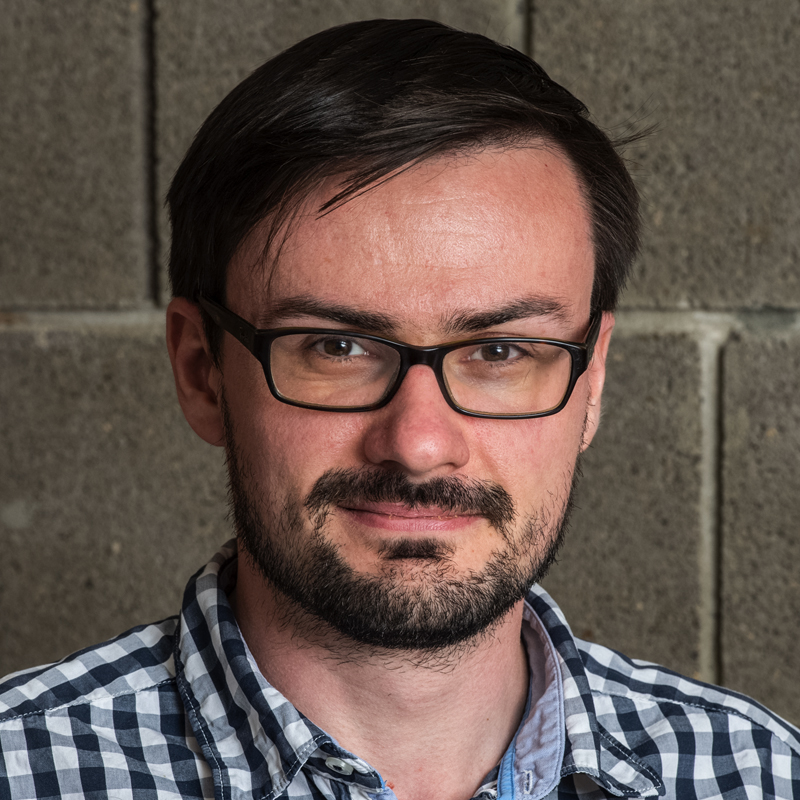
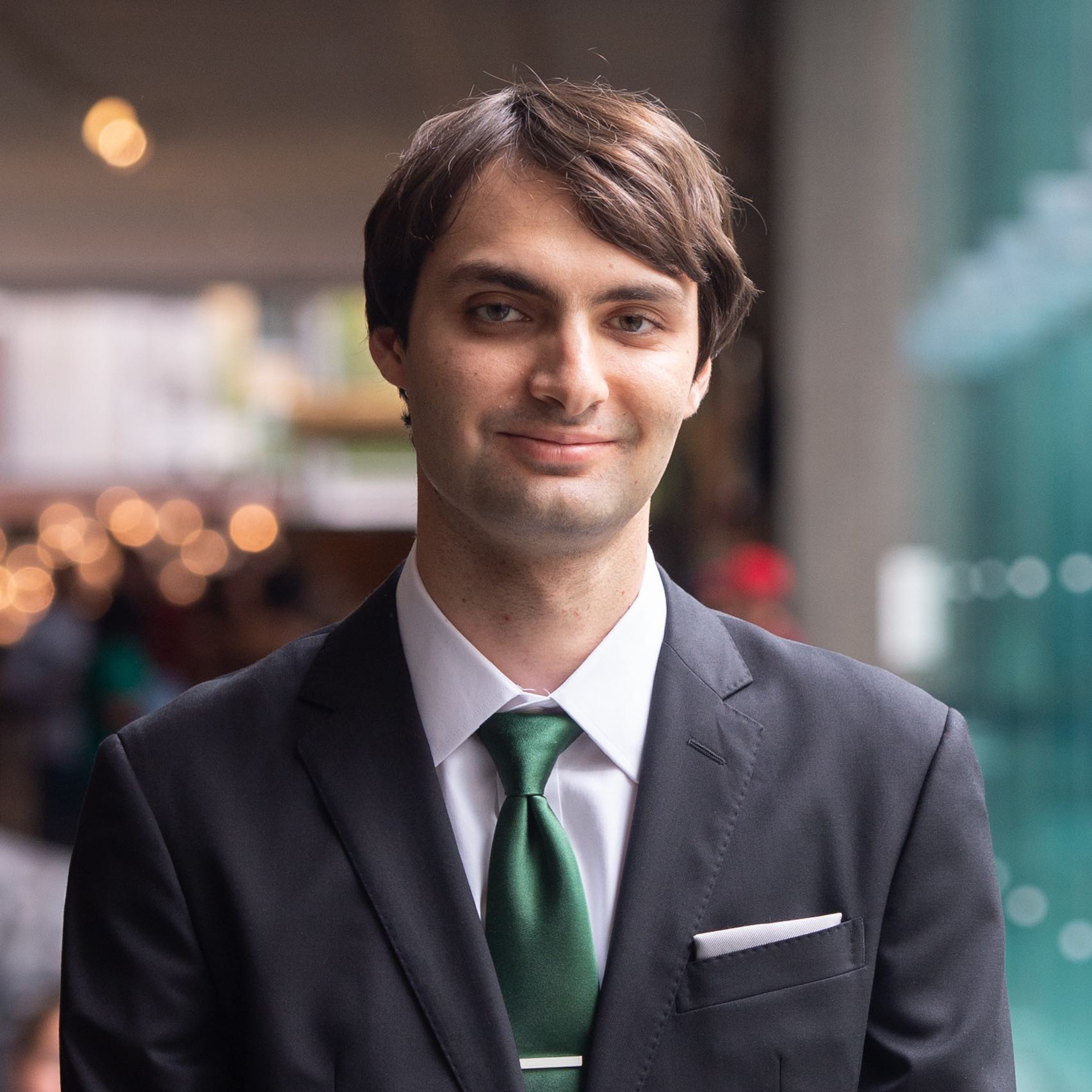
Dingyuan Liu is a Researcher at the Karlsruhe Institute of Technology (KIT) , affiliated with the Department of Mathematics and the Discrete Mathematics research group. His work is supervised by Prof. Maria Axenovich, and he focuses on extremal and probabilistic combinatorics , discrete geometry , and incidence structures of points and hyperplanes . Research Interests: Dingyuan Liu's research spans extremal combinatorics , probabilistic combinatorics , and discrete geometry . He investigates Ramsey and Turán type problems , extremal properties of random graphs , and geometric configurations in planar and hypercube settings . Publication Trends: Liu's recent work explores geometric combinatorics in higher dimensions, sumset bounds , interpoint distance multiplicities , and visibility in hypercubes . His contributions bridge extremal set theory , poset saturation , and graph coloring in discrete geometry contexts. Supervision: Dingyuan Liu is advised by Prof. Maria Axenovich, a leading expert in discrete mathematics. He collaborates with researchers such as F. C. Clemen, A. Dumitrescu, J. Balogh, L. Mattos, and T. Szabó. Labs and Teams: Liu is part of the Discrete Mathematics Research Group at KIT, which aligns with broader institutes like the Institute of Algebra and Geometry and Metrics Geometry groups.
Geraint Palmer is a Welsh Medium Lecturer at Cardiff University's School of Mathematics, where he teaches mathematics courses primarily in Welsh. His academic journey includes a BSc in Mathematics from Aberystwyth University (2013), followed by an MSc in Operational Research and Applied Statistics (2014) and a PhD in Applied Stochastic Modelling (2018), both from Cardiff University. His educational background includes: BSc in Mathematics, Aberystwyth University (2013) MSc in Operational Research and Applied Statistics, Cardiff University (2014) PhD in Applied Stochastic Modelling, Cardiff University (2018) Dr. Palmer's research spans several interconnected areas within operational research and applied mathematics. His primary focus is on queueing theory and stochastic modeling , with applications in healthcare systems and emergency services. He has made significant contributions to discrete event simulation , notably through the development of the open-source Ciw library. Additionally, his work extends to Welsh language processing, where he has contributed to computational linguistics projects including Welsh word embeddings and stemmers. His interdisciplinary approach combines theoretical mathematical modeling with practical software implementation, often using Python and R. His recent publications demonstrate a strong trend toward applying operational research methods to healthcare challenges, particularly emergency services optimization. His work on ambulance fleet allocation, emergency care transformation, and orthopaedic care systems shows a consistent focus on improving healthcare delivery through mathematical modeling. Simultaneously, his research in Welsh language processing represents a unique interdisciplinary contribution at the intersection of mathematics, computer science, and linguistics. His publication record also highlights his commitment to open-source software development, with contributions to libraries like Ciw (for discrete event simulation) and GCol (for graph coloring). His scientific contributions include: Development of Ciw, an open-source discrete event simulation library Development of GCol, a high-performance Python library for graph coloring Contributions to Welsh language processing tools and resources Co-authorship of "Applied Mathematics with Open-Source Software: Operational Research Problems with Python and R" (2022) Dr. Palmer is actively involved in teaching mathematics at Cardiff University, delivering modules including Preliminary Mathematics II, Problem Solving, and Computational Methods. His bilingual capabilities enable him to provide Welsh-medium instruction, supporting linguistic diversity in higher education. His research projects often involve collaboration with healthcare professionals, operational research specialists, and language technologists, reflecting the interdisciplinary nature of his work. Notably, he has contributed to standardized Welsh language assessment tools, demonstrating his commitment to both academic research and practical community applications.
Professor Jonathan Thompson serves as Head of School in the School of Mathematics at Cardiff University. He holds multiple administrative roles including Year Three Director of Studies, Chair of School Board, and has significant teaching responsibilities for both undergraduate and postgraduate students. His academic career spans over two decades with previous positions at Edinburgh University (Lecturer in Statistics and Operational Research, 1996-97) and Swansea University (Research Assistant, 1994-96). Dr. Thompson's research focuses on operational research with particular expertise in graph theoretic modelling, meta-heuristics (especially ant systems, genetic algorithms and simulated annealing), and various scheduling problems including examination scheduling, sports fixture scheduling, and manpower planning. His work bridges theoretical computer science with practical applications in healthcare, transportation, and logistics. He has established strong industry connections, having completed projects with WH Smiths, John Menzies, and the International Rugby Board. His research demonstrates consistent evolution from foundational work in graph coloring and ant colony optimization toward increasingly complex real-world applications in dynamic environments. Operational Research group member External funding from Office of National Statistics (2005-2006) Editorial Board member of International Journal of Operational Research Programme Committee member for major conferences (GECCO, PPSN, PATAT) Professor Thompson has successfully supervised numerous PhD students since 2000, with completed theses covering examination timetabling, nurse scheduling, vehicle routing, and other operational research problems. His supervision portfolio reflects the breadth of his research interests, from theoretical graph theory to practical healthcare and transportation applications. He has secured external funding for research projects and maintains active collaborations with both academic and industry partners.
Frank Stephan is a Professor at the National University of Singapore , jointly affiliated with the Department of Mathematics and the School of Computing . His primary office is located in Block S17 (Mathematics), and he maintains a secondary office in Block COM2 (Computing). He teaches advanced courses including Computational Complexity , Logic and Foundations of Mathematics , and Advanced Automata Theory . Stephan co-organizes the departmental Logic Seminar and maintains an extensive publication record in theoretical computer science. His research spans: Recursion Theory & Kolmogorov Complexity : Foundational computability and information theory. Learning Theory : Inductive inference and algorithmic learning models. Computational Complexity : Hardness, parameterization, and structural graph algorithms. Automata & Formal Languages : Automatic structures and language recognition complexity. Recent publications focus on combinatorial optimization in graphs, including dominating sets, geodetic monitoring, identifying codes, and parameterized complexity. His work frequently appears in top venues (e.g., STACS, ICALP, ISAAC) and journals (e.g., Discrete Mathematics , Theoretical Computer Science ). Stephan holds memberships in the European Association for Theoretical Computer Science , Deutsche Mathematiker-Vereinigung , and other academic societies. No awards or student advisees are documented.
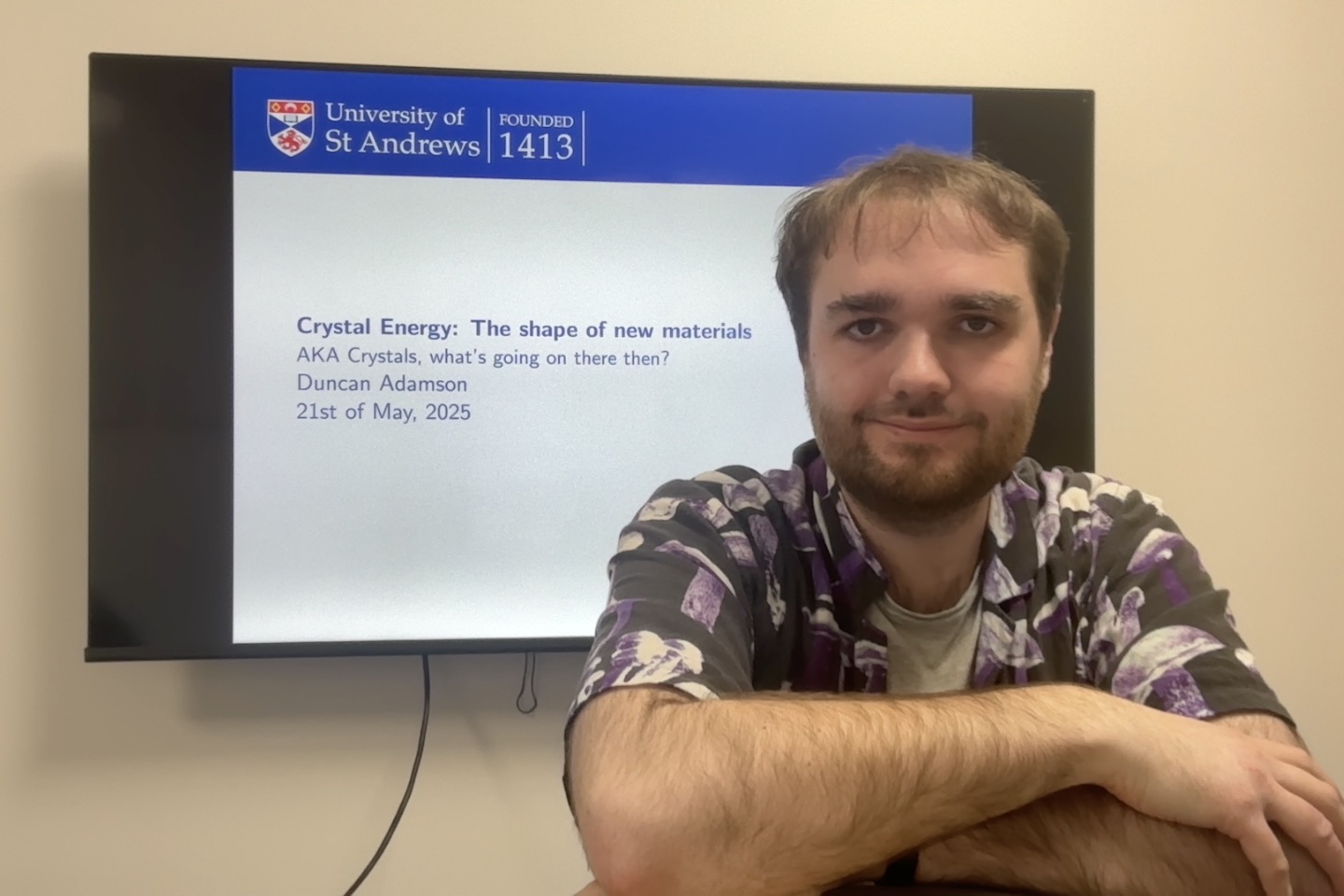
Duncan Adamson is a Lecturer in the School of Computer Science at the University of St Andrews, United Kingdom. He has held prior research positions at the Leverhulme Research Centre for Functional Materials Design, the University of Göttingen, Reykjavik University, and the University of Liverpool. His academic foundation includes a PhD from the University of Liverpool supervised by Prof. Igor Potapov and undergraduate studies at the University of Glasgow. His research lies at the intersection of theoretical computer science and discrete mathematics, with a focus on combinatorics on words , algorithm design , crystal structure prediction , and temporal graphs . He explores symmetry in multidimensional words, develops algorithms for combinatorial enumeration, and investigates computational hardness in materials science. His work often bridges abstract theory with real-world applications in chemistry and robotics. The recent publications show a strong trend in combinatorial algorithms , particularly in enumeration, ranking, and optimization over structured words, graphs, and sequences. A significant portion of his work involves the k-centre problem for implicitly defined combinatorial classes and temporal graph colouring , with increasing emphasis on algorithmic complexity and practical implementation. His 2024 paper on harmonious colourings in temporal matchings was awarded best paper at SAND 2024, highlighting the impact of his research. Scientific Awards: Best Paper Award, SAND 2024 – 'Harmonious Colourings of Temporal Matchings' Duncan Adamson has been supported by the Leverhulme Research Centre for Functional Materials Design during his PhD and postdoctoral work. While no formal advisees are listed, his supervision by leading researchers and collaborative projects suggest active mentorship and team integration. He teaches core computer science modules at St Andrews, including CS2001 and CS3302, and maintains a busy research schedule with weekly meetings and supervisory responsibilities. His research is conducted within the Algorithms and Complexity group at St Andrews, continuing collaborations with international teams in Iceland, Germany, and beyond. Projects often involve interdisciplinary efforts, especially in applying computational techniques to materials science and chemistry.
Carsten Witt is a Professor in the Department of Applied Mathematics and Computer Science at the Technical University of Denmark (DTU), working within the Algorithms, Logic and Graphs section. His research is centered on theoretical aspects of evolutionary computation, with a strong emphasis on runtime analysis, genetic algorithms, and randomized search heuristics. He is actively involved in guiding PhD research and has a substantial publication record in top-tier conferences and journals. PhD in Computer Science, Technical University of Dortmund, Germany Postdoctoral research at Max Planck Institute for Informatics Professor at DTU since appointment His primary research interests lie in evolutionary algorithms , runtime analysis , and probability theory in algorithmics . He investigates how bio-inspired optimization techniques such as genetic and compact genetic algorithms perform on benchmark problems like OneMax and LeadingOnes. His work often involves rigorous mathematical analysis to derive bounds on expected runtime and convergence behavior. The recent articles show a consistent trend in the theoretical foundations of evolutionary computation , particularly focusing on multi-valued representations, dynamic mutation strategies, neuroevolution models, and self-adjusting mechanisms. These works span subfields such as stochastic optimization, adaptive parameter control, and algorithmic analysis under probabilistic models. The dominant keywords include Computer Science, Theoretical Computer Science, Optimization, and Artificial Intelligence. Carsten Witt has not been explicitly listed with any scientific awards in the provided text. He has supervised several PhD students, including Adak, Rajabi, and Gießen, in projects related to nature-inspired algorithms and theoretical analysis. While specific grant names are not listed, his involvement in multiple funded PhD projects indicates active participation in research funding and academic leadership. Supervision roles include both main supervisor and examiner positions across various DTU research initiatives. Carsten Witt is affiliated with the Algorithms, Logic and Graphs group at DTU, which functions as a research lab focusing on foundational aspects of computing. This team conducts high-level theoretical research in algorithm design, discrete mathematics, and computational complexity, particularly in the context of heuristic and evolutionary methods.
Dr. Yoshi Gotoh is a Lecturer and Student Projects Officer in the Department of Computer Science at the University of Sheffield's School of Computer Science . He holds a PhD from Brown University and a first degree in Engineering from the University of Tokyo. As a member of the Speech and Hearing (SpandH) research group, his work bridges audio-visual processing and language technologies. His core research explores: Video analysis and retrieval systems Natural language generation for video content 3D visual speech animation Crowd behavior modeling through trajectory clustering Medical imaging enhancements via colorization techniques Analysis of his 15 most recent publications reveals strong emphasis on multimodal systems combining computer vision with speech/language processing. Dominant themes include egocentric video analysis, human activity recognition, and cross-modal translation between visual and textual domains. He has secured significant research funding as Co-Principal Investigator: £218,226 from Innovate UK (2021-2024) for fake imagery detection £393,115 from Innovate UK (2018-2021) for unsupervised dubbing systems £284,248 from EPSRC (2001-2005) for spoken language summarization He leads projects within the Speech and Hearing laboratory, focusing on developing computational methods for audiovisual integration and video understanding systems.
Dr. Stephen Tate is a Professor and Graduate Program Director in the Department of Computer Science at the University of North Carolina at Greensboro (UNCG). He joined UNCG in 2007 during its formative years as the department was established from a split of the former Department of Mathematical Sciences. Prior to UNCG, he spent 14 years at the University of North Texas (UNT), where he founded the Center for Information and Computer Security, recognized by the NSA and DHS as a National Center of Academic Excellence in Information Assurance Education. His academic background includes a Ph.D. from Duke University (1991) and a NASA-supported postdoctoral fellowship. Dr. Tate’s research focuses on computer security, cryptography, and secure software systems. He has pioneered techniques in cryptographic protocol design, secure hardware integration (e.g., Trusted Platform Modules), and high-assurance software development. His work emphasizes creating systems with strong security guarantees and has been supported by the National Science Foundation (NSF), industry partners, and Texas-based research programs. His recent publications span areas like secure container repositories, vulnerability analysis in Linux distributions, and cryptographic key management. Notable contributions include advancing the Advanced Encryption Standard (AES) and developing frameworks for dynamic proofs of data possession using trusted hardware. His educational innovations include integrating tablet-based active learning in lectures. Dr. Tate has held leadership roles, including Department Head at UNCG (2007-2019), and has contributed to interdisciplinary projects such as the UNT-led regional initiative to strengthen information assurance education. His research also extends to foundational topics in algorithms, including online algorithms, computational geometry, and data compression.
David P. Williamson is a Professor at Cornell University in the School of Operations Research and Information Engineering (ORIE), with a significant leadership role as former Chair of the Department of Information Science in the Cornell Ann S. Bowers College of Computing and Information Science from July 2021 through December 2023. His academic journey began at MIT where he earned his B.S. in Mathematics (1989), followed by an M.S. (1990) and Ph.D. (1993) in Computer & Information Science under Professor Michel X. Goemans. After completing a postdoc at Cornell under Professor Éva Tardos, he worked at IBM Research at both the T.J. Watson Research Center and Almaden Research Center before joining Cornell University in 2004. B.S. (Mathematics), Massachusetts Institute of Technology (1989) M.S. (Computer & Information Science), Massachusetts Institute of Technology (1990) Ph.D. (Computer & Information Science), Massachusetts Institute of Technology (1993) Professor Williamson's research centers on discrete optimization, specializing in approximation algorithms for NP-hard optimization problems. His work spans network design, scheduling, facility location, clustering, ranking, and particularly the traveling salesman problem. He has made seminal contributions to the field, evidenced by his co-authored paper 'Improved Approximation Algorithms for Maximum Cut and Satisfiability Problems Using Semidefinite Programming' which earned the 2022 AMS Steele Prize. His research approach emphasizes simple yet powerful approximation algorithms with provable performance guarantees, bridging theoretical computer science and operations research. Analysis of his recent publications reveals a strong focus on the traveling salesman problem, with particular attention to integrality gaps of semidefinite programming relaxations, combinatorial algorithms for solving Laplacian systems, and novel approaches to cycle cut instances. His work consistently demonstrates how theoretical insights can yield practical algorithmic improvements, with applications spanning network design, revenue management, and graph theory. Williamson has also contributed significantly to educational resources through his textbook 'Network Flow Algorithms' (2019) and 'The Design of Approximation Algorithms' (2011, with David Shmoys). American Mathematical Society Steele Prize for Seminal Contribution to Research (2022) SIAM Fellow (2016) ACM Fellow (2013) Lanchester Prize for best contribution to operations research (2013) Professor of the Year (ORIE Undergraduate Voted) (2018) ACM STOC 30-year Test of Time Award (2024) Professor Williamson has demonstrated significant academic leadership through his service as Chair of the Department of Information Science and as former Editor-in-Chief for the SIAM Journal on Discrete Mathematics. His teaching portfolio includes undergraduate courses like ENGRI 1101 (introduction to operations research) and ORIE 1380 (introduction to data science), as well as graduate courses including ORIE 6330 (network flows) and ORIE 6334 (spectral graph theory and algorithms). His research has attracted substantial funding from the National Science Foundation, including awards for projects like 'AF: Small: Looking Under Rocks: A Search for a Provably Stronger TSP Relaxation' (2019) and 'AF: EAGER: Approximation algorithms for the traveling salesman problem' (2015). While specific laboratory affiliations aren't detailed in the available information, Professor Williamson's work is deeply embedded in Cornell's theoretical computer science and operations research communities. His research collaborations span multiple institutions, with frequent co-authorship with colleagues at Cornell and beyond. His recent publications indicate active engagement with current challenges in approximation algorithms, particularly those related to the traveling salesman problem and semidefinite programming relaxations, suggesting ongoing leadership in these critical areas of theoretical computer science and operations research.
Florian Frick is an Associate Professor in the Department of Mathematical Sciences at Carnegie Mellon University . Prior to joining CMU, he held positions as an H.C. Wang Assistant Professor at Cornell University , a postdoctoral fellowship at the Mathematical Sciences Research Institute (MSRI) , and was a visiting professor at Freie Universität Berlin during 2021/22. His research spans algebraic topology , geometric topology , and combinatorics , with applications in convex geometry , game theory , and computational topology . His recent work includes counterexamples to the topological Tverberg conjecture , fair division algorithms , and metric reconstruction via optimal transport . He has advised over 40 undergraduate students through an NSF-funded REU program on Geometry and Topology in a Discrete Setting , with projects ranging from fair rent division to maximally linkless graphs . His 15 most recent articles focus on equivariant maps , hyperplane partitions , topological Ramsey theory , and Vietoris−Rips complexes . Dr. Frick received his Ph.D. from Technische Universität Berlin and the Berlin Mathematical School , with postdoctoral training at Cornell and MSRI. He has been awarded the NSF CAREER Award and leads research in topological combinatorics , metric geometry , and applied algebraic topology .
Prof. Ahmet Cosar is a faculty member in the Department of Computer Engineering at the Middle East Technical University (METU), Ankara, Turkey. He holds a PhD in Computer Science from the University of Minnesota (1996), an MS in Computer Engineering from Bilkent University (1988), and a BS in Computer Engineering from METU (1986). His research focuses on distributed database design, query optimization, evolutionary algorithms, computer networks, and cloud computing. He leads the Intelligent Data Analysis Group (IDAG) and teaches courses such as CENG 240, CMPE 275, and CENG 280. Education: PhD, Computer Science, University of Minnesota, 1996 MS, Computer Engineering, Bilkent University, 1988 BS, Computer Engineering, METU, 1986 Research Interests: Query optimization in distributed databases Evolutionary algorithms (e.g., genetic algorithms, particle swarm optimization) Cloud computing and data warehouse design Machine learning applications in cybersecurity Wireless sensor networks and data fusion Publications: Over 50 peer-reviewed articles in journals like Computers & Industrial Engineering and Neurocomputing , focusing on optimization algorithms, cloud resource allocation, and machine learning techniques. Recent work includes island-parallel metaheuristics for graph coloring and reinforcement learning for adaptive interventions. Advising & Grants: Supervised over 30 graduate students (PhD and MS) in areas like evolutionary algorithms, cloud databases, and sensor networks. Active in research grants related to distributed systems and big data. Labs/Teams: Leads the Intelligent Data Analysis Group (IDAG), collaborating on projects in optimization, machine learning, and cloud computing.
Arnfried Kemnitz serves as Professor in the Institute of Computational Mathematics at Braunschweig University of Technology, Germany, where he maintains active research and teaching responsibilities in discrete mathematics. His academic profile centers on theoretical graph theory with significant contributions to combinatorial structures and optimization problems. Kemnitz's research program focuses intensely on graph coloring variants including sum list colorings, rainbow connection, chromatic stability, and Hamiltonian properties. His work explores fundamental questions in structural graph theory, particularly concerning edge deletion effects, coloring constraints in planar graphs, and connectivity thresholds. The mathematical depth of his investigations spans combinatorial number theory, discrete geometry, and network reliability applications. Analysis of his publication record reveals consistent emphasis on sum choice number problems across diverse graph families including Θ-graphs, wheels, Cartesian products, and oriented graphs. His collaborative research demonstrates methodological innovation in establishing tight bounds for coloring parameters and identifying sufficient conditions for graph properties. This work appears predominantly in specialized combinatorics journals with strong international recognition. No scientific awards are documented in the available materials. Information regarding student supervision, grant funding, laboratory facilities, or research teams is not provided in the source text.
Peter Manohar is a postdoctoral researcher in the Computer Science and Discrete Math group at the Institute for Advanced Study , focusing on Theoretical Computer Science with emphasis on algorithms, coding theory, and cryptography. His work explores spectral algorithms for semirandom and smoothed instances of NP-hard constraint satisfaction problems, linking these methods to coding theory, extremal combinatorics, and cryptography. Education: PhD in Computer Science from Carnegie Mellon University, advised by Venkatesan Guruswami and Pravesh K. Kothari B.S. in EECS from UC Berkeley, advised by Alessandro Chiesa and Ren Ng Research Trends: His recent publications highlight advancements in spectral refutation techniques, locally decodable/correctable codes, and connections between complexity theory and coding. Articles span venues like FOCS, STOC, APPROX, and arXiv, reflecting his interdisciplinary approach. Awards: He has received prestigious NSF and Cylab Presidential Fellowships, along with ARCS scholarships during his PhD. His work on quantum proofs (TCC 2019) and constraint satisfaction problems has been recognized in invited journal special issues. Teaching & Collaboration: Peter has taught courses at Carnegie Mellon, including Quantum Computing and Computer Graphics. He interned at TTIC in Summer 2023 and co-organized CMU's Theory Club, demonstrating active engagement in academic communities.
Yusuke Kobayashi is an Associate Professor at the Research Institute for Mathematical Sciences (RIMS), Kyoto University. His research focuses on graph algorithms, combinatorial optimization, and discrete structures such as matroids, jump systems, and discrete convex functions. He has contributed to problems involving network design, disjoint paths, and fair allocation of indivisible goods. Education : Bachelor, Master, and Ph.D. in Information Science and Technology from the University of Tokyo (2005, 2007, 2010). Research Interests : Graph Algorithms: Network design, disjoint paths, and reconfiguration problems. Discrete Structures: Matroid theory, jump systems, and discrete convexity. Combinatorial Optimization: Applications to fair division, social welfare, and graph connectivity. Article Trends : Kobayashi’s recent work spans reconfiguration problems (e.g., colorings, matchings), fair allocation (EFX criteria), and quantum routing. His research often bridges graph theory with algorithmic applications, emphasizing structural properties like planarity and 4-edge-connectedness. Scientific Awards : Japan Operations Research Society Student Paper Award (2005). University of Tokyo Dean’s Award (2010). STOC Best Paper Award (2017). MEXT Young Scientists' Award (2020). Operations Research Society of Japan Research Award (2023). Grants and Collaborations : His work has been supported by the Japan Society for the Promotion of Science (JSPS) and involves collaborations with researchers in Japan and Hungary (e.g., Kristóf Bérczi, Naonori Kakimura).
Alexander Wolff is a Professor at the Chair of Algorithms and Complexity within the Institute of Computer Science at the University of Würzburg. His work focuses on graph drawing, computational geometry, and algorithmic complexity, with applications in geographic information systems and network visualization. Chair of Algorithms and Complexity, Institute of Computer Science, University of Würzburg (since 2009) Managing Director, Institute of Computer Science (2011–2013, 2015–2017) Editorial roles in journals like JoCG and JGAA Conference leadership in Graph Drawing (GD) and SOFSEM His research explores geometric graph representations, obstacle numbers, and parameterized complexity. Recent publications address level planarity, polyhedral surface adjacency, and metro map visualization. Collaborative projects include algorithmic quality assurance and interactive industrial network visualization. Wolff’s work bridges theoretical graph algorithms with practical applications, such as optimizing public transport schematics and enhancing data accessibility. He has supervised numerous PhD students and co-authored over 100 publications, with editorial and organizational roles in major computational geometry and graph drawing conferences.