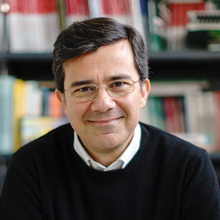
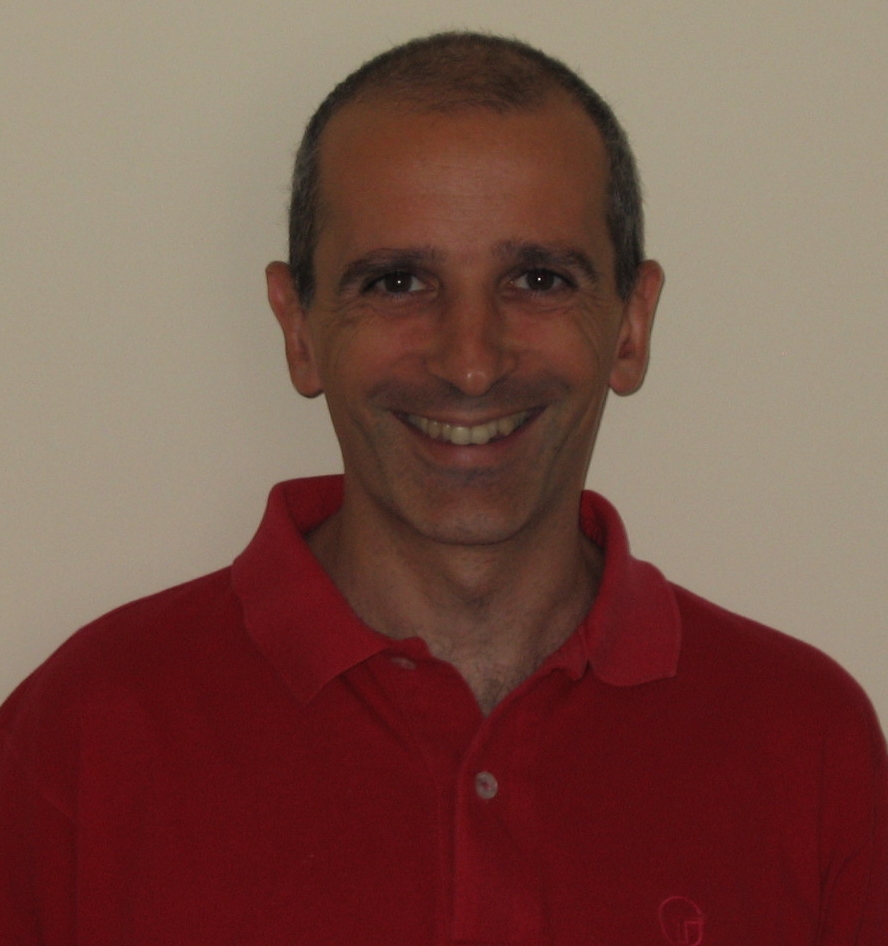
Delibra Giovanni is an Associate Professor at Sapienza University of Rome, specializing in aerodynamics, aeroacoustics, and renewable energy systems. His research focuses on optimizing turbomachinery performance, including axial fans, wind turbines, and hydrogen storage systems. He employs advanced computational fluid dynamics (CFD) and machine learning techniques to address challenges in renewable energy integration, thermal management, and noise reduction. Key research areas include: Wind energy systems and offshore wind farm design Hydrogen storage and safety in green energy applications Aeroacoustic control in industrial fans and turbines CFD-based optimization of heat exchangers and cooling systems Recent work emphasizes the integration of photovoltaic and biomass systems in renewable energy communities, as well as experimental validation of wave energy turbines. His publications highlight innovations in fan blade design, leakage modeling, and multi-objective optimization frameworks for sustainable energy infrastructure. Collaborations involve both academic institutions and industry partners, focusing on real-world applications such as tunnel ventilation systems and Mediterranean island energy solutions. Giovanni's contributions bridge theoretical modeling with practical engineering challenges in the transition to clean energy.
Marcello Pelillo is a **Full Professor** at the Department of Environmental Sciences, Computer Science and Statistics at Ca' Foscari University of Venice. His research focuses on machine learning, pattern recognition, computer vision, and adversarial machine learning. He has contributed significantly to graph-based methods, clustering algorithms, and security in machine learning systems. Pelillo is affiliated with the European Center for Living Technology (ECLT) and the Research Institute for Complexity Communications . His work spans theoretical advancements in graph theory and practical applications in cultural heritage digitization, climate science (e.g., ice core analysis), and AI security. Recent projects include entropy-guided graph clustering, backdoor poisoning defenses, and benchmark datasets for puzzle-solving tasks. Publications emphasize interdisciplinary applications, such as AI-assisted historical document digitization and energy-latency attacks in networks. He has supervised multiple collaborative projects involving institutions like the Research Institute for Complexity and the European Interuniversity Research Center.
Mauro Andreolini is a University Researcher at the Department of Physical, Computer and Mathematical Sciences, University of Modena and Reggio Emilia. He teaches Operating Systems and Secure Software Development courses within the Computer Science degree program. His research focuses on Cybersecurity , Network Security , Machine Learning in Security , and Cloud Computing . His recent publications analyze Data Privacy through geohashing and clustering, Adversarial Attacks in cybersecurity, and Moving Target Defense architectures. He has also contributed to frameworks for Automated Security Assessments using deductive reasoning and Realistic Botnet Detection benchmarks. Andreolini's work addresses Graph Neural Networks in intrusion detection, n-Gram Analysis for automotive network security, and Side-Channel Vulnerabilities in USB devices. He collaborates with researchers like Artioli, Ferretti, Marchetti, and Colajanni on projects spanning Adversarial Machine Learning , Secure Software Development , and Cloud-Based Monitoring .
Marco Ghirardi is an Associate Professor in the Department of Management and Production Engineering (DIGEP) at Politecnico di Torino. His academic work focuses on Operations Research within the broader field of Mathematical and Computer Sciences. His research interests include: Combinatorial optimization Heuristic algorithms Scheduling Professor Ghirardi's work spans multiple domains including industrial automation, traffic systems, and robotics. His research applies mathematical optimization techniques to solve complex real-world problems in manufacturing, transportation, and rehabilitation engineering. His expertise in combinatorial optimization and heuristic algorithms has led to significant contributions in scheduling problems, network optimization, and control systems. His recent publications demonstrate a strong focus on applying operations research to diverse fields: Developing algorithms for fuel treatment scheduling Solving graph theory problems like the maximum happy vertices problem Creating robust traffic assignment models under uncertainty Designing control systems for rehabilitation robotics Professor Ghirardi actively participates in multiple research projects including: NOUS - A catalyst for EuropeaN ClOUd Services (2024-2026) as Research Group Member ESOPO - Exoskeleton for rehabilitation of lower limbs (since 2009) as Scientific Director Design of planning algorithms for production scheduling for SMEs (2022-2023) as Scientific Manager He teaches various courses across different degree programs including: Software architecture for automation Optimization for problem solving Operations Research Industrial Automation Laboratory Heuristics and Metaheuristics for Problem Solving at PhD level
Corrado Loglisci is an Assistant Professor at the Department of Computer Science, University of Bari Aldo Moro, Italy. His research focuses on Temporal Data Mining , Machine Learning , and Quantum Computing , with applications in bioinformatics, medical informatics, and cybersecurity. He earned his Ph.D. in Computer Science with a thesis on temporal projection in longitudinal data. Research Highlights : Temporal Learning, Textual Data Mining, Quantum-Classical Hybrid Systems Collaborations : IRSTEA Research Institute (France), Aristotle University of Thessaloniki (Greece) His publications address dynamic network analysis , emotion detection in social media , and quantum-enhanced classification . He contributes to program committees and journal editorial work, including a special issue on Mining Complex Patterns in the Journal of Intelligent Information Systems . Notable contributions include the jKarma framework for change detection and studies on concept drift robustness in intrusion detection systems. His work spans European/National research projects, leveraging machine learning for tasks like mobile crowd sensing trustworthiness prediction (2020) and investor behavior analysis (2023-2025).
Stefan Weltge is a Professor of Discrete Mathematics at the Technical University of Munich (TUM). His research focuses on combinatorial optimization, linear and integer programming, and polyhedral combinatorics. He has received multiple teaching awards at TUM, including the Best Lecturer in Electrical and Computer Engineering (2019) and Best Advanced Course awards in Mathematics (2020/21, 2019). He also earned the Best Dissertation Award from the University of Magdeburg (2016). Education: PhD in Mathematics (University of Magdeburg), Postdoc (ETH Zurich) Research Grants: Funded by the German Research Foundation (DFG) via an Individual Grant (NextGen) and the PhD Program AdONE Professional Roles: Program Committee member for IPCO 2023, MIP 2022, ISCO 2022, ISCO 2020, ISCO 2018; Organizer of OR 2024, MIP 2022, and Cargese Workshops on Combinatorial Optimization (2024, 2022)
Valentina Agostini is an Associate Professor in the Department of Electronics and Telecommunications (DET) at Polytechnic University of Turin, where she has established herself as a leading researcher in biomedical engineering with expertise in human movement analysis and signal processing. She is also a member of the Interdepartmental Center PolitoBIOMed Lab - Biomedical Engineering Lab, contributing significantly to the university's biomedical research infrastructure. Her primary research interests include biomedical signal processing, gait analysis, motor control, muscle synergies, postural control, and neuroengineering. Dr. Agostini leads the Biolab: Biomedical Engineering Group within DET, conducting research at the intersection of engineering principles and clinical applications. Her work spans fundamental signal processing techniques to clinical applications for neurological disorders, orthopedic recovery, and aging populations. Dr. Agostini's recent publications demonstrate a strong focus on applying engineering methodologies to understand human movement, with increasing integration of machine learning and AI approaches. Her research shows evolution from foundational work on EMG signal processing toward sophisticated clinical applications, particularly for Parkinson's disease and cognitive-motor interactions. The trend indicates growing emphasis on wearable sensor technology, objective clinical assessment tools, and AI-driven diagnostic and therapeutic support systems. SIAMOC Best Methodological Paper Award (2009) Young Research Award from Società Italiana di Analisi del Movimento in Clinica (2010) AITA Best Paper Award (2013) MEMEA Best paper award from IEEE Instrumentation and Measurement Society (2014) Dr. Agostini serves as a dedicated mentor, currently supervising PhD student Fabrizio Sciscenti on neuroengineering techniques for Parkinson's Disease management. She leads significant research projects including S-CoDe (2025-2027) on stress and cognitive decline assessment, and PD_DBS (2023-2025) examining deep brain stimulation effects. Her editorial service includes Scientific Reports, Sensors, and Frontiers in Sports and Active Living, reflecting her standing in the international research community. She is a founding member of the National Bioengineering Group (GNB) and maintains active roles in professional societies including IEEE-HKN. Her laboratory work centers around the PolitoBIOMed Lab, where her team develops innovative approaches to biomedical signal processing, human movement analysis, and neuroengineering applications for healthcare, with particular focus on translating research findings into clinical practice for improved patient outcomes.
Cristiano Bocci is a Full Professor at the Department of Information Engineering and Mathematical Sciences, University of Siena. His research focuses on Algebraic Geometry, Commutative Algebra, and their applications in sensor networks and statistics. He teaches courses like Computational Geometry and Analytical Geometry, and his work extends to interdisciplinary projects involving engineering and data science. Contact him at cristiano.bocci@unisi.it. Research Interests: Geometric constructions in projective spaces Hadamard products of varieties and ideals Applications of algebraic methods in sensor networks and granular material measurement Recent Trends in Publications: Over 2023-2024, Bocci has explored Hadamard products' algebraic properties, Gorenstein points in projective spaces, and sensor network designs. His work bridges pure mathematics with engineering solutions like LoRaWAN-based systems for granular material volume measurement. Grants & Advising: While specific grants aren't listed, his active publication record suggests ongoing research projects. No student advisees are explicitly mentioned. Labs/Teams: Collaborates on interdisciplinary teams applying algebraic geometry to sensor technology and data modeling.
Giuseppe Agapito is a Professor at the Department of Law, Economics and Sociology (DiGES) at the University of Camerino, where he teaches courses such as Elements of Computer Science and Data Analysis. He specializes in computational biology, bioinformatics, and health informatics, focusing on genomic data analysis, machine learning applications in healthcare, and parallel computing methodologies. His research integrates multi-omics approaches, pathway enrichment analysis, and predictive modeling for drug response and disease mechanisms. Notable contributions include tools like BioPAX-Parser and cPEA, which enhance genomic data interpretation. He actively collaborates in international studies, such as the 4CE consortium analyzing SARS-CoV-2 impacts. His work addresses challenges in privacy-aware bioinformatics, high-performance computing for genomics, and AI-driven medical diagnostics. Education details are not explicitly provided in the texts, but his academic profile reflects extensive expertise in interdisciplinary fields bridging computer science and biomedical research. He maintains an active research agenda with over 50 publications since 2018, emphasizing scalable data analysis, drug biomarker discovery, and computational methods for clinical outcomes prediction. His teaching responsibilities include IT management and data analysis modules within social science curricula, reflecting a commitment to digital literacy across disciplines. Research interests span bioinformatics tool development, genomic data preprocessing, and AI applications in healthcare, with a focus on translational research. Recent articles highlight advancements in fMRI classification using graph neural networks, privacy-preserving genomic pipelines, and edge-based deep learning for medical signal analysis. Awards and grants are not explicitly listed, but his sustained contribution to international research consortia underscores his field influence. He advises students and researchers on computational methodologies and hosts weekly office hours for academic consultations.
Beppe Liotta is a Full Professor at the Department of Engineering, University of Perugia. He serves as Rector Delegate for ICT and Digital Agenda. His research spans network discovery, graph drawing, algorithm engineering, and computational geometry . Laurea in Electrical Engineering (1990), Ph.D. in Computer Engineering (1995), both from University of Rome 'La Sapienza' Post-doc at Brown University (1995-1996) Current teaching: Information Visualization and Database Management Systems Liotta has authored over 170 papers and led projects like VisFAN (financial crime detection), VHyXY (large graph visualization), COWA (web traffic analysis), and WhatsOnWeb (web clustering). His work focuses on hybrid visualizations and network robustness . Recent articles highlight his expertise in biological networks , financial activity networks , and one-to-many matched graph visualizations . He has contributed to journals like IEEE Transactions on Visualization and Computer Graphics and conferences including PacificVis and Graph Drawing . Liotta actively participates in scientific service, including editorial roles for the Journal of Graph Algorithms and Applications and program committees for IEEE PVIS 2019.
Umberto Villano is a Full Professor at the Department of Engineering of the University of Sannio in Italy. His academic specialization is in the field of Information Processing Systems (ING-INF/05), where he conducts research and teaching activities focused on cybersecurity, machine learning applications for security, and network analysis. Professor Villano's research interests span multiple cutting-edge areas in computer science and security. His primary focus is on cybersecurity , particularly in the domains of intrusion detection systems, IoT security, and cloud security. He has made significant contributions to the application of machine learning techniques for security purposes, especially deep learning approaches using autoencoders for anomaly detection. Another major research stream involves fake news and misinformation analysis , where he applies topic modeling and graph-based approaches to understand information propagation patterns. His work bridges theoretical foundations with practical implementations in real-world security systems. An analysis of Professor Villano's recent publications (2023-2025) reveals a strong focus on advanced security techniques using artificial intelligence. His work demonstrates a consistent pattern of addressing contemporary security challenges through innovative machine learning approaches. The publications show particular emphasis on intrusion detection systems, with numerous papers exploring deep learning methods, especially autoencoders, for identifying network anomalies. There's also a significant thread of research on misinformation analysis, where he applies graph theory and topic modeling to understand fake news propagation. His work often bridges multiple domains, such as combining cybersecurity with IoT systems or applying AI techniques to cloud security challenges. Professor Villano has supervised numerous graduate students through their research in cybersecurity and related fields. His research has been supported by various grants focused on cybersecurity, machine learning applications, and information systems security. His work has contributed to the development of practical security tools and methodologies that address real-world security challenges in networked systems. Professor Villano leads or participates in research groups focused on cybersecurity and machine learning applications. These teams work on developing advanced security solutions, creating benchmark datasets for security research, and investigating novel approaches to information security challenges. His laboratory environment emphasizes both theoretical research and practical implementation, with projects often resulting in open-source tools and publicly available datasets that benefit the broader security research community.
Federica Ricca is an Associate Professor (SECS-S/06) at the Department of Methods and Models for Economy, Territory and Finance (MEMOTEF) at Sapienza University of Rome. She teaches courses including Project Management, Financial Optimization and Asset Management, and Quantitative Portfolio Selection for Management at the Faculty of Economics. Her academic career includes: Associate Professor at MEMOTEF Department since 2015 Researcher (MAT/09) at the Department of Statistical Sciences, University of Rome 'La Sapienza' from December 30, 2008 to September 30, 2015 Federica Ricca's research focuses on applied mathematics, combinatorial optimization, and network optimization . Her work has significant applications in electoral system mathematics (particularly biproportional seat allocation and electoral districting), service location problems and customer center assignment, and classification problems. She has developed innovative approaches to portfolio selection problems using combinatorial optimization and financial network analysis. Her recent publications demonstrate a strong focus on the intersection of mathematical optimization with practical applications in finance and political systems. She has made significant contributions to portfolio optimization through network approaches, political districting with attention to minority representation, and combinatorial optimization for financial decision-making. Her work bridges theoretical mathematical concepts with real-world applications in finance and electoral systems. Dr. Ricca is actively involved in research projects including: Mathematical Models for Portfolio Selection Problems: Innovative Combinatorial Optimization and Financial Network Analysis Approaches Quantitative models and efficient procedures for territorial partition and aggregation problems with applications in the public and private services sector She maintains regular office hours for student consultations and follows institutional protocols for student communications, requiring students to use their institutional email addresses when contacting her.
Nicola Galesi serves as an Associate Professor in the Department of Computer, Control and Management Engineering (DIAG) at Sapienza University of Rome since 2022, following 17 years in Sapienza's Department of Computer Science (2005-2022). His academic journey began with an Associate Professorship at Universitat Politecnica de Catalunya (2001-2005) after postdoctoral positions at the Institute for Advanced Studies in Princeton (2000-2001) and University of Toronto (2002-2003) under Stephen Cook and Toni Pitassi. His educational background features a PhD from Universitat Politecnica de Catalunya supervised by Maria Luisa Bonet, complemented by dual Italian habilitations as full professor in Mathematical Logic (2012) and Computer Science. These qualifications underpin his rigorous theoretical approach across research domains. Galesi's research program centers on Computational Complexity and Logic in Computer Science , with specialized expertise in Proof Complexity (investigating resolution refinements and algebraic proof systems), SAT-Solving , Optimization , and applied domains like Group Testing and Network Tomography . His seminal work on space complexity in algebraic proof systems (JACM 2015) established foundational frameworks, while recent network tomography research develops mathematical models for node failure identification in communication networks using Boolean algebra and graph connectivity principles. Analysis of his 15 most recent publications (2022-2025) reveals a cohesive research trajectory bridging theoretical proof complexity and practical network analysis. Key trends include depth lower bounds in stabbing planes for combinatorial principles, vertex-connectivity metrics for failure localization, and algebraic investigations of vanishing sums in polynomial calculus. His work consistently applies combinatorial principles to derive tight bounds across graph structures while advancing the theoretical understanding of proof systems through tensor isomorphism and roots of unity analyses. His scientific recognition includes: ACM Computing Review Most Notable paper in Theory of Computing for 2012 Galesi mentors the next generation through PhD supervision of Massimo Lauria (2009), Ilario Bonacina (2015), and Fariba Ranjbar (2021), while hosting postdocs including Alan Skelley, Olaf Beyersdorff, and Massimo Lauria. His research is amplified through prestigious visiting positions at the Simons Institute for Theory of Computing (2015, 2021) and Tokyo Institute for Technology (2015), building on his foundational work at IAS Princeton and Toronto. He actively shapes the theoretical CS landscape as organizer of the Sapienza LOC3 (Logic, Complexity, Combinatorics, Computability) seminar series and founder of the RaTLoCC workshops (Ramsey Theory in Logic, Complexity and Combinatorics). His editorial role for Logical Methods in Computer Science (LMCS) and program committee service for CIAC, IJCAI, and FSTTCS conferences demonstrate sustained community leadership beyond his core research and teaching responsibilities in Calculus, Mathematical Logic, and Computational Complexity.
Marc Mezard is a Professor of Theoretical Physics at Bocconi University, where he leads the newly established Department of Computational Sciences. Previously, he served as Research Director at CNRS in Paris and held roles at Université Paris Sud. He earned his PhD in Physics from École Normale Supérieure in Paris in 1984. His research focuses on statistical physics of disordered systems, with applications to machine learning, information theory, computer science, and biophysics. His work bridges theoretical physics and interdisciplinary fields, including neural networks and deep learning, where he explores the impact of data structure on learning strategies. He teaches undergraduate courses in statistical and quantum physics and a doctoral course on complex systems. Key research themes include emergent phenomena in complex systems, with contributions to spin glass theory, compressed sensing, and algorithmic solutions for random satisfiability problems. His publications span foundational topics in statistical mechanics and modern applications in data science. Marc Mezard has collaborated extensively with institutions and researchers globally, contributing to the theoretical foundations of computational and physical sciences. His academic leadership includes directing École Normale Supérieure from 2012 to 2022, fostering interdisciplinary research initiatives.
Alberto Marcone is a Full Professor of Mathematical Logic at the University of Udine, where he serves as the Director of the Department of Mathematical, Computer and Physical Sciences (DMIF) since October 1, 2024. His academic home is within the Department of Mathematical, Computer and Physical Sciences at the University of Udine, located at Via delle Scienze, 208 -- Loc. Rizzi, 33100 Udine, Italy. Professor Marcone's research spans several interconnected areas within mathematical logic. His primary interests include reverse mathematics, descriptive set theory, well-quasi-order and better-quasi-order theory, and computable analysis with particular emphasis on the Weihrauch lattice. His work explores the logical strength of mathematical theorems, classification problems in continuum theory, and the computational content of mathematical principles. He has made significant contributions to understanding the relationships between different mathematical principles and their proof-theoretic strength. Analysis of his recent publications reveals a consistent focus on the intricate connections between order theory, reverse mathematics, and descriptive set theory. His work often examines the logical strength of combinatorial principles related to well-quasi-orders and better-quasi-orders, while increasingly exploring connections to computable analysis through the Weihrauch lattice framework. Recent publications demonstrate growing international collaboration, particularly with researchers across Europe, and an expanding application of logical methods to topological and metric space problems, including connections to knot theory and fractal geometry. Member of editorial board of the journal Computability Member of the board of the PhD program in Mathematics and Physics Organizer of Logic Colloquium 2018 (Udine) Organizer of Special Session on Computability Theory at AMS-UMI International Joint Meeting (Palermo, July 2024) Organizer of XXVIII Incontro di Logica AILA (Udine, September 2024) Professor Marcone teaches Mathematical Logic for both undergraduate and graduate mathematics programs at the University of Udine. His office is located on the 2nd floor, room A2 90, where he holds student reception hours either in person or via Microsoft Teams by appointment. As department director, he oversees the academic and administrative functions of the Department of Mathematical, Computer and Physical Sciences.