Jorge Marx Gómez is affiliated with the Carl von Ossietzky University of Oldenburg , Germany. As a researcher, he contributes to interdisciplinary domains spanning blockchain technology , sustainable systems , artificial intelligence , and smart agriculture . His research explores blockchain applications for regulatory compliance (e.g., electronic bills of lading, GDPR-enforcing systems), machine learning for internal auditing and environmental data analysis, and computer vision in precision livestock farming. Recent work includes 5G-enabled smart farming dashboards and environmental information portals with citizen participation. Analysis of his 15 most recent publications reveals a focus on technology-driven sustainability , combining NLP , data lakes , and multimodal models to optimize resource efficiency, transportation safety, and agricultural practices. Trends emphasize cross-sectoral integration of emerging technologies. His collaborations span institutions in Germany and Latin America, with co-authors like Hauke Precht , Felix Kruse , and Manuel Mora Tavarez . Publications appear in venues such as EnviroInfo , HICSS , and CENTERIS .
Andreas Kunz is a Lecturer at the Department of Mechanical and Process Engineering, ETH Zurich, where he leads the Innovation Center for Virtual Reality (ICVR). His research focuses on developing user-oriented virtual and mixed reality systems tailored for industrial applications across product development processes and digital factories. Current Affiliation: ETH Zurich, Institute for Machine Tools Research Themes: Virtual Reality, Mixed Reality, Human-Computer Interaction, Digital Twin Systems Since joining ETH Zurich in 1994 and completing his habilitation in 2004 on "Interaction with the digital product model in virtual space," Kunz has pioneered VR systems for visualization, collaboration, and haptic interfaces in industrial contexts. His work combines academic research with practical implementation through industry collaborations. Recent research trends show increasing focus on real-world VR applications including: Multiuser redirected walking algorithms Attention guidance systems Industrial MTM motion transcription Smartphone-MR device integration Eye tracking for cognitive analysis Haptic interfaces for control panels The ICVR group under Kunz's leadership maintains strong industry partnerships while producing significant publications in IEEE VR, ISMAR, and ACM VRST conferences. Their work bridges theoretical VR research with practical implementations in manufacturing, assembly, and safety-critical environments.
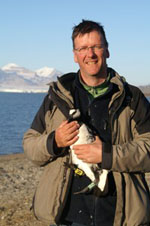
Dr. Maarten J J E Loonen is an Associate Professor of Arctic Ecology at the University of Groningen's Faculty of Arts, with over 25 years of field experience studying migratory birds and climate change impacts in the Arctic. He serves as Manager and Scientific Director of the Netherlands Arctic Station on Spitsbergen and holds leadership positions in multiple international Arctic research initiatives including CAFF (Conservation of Arctic Flora and Fauna) and SIOS (Svalbard Integrated Arctic Earth Observing System). Loonen's research focuses on Arctic ecology, particularly the behavior and migration patterns of geese and Arctic terns, and how climate change affects polar ecosystems. His work examines the complex interactions between migratory birds, vegetation, and other Arctic species like reindeer and Arctic foxes. He pioneered innovative research methods, including implementing crowdfunding to track Arctic tern migration routes using geolocators. His research has significant implications for understanding global ecological changes, as the Arctic serves as an early indicator of climate impacts. His publication record shows consistent productivity with research spanning from 2002 through 2025, with recent work focusing on migratory timing, Arctic flyways, permafrost dynamics, and the ecological consequences of climate change. Loonen led the largest Dutch polar expedition in history to the east side of Spitsbergen in 2015, which was repeated in 2022, and participated in a 2014 expedition to Jan Mayen island with the Dutch Navy. Officer of the order of Orange Nassau (2021) Member of the Norwegian Scientific Academy for Polar Research (2014) Loonen actively engages in science communication and policy, serving on committees for BirdLife Netherlands and the Netherlands Ornithological Union. His work contributes to multiple UN Sustainable Development Goals related to climate action and life on land. He has supervised numerous research projects and mentored early-career scientists through field expeditions and collaborative research. As Station Manager of the Netherlands Arctic Station on Spitsbergen, Loonen oversees an important hub for international Arctic research. He collaborates extensively with researchers across Europe and beyond, contributing to large-scale interdisciplinary projects that integrate biology, archaeology, and climate science to understand the rapidly changing Arctic environment.
Professor Partsinevelos Panagiotis is affiliated with the Technical University of Crete's School of Mineral Resources Engineering, where he works in the Mineral Resources Detection and Identification Department. He leads the Laboratory of Geodesy and Geoscience Informatics (SenseLab) and teaches courses including Geographic Information Systems, Technical Geodesy, and Environmental Remote Sensing. His office is located in rooms M3.305 and M1.212, with contact number +30 28210 37628. Research Focus Space Informatics Unmanned Systems (drones, airborne, ground, and sea applications) Machine Learning and Neural Networks Geometric Documentation of Monuments Smart Cities and Precision Agriculture His recent publications demonstrate expertise in UAV-based spatial analysis, environmental monitoring, and geoinformatics applications. Research projects include EU-funded initiatives like 'Space Innovation Analysis' and 'AID4PV PV Plant Diagnosis', alongside national projects such as 'SandMap' and 'Drones 2 GNSS.' Notable Projects Partner PI in EU-funded 'Space Innovation Analysis' (2023) Co-PI in 'AID4PV' UAV-based PV diagnostics (2021-present) Coordinator of 'SandMap' (2020-present) PI for 'UAV Precision Measurements' (2018-2023) Coordinator of Crete-GIS architecture (2017-2019) Leader in ERANETMED 'DESiRES' project Professor Partsinevelos contributes to geospatial innovation through field robotics, satellite technologies, and data science applications, with emphasis on environmental and urban challenges.
Dr. Lyudmyla Kirichenko serves as a Research and Teaching Assistant Professor in the Insurance and Capital Markets Department at Lodz University of Technology, Poland. Her academic profile includes active research publication through 2025, with contact details listing room 167 and email lyudmyla.kirichenko@p.lodz.pl. She maintains collaborative research ties with institutions in Ukraine and international conferences. Her research spans Machine Learning, Time Series Analysis, and Cybersecurity with specialized focus on fractal dynamics and computational finance applications. She develops advanced methodologies including wavelet transforms, recurrence plots, and LSTM autoencoders for classifying complex time series data. Her work bridges theoretical computer science with practical implementations in intrusion detection systems, financial market analysis, and computer vision security applications. The departmental affiliation with Insurance and Capital Markets indicates applied research directions in e-commerce forecasting and risk modeling. Analysis of her 15 most recent publications (2022-2025) reveals dominant trends in machine learning classification of fractal time series, with increasing interdisciplinary applications. Her 2023-2025 work shows expansion into public health modeling (respiratory infections in conflict zones) and crisis response optimization, while maintaining core expertise in wavelet-based feature extraction and neural network approaches for time series problems. The publications demonstrate consistent methodological innovation across computer science, physics, and operations research domains. Scientific Awards No scientific awards were documented in the provided materials Advising and grant activities cannot be confirmed from the available information. The publication record indicates extensive collaboration with Ukrainian researchers including Tamara Radivilova and Sergiy Yakovlev, but no student supervision or funding details are specified. Her research appears supported through institutional affiliations and conference participations. Laboratory resources or dedicated research teams are not explicitly described, though her methodology-focused publications suggest computational laboratory work involving machine learning frameworks and signal processing tools. The departmental context implies integration with financial data analysis infrastructure.
Dr. Tolga Berber is an Assistant Professor at the Faculty of Science, Karadeniz Technical University . With a PhD in Computer Engineering from Dokuz Eylül University, his academic career spans over 20 years, including roles as Deputy Head of Department (2013–2023) and extensive research in Computer Sciences, Artificial Intelligence, and Medical Informatics .
Dimitris Kalogeras is a Researcher at the National Technical University of Athens (NTUA) , affiliated with the School of Electrical and Computer Engineering and the EPISEY research institute. He has been a key contributor to advanced networking initiatives, including the NTUA Network, EDET optical network, and University School Network. His work spans national and European projects like GEANT, 6net, and NOVI, and he pioneered IPv6 and multicast deployment in Greece and Europe. His research focuses on Network security Internet of Things (IoT) Artificial intelligence in networking Cyber-physical systems Robotics Medical image processing Recent work involves federated learning, UAV-based localization, and privacy-preserving frameworks in IoT environments. An analysis of his 15 most recent publications reveals strong emphasis on applications of machine learning in network security, robotic infrastructure maintenance, and lightweight AI for IoT. His projects include thethingsNetwork deployment in Athens, the HERON robotic platform, and the FELICE collaboration framework. He has contributed to global IoT initiatives through multi-channel LoRAWAN gateways and 6LowPAN mesh networks. His work on blockchain-based DDoS mitigation and semantic-aware policy management demonstrates leadership in cyber infrastructure resilience.
Dr. Taotao Cai serves as an Honorary Lecturer and Postdoctoral Research Fellow in the School of Computing at Macquarie University, bringing expertise in graph analytics and machine learning. Previously, they held an Associate Research Fellow position at Deakin University's School of Information Technology. Their academic foundation includes a Ph.D. from Deakin University and a Master's in Computer Science from Shenzhen University, China. Education: Ph.D. in Computer Science, Deakin University, Australia Master of Computer Science, Shenzhen University, P.R. China Research spans graph data processing, social network analytics, and data mining with significant contributions to causal graph neural networks, influence maximization, and privacy-preserving machine learning. Recent work demonstrates strong interdisciplinary applications in remote sensing, healthcare decision systems, and battery management, while maintaining core focus on dynamic network analysis. The research portfolio reveals increasing sophistication in causal reasoning within graph structures and practical implementations for real-world systems. Publication trends from 2023-2025 show concentrated activity in graph neural networks (40%), privacy/security (25%), and remote sensing applications (20%), with emerging work in causal classification and medical AI. This evolution reflects both theoretical advancement and practical problem-solving across diverse domains. No formal scientific awards are documented in available sources. While no formal student advising is recorded, collaborative patterns indicate active mentorship within research teams. Grant activity remains unspecified, but extensive cross-institutional collaborations (particularly with Deakin University and international partners) suggest participation in multiple funded projects. Current trajectories point toward causal graph neural networks for explainable AI and privacy-enhanced federated learning systems as primary research frontiers. Active participation in international research networks is evident through co-authorship spanning Australia, China, and global institutions, with particular strength in graph algorithm development and social network analysis communities.
Musa BALTA is an Assistant Professor in the Department of Cyber Security Engineering at Sakarya University's Faculty of Computer and Information Sciences. He maintains an active research and teaching career focusing on cybersecurity, computer networks, and artificial intelligence applications in critical infrastructure protection. His educational background includes a Doctorate (2012), Master's Degree (2009-2016), and License (2004-2009), all from Sakarya University in Computer and Information Engineering/Computer Engineering. His doctoral thesis focused on SDN-based VANET architecture for urban traffic management systems. Dr. BALTA's research spans several critical areas including cybersecurity for critical infrastructure (particularly water and energy systems), software-defined networking, vehicular ad-hoc networks, and fuzzy logic applications in traffic management. His work demonstrates a consistent focus on applying artificial intelligence techniques to solve real-world problems in network security and transportation systems. He has developed secure testbed infrastructures for both energy and water management systems, highlighting his contribution to critical infrastructure protection. His publication record shows a clear trajectory from network topology discovery (early career) to sophisticated applications of AI in critical infrastructure security (recent work). The most recent publications focus on image-based security techniques for water infrastructure, advanced testbed development for energy systems, and continued work on intelligent traffic management solutions. EFQM Excellence Award Dr. BALTA teaches various computer engineering courses including Logic Circuits, Computer Engineering Design, Internet Engineering, Network Programming, and Network Security. His current course load demonstrates expertise across foundational computer engineering topics and specialized security courses. He has supervised graduation projects and appears to be involved in several research projects related to critical infrastructure security, including projects titled 'Artificial Intelligence and Big Data Supported Water Quality Monitoring and Anomaly Detection System for Water Management Systems,' 'Integrated Security Management Platform Design and Application for Meter Management Systems in Software Defined Smart Grids,' and 'Development of Cybersecurity Capabilities for Energy Critical Infrastructure (SYNERGY) Project.' His research group appears to focus on critical infrastructure protection, with particular emphasis on developing testbed infrastructures for both energy (CENTER Energy) and water (CENTER Water) systems. This work positions his team at the intersection of cybersecurity, industrial control systems, and critical national infrastructure protection.
Sümeyye KAYNAK serves as an Assistant Professor in the Department of Computer Engineering at Sakarya University's Faculty of Computer and Information Sciences. Her academic profile demonstrates interdisciplinary expertise bridging computer science with environmental sustainability and educational technology through computational modeling and data-driven solutions. Her educational foundation includes: Doctorate (2019) from Sakarya University Institute of Science/Computer and Information Engineering with thesis on solar energy potential modeling using 3D data Master's degree (2014) from same institution focusing on AI-based student counseling infrastructure Bachelor's degree (2012) in Computer Engineering from Sakarya University Faculty of Engineering Dr. KAYNAK's research integrates advanced computational methodologies across multiple domains. Her primary focus areas include Artificial Intelligence applications for resource allocation in cloud manufacturing (utilizing genetic algorithms and AHP), Environmental Informatics for flood modeling and hydrological analysis, and Sustainable Energy systems through solar potential estimation tools. Recent work demonstrates significant expansion into geospatial web components for earth science agencies and digital twin frameworks for urban infrastructure resilience, reflecting growing emphasis on climate change adaptation technologies. Publication analysis from 2012-2025 reveals a clear research evolution: early work (2012-2018) concentrated on educational AI systems and solar energy tools, while current output (2023-2025) prioritizes environmental applications with city-scale flood impact modeling, hydroinformatics, and open data frameworks. This trajectory shows increasing sophistication in real-time data analytics and cross-domain integration, particularly between manufacturing systems and environmental monitoring. No scientific awards were documented in the source materials. Regarding academic mentoring, the available documentation contains no references to graduate student supervision or grant-funded research projects. No laboratory affiliations or research team leadership roles were specified in the provided information.
Bing Zhai is an Assistant Professor in Computer Science at Northumbria University, specializing in developing practical AI tools to solve time-series data challenges in real-world applications. His research bridges the gap between signal/data and human-understandable knowledge through mathematical modeling and machine learning algorithms, with particular focus on healthcare applications. Education PhD in Data Science for Healthcare, School of Computing, Newcastle University Research Interests Dr. Zhai's primary research interests include time series data analysis, biosignal analysis, computational behaviour analysis, and healthcare applications. He has extensive experience developing machine learning and deep learning algorithms for biosignal data-based applications in physical behaviour assessment and health and well-being monitoring. His work spans AI for good initiatives, computer vision, and audio/speech analysis. At Northumbria University, he conducts sleepiness and fatigue research using machine learning methods and collaborates with more than a dozen research institutions on the IDEA-FAST project (€40 million), which focuses on identifying digital endpoints and biomarkers of sleep disturbance and fatigue. Research Trends Dr. Zhai's recent publications demonstrate a strong focus on applying machine learning to healthcare challenges, particularly in sleep analysis, medical imaging, and cardiovascular risk prediction. His work shows expertise in multimodal data fusion, explainable AI for medical applications, and specialized architectures for time-series and biosignal data processing. He frequently develops novel neural network architectures tailored for specific healthcare applications while maintaining practical usability. Supervision and Projects Dr. Zhai currently supervises PhD research, including Sarah Alshahrani's work on 'AI-Based Multimodal Model for Enhanced Clinical Decision Support and Phrase-Level Grounding in Chest Disease Detection' (started June 2024). He was previously a research associate at the School of Computing at Newcastle University, working on the IDEA-FAST project to identify digital endpoints and biomarkers of sleep disturbance and fatigue.
Dr. Chuanbin Zhu is an Assistant Professor in Geotechnical Engineering at Northumbria University 's Faculty of Engineering and Environment. He holds a PhD in Civil Engineering from Queensland University of Technology (2018) and has worked at prestigious institutions including GFZ German Research Centre for Geosciences (2018-2022) and University of Canterbury (2022-2024). Research Focus: Earthquake hazard assessment through site effects characterization, physics-based simulations, and machine learning Key Contributions: Horizon 2020 SERA project (European seismic hazard model), New Zealand NSHM project Academic Service: Journal reviewer, Guest Editor for SCI journals, and session organizer at major seismology conferences Research Interests Dr. Zhu specializes in earthquake site effects , focusing on: Site-effects characterization using observational data and simulations Subsurface property inversion with microtremor data Uncertainty quantification in seismic modeling Deep learning applications in engineering seismology Signal processing for seismic wave analysis Scientific Recognition Outstanding PhD Thesis Award (top 5%) from QUT Associate Fellow of the Higher Education Academy Publications Trends His recent work emphasizes machine learning integration with traditional seismology, focusing on site classification via neural networks, high-resolution site mapping , and hybrid simulation methods that combine physics and data-driven approaches. Geographic focus includes China, New Zealand, and Japan.
Lionel Bombrun is an Associate Professor at the University of Bordeaux, specializing in Signal and Image Processing within the MOTIVE team at IMS Bordeaux. His research focuses on the application of Riemannian geometry to texture analysis, remote sensing, and machine learning problems. His educational background includes advanced studies in signal processing and mathematics, though specific degrees aren't detailed in the provided text. His research interests span multiple domains including: Statistical modeling on Riemannian manifolds Covariance matrix analysis for texture classification Wavelet-based feature extraction Remote sensing applications for environmental monitoring Machine learning approaches for hyperspectral and radar data Bombrun's publication record shows consistent contributions to high-impact journals, particularly in IEEE Transactions. His recent work demonstrates growing interest in applying conformal prediction and deep learning techniques to aviation safety and precision agriculture. The publications reveal a strong pattern of interdisciplinary collaboration across mathematics, engineering, and environmental science domains. Among his notable scientific contributions is the development of Riemannian statistical models for covariance matrix descriptors, which has become influential in texture analysis and remote sensing classification tasks. Professor Bombrun actively collaborates with researchers across multiple institutions and industries, particularly in applications related to vineyard monitoring, forest management, and aircraft navigation systems. His work demonstrates both theoretical depth in mathematical statistics and practical applications in real-world problems.
Maria Vitalievna Talakh serves as an Assistant Professor in the Department of Computer Science at Yuriy Fedkovych Chernivtsi National University. Holding a Candidate of Biological Sciences degree, she bridges the gap between biological sciences and computer science with her unique interdisciplinary expertise. Education: Bohdan Khmelnytskyi National University of Cherkasy (2018): Systems Analysis, Qualification: Systems Analyst (Diploma with honors) Yuriy Fedkovych Chernivtsi National University (2004): Ecology and Environmental Protection, Qualification: Master of Ecology (Diploma with honors) Candidate of Biological Sciences (2009): Specialty 03.00.16 – ecology, dissertation on 'The role of the forest beech as an edificator species in the forest ecosystem' Research Interests: Dr. Talakh's research spans machine learning algorithms (particularly ensemble models), big data analytics, computer vision, and their applications in life sciences and ecological modeling. Her work demonstrates how computational methods can solve complex problems in environmental monitoring, medical diagnostics, and software engineering. She has developed intelligent monitoring systems for climate, air temperature, plant health, and software test automation, showing the versatility of her methodological approaches. Publication Trends: Her recent scholarly output reveals a strong focus on practical applications of machine learning across diverse domains. The majority of her publications from 2020-2024 explore convolutional neural networks, ensemble methods, and big data processing techniques applied to environmental monitoring, medical diagnostics, and software quality assurance. She frequently collaborates with researchers across disciplines, particularly with colleagues at her institution on projects involving satellite data analysis and ecological monitoring systems. Professional Activities: Member of the Bukovina Information Technology Cluster named after Joseph Schumpeter (Chernivtsi IT Cluster, Cluster Bit Association) since 2019 Scientific consultant for Limited Liability Company 'KM TRADE: Security Systems' (2019) Teaching: Dr. Talakh teaches courses related to data mining, intelligent data analysis, ensemble architectures, geoinformation systems, and big data technologies. She has authored numerous textbooks and teaching materials in these areas, demonstrating her commitment to both research and education in computational methods.
Yuriy Yaroslavovych Tomka is an Associate Professor in the Department of Computer Science at Yuriy Fedkovych Chernivtsi National University. He holds a Candidate of Physical and Mathematical Sciences degree and has been serving as an Associate Professor since April 15, 2021. His academic work spans software engineering, neural networks, and biomedical image processing, with numerous publications in these fields. Dr. Tomka's educational background includes: Bachelor's degree in Laser and Optoelectronic Engineering from Yuriy Fedkovych Chernivtsi National University (2005), with honors Candidate of Physical and Mathematical Sciences degree (2009) in specialty 01.04.05 – Optics, Laser Physics Dr. Tomka's research interests focus on software architectures, enterprise application development on the .NET platform, pattern recognition, digital image processing, and neural networks. His work bridges theoretical computer science with practical applications in biomedical diagnostics, financial technology, and e-commerce systems. He has made significant contributions to the development of information systems, machine learning applications, and educational methodologies in computer science. Analysis of Dr. Tomka's recent publications reveals a strong focus on practical applications of software engineering principles, particularly in the .NET ecosystem. His work spans from fundamental software architecture to specialized applications in biomedical imaging and financial forecasting. There's a clear trend toward interdisciplinary research, combining computer science with fields like medicine and finance, demonstrating the versatility and applicability of his technical expertise. Dr. Tomka has received recognition for his mentorship, guiding student research that won second-degree diplomas in national competitions. His professional development includes numerous certifications in modern software technologies from institutions like Sigma Software University. As an active member of the Bukovina Information Technology Cluster named after Joseph Schumpeter since 2019, Dr. Tomka contributes to regional IT development initiatives. He also provides scientific consulting to the Limited Liability Company "Buknanotech" and has managed research projects including "Development of new methods and biomedical systems for polarization-holographic fractalmetry of crystallites of tissues and fluids of human organs" (2019-2021).