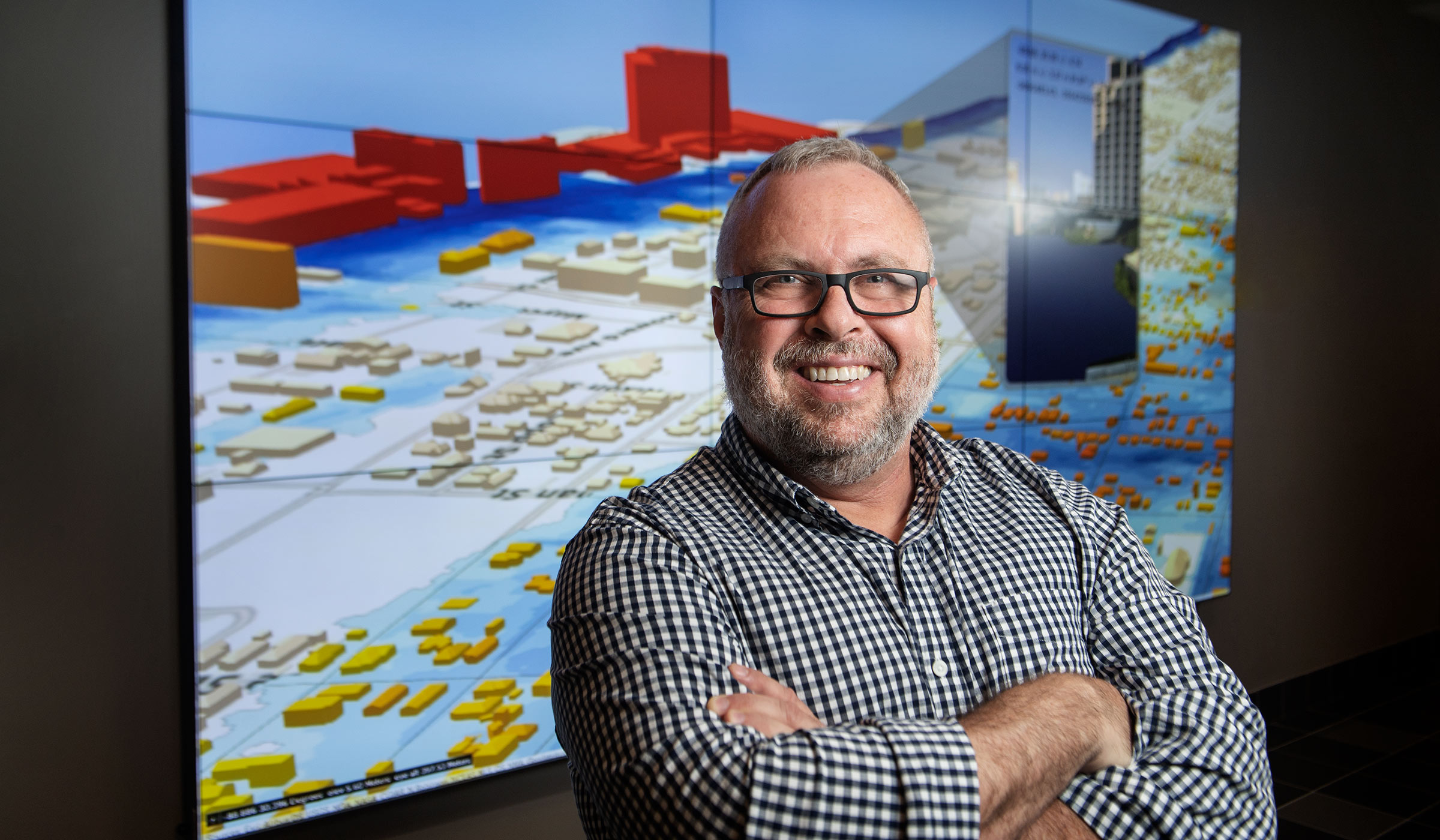
John Cartwright is a Lecturer at Mississippi State University's Department of Geosciences, focusing on geospatial technologies and coastal resilience. His work bridges academic research with practical applications to address environmental challenges along the Mississippi Gulf Coast. His research interests include: Using geospatial tools for watershed management Studying surficial erosion in coastal watersheds Developing coastal resilience strategies Training natural resource managers in geospatial technologies The GEO Project, under his leadership, provides foundational research and technical training to address long-term coastal challenges through the Northern Gulf Institute and MSU Extension Service. Scientific awards include: NOAA Graduate Research Fellow
Prof. Holger Frey is a Full Professor of Organic and Macromolecular Chemistry at the Department of Chemistry, University of Mainz, Germany, since 2003. He has held leadership roles as Dean (2013-2015) and Vice-Dean (2009-2013, 2015-2017) for the Faculty of Chemistry, Pharmaceutical Sciences and Geosciences. He serves as Associate Editor for the Journal of Polymer Chemistry and an Executive Board Member of the GDCh Fachgruppe Makro. PhD: University of Twente, The Netherlands (1990), supervised by Prof. M. Möller Habilitation: University of Freiburg (1998), under Prof. R. Mülhaupt His research focuses on carbanionic polymerization , block copolymers , terpene-based polymers , polyethers , epoxide polymers , biodegradable materials , CO₂-based polycarbonates , silicone copolymers , and hyperbranched materials . His work bridges synthetic polymer chemistry with applications in medicine, nanotechnology, and sustainable materials. Prof. Frey has received prestigious awards, including the Hermann-Schnell Award (1998), IUPAC Young Scientist Award (2000), and ERC Advanced Grant (2022). He is a Fellow of the Royal Society of Chemistry (2021) and has founded the company Hyperpolymers (2001). His team includes PhD Students : Caroline Bockhard, Thi Dinh, Fabian Fuß, Tobias Gäb, Lena Grieser, Milena Hesse, Maximilian Kaiser, Benny Mathes, Robin Mathes, Verena Müller, Frédéric Petrov, Tom Reimers, Julian Schmidt, Dominik Schulz, Lea Simon, Moritz Simon, Ruocheng Tang Master Students : Carolina Alzate Millan, Lara Jendrny, Denis Rohrmann Post Docs : Gregor Linden Supporting Staff : Dr. Elena Berger-Nicoletti His lab is located at the Department of Chemistry, University of Mainz (Duesbergweg 10-14, Rooms 2222.03.128 and 2225.02.136).
Dr. Igor Poniger is a researcher at the University of Novi Sad , affiliated with the Faculty of Economics and its Department of Geography, Tourism and Hospitality . His career spans wildlife ecology, hunting management, and GIS applications in tourism and environmental science. Education: MS in Geosciences-Tourism (2015), PhD in progress (Geosciences-Tourism) Languages: English, Slovak, Italian (basic) Projects: Transformations of the Geospace of Serbia (team member) Dr. Poniger's research focuses on wildlife population dynamics , hunting tourism , and GIS-based habitat evaluation . His work addresses interactions between game species (e.g., red fox, brown hare) and human activities, including disease control and sustainable tourism practices. Recent publications highlight GIS applications in hunting ground resource management, climate impacts on game populations, and community attitudes toward hunting tourism. His interdisciplinary approach bridges ecological data with tourism development strategies. He teaches courses in hunting fundamentals , game protection , and firearms ballistics , reflecting his expertise in practical and theoretical aspects of game management. Consultations available Tuesdays 10-12, Wednesdays 12-14, Room 13.
Dr. Angela Meyer is an Assistant Professor of Energy Meteorology and Artificial Intelligence at TU Delft, Faculty of Civil Engineering and Geosciences, Department of Geoscience and Remote Sensing since October 2023. She concurrently leads the Energy Weather & AI Lab at the Bern University of Applied Sciences (BFH), School of Engineering and Computer Science. She earned her PhD in atmospheric physics from ETH Zurich (2015) and a master’s degree in mathematics from the University of Cambridge (2009). Research Focus: Intersection of data science, atmospheric science, and renewable energy applications. Machine learning for solar and wind energy forecasting. Federated learning for privacy-preserving wind turbine condition monitoring. Satellite-based solar radiation retrieval and bias correction. Probabilistic intraday and sub-seasonal forecasting. Her research is supported by major grants from the Swiss National Science Foundation (SNSF) and Innosuisse , and she is a project partner in the Horizon Europe UrbanAIR initiative. Scientific Contributions: Over 40 peer-reviewed publications since 2015 in journals such as Applied Energy , Solar Energy , Energy and AI , and Journal of Climate . Key publications include advances in deep generative models for solar forecasting, federated learning in renewable energy, and AI-based satellite retrieval of solar radiation. Active reviewer for Applied Energy , Energies , and program committee member for ECML PKDD and LOD conferences. Research Team & Supervision: Dr. Meyer currently supervises six PhD candidates and six postdoctoral researchers across her labs at TU Delft and BFH. Her group focuses on AI-driven solutions for renewable energy reliability and resilience. Laboratories & Collaborations: Energy Weather & AI Lab – Bern University of Applied Sciences. GRS Lab – TU Delft, Department of Geoscience and Remote Sensing. Active collaborations with ETH Zurich, Siemens Smart Infrastructure, Hexagon AB, and NVIDIA. For more information, visit her personal website or ResearchGate profile .
Stephen E. Kaczmarek is an Associate Professor in the Department of Geological and Environmental Sciences at Western Michigan University, where he has served since 2015 as head of the Carbonate Petrology & Characterization Laboratory (CPCL). Prior to academia, he worked as a research scientist for ExxonMobil Upstream Research Company (2005-2011), conducting global carbonate reservoir studies and exploration projects. His academic credentials include: Ph.D. in Geology, Michigan State University, 2005 B.S. in Geology, Michigan State University, 2000 Dr. Kaczmarek's research centers on sedimentary petrology with specialized expertise in carbonate diagenesis, particularly dolomitization mechanisms and calcitization processes. His methodology integrates advanced textural analysis, mineralogical characterization, and geochemical techniques to decode fluid-rock interactions in carbonate systems. Key research themes include dolomite stoichiometry, cation ordering effects, isotope fractionation patterns, and the application of these principles to petroleum reservoir characterization and paleoenvironmental reconstruction. His 2023-2025 publications reveal a pronounced shift toward experimental geochemistry, with 60% of recent work focusing on laboratory-synthesized dolomites to quantify relationships between cation ordering and isotope signatures. Concurrently, he has expanded into environmental applications, notably road salt remediation studies. These works predominantly appear in top-tier journals like Journal of Sedimentary Research and Geochimica et Cosmochimica Acta, demonstrating methodological innovation through high-resolution XRD, clumped isotope thermometry, and process-based diagenetic frameworks. Dr. Kaczmarek actively mentors students through courses including Carbonate Petrology (GEOS 6650) and Sedimentation & Stratigraphy (GEOS 4350). His research is funded by substantial grants including an NSF award (EAR-GG-2120193, $294,939 as PI) for dolomite cation ordering studies and ExxonMobil funding ($221,837) for Smackover Formation analysis. He serves as co-editor for Journal of Sedimentary Research and referees for leading geoscience journals and funding agencies worldwide. The CPCL under his direction employs cutting-edge instrumentation for carbonate characterization, supporting research on diagenetic overprinting, reservoir quality prediction, and experimental diagenesis. Current projects integrate field studies from Michigan Basin formations with global carbonate platforms to develop predictive models of diagenetic evolution.
Matt Reeves serves as a Presidential Innovation Professor and Professor of Hydrogeology in the Department of Geological and Environmental Sciences at Western Michigan University, where he also directs the Hydrogeology Field Course. His research focuses on fluid flow, heat and solute transport in porous media with specialization in fractured rock systems and emerging contaminants. His academic background includes: Ph.D. in Hydrogeology, University of Nevada-Reno (2006) M.S. in Geology/Hydrogeology, University of Montana-Missoula (2001) B.S. in Soils and Environmental Science, Montana State University-Bozeman (1998) Dr. Reeves' research addresses climate change impacts on water resources, environmental fate of contaminants (including PFAS, radionuclides, and road salts), geological waste disposal, geothermal energy, and surface water-groundwater interactions. His work combines theoretical modeling with field applications to solve complex hydrogeological problems. Recent publication analysis reveals dominant themes in PFAS contamination pathways, innovative foam-based sampling/removal techniques, and advanced characterization of fractured rock transport. His Michigan-focused studies on wastewater treatment plants and biosolids demonstrate practical responses to regional environmental challenges. Dr. Reeves actively mentors graduate students, including: G.W. Link D.S. Vitale E.S. Coffin M.E.M. Akara R.W. Helmer T.T. Buszka R.N. Cascarano His research program likely receives support from agencies like the National Science Foundation and EPA, though specific grants aren't detailed in the source text. As Hydrogeology Field Course Director, he leads hands-on aquifer testing training that bridges classroom theory with real-world hydrogeological practice.
Shu-Gang Ai is a Research Assistant Professor at the Southern University of Science and Technology's School of Earth and Space Sciences. He holds a PhD in Civil Engineering from Tongji University (2021) and a Master's in Architectural and Civil Engineering from the same institution (2016). His research focuses on carbon dioxide geological sequestration, disaster prevention in complex rock masses, and finite element-discrete element numerical software development. His publications highlight expertise in geosynthetic reinforcement mechanics, landfill stability analysis, and computational geoscience. Recent work includes multiscale modeling of material interfaces and leachate distribution monitoring using geophysical methods. While no formal awards are listed, his contributions span both theoretical and applied studies in geotechnical and environmental engineering.
Nicolas Roberts is an Assistant Professor of Geosciences at Hamilton College, appointed in 2022. His research focuses on structural geology and continental crust deformation throughout Earth's history, with field studies in Western Australia's Pilbara Craton and the Grand Canyon basement. His educational background: Ph.D., University of Wisconsin-Madison B.A., Carleton College Roberts synthesizes map-scale, outcrop-scale, and microscale observations to quantify crustal deformation in diverse tectonic settings. His work on cryptic structures in Western Australia illuminates early continent formation processes, while Grand Canyon shear zone studies constrain middle-crust rheology in active mountain belts. Laboratory methodologies include anisotropy of magnetic susceptibility, microstructural analysis, and electron backscatter diffraction, supported by extensive fieldwork. Recent publications (2022-2024) demonstrate concentrated research on Precambrian structural evolution in the Pilbara Craton and Grand Canyon shear zone mechanics, alongside significant contributions to geoinformatics through the Strabospot digital data ecosystem for field and microstructural geology. Roberts teaches undergraduate courses including "Our Interconnected Earth" and "Structural Geology and Tectonics" at Hamilton College.
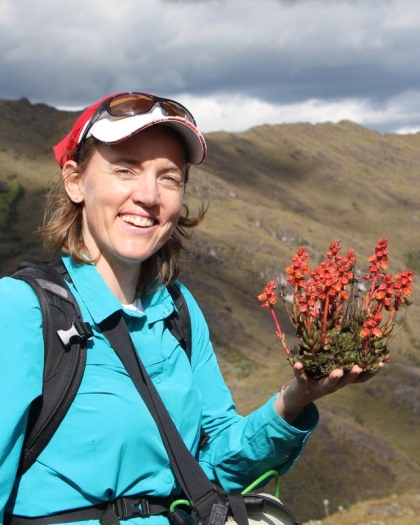
Suzette Flantua is a Researcher at the Department of Biological Sciences (BIO) , University of Bergen, Norway. She leads the PPF-Alpine project (2022-2026), funded by the Trond Mohn Foundation and the University of Bergen, integrating biology, geography, and climatology for mountain biodiversity conservation. Her research focuses on Global change ecology through macroecology, biogeography, and paleoecology Climate-biodiversity dynamics across past, present, and future time scales GIS and remote sensing applications in spatial analysis Historical environmental impacts on tropical mountain ecosystems Recent studies highlight 2025: Advancing paleoecological data standardization for global biomes 2024: Quantifying fire regime changes and bridging ecological disciplines through publishing guidelines 2023: Investigating diurnal temperature effects on plant elevation ranges and anthropogenic pollen indicators She contributes to Outreach via video communication about sustainability and has been featured in Science , Nature Geoscience , and J. Biogeography papers, with media coverage from Smithsonian Tropical Research Institute and Phys.org . Her work spans fieldwork in Andean expeditions, teaching university courses in GIS and global change, and organizing scientific events.
Dr. Roméo Courbis is a University Researcher at the Department of Geosciences and Geography, Institute of Seismology, University of Helsinki. His work focuses on advanced seismic methodologies including ambient noise tomography, distributed acoustic sensing (DAS), and passive seismic monitoring techniques. Previously, he served as a Post-Doctoral Researcher at Université Grenoble-Alpes (2017–2018) and as a geophysicist/research engineer at Sisprobe Inc (2018–2023). Education : Master of Science in Computer Science (Université de Franche-Comté, 2007), Master of Science in Geophysics (Université Grenoble-Alpes, 2017), Doctor of Philosophy in Computer Science (Université de Franche-Comté, 2011) Courbis specializes in Seismology and Geophysics , with technical expertise in Ambient Noise Tomography , DAS Data Processing , Seismic Imaging , and Instrumentation . His recent publications emphasize applications of passive seismic monitoring for subsurface fluid dynamics, structural defect detection, and geological hazard assessment. He manages the FLEX-EPOS mobile Finnish Seismic Instrument Pool , a collaborative infrastructure for seismic data acquisition. Key trends in his research include: Integration of DAS with traditional seismic methods Development of ambient noise-based imaging algorithms Time-lapse monitoring of subsurface processes Applications in geohazard detection and civil engineering Courbis has contributed to 17 total research outputs since 2008 and currently leads a project funded by K.H. Renlunds Stiftelse (2025–2028) titled Toward integration of seismic interferometry .
Stephen J. Quigley serves as a Teaching Professor in the Department of English at the University of Pittsburgh's Dietrich School of Arts & Sciences, where he teaches in the Digital Narrative and Interactive Design (DNID) Program. His academic affiliations include Homewood CEC, Pitt Cyber, Remake Learning, and the STEM Coding Lab. Quigley's research centers on digital rhetoric and basic coding education, with particular focus on craft theory applications in digital composition. His work bridges woodworking craftsmanship principles with digital pedagogy, emphasizing scaffolded learning approaches where technical skills inform theoretical development. Key projects include Open Fuego web tools for classroom coding integration and My Nature Study for environmental digital literacy. His publication portfolio demonstrates consistent contributions to digital humanities journals including Kairos , Reflections , and Computers and Composition Online . Recent work analyzes multimodal environmental education frameworks and digital archiving practices, showing strong interdisciplinary connections between rhetoric, computer science, and environmental studies. Quigley actively participates in educational technology initiatives, serving on the Senate Computing Committee and contributing to NSF-funded Computer Science for All (CSforALL) projects. His teaching portfolio spans technical communications, digital composing, usability studies, and project-based design courses that integrate writing with computational thinking.
Dr. Mark Bos is an Assistant Professor in Science Communication at the Freudenthal Institute, Faculty of Science, Utrecht University. He focuses on public engagement with science, particularly through visual communication in health and climate domains. His research explores how visuals aid or hinder science communication, with applications in science journalism and sustainability initiatives. He leads the NWA project 'Hersenschimmen: Praten over Prikkels' (2024), examining AI's role in patient-scientist communication. Key Research Areas: Science Communication, Climate Communication, Health Communication, Pathways to Sustainability Current Projects: NWA Wetenschapscommunicatie 'Hersenschimmen', Interdisciplinary Education Development Academic Contributions: Bos has published extensively on topics like climate communication strategies, visual health information design, and science journalism integrity, with recent 2024 works in Journalism Studies , Geoscience Communication , and European Journal of Health Communication . His research trends emphasize climate science, health literacy, and media-science dynamics. Professional Activities: He serves as a peer reviewer for the Journal of Science Communication and chairs the Science for Sustainability advisory board (2023-present). His invited talks include workshops on reading strategies in biology education and visual science communication.
Wendy R. Eisner is an Associate Professor in the Department of Geography at the University of Cincinnati, with affiliate appointments in the Environmental Studies Program and Department of Women's, Gender, and Sexuality Studies. She has held academic positions at multiple institutions including The Ohio State University, University of Alaska Anchorage, and University of Utrecht. Dr. Eisner serves as Editor of Polar Geography and as Graduate Program Director for the Department of Geography at the University of Cincinnati. Dr. Eisner earned her Doctor of Science in Geography from the University of Utrecht (1999), Doctorandus in Pre and Protohistory from the University of Amsterdam (1984), Kandidaats (M.A.) in Cultural Anthropology from the University of Leiden (1984), and Bachelor of Arts in Anthropology from Barnard College, Columbia University (1975). Her research focuses on Arctic system science, specifically examining paleoecology and paleoclimatology through the lens of both scientific and Indigenous knowledge systems. Dr. Eisner's work integrates traditional Iñupiat knowledge with Western scientific approaches to understand landscape evolution, climate change impacts, and human-environment interactions in the Arctic. Her research spans multiple disciplines including environmental science, geography, anthropology, and gender studies, with particular attention to how indigenous communities perceive and respond to environmental change. Dr. Eisner's recent publication portfolio demonstrates a strong emphasis on integrating Indigenous Knowledge with climate and geomorphic studies in Arctic Alaska, particularly through GIS applications and community-based research approaches. Her work increasingly focuses on documenting environmental, cultural, and social changes as observed by Iñupiat elders over their lifetimes, creating valuable cross-generational knowledge records. Best of Show, Baraga County Fair, Baraga Michigan Adult Embroidery blue ribbon (2010) Dr. Eisner has secured numerous significant research grants, primarily from the National Science Foundation, totaling over $2.5 million as Principal Investigator or Co-PI. Her major projects include "Connecting Indigenous Knowledge to Landscape Process Research" (NSF-BCS-0548846, $249,000), "Advanced End-to-End Cyberinfrastructure Installation" for the Barrow Global Climate Change Research Facility (ARC-0641623, $822,340), and "Changes in Lake Dynamics on the Arctic Coastal Plain" (ARC-0713813, $378,618). She has also served on the U.S. Civilian Research and Development Foundation panel for Geosciences. Dr. Eisner leads research teams focused on the Arctic Coastal Plain of Alaska, working collaboratively with Alaskan Native elders and communities. Her projects often involve interdisciplinary teams of geographers, environmental scientists, anthropologists, and indigenous knowledge holders to document landscape changes and develop integrated knowledge systems for understanding Arctic environmental dynamics.
Dr. Richard Anyah is an Associate Professor in the Department of Natural Resources & the Environment at the University of Connecticut, where he has served since 2008 (as Assistant Professor from 2008-2014 and Associate Professor since 2014). His research focuses on coupled climate-hydrologic systems, with particular emphasis on sub-Saharan Africa and the Greater Horn of Africa regions. Dr. Anyah's educational background includes: PhD in Atmospheric Science from North Carolina State University (2005) MS in Atmospheric Science from University of Nairobi/North Carolina State University (2001) BS in Meteorology from University of Nairobi (1997) Dr. Anyah's research interests span multiple dimensions of climate science and hydrology. His primary focus is on coupled regional climate-hydrologic modeling and analysis, with special attention to groundwater reservoirs and water table dynamics in regional climates, particularly in sub-Saharan Africa. His work explores regional hydroclimate dynamics, variability and extremes and their impacts on water resources, agriculture and food systems. He also investigates regional climate change impacts and vulnerability assessments as well as climate-human-ecosystems interactions . His research has significant policy implications for climate-resilient infrastructure and livelihoods in vulnerable regions. Dr. Anyah's publication record demonstrates consistent contributions to understanding climate dynamics in Africa and other regions. His most recent work focuses on climate projections for the Greater Horn of Africa under different global warming scenarios, hydro-climatic extremes in the Congo Basin, and the role of groundwater in regional climate systems. His research spans multiple disciplines including atmospheric science, hydrology, climate modeling, and environmental policy, with particular emphasis on applying scientific findings to real-world challenges in water resource management and climate adaptation. Dr. Anyah has been actively involved in significant research projects including: Integrating hydro-climate science into policy decision making for climate resilient infrastructure and livelihoods (East Africa-HyCRISTAL Consortium) Investigating the role of coupled climate-hydrology-land use connections in sub-Saharan Africa Examining water table dynamics in modeling regional climate variability Studying climate extremes and variability in the Northeastern United States Modeling climate variability and change of the Greater Horn of Africa UCAR Africa Initiative on NWP Demonstration to investigate impacts of weather extremes on meningitis outbreak Throughout his career, Dr. Anyah has presented his research at numerous international forums and workshops, particularly those focused on African climate systems. His work has strong connections to policy applications and decision-making processes in climate-vulnerable regions.
Dr. Yves Bühler is a leading researcher at the Swiss Federal Institute for Forest, Snow and Landscape Research (WSL) , heading the Alpine Remote Sensing group within the Alpine Environment and Natural Hazards unit. His work focuses on remote sensing applications for snow and avalanche research, rock-ice avalanches, and alpine mass movement monitoring using drones, SAR satellites, and machine learning. Education: PhD in Remote Sensing (University of Zurich, 2005-2009), High-School Teaching Certification (MAS SHE, 2003-2005). Key projects: Large-scale avalanche mapping in India, drone-based snow depth monitoring, and thermomechanical modeling for hazard indication. Research Trends : Recent publications highlight advancements in machine learning for avalanche segmentation , multi-sensor displacement monitoring , and climate change integration into hazard models . His work bridges geomechanics , remote sensing technology , and operational risk mitigation across Switzerland, Himalayas, and international collaborations. Scientific Contributions : He has received a Research Fellowship at the University of Otago and led leadership programs at FHNW. His team developed RAMMS::LSHIM for large-scale hazard mapping and pioneered low-cost lidar for avalanche monitoring.