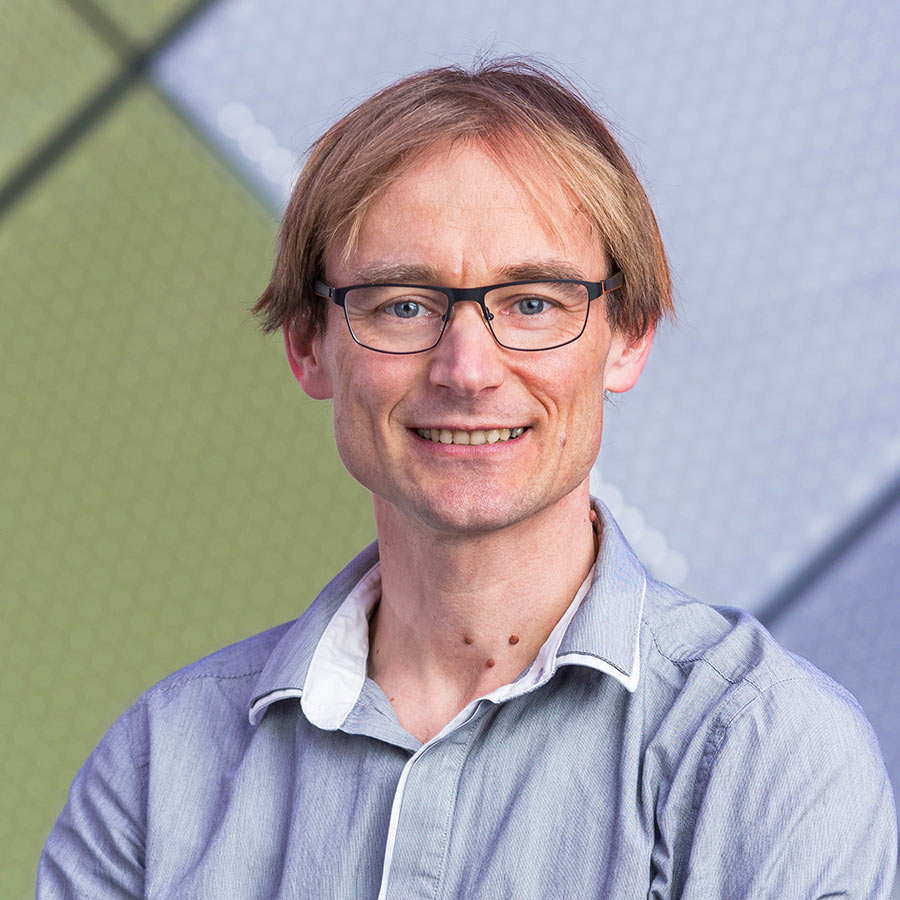
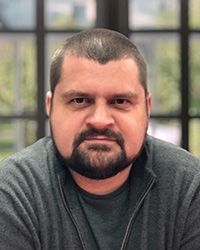
Dionysios Christopoulos is a Professor at the School of Electrical and Computer Engineering, Technical University of Crete. He holds a PhD in Physics from Princeton University (1991) and an Electrical Engineering degree from NTUA (1985). His career spans postdoctoral work at UNC Chapel Hill, research at FPInnovations, and academic roles at TUC since 2002. Teaching: Probability Theory, Statistics, Geostatistics, Time Series, Random Fields Collaborations: Interdisciplinary work with engineers, statisticians, mathematicians, physicists, and geologists Editorial Roles: Stochastic Environmental Research and Risk Assessment (Springer), Computers & Geosciences (Elsevier) His research focuses on spatial/spatiotemporal data modeling, with applications in statistical physics and stochastic methods. He has coordinated national and EU research programs and authored 202 publications, including two foundational books. Awards: 2003 Johannes A. Van den Akker Prize
Dr. TÖRÖK Ákos is a Professor and Head of the Department of Engineering Geology and Geotechnics at the Faculty of Civil Engineering, Budapest University of Technology and Economics (BME). He serves in key academic leadership roles, including Head of the Habilitation and Doctoral Council and Head of the Scientific Committee of the Faculty Council. He is also a representative of organization units within the Faculty Council. Research Interests: His research spans multiple areas in engineering geology and environmental geosciences, with a strong focus on the durability and degradation of natural stone materials used in construction and cultural heritage. His expertise includes: Weathering processes of monumental and dimension stones Impact of air pollution on stone decay Carbonate sedimentology Environmental geology and geotechnics Applications in radioactive waste disposal Geodynamics and rock mechanics These interests reflect both fundamental geological research and practical applications in civil engineering and environmental protection. Scientific Awards: No specific awards mentioned in the provided text. Advising and Grants: While specific students and grant projects are not listed, Dr. Török actively supervises MSc thesis work through the Diploma Project course in the Structural Engineering MSc program. His leadership in doctoral councils indicates a central role in PhD education and academic evaluation at the faculty level. Labs and Research Teams: He is affiliated with the Department of Engineering Geology and Geotechnics, which is part of the broader research and educational structure of the Faculty of Civil Engineering at BME. The department likely conducts laboratory and field-based research in geotechnics, engineering geology, and environmental geosciences, though specific lab names or team structures are not detailed in the text.
Olivier DECK is a Professor at the University of Lorraine , affiliated with the Department of Geosciences and Civil Engineering . He serves as Head of the department and is attached to the GeoResources Laboratory and the GEOSYSTEMES research team. His professional address is at ARTEM-Office R220, and he has been a member of the University Association of Civil Engineering's scientific committee since 2015. Research interests include: Soil-structure interaction Vulnerability of structures to natural hazards Risk management in civil engineering Uncertainty quantification in geological hazards His work focuses on mining subsidence, ground movement, and building damage assessment using analytical and numerical methods. He has supervised numerous PhD theses on these topics and contributed to decision-support methodologies for sustainable risk management. Teaching responsibilities include leading the M2 "Risques" track in Civil Engineering at University of Lorraine, lecturing in structural mechanics, geotechnics, and numerical modeling, and serving on the Civil Engineering aggregation jury since 2015. Scientific responsibilities include: Leading the ANR-INCERDD project (2011-2014) on uncertainty quantification Organizing committees for National Geotechnics Days (2016) and other scientific events Peer-reviewer for journals like Computers and Geotechnics and Natural Hazards
Thierry VERDEL is a Professor in the Department of Geosciences and Civil Engineering at the University of Lorraine. His role focuses on the intersection of geological sciences and civil engineering applications, reflecting expertise in subsurface systems and infrastructure development. Research Interests: Dr. Verdel's work appears centered on geotechnical engineering challenges, including rock mechanics, environmental geoscience applications, and sustainable civil engineering materials. This aligns with the Department of Geosciences and Civil Engineering's focus on both theoretical and applied aspects of earth sciences and structural engineering. Contact: Email: thierry.verdel@mines-nancy.univ-lorraine.fr
Laurie Reisberg is a Research Professor at the University of Lorraine, affiliated with the CRPG UMR 7358 CNRS-UL. Her work focuses on geochemistry, isotope geology, and geochronology, particularly using Re-Os and Os isotope systematics to study mantle processes, lithospheric evolution, and ore deposit formation. Her recent publications highlight applications of Re-Os dating to uranium and gold deposits, mantle melt interactions, and geochronological constraints on CAMP magmatism. Collaborative projects include the Oman Drilling Project and studies across the West African Craton and Himalayan regions. Key subfields include platinum-group element behavior, sediment provenance, and analytical method development. No formal awards or student advisement details are listed in the provided text.
France Floc'h is a Lecturer-Researcher and Deputy Director at the Geo-Ocean Research Unit (UMR 6538) within the European University Institute of the Sea (IUEM) at the University of Brest. Her work focuses on coastal physics, sediment transport modeling, and climate change adaptation. She leads major projects like FUTURISKS (2022–2028), addressing coastal risks in French overseas territories, and WEST (2021–2024), studying sediment transport during accretion phases. She has supervised 8 PhD students and holds a HDR (2021). Education: HDR in Coastal Dynamics (2021), PhD in Fluid Mechanics (2011), Master's in Ocean Physics (2007). Research Interests: Coastal morphodynamics, hydrodynamic modeling, sediment flux quantification, and impacts of climate change on coastal systems. Projects include DYNALIT observatory studies and contributions to ANR-funded initiatives. Awards: HDR in Coastal Dynamics (2021). Grants: ANR JCJC (€289k) for sediment transport research, LabexMer funding for coastal monitoring systems. Labs/Teams: Core member of Geo-Ocean UMR 6538, involved in interdisciplinary coastal observatories like SNO DYNALIT.
Professor Eleni Kokkinou holds a position at the Hellenic Mediterranean University (HMU) as a Professor of Environmental Geology and Geotechnology, with an affiliation to the Institute of Computer Science at FORTH. She earned her Geology degree from Aristotle University of Thessaloniki, followed by a postgraduate diploma and PhD in Applied Geophysics from the Technical University of Crete. Her research focuses on environmental geology, geotechnical studies, geodata modeling, and coastal vulnerability. She has pioneered work in remote sensing for agricultural management, oil spill modeling in the Eastern Mediterranean, and precision agriculture using UAV technology. She has supervised over 73 diploma dissertations, 5 ongoing theses, and examined multiple international M.Sc. theses in Egypt and Cyprus. Teaching includes courses on GIS, geotectonics, and geoscience software at HMU and TEI Crete. She actively contributes to committees like the Research Management Board of HMU and is a licensed UAV pilot with expertise in geophysical prospection. Her work integrates geomatics, environmental monitoring, and civil protection strategies for coastal and marine systems. Key collaborations include Cairo University and the Technical University of Crete. She has developed decision-support systems for irrigation optimization and participated in major projects like the Nereids oil spill risk assessment initiative.
Dr. Jaleena Sunny is a Research Fellow at the Swiss Seismological Service (SED) based at ETH Zürich. Her work focuses on advancing ground motion prediction methodologies, induced seismicity analysis, and uncertainty quantification in seismic hazard assessment. She specializes in developing stochastic models for earthquake ground motion and validating their performance through novel metrics. Her research interests include seismology, earthquake engineering, and regional seismic risk analysis with applications to both natural and induced seismic events. Dr. Sunny's recent work emphasizes improving ground motion prediction equations for unconventional seismic sources like hydraulic fracturing-induced tremors and optimizing computational algorithms for model validation. Her publications (2018-2025) demonstrate contributions to stochastic ground motion modeling, induced seismicity characterization, and the development of metrics for comparing seismic models. Notable projects include extending the ERM-CH23 model for Swiss shallow induced seismicity and creating soil amplification maps for spectral acceleration periods. Awards: None explicitly mentioned Grants/Advising: No grants or advisees listed She is affiliated with the SED lab at ETH Zürich, contributing to Switzerland's earthquake monitoring infrastructure and hazard mitigation strategies.
Peter G. Kropf is a Professor in the Department of Computer Science at the University of Neuchâtel, Switzerland, with a distinguished research career spanning over three decades. His academic journey reflects significant contributions to distributed systems, peer-to-peer networks, and cloud computing, with recent focus on IoT analytics and scientific computing applications. Dr. Kropf's research interests center on Distributed Systems , Peer-to-Peer Networks , Cloud Computing , Wireless Mesh Networks , and Scientific Workflows . His work demonstrates a clear evolution from foundational distributed systems research to practical applications in environmental monitoring, IoT analytics, and large-scale scientific computing. He has maintained consistent research productivity throughout his career, with publications appearing regularly from 1990 through 2024. Analysis of his recent publications reveals a strong trend toward real-time data processing for environmental applications, IoT analytics , and cloud-based scientific workflows . His work often bridges theoretical distributed systems concepts with practical implementations, particularly in environmental monitoring and resource management contexts. The interdisciplinary nature of his research connects computer science with environmental science and hydrology. Dr. Kropf has established long-term collaborations with researchers including Gilbert Babin (15 joint publications), Pascal Felber (14 publications), and Sabina Serbu (7 publications), forming a productive research network focused on distributed systems challenges. His work has appeared in prestigious venues including IEEE Internet Computing, Future Generation Computer Systems, and Middleware conference proceedings.
Dr. Paula Duffy is a Lecturer in the Department of Geography and Environment at the School of Geosciences, University of Aberdeen, since 2020. Previously, she served as a Lecturer in Sustainable Development at the School of Geography and Sustainable Development, University of St Andrews (2019-2020), where she also completed her PhD in Sustainable Development (2019) and worked in teaching roles (2015-2019). Her research focuses on human geography, applied social science, and marine socio-economics, particularly examining socio-demographic change, coastal community sustainability, and just transition policies. PhD Sustainable Development (2019) - University of St Andrews MSc Applied Population and Welfare Geographies (2011) - University of Dundee MA (First Class Honours) in Geography (2009) - University of Dundee Her funded research includes the UKRI-ESRC project "Solar Power in the UK: Planning for a Sustainable Future" (2023-2025), the Royal Society of Edinburgh funded comparative study on climate change risk perceptions in Scotland and Taiwan, and the Erasmus+ Ecovillage Transition in Action initiative. She co-led the DigiEthics project for digital ethics in rural research and contributed to the "Community Wellbeing and the Coast" project, shortlisted for Heriot-Watt University's PRIME Award. Paula's recent publications address solar farm planning determinants, island repopulation opportunities, and digital ethics frameworks. She actively collaborates with institutions like the James Hutton Institute and Marine Scotland, and participates in professional societies including the Royal Geographical Society (Fellow) and American Association of Geographers. Shortlisted for Heriot-Watt University PRIME Award (2024) Fellow of Royal Geographical Society (RGS-IBG) Member of Royal Scottish Geographical Society (RSGS) Member of American Association of Geographers (AAG) UKRI Early Career Researcher Forum participant As a supervisor, she guides PhD candidates Marcus Craigie and Kirsten Gow. Her affiliations include the Aberdeen Institute for Coastal Science and Management (AICSM) and Just Transition Lab, contributing to interdisciplinary teams focused on coastal resilience, smart sustainable futures, and environmental governance.
Enrico Di Minin is a Professor at the University of Helsinki's Faculty of Science , Department of Geosciences and Geography. His research spans interdisciplinary fields including Ecology , Conservation Biology , and Sustainability Science , with a focus on leveraging digital data for biodiversity monitoring. Primary Affiliation: University of Helsinki Research Pillars: Ecology, Evolutionary Biology, Geosciences, Economics Research Interests : Dr. Di Minin pioneers the use of social media analytics , machine vision models , and artificial intelligence in conservation science. His work addresses illegal wildlife trade monitoring , human-wildlife coexistence , and spatial assessment of ecosystem services . Publication Trends : Recent articles highlight AI applications in conservation (2025), global biodiversity priorities (2025), and digital data's role in policy formulation. Earlier works (2023-2024) analyze wildlife trade dynamics, conservation ethics, and climate-smart land use.
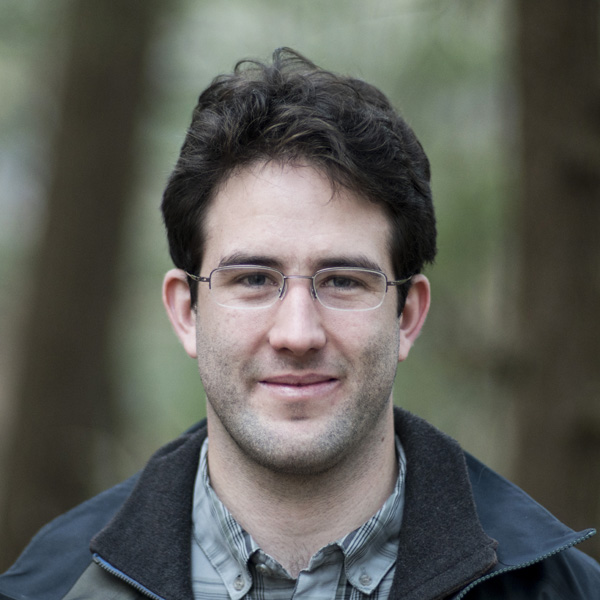
C. Brenhin Keller is an active Assistant Professor in the Department of Earth Sciences at Dartmouth College since 2019, previously serving as a Postdoctoral Fellow at the Berkeley Geochronology Center and UC Berkeley (2016-2019), and Visiting Scientist at Lawrence Livermore National Laboratory (2016-2019). His research integrates computational, field, and geochronological methods to investigate continental crust formation and its coevolution with Earth's biosphere and surface systems. Education: B.S. summa cum laude in Science of Earth Systems, Cornell University (2010) M.A. in Geosciences, Princeton University (2012) Ph.D. in Geosciences, Princeton University (2016) Dr. Keller's work centers on geochronology and statistical geochemistry , with expertise in zircon dating, crustal evolution modeling, and Bayesian inversion techniques. He develops open-source computational tools like Chron.jl for eruption age modeling and StatGeochem.jl for geochemical resampling, addressing fundamental questions about Earth's history through innovative data-driven approaches. Recent publications show strong emphasis on Bayesian methodologies , zircon trace element analysis , and interdisciplinary connections between solid Earth processes and paleoenvironments. His work spans volcanic-plutonic systems, Great Unconformity studies, and planetary science applications, frequently appearing in high-impact journals like Nature and PNAS. Scientific awards: James B. Macelwane Medal (AGU, 2024) Donath Medal (GSA, 2024) Hisashi Kuno Award (AGU, 2023) Class of 1962 Faculty Fellowship (Dartmouth, 2023) Computational Science Graduate Fellowship (DOE, 2012-2016) He mentors graduate students including Jannitta Yao, Reina Harding, and Alexander Cox, with alumni such as Gailin Pease (M.S. 2021). His research has been supported by DOE and Princeton fellowships, and he actively contributes to open science through software development and large collaborative projects like the Sedimentary Geochemistry and Paleoenvironments Project. Dr. Keller leads a computational geoscience research group developing Julia-based tools for geochronology and geochemistry. His team conducts fieldwork globally across glacial, volcanic, and tectonic settings, including Antarctica, the Himalayas, and North American Cretaceous-Paleogene boundary sites, while maintaining strong connections with Lawrence Livermore National Laboratory.
Sara Elliott is a Research Scientist Associate III at the Bureau of Economic Geology, part of the Jackson School of Geosciences at the University of Texas at Austin. She specializes in geological research with a focus on paleoecology and advanced rock analysis techniques. Her educational background includes: B.S. in Geological Sciences & Biology, Provost Honors from the University of Miami (2010) M.S. in Geosciences from Pennsylvania State University (2012) Elliott's research focuses on advanced microscopy applications in geology. She is particularly known for her expertise in Scanning Electron Microscopy, especially SEM-Cathodoluminescence. Her work encompasses diagenesis processes, deformation structures, fluid flow in geological formations, and detailed clastic and carbonate petrography. She conducts significant research on bedding-parallel fractures in shale and Holocene wetland and riparian paleoecology in the Northeastern United States. Her groundbreaking studies on pre-colonial forests have provided crucial historical ecological data that directly informs modern stream restoration projects. Elliott has received notable recognition for her scholarly contributions: Early Career Development Publication Award from the Bureau of Economic Geology (2015) P.D. Krynine Scholarship from Pennsylvania State University (2011-2012) Geological Society of America Student Research Grant (2011) Bowman-Foster-Ashe Academic Tuition Scholarship from the University of Miami (2006-2010) Florida Bright Futures Academic Scholars Award (2006-2010) As an active member of The Geological Society of America, The American Geophysical Union, and The Nature Conservancy, Elliott contributes to the broader scientific community. Her research has garnered significant media attention, featured in Scientific American, Discovery News, Science Daily, and other major outlets, highlighting the importance of her work on pre-colonial American forests and its practical applications for ecological restoration. Elliott utilizes the Bureau of Economic Geology's specialized research facilities, particularly the SEM Labs, to conduct her geological analyses. Her work exemplifies how historical ecological research can bridge academic inquiry with practical environmental solutions, demonstrating the real-world impact of geological science on contemporary conservation efforts.
Andras Fall is a Researcher at the Bureau of Economic Geology , affiliated with the Jackson School of Geosciences at The University of Texas at Austin. He holds a Ph.D. (2008) and M.Sc. (2005) in Geosciences from Virginia Tech, an M.Sc. in Geology (2002) from the University of Bucharest, and a B.Sc. in Geology-Geography (2001) from Babeş-Bolyai University. Research Interests include diagenetic and hydrothermal fluid systems, fluid inclusion analysis for geochemical and structural studies, fracture characterization in unconventional reservoirs, and Raman spectroscopy applications. His work bridges structural geology, reservoir characterization, and hydrocarbon recovery. Scientific Awards highlight his excellence in research and teaching, including the 2016 Tinker Family BEG Best Publication Award and the 2006 C.G. Tillman Teaching Excellence Award. He is a member of the Geochemical Society, Society of Economic Geologists, American Association of Petroleum Geologists, and American Geophysical Union.
Peter P. Flaig is a Research Associate Professor at the Bureau of Economic Geology's State of Texas Advanced Resource Recovery (STARR) program within the Jackson School of Geosciences at The University of Texas at Austin. He also serves as an Affiliate Faculty member at the University of Alaska Fairbanks, Department of Geology. His expertise spans clastic sedimentology, paleoenvironmental reconstruction, and high-latitude depositional systems, with specialized knowledge in dinosaur-bearing strata and advanced imaging techniques for geological analysis. Dr. Flaig's educational background includes: Ph.D. in Geology (2010) from the University of Alaska-Fairbanks M.S. in Geology (2005) from the University of Wisconsin-Milwaukee B.S. in Geology with a Geography Minor (2002) from the University of Wisconsin-Milwaukee His research encompasses multiple dimensions of sedimentology and paleoenvironmental interpretation. Dr. Flaig has developed significant expertise in fluvial sedimentology, examining ancient river systems and their deposits to reconstruct past hydrological conditions. His work on paleoenvironmental reconstruction spans continental, deltaic, shoreface, and shallow-marine systems, providing holistic interpretations of ancient environments. A distinctive aspect of his research focuses on high-latitude clastic depositional sequences, particularly from Arctic regions, which offers critical insights into Earth's climate history during greenhouse periods. His investigations of dinosaur-bearing clastic successions connect sedimentological evidence with paleontological findings to understand extinction events and ecosystem dynamics. Dr. Flaig's innovative use of high-resolution imaging techniques, including photography and LiDAR, has advanced field methodologies in geology. His work in paleopedology (the study of ancient soils) and expertise in remote logistics demonstrate his comprehensive approach to geological research in challenging environments. Dr. Flaig's publication record reveals consistent contributions across sedimentology, paleoenvironmental science, and Arctic geology. His recent work demonstrates increasing interdisciplinary integration, combining sedimentological analysis with paleontological, climatological, and geochemical approaches. Many publications focus on Cretaceous systems, particularly in Arctic Alaska, providing valuable data about ancient greenhouse climates. His research typically involves extensive field work in remote locations followed by sophisticated laboratory analysis, reflecting both logistical expertise and analytical rigor. The collaborative nature of his work is evident in diverse author lists spanning multiple institutions. Dr. Flaig has actively mentored students and early-career researchers through his academic positions. His extensive publication record suggests successful acquisition of research funding, particularly for complex field operations in remote Arctic locations. His dual affiliation with UT Austin and University of Alaska Fairbanks indicates strong collaborative networks across institutions and geographical boundaries. As part of the Bureau of Economic Geology and the STARR program at UT Austin, Dr. Flaig contributes to a research ecosystem focused on both fundamental geological understanding and practical applications in resource recovery and environmental management. His affiliation with the Quantitative Clastics Laboratory suggests involvement in advanced analytical techniques for sedimentary systems, bridging traditional field geology with modern quantitative methods.