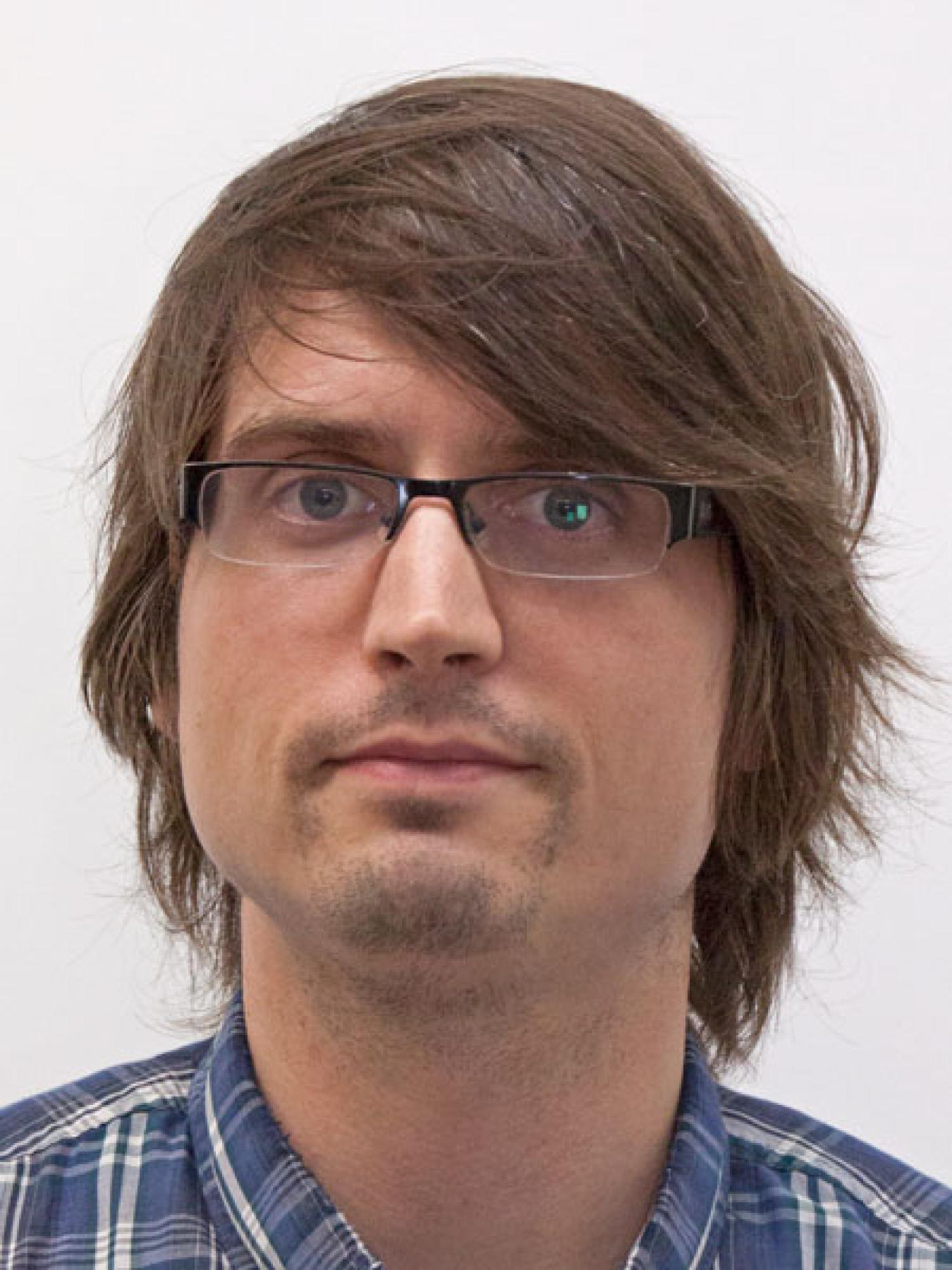
Robin Deeley is an Associate Professor in the Department of Mathematics at the University of Colorado Boulder. His research focuses on dynamical systems (especially Smale spaces), index theory, and noncommutative geometry, with applications to C*-algebras. Funded by the NSF, his work bridges topology, algebra, and dynamics. Recent publications explore synchronizing dynamical systems, classifiable C*-algebras, and geometric models for K-homology. His results contribute to the classification of operator algebras arising from minimal group actions.
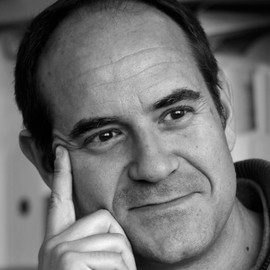
José E. Chacón is a Professor of Statistics at the Department of Mathematics, University of Extremadura, Spain. He is also a member of the Institute of Mathematics at the same university. His research focuses on nonparametric kernel smoothing, cluster analysis, and mathematical statistics. He earned his PhD in Statistics from the University of Extremadura in 2004. Chacón’s work emphasizes methodological advancements in density estimation, clustering algorithms, and statistical theory. His recent publications address topics like geodesic distributions, Bayesian taut splines for mode estimation, and bump detection via density curvature. He has contributed to applied areas such as animal home range estimation and data science for pandemic analysis. His articles often explore cross-validation techniques, bandwidth selection, and mixture model clustering. He co-authored the textbook Multivariate Kernel Smoothing and Its Applications (2018), consolidating his expertise in kernel-based methods. Chacón’s research bridges theoretical statistics with practical applications, influencing both academic and applied domains.
Brendan Mumey is a Professor of Computer Science at Montana State University, affiliated with the Gianforte School of Computing under the College of Engineering. He holds a Ph.D. in Computer Science from the University of Washington (1997), an MS from the University of British Columbia, and a BS in Mathematics from the University of Alberta. His research focuses on applied algorithms, computational biology, and optimization, particularly in pangenomics, flow decomposition, and genomics. Key research areas include DNA/RNA sequence multiassembly, pangenomics, and algorithms for flow decomposition in networks. He is part of the Applied Algorithms Group and develops software through the MSU Algorithms Lab. Notable projects involve NSF-funded initiatives to scale flow decomposition and explore plant genetic diversity using pangenomic tools. Selected awards include multiple Excellence in Research Awards (2007, 2011, 2012, 2013) and an Excellence in Service Award (2011). His teaching spans algorithms, discrete structures, and computational biology at both undergraduate and graduate levels. Grants include NSF support for pangenomic tools, functional genomics, and interdisciplinary mentoring programs. Collaborative work emphasizes bridging theoretical algorithms with practical applications in biology and sustainability.
Sridip Pal is a Sherman Fairchild Postdoctoral Scholar Research Associate in Theoretical Physics, focusing on foundational questions in quantum field theory, conformal field theory, and holography. His research explores the interplay between mathematical structures and physical phenomena, with particular emphasis on entanglement entropy, spectral properties of quantum systems, and the application of modular bootstrap techniques. Key research areas include universality in entropy calculations, spectral bounds in hyperbolic manifolds, symmetry defects in boundary CFTs, and the interplay between holography and Weyl anomalies in string theory. Recent work addresses the fine-grained asymptotics of quantum field theories, automorphic spectra in bootstrap frameworks, and the behavior of wormholes under quantum deformations. Published articles span topics from thermal QFT fractals to nonrelativistic CFTs at large charge, reflecting a broad engagement with high-energy physics and mathematical physics. His studies often utilize advanced analytic methods such as Tauberian theory, Beurling-Selberg extremization, and geometric analysis to derive universal results in quantum systems.
Yury Makarychev is an Associate Professor at the Toyota Technological Institute at Chicago (TTIC) and holds a part-time appointment as an Associate Professor in the Department of Computer Science at the University of Chicago. His research focuses on the theoretical foundations of computer science, particularly in algorithm design, approximation algorithms, and computational geometry. He is a core member of the Theoretical Computer Science Group, bridging connections between computer science and mathematical disciplines like physics and statistics. Yury's academic journey includes teaching courses such as Geometric Methods in Computer Science and Computational and Metric Geometry . His recent work emphasizes fair clustering algorithms, metric embeddings, and certified algorithms beyond worst-case analysis. Notable contributions include approximation algorithms for correlation clustering, k-means, and graph partitioning problems. He has advised PhD students including Naren Manoj, Max Ovsiankin, and Omshi Samal. Yury organizes workshops on topics like algorithms for massive datasets and high-dimensional analysis. His research has been recognized through grants such as the NSF Collaborative Medium Research Project. Professional contributions include editorial roles, program committee memberships, and impactful publications in venues like STOC, FOCS, and ICML.
Prof. SEHER ASLANCI is a Professor of Mathematics Education at ALANYA ALAADDİN KEYKUBAT UNIVERSITY, Faculty of Education. Her academic journey includes roles such as Vice Dean (2022–2023) and Department Head (2017–2018). She holds a Doctorate in Geometry from Atatürk University (2011). Research focuses on differential geometry (tensors, Riemannian structures) and mathematics education (bibliometric analyses of pedagogical methods like inquiry-based learning and realistic mathematics education). Publications span 20+ years, emphasizing geometric structures and educational methodologies. Awards include TUBITAK's UBYT grants (2009, 2011, 2014). Administrative roles include Scientific Research Commission membership (2020–2021) and Mevlana Exchange Program coordination (2016–2017). Education: Integrated PhD (Geometry), Atatürk University, 2011 Mathematics Teaching Programme, Atatürk University, 1999–2004 Awards: Encouragement of International Scientific Publications (TUBITAK UBYT-2014) Encouragement of International Scientific Publications (TUBITAK UBYT-2011) Encouragement of International Scientific Publications (TUBITAK UBYT-2009) Research themes blend pure geometry (tensor bundles, complex structures) with applied educational studies (bibliometric trends in tech-enhanced learning). Recent work explores heat flux control systems and deformations in geometric structures.
Dr. Christopher Green is an Assistant Professor of Applied Mathematics at Wichita State University's Fairmount College of Liberal Arts and Sciences, Department of Mathematics, Statistics & Physics. He holds a PhD from Imperial College London (supervised by Prof. Darren Crowdy) and has held postdoctoral positions at the University of California San Diego and Queensland University of Technology. Previously, he served as a Lecturer in Applied Mathematics and ARC DECRA Fellow at Macquarie University in Sydney, Australia. His research focuses on computational and applied complex analysis, particularly in multiply connected domains. Key interests include the Schottky-Klein prime function, ideal fluid mechanics, and free boundary problems. His work bridges classical function theory with modern computational methods. Recent publications emphasize fluid dynamics applications such as Hele-Shaw bubble dynamics, harmonic measure computations, and airfoil potential flow. His research has been published in high-impact journals across applied mathematics and fluid mechanics. Christopher Green has received the ARC DECRA Fellowship, a prestigious early-career award. His advising and grants include contributions to computational methods in complex analysis and fluid dynamics. He maintains active collaborations internationally, leveraging both theoretical and numerical approaches to geometrically complex problems.
Christina Sormani is a Professor of Mathematics at Lehman College and the CUNY Graduate Center, part of the City University of New York system. She earned her doctorate from the Courant Institute in 1996 and worked as a postdoc at Johns Hopkins and Harvard before joining Lehman College in Spring 2000. She is also a frequent visitor at Stony Brook, working with doctoral students and postdocs conducting mathematics research. Professor Sormani is an American Mathematical Society Fellow (2015) and a Fellow of the Association for Women in Mathematics (2024). Her research is in Geometric Analysis, specializing in Riemannian Geometry, Metric Spaces, and Geometric Measure Theory. She is particularly known for her work on the Intrinsic Flat Distance, which she developed with Stefan Wenger, providing a powerful framework for studying convergence of Riemannian manifolds with applications to General Relativity. Her research program has been consistently funded by the National Science Foundation (NSF DMS) and PSC CUNY. She has held prestigious visiting positions including at the Mathematical Sciences Research Institute (MSRI) in 2013, the Institute for Advanced Study (IAS), and Simons Center for Geometry and Physics (SCGP) during her 2018-2019 fellowship leave. Her work has focused on stability problems for the Positive Mass Theorem, scalar curvature, and convergence theory. American Mathematical Society Fellow (2015) for 'contributions to geometry, including the study of Ricci curvature, and for mentoring activities, especially for young mathematicians from underrepresented groups' Association for Women in Mathematics Fellow (2024) for 'utilizing every opportunity to open pathways to mathematics for more women and students by creating and maintaining online access to advice, mathematical resources, and information about women mathematicians; for organizing the 'Inspiring Talks by Mathematicians' lecture series featuring under-represented speakers, and for dedicated and active contributions to the Association for Women in Mathematics' Professor Sormani has been deeply committed to mentoring and outreach throughout her career, particularly for women and underrepresented groups in mathematics. She organizes the 'Inspiring Talks by Mathematicians' lecture series and has created extensive online resources to support young mathematicians. Her research group includes numerous doctoral students and postdocs, and she has been instrumental in developing workshops and programs that bridge geometric analysis with general relativity.
Fabian Haiden is an Associate Professor in the Department of Mathematics and Computer Science at the University of Southern Denmark, affiliated with the Quantum Mathematics research group. His academic work focuses on advanced topics in algebraic geometry, category theory, and mathematical physics. He holds a prestigious Sapere Aude Research Leader Grant (2023), enabling him to lead a research group exploring categorical structures in geometry. Research interests include derived categories, Calabi-Yau categories, stability conditions, and their applications to Teichmüller theory, spectral networks, and geometric topology. His recent work bridges algebraic structures with dynamical systems, such as pseudo-Anosov autoequivalences and iterated logarithms in gradient flows. Key Projects: Leading the Emergent Geometry of Categories project (2024–2028), funded by the Danish Ministry of Higher Education and Research. Grants & Awards: Sapere Aude Research Leader Grant (DKK 6.192.000). Publications span journals like Advances in Mathematics , Duke Mathematical Journal , and Communications in Mathematical Physics , reflecting his expertise in algebraic structures, geometric categorification, and stability phenomena. His research often intersects with topological and physical systems, such as knot polynomials and quantum topology.
Erol Demirkan is a Lecturer at the Department of Civil Engineering, Faculty of Civil Engineering at Istanbul Technical University. His research focuses on structural mechanics, nonlinear behavior of materials and structures, and vibration analysis of beams and plates. He holds a PhD in Structural Engineering from Istanbul Technical University (2014) and has held academic positions since 2015, including Research Assistant and Lecturer roles. Demirkan's work integrates advanced analytical methods with computational tools like artificial neural networks for structural analysis. Education: PhD in Structural Engineering, Istanbul Technical University (2014) MSc in Structural Engineering, Istanbul Technical University (2012) BSc in Civil Engineering, Istanbul University (2009) BSc in Civil Engineering, Balikesir University (2006) Research interests include non-local elasticity, buckling analysis of nanobeams, and finite element modeling of insulating glass units. His recent work explores hybrid analytical-machine learning approaches for vibration analysis of functionally graded materials. Professional memberships include the TMMOB Chamber of Civil Engineers since 2009. Administrative roles include membership in the Civil Engineering Department Promotion Committee (2021–present) and the Scholarship Committee (2015–2020). Current research emphasizes structural stability, composite beam dynamics, and nonlinear plate interactions. He collaborates on projects involving porous beams and ANN validation for engineering systems.
Max Klimm is an Assistant Professor for Discrete Optimization at Technische Universität Berlin, affiliated with Faculty II – Mathematics and Natural Sciences and the Department of Mathematics. He leads the research group in Discrete Optimization and holds editorial roles at journals like the International Journal of Game Theory and Operations Research Forum . His academic journey includes a PhD in Mathematics from TU Berlin (2012), followed by roles as an Assistant Professor at Humboldt-Universität zu Berlin and Head of the Junior Research Group at the Einstein-Center for Mathematics. His research focuses on mathematical optimization, game theory, and mechanism design applied to multi-agent systems in traffic, telecommunications, and economics. Recent work addresses equilibrium computation in congestion games, stochastic optimization, and algorithmic challenges in network design. Key projects include Combinatorial Network Flow Methods for Gas Markets and the Math+ projects on mechanism design and evolutionary models for networks. Teaching responsibilities include courses on Discrete Optimization, Algorithmic Game Theory, and introductory mathematical courses. His research has been funded by DFG, Einstein Center, and Math+ initiatives. Notable contributions include advancements in parametric flow algorithms, impartial selection mechanisms, and reconstructing historical road networks using cost-benefit models.
Roger Smith is a Professor in the Department of Mathematics at Texas A&M University, affiliated with the College of Arts & Sciences. His research specializes in operator algebras, including von Neumann algebras, C*-algebras, CSL-algebras, and functional analysis. He earned his Ph.D. from Oxford University in 1975 after completing his S.M. at MIT and B.A. at Jesus College, Oxford. Smith's current work focuses on computational methods for partial differential equations and numerical homogenization, with recent publications exploring multiscale techniques for elliptic equations. His articles demonstrate strong engagement with finite element approximations and convergence analysis for complex mathematical systems. While no awards are documented, Smith maintains active collaborations internationally and contributes to seminar organization. His teaching includes courses like Math 172 and 407, with office hours available for student consultation.
Rupert L. Frank is a Visiting Associate Professor in Mathematics at the California Institute of Technology (Caltech), part of the Division of Physics, Mathematics and Astronomy. His research focuses on Analysis, Partial Differential Equations (PDEs), and Mathematical Physics, with an emphasis on developing analytical tools to understand complex natural phenomena. Frank earned his Diplom from Ludwig-Maximilians-Universität Munich (2003) and his Ph.D. from the Royal Institute of Technology (2007). His research interests span functional inequalities, spectral theory, and mathematical physics, particularly in the context of quantum systems and PDEs. Frank has contributed to topics such as the Lieb-Thirring inequalities, fractional Sobolev spaces, and the liquid drop model for nuclear matter. He is an editorial board member for journals including Communications in Contemporary Mathematics , Journal of Mathematical Physics , and Journal of Spectral Theory . Frank’s work often bridges analysis and physics, addressing questions in quantum mechanics, nonlinear PDEs, and geometric analysis. His recent articles explore quantum corrections to polaron models, inequalities in Lp spaces, and energy asymptotics in critical elliptic equations. Collaborations include notable figures like Elliott H. Lieb and Robert Seiringer.
Paolo Bonicatto is an Assistant Professor in the Department of Mathematics at the University of Trento . His teaching responsibilities include courses such as Analisi matematica 2 for Industrial Engineering students, focusing on differential and integral calculus for functions of several variables and applications to physics. He also contributes to advanced programs in Mathematics at the Master's level, including Geometric Measure Theory and Optimal Transport , emphasizing problem-solving and mathematical modeling skills. His research interests span Geometric Measure Theory , Optimal Transport , and Partial Differential Equations (PDEs) , with a focus on topics like current transport, regularity theory for transport equations, and applications to material science. Recent work involves the analysis of advection-diffusion equations, homogenization of elasto-plastic evolutions, and the structure of divergence-free measures in low dimensions. His publications highlight contributions to the well-posedness of transport equations, renormalization techniques for vector fields, and the study of BMO-type norms and Poincaré inequalities. Notably, his work addresses foundational questions in calculus of variations and functional analysis, such as representations of total variation and decomposition results for vector fields. While no scientific awards or grants are explicitly listed, his academic output reflects active engagement with cutting-edge problems in mathematical analysis. He collaborates on interdisciplinary projects, bridging pure mathematics and applications in physics and engineering. No lab affiliations or student advisements are documented in the provided materials.
Annalisa Marzuoli is a Full Professor at the Department of Mathematics, University of Pavia, specializing in Mathematical Physics. Her research focuses on geometric methods in quantum field theory, discrete models in gravity, quantum computing, and data science. She is affiliated with the Mathematical Physics group and has contributed to advancements in spin networks, quantum triangulations, and topological quantum computing. Her work bridges quantum mechanics and geometry, exploring topics like Ricci flow, non-linear sigma models, and topological invariants. Recent publications emphasize knotted optical fields, Ponzano-Regge models, and quantum angular momentum configurations. Her research also addresses geometric structures in quantum gravity and computational approaches to topological phases. Marzuoli's articles reveal a focus on interdisciplinary applications of geometric and combinatorial techniques to quantum systems. Key themes include spin network dynamics, topological quantum computing architectures, and geometric flows in theoretical physics. Her contributions to mathematical physics underscore the interplay between discrete models and continuous geometric frameworks. She has no listed scientific awards but maintains an active research profile with collaborations in quantum geometry and computational physics. No advising or grant details are provided in the text. Her group explores quantum geometry through projects like spin network quantum circuits and discrete gravity models, reflecting a commitment to advancing foundational theories in mathematical physics.