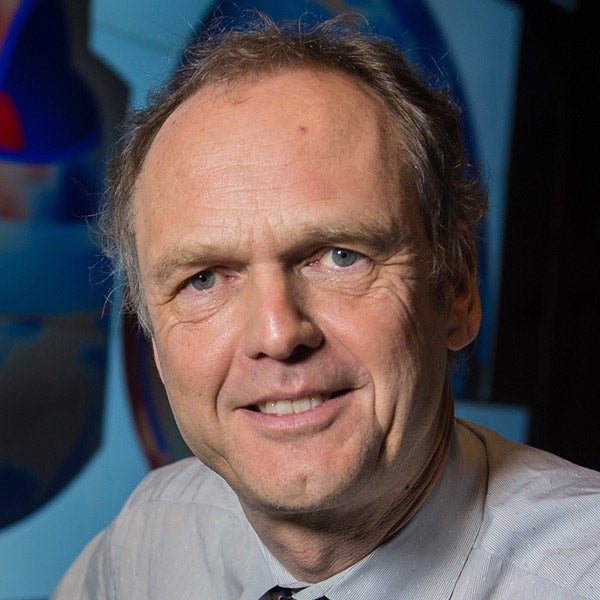
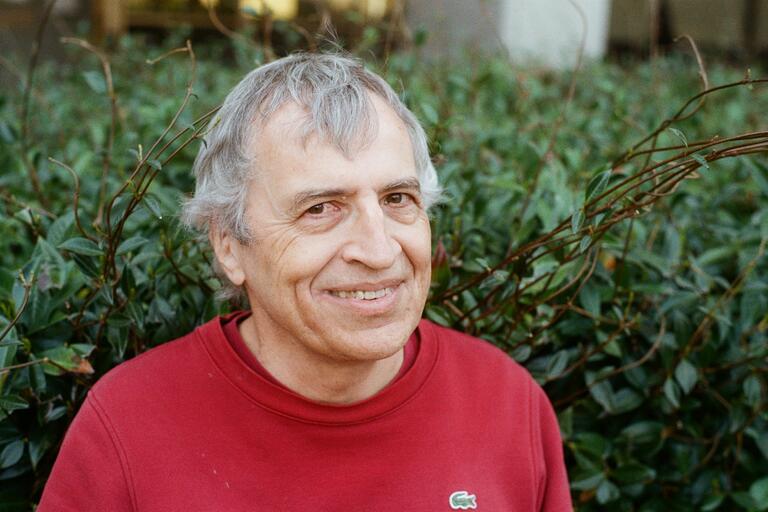
Maarten de Hoop is the Simons Chair and Professor of Computational and Applied Mathematics at Rice University, part of the George R. Brown School of Engineering. He holds visiting roles at MIT and the Chinese Academy of Sciences. His research spans seismic wave analysis, inverse problems, deep learning, and planetary seismology. He earned his Ph.D. in Technical Sciences from Delft University of Technology (1992), and earlier degrees from Utrecht University. Notable awards include the 1996 J. Clarence Karcher Award and 2001 Fellowship from the Institute of Physics. His work integrates computational mathematics with geophysics, focusing on extracting signal information from large datasets, developing novel inverse scattering methods, and applying deep learning to geoscience challenges. Recent studies include transformer models for in-context learning, semialgebraic neural networks, and seismic waveform foundation models like SeisLM. He leads the Geo-Mathematical Imaging Group, fostering interdisciplinary projects in planetary missions and data-driven discovery.
Prof. Igors Gorbovickis is an Associate Professor of Mathematics at the Department of Mathematics, School of Computer Science and Engineering, Constructor University (formerly Jacobs University Bremen). His research focuses on complex dynamical systems, including topics such as renormalization theory, bifurcation analysis, Julia sets, and applications to mathematical physics. He also contributes to discrete geometry, particularly exploring conjectures like the Kneser-Poulsen problem. His work bridges pure mathematics with interdisciplinary applications, emphasizing rigorous analysis of nonlinear systems and geometric configurations. Key areas of investigation include critical point accumulations, Hausdorff dimension estimates, and equidistribution phenomena in parameter spaces. Recent publications highlight advancements in understanding chaotic systems, circle maps, and the interplay between algebraic structures and dynamical behavior. Prof. Gorbovickis collaborates internationally, with co-authored papers appearing in journals like Advances in Mathematics , Ergodic Theory and Dynamical Systems , and Nonlinearity . His office is located at Research I, Room 128 on the Constructor University campus in Bremen, Germany.
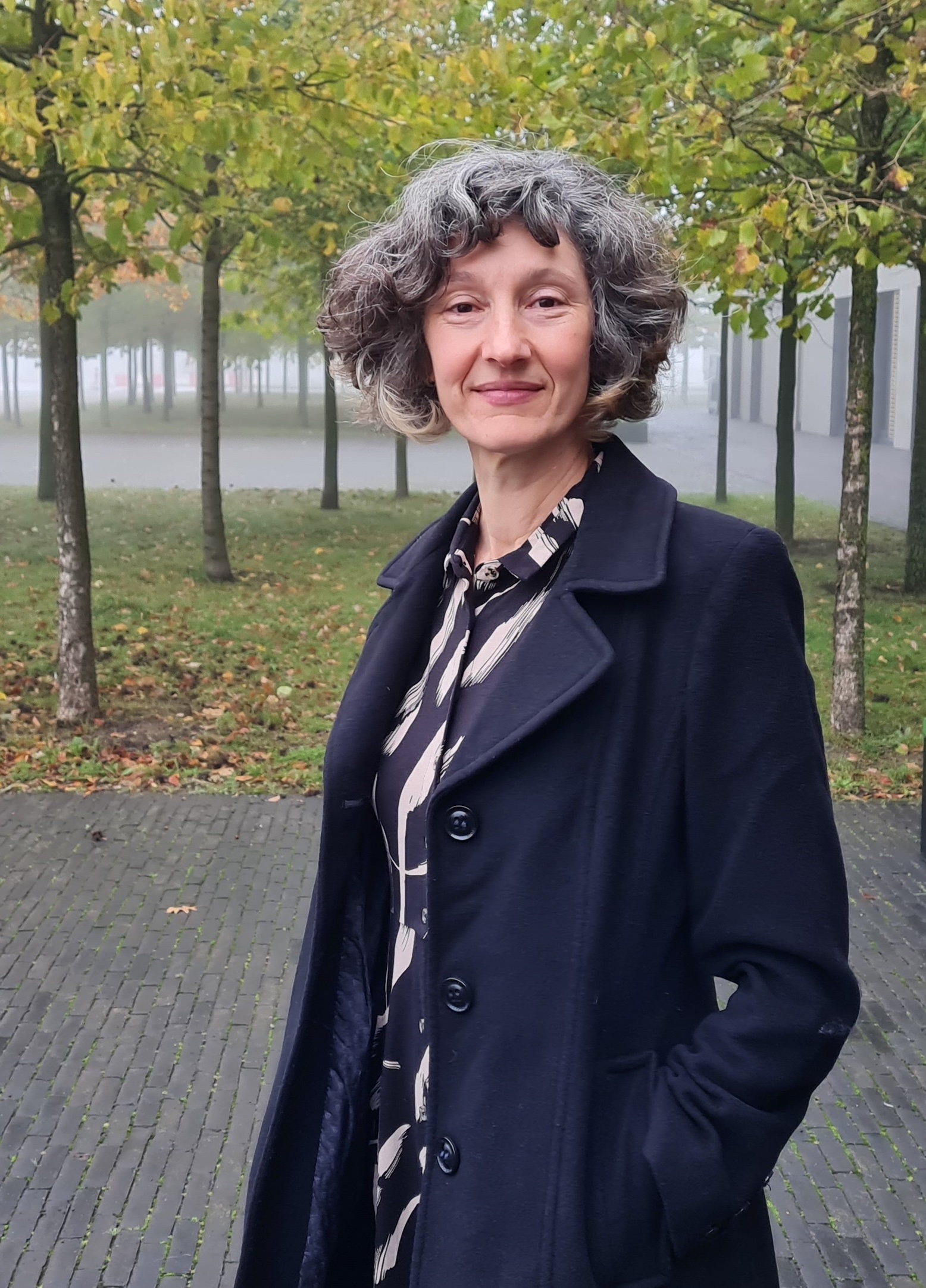
Karin Melnick is a Full Professor in Mathematics at the University of Luxembourg, Faculty of Science, Technology and Medicine, Department of Mathematics. She heads the research group Group Actions, Geometric Structures, and Smooth Dynamics . Previously, she held positions at the University of Maryland (2009–2023), where she advanced from Assistant Professor to Professor and Associate Chair for Faculty Affairs, and at Yale University (2006–2009). Education: PhD and Master's degrees from the University of Chicago Research Interests: Her work spans differential-geometric rigidity, Lorentzian geometry, conformal pseudo-Riemannian structures, parabolic Cartan geometries, and smooth dynamical systems. She investigates symmetries of geometric structures, classification of manifolds with prescribed curvature properties, and dynamics of group actions on differentiable manifolds. Publications: Melnick's 15 most recent articles (2011–2025) predominantly explore rigidity phenomena in geometric structures, conformal/Lorentzian geometry, and dynamical systems. Key themes include automorphism groups of parabolic geometries, embedding theorems for tractor bundles, non-existence results for quasihomogeneous metrics, and applications of Frobenius-type theorems to Cartan geometries. Academic Leadership: She organizes major conferences including the upcoming BeNeLux Mathematical Congress (2026) and Lorentzian, Affine, and Hyperbolic Geometry: In Memory of Todd Drumm (2025). She frequently delivers invited talks at institutions like IHES Paris, Isaac Newton Institute, and Universität Hamburg. Teaching: Currently instructs Géométrie des courbes et des surfaces (Summer 2025).
Prof. Dr. Urs Hartl is a faculty member in the Department of Mathematics and Computer Science at the University of Münster, affiliated with the Faculty of Mathematics and Computer Science. He is an Investigator in Mathematics Münster and a member of the Collaborative Research Centre (CRC) 1442 'Geometry: Deformations and Rigidity.' His research focuses on arithmetic geometry, representation theory, algebraic number theory, and arithmetic of function fields. He holds a prominent position in the field, contributing to areas such as Shimura varieties, p-adic Hodge theory, and the Langlands program. Affiliations: Member of CRC 1442 Geometry Investigator in Mathematics Münster Research Interests: Arithmetic algebraic geometry Algebraic number theory Arithmetic of function fields Structure theory of Shimura varieties p-adic Hodge theory p-adic Langlands programme Model theory Recent Publications: Hartl's recent work includes studies on moduli stacks of global G-shtukas, periods of Drinfeld modules, and p-adic Galois representations. His research emphasizes foundational contributions to arithmetic geometry and number theory, often involving collaborations with leading mathematicians such as Rajneesh Kumar Singh and Eva Viehmann. Grants & Advising: Hartl’s involvement in CRC 1442 reflects his leadership in geometric research. While specific advising details are not provided, his extensive publications suggest active mentorship in advanced mathematical research. Labs/Teams: Collaborates within the Mathematics Münster research group and the CRC 1442 team, focusing on geometric and arithmetic structures.
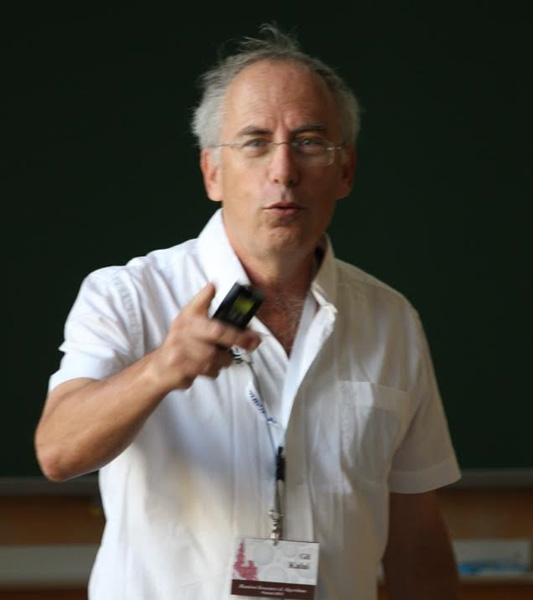
Gil Kalai is a Professor of Mathematics at the Hebrew University of Jerusalem since 1992, where he holds the Henry and Manya Noskwith Chair. He also serves as an Adjunct Professor of Mathematics and Computer Science at Yale University since 2004 in a long-term part-time visiting position. His academic career includes visiting positions at prestigious institutions including MIT, Cornell, IAS Princeton, Berkeley, Bell-labs, IBM, and Microsoft. Professor Kalai's research spans multiple areas within mathematics and theoretical computer science. His work in combinatorics encompasses geometric, probabilistic, and topological approaches. He has made significant contributions to the study of convex sets and polytopes, linear programming, and theoretical computer science. His influential 1988 paper with Kahn and Linial on Boolean functions pioneered applications of Fourier analysis in theoretical computer science. Kalai's research has evolved to include the application of Fourier analysis to thresholds, influences, symmetries, noise, percolation, and social choice. He has developed theories in algebraic shifting and studied face-numbers and other combinatorial invariants of polytopes. His work on the diameter of polytopes and randomized simplex algorithms has been influential in optimization theory. In 1993, his collaboration with Kahn produced a groundbreaking counterexample to Borsuk's Conjecture in 1325 dimensions. Professor Kalai's publications reveal a consistent focus on the intersection of combinatorics, geometry, and theoretical computer science. His work shows a progression from foundational combinatorial geometry to increasingly sophisticated applications of harmonic analysis in discrete mathematics. The recurring themes across his 30+ year career include Boolean functions, polytope theory, and probabilistic methods in combinatorics, demonstrating remarkable coherence in his research trajectory. 2016 European congress of Mathematics, plenary speaker 2013 ERC advanced grant 2012 Rothschild Prize 1994 International Congress of Mathematicians invited section talk, Zurich 1994 Fulkerson Prize 1993 Erdos Prize 1992 Polya Prize Though specific details of his advising are not provided in the source material, Kalai has written over 70 scientific papers and maintains an active research blog entitled "Combinatorics and More." His 2013 ERC advanced grant indicates significant research funding for his work. His extensive collaborations with researchers across multiple institutions suggest a robust research program with numerous PhD students and postdoctoral researchers, though specific names are not mentioned in the provided texts. Professor Kalai maintains active research connections across multiple institutions including Hebrew University, Yale, and various research centers worldwide. His work bridges pure mathematics and theoretical computer science, creating a unique interdisciplinary research environment that influences both fields.
Haruzo HIDA is a Distinguished Research Professor of Mathematics at the University of California, Los Angeles (UCLA). His work spans advanced topics in Number Theory, Modular Forms, Galois Representations, and Arithmetic Geometry. HIDA has held significant positions globally, including lectures and research visits at institutions in India, China, Japan, and Europe. University: University of California, Los Angeles Department: Mathematics Academic Rank: Research Professor Research Interests: HIDA’s research focuses on complex and p-adic Number Theory, Modular Forms, and their connections to Galois Representations, Iwasawa Theory, L-functions, and Automorphic Forms. His recent work addresses adjoint L-values, Selmer groups, and the interplay between arithmetic invariants and geometric structures. Publications: HIDA’s recent articles (2014-2025) explore themes like Hecke algebras, anticyclotomic Iwasawa theory, Tate-Shafarevich groups, and p-adic rigidity. His work often bridges modular forms with arithmetic geometry and automorphic representations. Students: He has supervised numerous PhD students, including Koji Kitagawa, Chandrashekhar Khare, Eknath Ghate, Ashay Burungale, and Jaclyn Lang, contributing to their research in topics like modular forms and arithmetic geometry. Grants: His research has been partially supported by NSF grants, documented across multiple publications and lecture notes.
Dr. Sugata Mondal is a Lecturer in Pure Mathematics at the University of Reading's Department of Mathematics and Statistics, part of the School of Mathematical, Physical and Computational Sciences. He serves as the School Director of Postgraduate Research Studies. His research focuses on spectral geometry, analysis of partial differential equations (PDEs), geometric analysis, and hyperbolic geometry. He obtained his PhD from Université Paul Sabatier in Toulouse, followed by postdoctoral positions at the Max-Planck Institute in Bonn and Indiana University. Previously, he held a Reader position at TIFR, Mumbai until 2022. His academic qualifications include a BSc (Honors) in Mathematics from Ramakrishna Mission Vidyamandira (University of Calcutta) and an M.Math from ISI, Kolkata. His research explores geometric properties of Laplace eigenfunctions on domains and manifolds, with recent work addressing spectral instability, Schiffer's conjecture, and critical points on polygons. His publications span topics in spectral geometry, hyperbolic surfaces, and eigenvalue analysis. Dr. Mondal’s work bridges pure mathematics with geometric analysis, emphasizing the interplay between spectral theory and geometric structures. He teaches Real Analysis I (MA1RA1) and contributes to the Pure Mathematics and Analysis research groups at Reading.
Henri Darmon is a Distinguished James McGill Professor in the Department of Mathematics and Statistics at McGill University, affiliated with the Centre Interuniversitaire en Calcul Mathématique Algébrique (CICMA) and the Centre de Recherches Mathématiques (CRM). He holds citizenships of Canada, France, and Switzerland. His research focuses on algebraic number theory, particularly elliptic curves, modular forms, and L-functions, with contributions to the Birch and Swinnerton-Dyer conjecture and Stark conjectures. Education: B.Sc. Mathematics & Computer Science, McGill University (1987) Ph.D. Mathematics, Harvard University (1991) Key Positions: Director of CICMA (1998–2024) Editorial roles at journals like Commentarii Mathematici Helvetici and Transactions of the AMS Organizer of major conferences including CNTA, ICM satellite events, and thematic programs at MSRI and CRM Research Interests: Stark-Heegner points and Euler systems p-adic L-functions and Iwasawa theory Arithmetic of modular curves and Shimura varieties His work bridges analytic and algebraic approaches to number theory, emphasizing computational and geometric methods.
Richard Hind is a Professor in the Department of Mathematics at the University of Notre Dame, part of the College of Science. He holds a B.A. from Cambridge University (1992) and a Ph.D. from Stanford University (1997). His research focuses on differential geometry, particularly complex and symplectic geometry, with an emphasis on the interplay between Riemannian metrics and canonical geometric structures. His work explores symplectic embeddings, Lagrangian submanifolds, and geometric rigidity, utilizing pseudoholomorphic curves as a key tool. Key research areas include symplectic packing problems, Stein manifolds, and the topology of symplectic manifolds. Recent work addresses symplectic barriers, packing stability, and geometric invariants of ellipsoids. His publications span journals like Geom. Funct. Anal., Duke Math. J., and Invent. Math., often collaborating with leading researchers in the field. Teaching includes MATH 10270: Mathematics in Architecture, linking geometric principles to historic structures. Professional roles include service on editorial boards and contributions to conferences. Office: 238 Hayes-Healy Bldg, Email: rhind@nd.edu and hind.1@nd.edu.
Urs Lang is a Full Professor at the Department of Mathematics, ETH Zurich, where he has held a professorship since 2001. His academic journey began with mathematics studies at the University of Berne and the University of Freiburg i.Br., culminating in a doctoral degree focused on hyperbolic geometry and minimal surfaces. Education: University of Berne (undergraduate) University of Freiburg i.Br. (doctoral degree) Lang's research lies at the intersection of differential geometry , metric geometry , and geometric group theory . His work explores non-positive curvature spaces, geometric measure theory, and large-scale Lipschitz analysis. Recent publications examine combinatorial hyperbolicity, isoperimetric inequalities, and rank-rigidity phenomena. The publications overview reveals a consistent focus on geometric structures, including: Higher-rank hyperbolicity in singular spaces Convex geodesic bicombings Injective hulls in geometric group theory Nonlinear potential theory on hyperbolic metric spaces Lipschitz extension problems Curvature comparison theorems Lang actively contributes to academic discourse through editorial roles at journals like Geometry and Topology and Analysis and Geometry in Metric Spaces , as well as organizing major conferences including the 2025 Metric Analysis Trimester Program at Bonn's Hausdorff Institute.
Markus Land is a Tenure Track Professor at the Department for Mathematics, Ludwig Maximilian University of Munich, affiliated with the Algebraic Geometry Working Group. His research bridges algebraic topology, homotopy theory, and K-theory, focusing on their interplay with L-theory and manifold topology. He has held postdoctoral positions at the University of Copenhagen (supported by an EU Marie Curie Fellowship and DFG Grant) and the University of Regensburg, and earned his PhD at the University of Bonn under Wolfgang Lück. Education : PhD in Mathematics (University of Bonn, 2016) Positions : Postdoctoral (University of Copenhagen, 2019–2022; University of Regensburg, 2016–2019) Research Interests : Markus Land explores algebraic topology and homotopy theory , particularly algebraic K-theory , hermitian K-theory , and their connections to L-theory and manifold topology . His work often applies infinity-categories to foundational problems in operator K-theory and geometric topology. Recent Publications : His research includes groundbreaking studies on chromatic localization in K-theory, Grothendieck-Witt groups in ring theory, and additivity in cobordism categories . Collaborations with leading mathematicians like Georg Tamme and Ulrich Bunke highlight interdisciplinary approaches to algebraic and geometric problems. Awards & Grants : EU Marie Curie Individual Fellowship (2020–2022) DFG Individual Research Grant (2019–2020) Teaching & Academic Leadership : He has designed advanced courses including Topology I–V , Algebraic K-Theory , and Condensed Mathematics , emphasizing homotopy theory and infinity-categories . Future initiatives include student seminars on arithmetic and algebraic geometry to foster academic collaboration. Working Group : As part of the Algebraic Geometry Working Group at LMU Munich, he contributes to seminars and research projects on arithmetic geometry , manifold classification , and spectral algebra .
John Lott is a Professor in the Department of Mathematics at the University of California, Berkeley, specializing in Differential Geometry , Geometric Analysis , and Optimal Transport since his appointment in 2008. His research explores the interplay between Ricci curvature , metric-measure spaces , and geometric flows , with notable contributions to Ricci flow and noncommutative geometry . He has supervised multiple PhD students including Thunwa Theerakarn and Patrick Wilson , and maintains an active publication record with over 40 research papers. Selected Research Areas : Differential Geometry, Geometric Analysis, Optimal Transport, Mathematical Physics, Noncommutative Geometry Recent Publications (2020-2025) focus on Kähler manifolds , collapsing geometry , and quasilocal mass in general relativity. His work on Ricci curvature via optimal transport with Cédric Villani has become foundational in the field. Academic Affiliation : Position: Professor Institution: University of California, Berkeley Department: Mathematics
Manfred Einsiedler is a Professor in the Department of Mathematics at ETH Zurich, Switzerland, with office HG G 64.2 at Rämistrasse 101, 8092 Zurich. He teaches undergraduate and graduate courses including Linear Algebra (HS 2019), Analysis I/II, and Functional Analysis I/II, using his co-authored textbook Functional Analysis, Spectral Theory, and Applications . His research centers on dynamical and equidistribution problems in homogeneous spaces, with focus on closed horocycle orbits, geodesic orbits on the modular surface, and measure rigidity. Key contributions include work on effective equidistribution, entropy methods, and connections between ergodic theory and number theory. He has co-authored foundational texts: Ergodic Theory with a view towards Number Theory and Functional Analysis, Spectral Theory, and Applications in Springer's Graduate Texts in Mathematics series, alongside multiple in-progress volumes on entropy, homogeneous dynamics, and unitary representations. Recent publications explore integer points on spheres, rigidity of invariant measures, and Diophantine approximation on fractals, emphasizing collaborations with Lindenstrauss, Ward, Margulis, and Venkatesh. His work demonstrates consistent focus on homogeneous dynamics with applications to arithmetic problems, particularly through effective methods and measure classification theorems. While no specific awards or student lists are documented in the source, his extensive publication record and textbook authorship establish significant scholarly impact.
Dima Arinkin is a Professor in the Department of Mathematics at the University of Wisconsin–Madison, specializing in algebraic geometry with significant contributions to geometric representation theory and mathematical physics. His research focuses on: Geometric Langlands Program: Developing frameworks connecting automorphic forms and Galois representations through geometric methods Moduli Spaces: Analyzing spaces of algebraic connections, Higgs bundles, and their compactifications D-modules: Studying systems of linear differential equations via algebraic geometry Integrable Systems: Investigating geometric structures in soliton theory and Painlevé equations Irregular Singularities: Exploring connections with irregular behavior on algebraic curves Analysis of his publications (2008-2016) reveals consistent advancement in geometric Langlands through derived algebraic geometry techniques, particularly in relating singular support of sheaves to automorphic forms and establishing oper structures for connections. No scientific awards are documented in the provided materials. No information regarding student advisement or research grants appears in the source texts.
Tara Brendle is Professor of Mathematics at the University of Glasgow within the School of Mathematics and Statistics, specializing in the interplay between algebra and topology. Her research centers on mapping class groups of surfaces and their profound connections to braid groups, Coxeter groups, arithmetic groups, and automorphism groups of free groups. Her primary research explores how these algebraic structures determine the topology of 3- and 4-manifolds through constructions like Heegaard splittings and Lefschetz fibrations. She investigates cohomological properties, subgroup structures, and representation-theoretic aspects of mapping class groups, with significant contributions to understanding the Johnson kernel and hyperelliptic Torelli groups. Over the past two decades, Brendle's publications reveal a consistent focus on geometric and algebraic properties of surface automorphism groups, evolving from foundational work on generators and relations to cutting-edge research on high-dimensional cohomology of moduli spaces and stability phenomena. Her collaborations with leading mathematicians like Dan Margalit and Andrew Putman have produced influential results across geometric group theory. She actively supervises doctoral research on mapping class groups, braid groups, and low-dimensional topology, guiding students including Bader, Philipp; Corrigan, Gabriel; Giannini, Riccardo; and Pietrzak, Alicja on advanced topics at the intersection of algebra and geometry.