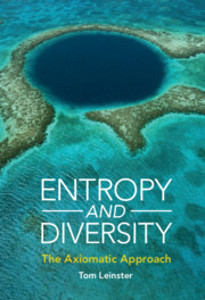
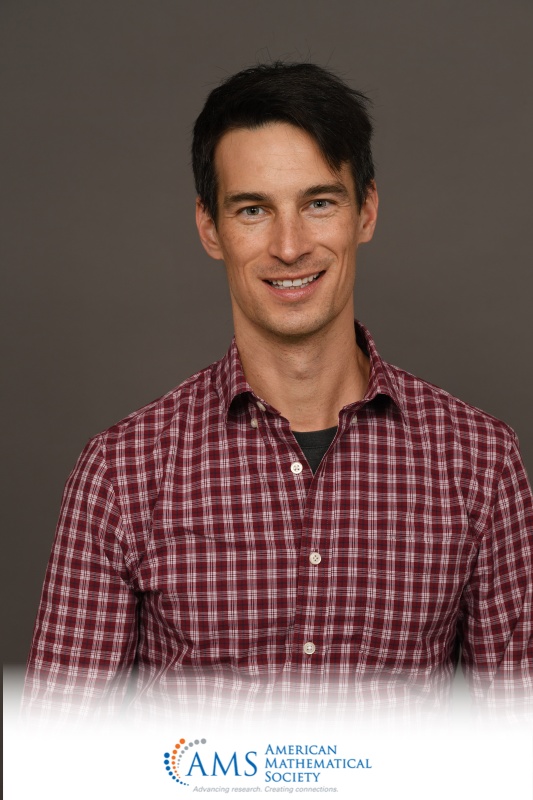
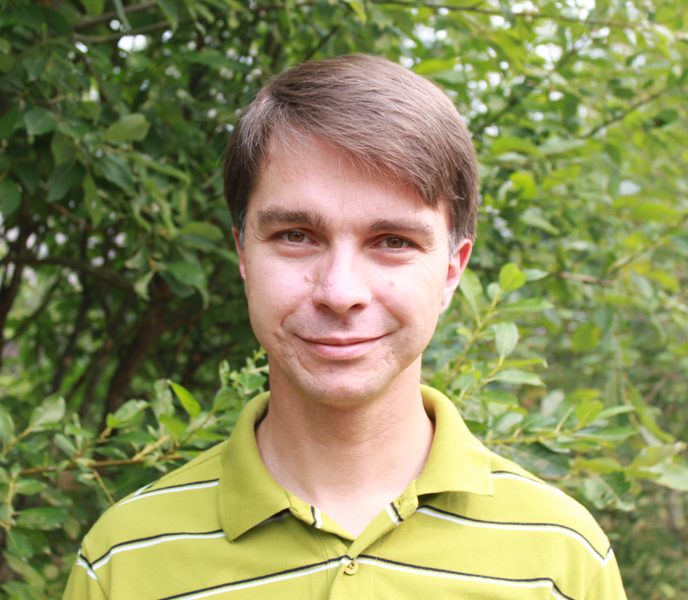
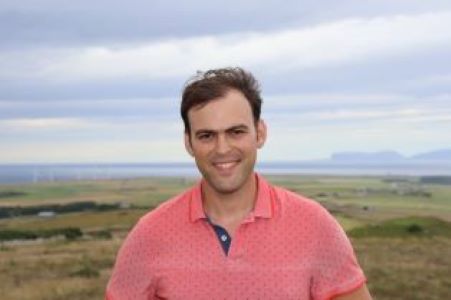
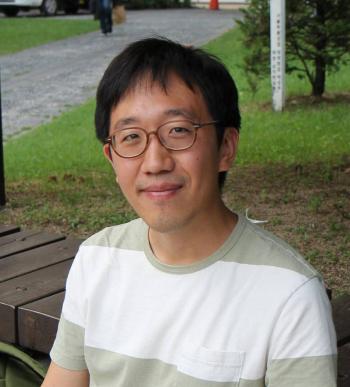
Tom Leinster is a mathematician at the University of Edinburgh, specializing in category theory, metric geometry, and their applications to areas such as algebra, topology, and mathematical biology. His research focuses on the concept of magnitude, a measure for metric spaces and enriched categories, as well as entropy and diversity. He has authored influential books including *Basic Category Theory* and *Entropy and Diversity: The Axiomatic Approach*. Leinster's work bridges foundational mathematics with interdisciplinary applications, emphasizing the interplay between abstract structures and concrete problems. His research interests span category theory, metric geometry, algebraic topology, and mathematical biology. Key contributions include foundational work on magnitude and its connections to geometric measure theory, entropy characterization, and categorical frameworks for diversity measurement. Leinster also engages in mathematical education and ethics, advocating for responsible research practices. Notable publications include recent advancements in magnitude homology of Euclidean sets, extremal magnitude in metric spaces, and entropy modulo primes. His work often highlights interdisciplinary applications, such as biodiversity quantification and information-theoretic foundations.
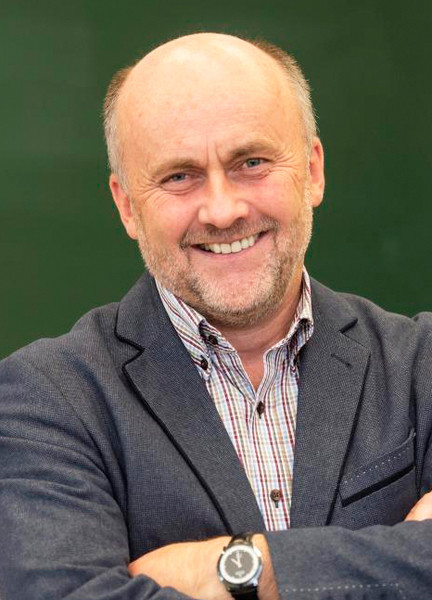
Karl-Theodor Sturm is a Professor of Mathematics at the University of Bonn, holding this position since 1997. He is affiliated with the Institute for Applied Mathematics and leads the Cluster of Excellence Hausdorff Center for Mathematics. His academic journey includes a PhD (1989) and habilitation (1993) from the University of Erlangen-Nürnberg, followed by postdoctoral positions at Zurich, Erlangen-Nürnberg, and the Max Planck Institute for Mathematics in the Sciences (MPI Leipzig). He has held visiting professorships at Stanford, Toulouse, Paris, and Bonn. Sturm's research focuses on stochastic analysis and geometric analysis, particularly in optimal transport, metric measure spaces, synthetic curvature bounds, and diffusion processes. His work on synthetic Ricci curvature bounds, developed in competition with Cédric Villani, has been highly influential. He received the ERC Advanced Grant (2016-2022) for research on metric measure spaces and Ricci curvature, and was a Plenary Speaker at the 2020 European Congress of Mathematics. His leadership roles include Vice Chairman of Collaborative Research Center SFB 611 (2002–2012), Managing Director of the Institute for Applied Mathematics (2007–2010), and Coordinator of the Hausdorff Center for Mathematics (2012–2019). Awards include the Heisenberg Fellowship (1994) and recognition through numerous invited lectures and editorial roles. His mentorship has shaped the careers of prominent researchers such as Nicola Gigli and Jan Maas.
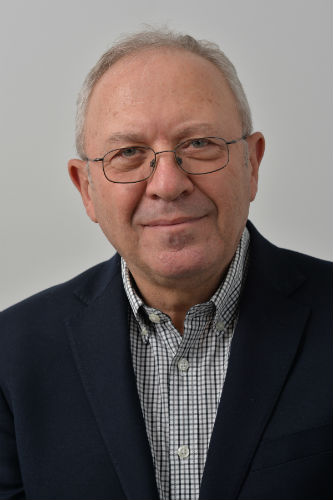
Günter Rote is a Professor in the Department of Computer Science at Freie Universität Berlin, specifically within the Theoretical Computer Science group (Arbeitsgruppe Theoretische Informatik). He holds a formal academic title of Professor Dr. and is affiliated with the Faculty of Mathematics and Computer Science. His research focuses on theoretical computer science, computational geometry, algorithms, and discrete mathematics. Key research interests include geometric algorithms, optimization problems (e.g., shortest paths, traveling salesman problems), and algorithm design for parallel computing systems. His work spans topics such as systolic arrays, convex hulls, and combinatorial optimization. Rote’s contributions include foundational studies on computational geometry problems, algorithmic complexity, and practical applications in energy equity and infrastructure design. Publications highlight contributions to solving extremal equations, polygon transformations, and the quadratic assignment problem. He has been active in academic leadership, mentoring students, and contributing to computational science communities. His email is rote@inf.fu-berlin.de, and his office is located at Takustraße 9 in Berlin.
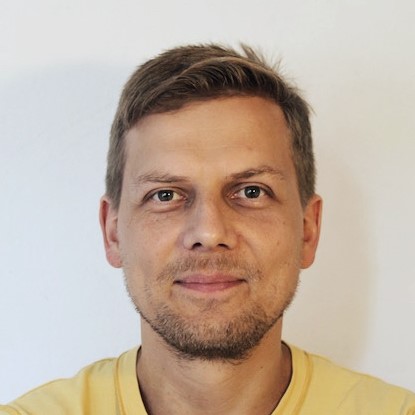
Piotr Zwiernik is an Associate Professor in the Department of Statistical Sciences at the University of Toronto's Faculty of Arts and Science, with a cross-appointment in the Department of Mathematics. Currently on leave from the University of Toronto, he is based in Barcelona following his return in July 2025. His academic journey includes a PhD in Statistics from the University of Warwick (2011), research positions at prestigious institutions including Mittag Leffler Institute, IPAM, TU Eindhoven, UC Berkeley, and the University of Genoa, and an Assistant Professorship at Universitat Pompeu Fabra in Barcelona (2016-2021). His research spans the intersection of statistics, mathematics, and computational methods, with particular emphasis on graphical models, covariance matrix estimation, convex analysis, tensors, and algebraic and combinatorial methods in statistics. Zwiernik's work demonstrates a consistent focus on high-dimensional statistics, mathematical statistics, and elegant theoretical frameworks that bridge abstract mathematics with practical statistical applications. His recent publications reveal a deepening exploration of tensor analysis, algebraic statistics, and the geometric properties of statistical models. Zwiernik serves as an associate editor for leading journals including Biometrika, Scandinavian Journal of Statistics, and Algebraic Statistics. His research program includes the development of the GOLAZO R package for asymmetric regularization of log-likelihood in Gaussian graphical models. As an academic leader, he has served as Associate Chair for Research in his department and actively participates in numerous international conferences and workshops, reflecting his significant standing in the statistical community. His recent publications show a strong trend toward algebraic and geometric approaches to statistical problems, with increasing focus on tensor methods, positivity constraints in statistical models, and the theoretical foundations of graphical models. The work demonstrates remarkable continuity in exploring the mathematical structures underlying statistical models while adapting to emerging challenges in high-dimensional data analysis. Zwiernik is committed to mathematical accessibility and education, guided by Federico Ardila's four axioms which emphasize equitable distribution of mathematical potential, joyful mathematical experiences, mathematics as a malleable tool, and treating every student with dignity and respect. He actively seeks PhD students with strong mathematical backgrounds for research at UPF or the Institute of Mathematics of UPC.
Michael Farber is a Professor of Mathematics at Queen Mary University of London's School of Mathematical Sciences. Previously, he held professorships at the Universities of Warwick, Durham, and Tel Aviv. His research focuses on applied and computational topology, topological robotics, stochastic topology, and their applications in distributed computing, genomics, and brain connectivity modeling. He has authored influential monographs such as Invitation to Topological Robotics and Topology of Closed One-Forms . Farber's current research includes projects funded by the Leverhulme Trust and EPSRC, addressing probabilistic and deterministic topology, automated motion planning, and topological robotics. He advises PhD students including Lewin Strauss, Gabriele Beltramo, and Lewis Mead. His work has been recognized with the Royal Society Wolfson Research Merit Award. Key research interests include parametrized topological complexity, sequential motion planning algorithms, and the intersection of topology with AI and robotics. His collaborations span interdisciplinary fields, such as using topological methods in cancer research and genomic analysis. Grants and funding include the Leverhulme Trust's 'Probabilistic and Deterministic Topology' and EPSRC's 'Topology of Automated Motion Planning.' Farber is affiliated with Queen Mary's Centre for Geometry, Analysis, and Gravitation, contributing to advancing topological methodologies in algorithmic and stochastic systems.
Nathan Kaplan is a Professor in the Department of Mathematics at the University of California, Irvine, where he conducts research in number theory, algebraic geometry, and combinatorics. His work spans rational points on varieties over finite fields, arithmetic statistics, coding theory, and the study of numerical semigroups. He is actively involved in the mathematical community, organizing seminars and conferences including the UC Irvine Number Theory Seminar and the Southern California Number Theory Day. Dr. Kaplan received his PhD from Harvard University in 2013 under the direction of Noam Elkies. Following his doctorate, he was a postdoctoral researcher at Yale University from 2013-2015 before joining the faculty at UC Irvine. His research interests focus on the intersection of number theory and algebraic geometry, with particular attention to problems involving rational points on varieties over finite fields, arithmetic statistics, and coding theory. He has made significant contributions to the study of numerical semigroups, cokernels of random p-adic and integer matrices, and quadratic forms and lattices. His work often bridges theoretical mathematics with applications in coding theory and cryptography. Analysis of his recent publications shows a strong trend toward combinatorial aspects of number theory, particularly in the study of numerical semigroups and their properties. He frequently collaborates with researchers across institutions, with recent work spanning algebraic geometry, combinatorics, and coding theory. His publications demonstrate expertise in both theoretical developments and computational aspects of number theory. Dr. Kaplan is deeply committed to undergraduate research and mentoring. He has experience as a mentor for undergraduate research projects through programs including SUMRY (a research program for Yale undergraduates), the University of Minnesota-Duluth REU program, and the Trinity University REU program. He actively encourages undergraduates to apply for summer research opportunities and has organized numerous outreach activities. He is an organizer of the UC Irvine Number Theory Seminar and the Southern California Number Theory Day conference series. In 2018, he co-organized the Conference on Open Questions in Cryptography and Number Theory in honor of Alice Silverberg's 60th Birthday. Dr. Kaplan has given numerous talks at mathematical venues including the Museum of Mathematics' Math Encounters series, where he presented "Error-Correcting Codes: The Mathematics of Communication" in July 2022. He has also spoken at the Yale Undergraduate Math Society, the UCI Math Circle, and various other outreach events.
Stanislav Smirnov is a Professor at the University of Geneva and holds a part-time position at the Chebyshev Laboratory of St. Petersburg State University. A leading figure in mathematical physics, he works on probability, complex analysis, and dynamical systems, with significant contributions to conformal invariance in statistical mechanics models.
Krzysztof Burdzy is a Professor of Mathematics and Adjunct Professor of Statistics at the University of Washington, where he is affiliated with the Department of Mathematics in the College of Arts and Sciences. He maintains an active research and teaching profile, currently offering undergraduate courses in probability. His research interests span Probability Theory , Stochastic Processes , Neumann Eigenfunctions , Hot Spots Problem , and the Philosophy of Probability . He is particularly known for his work on Brownian motion, eigenfunction behavior, and spectral theory in geometric domains. His recent work includes contributions to the resolution of the hot spots conjecture for Euclidean triangles and the discovery of interior hot spots in convex sets. The most recent articles reflect a deep engagement with both theoretical mathematics and foundational philosophy. Topics include spectral geometry, probabilistic methods in PDEs, critiques of philosophical theories of probability, and interdisciplinary reflections on epistemology. The publication trend shows sustained contributions from the 1990s through 2024, with a dual focus on rigorous mathematical proofs and meta-scientific analysis. Euclidean triangles have no hot spots (Annals of Mathematics, 2020) Convex sets can have interior hot spots (preprint, 2024) Hypocrisy++: On Philosophy of Probability and Sociology of Ideologies (2023) Burdzy has advised students in mathematics and probability, though specific names are not listed. He has received recognition through publications in top-tier journals such as Annals of Mathematics and Journal of Functional Analysis , though formal awards are not explicitly mentioned. He has delivered numerous talks on the philosophy of probability and its relationship to statistics. He is actively involved in public scholarship, maintaining a personal website with essays on quantum probability, real estate, philosophy, and AI. His work on the limitations of mathematics, suicide prevention, and critiques of post-modern thought reflect a broad intellectual engagement beyond technical mathematics. He does not appear to lead a formal lab or research team, but collaborates with scholars such as R. Bañuelos, W. Werner, and others in probability and analysis.
Ron Peled is a Full Professor in the School of Mathematical Sciences at Tel Aviv University , currently on leave to serve as the Brin Professor in the Department of Mathematics at the University of Maryland starting summer 2024. During 2022–2024 he was a Member at Princeton University and the Institute for Advanced Study . Education & Career: While explicit degrees are not listed, his trajectory shows appointments at NYU (2009–2010), UC Berkeley and Tel Aviv University as a teaching assistant, followed by faculty positions culminating in full professorship. Research Interests: His work lies at the intersection of probability theory, statistical physics, and combinatorics . Key themes include: Disordered systems and random environments (random-field Ising, spin glasses) First-passage percolation and random metrics Random surfaces and height functions Loop models and critical phenomena Random matrices and band matrices Geometric probability and allocation problems Publications & Impact: With over 70 papers in top journals such as Annals of Mathematics , Annals of Probability , Inventiones Mathematicae , and Communications in Mathematical Physics , his recent work explores minimal surfaces in random environments, localization in random band matrices, and quantitative disorder effects in low-dimensional spin systems. Grants & Awards: Research has been continuously funded by: Israel Science Foundation (grants 1048/11, 861/15, 1971/19, 2340/23) ERC Starting Grant LocalOrder ERC Consolidator Grant Transitions Marie Skłodowska-Curie International Reintegration Grant SPTRF Teaching & Mentoring: Prof. Peled has taught a broad spectrum of courses at Tel Aviv University (Brownian motion, probability, percolation, random matrices, stochastic calculus) and NYU (combinatorics, discrete mathematics). He has supervised 13 post-doctoral fellows and 8 graduate students (PhD & MSc) to date. Service & Outreach: He co-organizes the Joint Israeli Probability Seminar and has organized numerous international workshops and conferences including at Oberwolfach, Technion, and Tel Aviv University.
Dr. Antal Jarai is a Senior Lecturer in the Department of Mathematical Sciences at the University of Bath, where he also contributes to the EPSRC Centre for Doctoral Training in Statistical Applied Mathematics (SAMBa) and the Probability Laboratory at Bath. His work bridges probability theory and statistical physics, focusing on random processes with spatial and/or temporal structure. PhD in Mathematics from Cornell University (2000) BSc from Eötvös Loránd University (1996) Dr. Jarai's research explores problems motivated by statistical physics, including percolation, random walks, branching random walks, uniform spanning trees, and Abelian sandpiles. His recent publications address interlacement limits, asymptotics of optimal policies, resistance scaling, and wireless network proximity. He actively collaborates on interdisciplinary projects in network mathematics and wireless technology. Key trends in his publications include asymptotic analysis (5/5 papers), random walk theory (4/5), and probabilistic methods in statistical physics (4/5). Subfields span interlacement theory, self-organized criticality, stochastic geometry, and disordered systems. Royal Society Grant for 'Zero Dissipation Limit in Abelian Sandpiles' London Mathematical Society Grant for 'Critical Exponents in Sandpiles via Exact Sampling' EPSRC Centre for Doctoral Training in Statistical Applied Mathematics (SAMBa) Dr. Jarai serves as Principal Investigator on multiple research grants and supervises students in probability and applied mathematics. He has contributed datasets on sandpile simulations and collaborates internationally on network mathematics projects.
Yvain Bruned is a Professor of Mathematics at Université de Lorraine, Nancy, France, where he leads research in singular stochastic partial differential equations and related fields. He serves as Principal Investigator for the ERC Starting Grant LoRDeT (2023-2028), which focuses on advancing the theory of decorated trees and Hopf algebraic structures for solving singular SPDEs and dispersive PDEs at low regularity. Previously, he was a Lecturer at the University of Edinburgh (2019-2022) and completed postdoctoral work at Imperial College London and University of Warwick under Martin Hairer. His educational background includes: PhD in Mathematics (2012-2015), UPMC (Paris 6), on "Singular KPZ type equations" under Lorenzo Zambotti Master 2 in Probability and Statistics, ENS Cachan / Rennes 1, with honors Master 1 in Mathematics, ENS Cachan, with honors Bachelor in Mathematics and Computer Science, University of Rennes 1, with honors Student at ENS Cachan Brittany extension (2009-2013) Classes Préparatoires in Mathematics and Physics (2007-2009) Bruned's research centers on singular stochastic partial differential equations, with particular focus on Regularity Structures, renormalization theory, and their connections to Hopf algebras. His work bridges theoretical mathematics with applications in quantum field theory, wave turbulence, and numerical analysis. He has developed novel approaches using decorated trees to handle renormalization procedures for singular SPDEs and has extended these methods to dispersive PDEs with random initial data. His research program aims to establish existence and uniqueness results for quasilinear and dispersive SPDEs while developing algebraic tools through deformations of Hopf algebras. His extensive publication record demonstrates consistent contributions to the field of singular SPDEs, with a clear trajectory from foundational work on Regularity Structures to more recent applications in dispersive PDEs and numerical methods. The publications reveal a strong collaborative network with leading researchers in stochastic analysis, mathematical physics, and algebra. His work shows increasing sophistication in handling renormalization procedures through algebraic structures, with recent papers exploring connections between different mathematical frameworks. His major scientific recognition includes: ERC Starting Grant LoRDeT (2023-2028) Bruned actively supervises a large group of researchers, currently advising 4 PhD students and 2 postdoctoral researchers at Université de Lorraine, with several former PhD students having completed their degrees at the University of Edinburgh. His ERC grant has enabled him to organize multiple international workshops in Nancy, fostering collaboration between researchers in singular SPDEs, algebraic structures, and numerical analysis. The grant also supports the development of software platforms for decorated trees and their Hopf algebraic structures. As Principal Investigator of the ERC LoRDeT project, Bruned leads a vibrant research team based at the Elie Cartan Institute of Lorraine, which includes postdocs, PhD students, and visiting researchers. The team regularly organizes specialized workshops on topics including operads, symmetries for quantum field theory, and normal forms for singular dynamics, creating a dynamic research environment that bridges multiple mathematical disciplines.
Samuel Johnston is a Lecturer in Probability Theory at the Department of Mathematics, King's College London, affiliated with the Faculty of Natural, Mathematical & Engineering Sciences. He joined King's in 2022 after postdoctoral roles at the University of Bath, University of Graz, and University College Dublin. MMath, University of Oxford (2014) PhD in Probability, University of Bath (2017) Johnston's research spans probability theory, with a focus on stochastic processes involving branching, coalescence, and fragmentation. He actively explores free probability, random matrices, integrable combinatorics, and combinatorial approaches to the Jacobian conjecture. His work intersects with statistical physics and asymptotic geometric analysis. Recent publications highlight coalescent structures in heavy-tailed branching processes, integrable probability models, free probability via entropic transport, and convexity in high dimensions. Keywords include universality classes, Berry-Esseen bounds, and fragmentation-scaling limits. Samuel has not been mentioned to have received specific scientific awards or honors. He advises PhD students Rohan Shiatis (2023-) and Neil Mukerji (2024-). Collaborations span institutions in the UK, USA, Mexico, Austria, and Poland, with invited talks at global conferences including Xiangtan University, Imperial College London, and UCLA.
Arun Ram is a Professor and Chair of Pure Mathematics at the School of Mathematics and Statistics . His work bridges representation theory, algebraic combinatorics, and mathematical physics, with a focus on Hecke algebras, Macdonald polynomials, and symmetry in algebraic structures. Education: PhD, University of California - San Diego Bachelors Degree, Massachusetts Institute of Technology His research explores the interplay of representation theory with combinatorial models and geometric configurations, including applications to network analysis and number systems. Key contributions include advancements in understanding Macdonald polynomial expansions, Clebsch-Gordan coefficients, and Monk rules. His projects, such as Tantalizer Algebras and Macdonald Polynomials: Combinatorics and Representations , highlight collaborations and grants in algebraic research. While no explicit scientific awards are listed, his 66+ scholarly works and 2007-2016 research contracts demonstrate sustained academic impact.
Lauren K. Williams is the Dwight Parker Robinson Professor of Mathematics at Harvard University and the Sally Starling Seaver Professor at the Radcliffe Institute. Her research focuses on algebraic combinatorics, cluster algebras, and mathematical physics, with notable contributions to the study of the positive Grassmannian, amplituhedron geometry, and integrable systems. She holds affiliations with Harvard’s Department of Mathematics and the Radcliffe Institute for Advanced Study. Her work bridges combinatorics, algebraic geometry, and physics, particularly in understanding geometric structures like the amplituhedron, which encode scattering amplitudes in quantum field theory. Key areas include cluster algebras, Schubert varieties, and applications of combinatorial methods to stochastic processes such as the asymmetric exclusion process (ASEP). Recent activities include organizing conferences on combinatorics, mathematical physics, and the legacy of mathematicians like Richard P. Stanley. Her research often explores connections between discrete structures and continuous systems, with a focus on positivity and geometric positivity principles. Awards and grants are not explicitly listed in the provided texts, but her contributions have been recognized through invitations to major international conferences and leadership in the field. She actively mentors students and postdocs in combinatorics and algebraic geometry.
June Huh is a Mathematics Professor at Princeton University's Department of Mathematics. His research focuses on the interplay between algebraic geometry, combinatorics, and matroid theory, with notable contributions to Hodge theory, tropical geometry, and log-concavity phenomena. He is actively involved in collaborative projects such as the FRG initiative on matroids, graphs, and algebraic geometry. Key research interests include matroid polytopes, Chow rings, Lagrangian geometry, and combinatorial applications of Hodge-Riemann relations. His work bridges discrete and continuous mathematics, with implications for enumerative geometry and geometric combinatorics. Recent publications explore topics like volume polynomials, Bergman fans, and singular Hodge theory in combinatorial geometries. He has received funding for interdisciplinary research through grants like the FRG Collaborative Research program. His contributions highlight innovative methods in geometric and algebraic combinatorics.