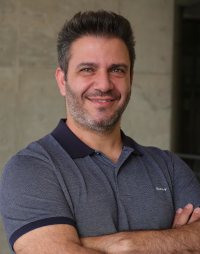
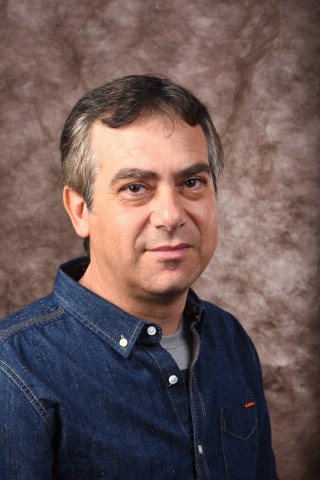
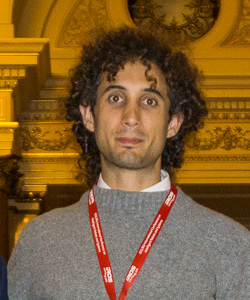
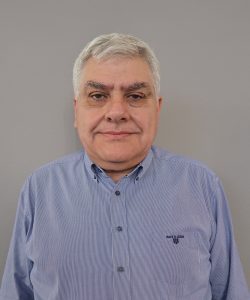
Aristidou Andreas is an Associate Professor at the Department of Informatics, University of Cyprus. His academic journey includes a BSc from National and Kapodistrian University of Athens (2005), MSc from King's College London (2006), and a PhD from the University of Cambridge (2011). He has held postdoctoral positions at multiple institutions and served as a visiting professor at the University of Nicosia. His research focuses on human motion analysis, computer graphics, cultural heritage digitization, and geometric algebra applications. He is a senior member of IEEE, ACM, and Eurographics, and serves on editorial boards for journals like The Visual Computer. Research highlights include the FABRIK algorithm (widely used in game engines) and motion capture innovations for cultural heritage preservation. Awards include the DIDAKTOR scholarship, Erasmus Mundus Grant, and NVIDIA GPU grant. He leads projects funded by EU initiatives (e.g., ITN-DCH, SCHEDAR) and collaborates internationally on digital twins, virtual museums, and AI-driven motion synthesis. Key contributions span 3D motion analysis, motion reconstruction from sparse data, and emotion recognition in theater performances. His work bridges computational methods with cultural preservation, biomedical applications, and interactive VR systems.
Dr. Andreas Savva is an Associate Professor at the Department of Computer Science , School of Sciences and Engineering , University of Nicosia . He has over 25 years of teaching experience across institutions like the University of North London, Kingsway College, Intercollege, and the University of Nicosia. Education: BSc Hons (First class) in Mathematics and Computing, University of North London PhD in Computer Graphics, University of North London His research focuses on Geometric Modeling , Subdivision Surfaces , and Spline Methods , with over 50 publications. Recent work includes interdisciplinary studies in Computing Education , Accessibility in Information Systems , and Real-Time Emotional Analysis via machine learning. The 15 most recent articles span topics in geometric modeling, software development, and educational technology. Trends include applications of subdivision surfaces in design, stakeholder-driven curriculum reform, and emotional analysis in educational contexts. Grants & Collaborations : He has participated in local and international funded projects, with collaborations across Cyprus, Greece, and the UK. His work aligns with UN Sustainable Development Goals, particularly education quality.
Yiorgos-Sokratis Smyrlis is a Professor in the Department of Mathematics and Statistics at the University of Cyprus, where he has served since 1993, progressing from Assistant Professor to Associate Professor (2003) and finally to Professor (2010). His academic career includes prior positions as Research Assistant Professor at UCLA (1989-91) and Lecturer at the University of Manchester (1991-93). Professor Smyrlis received his secondary education at Model School of Anavruta, Kifissia, Greece (1977-1980), followed by undergraduate studies at the University of Athens, Department of Mathematics (1980-84), where he ranked 1st with a grade of 9.7/10.0. He earned his MS (1986) and Ph.D. (1989) in Mathematics from the Courant Institute, New York University, with a dissertation titled "Existence and stability of stationary profiles of the LW scheme" under Peter D. Lax. His research focuses on Conservation Laws, Numerical methods for elliptic boundary value problems, Density results with linear combinations of particular solutions of elliptic equations, Dissipative and dispersive–dissipative dynamical systems, and Development of linearly implicit schemes for nonlinear parabolic equations. His work often centers on the Method of Fundamental Solutions (MFS) and its theoretical foundations and practical applications. Analysis of his publication record reveals a strong emphasis on developing and analyzing numerical methods, particularly the MFS, for solving partial differential equations across diverse physical contexts. His research spans theoretical mathematical analysis to practical computational implementations, with significant contributions to understanding the Kuramoto-Sivashinsky equation and related dynamical systems. Professor Smyrlis has maintained extensive collaborations, particularly with A. Karageorghis, G. Akrivis, and D.T. Papageorgiou, resulting in publications in prestigious journals including Mathematics of Computation, Numerische Mathematik, and SIAM Journal on Scientific Computing.
Prof. Andreas Anayiotos is the Rector of the Cyprus University of Technology (CUT) and Director of the Biomechanics and Living Systems Analysis Laboratory (BioLISYS). His leadership has elevated CUT to global recognition (THE ranking 351-400) and established key initiatives like INTENT (Innovation and Technology Transfer Office) and CUTing Edge to foster academic entrepreneurship. He previously served as Vice-Rector (2012-2015) and contributes to EU/NSF grant evaluations. His research encompasses: Cardiovascular biomechanics : Hemodynamics, stent design, and implant safety. Cancer research : Novel imaging techniques and targeted therapies. Tissue engineering : Biomaterial scaffolds for regenerative applications. Preclinical testing : Toxicokinetic modeling of medical implants. Recent publications (2022-2025) demonstrate interdisciplinary focus on biomedical engineering (implants, toxicology), environmental sustainability (waste valorization), and remote sensing. He mentors graduates employed at NASA, Emory University, and leading med-tech firms. Prof. Anayiotos consults for global cardiovascular device manufacturers including Boston Scientific, Johnson & Johnson, and Guidant Corporation. He holds editorial roles in Annals of Biomedical Engineering and Ultrasound in Medicine and Biology .
Rahaf Orabi is a Research Technical Scientist at The Cyprus Institute's Science and Technology in Archaeology Research Center (STARC), specifically working within the Andreas Pittas Art Characterization Laboratories (APAC Labs). She joined The Cyprus Institute in 2022 and contributes to cutting-edge research in digital cultural heritage and archaeological documentation, with particular focus on post-conflict sites in Syria. Her academic background includes: PhD in History and Archaeology at Pázmány Peter Catholic University, Budapest, Hungary (2017-2023) MSc in Digital Cultural Heritage from The Cyprus Institute (2020-2021) MArch in Architectural Design/Digital Architecture from Damascus University (2013-2016) BSc in Architecture from Damascus University (2012) Rahaf's research focuses on digital documentation of endangered cultural heritage sites using laser scanning, photogrammetry, and point cloud analysis. She specializes in post-conflict recovery of cultural heritage, particularly in war-torn regions like Syria. Her work combines technical precision with deep historical understanding, allowing for accurate digital reconstructions of damaged heritage. She has pioneered urban-scale digital documentation projects in historic cities including Aleppo and Damascus, creating detailed records that support academic research and conservation efforts. Her publications demonstrate consistent focus on urban heritage reconstruction, with significant work on Aleppo's historic districts using parametric modeling and historical map analysis. Her achievements include the Stipendium Hungaricum Scholarship (2017) and 19 publications with over 5,830 reads and 24 citations on ResearchGate. She has collaborated on major international projects including "Project Anqa" for documenting Syrian heritage and has participated in documenting Palmyra after its liberation from ISIS. Rahaf has been instrumental in developing digital methodologies for heritage documentation in challenging post-conflict environments. Her work bridges practical field documentation with academic research, creating valuable resources for heritage conservation and urban recovery planning. She maintains active collaborations with researchers across European institutions and continues to advance methodologies for digital reconstruction of war-damaged urban heritage sites.
Nikolaos Tziolas serves as a Professor in the Department of Mathematics and Statistics within the School of Natural and Applied Sciences at the University of Cyprus, with his office located in THEE 01, room 061 on campus. His academic profile reflects a distinguished career in pure mathematics with international research collaborations. His educational foundation includes: PhD in Mathematics from the University of Utah (1999) BA in Mathematics from Aristotle University of Thessaloniki (1991) Specializing in Algebraic Geometry , Professor Tziolas investigates complex geometric structures with emphasis on surface classifications, singularity theory, and birational transformations. His research spans both characteristic zero and positive characteristic settings, addressing fundamental questions about automorphism groups, polarized varieties, and minimal model program contractions. This work bridges theoretical frameworks with concrete geometric constructions. Analysis of his publications (2004-2017) reveals consistent focus on advanced surface and threefold geometry, particularly examining deformation theory, singularities, and classification problems under varying algebraic conditions. The trajectory demonstrates progressive depth in handling non-standard geometric scenarios like positive characteristic and non-normal varieties. His scholarly recognition includes: Marie Curie Fellowships at University of Warwick (2000-2002) and University of Crete (2003-2004) JSPS Fellowship at University of Tokyo (2005) While specific student advisement details and grant histories aren't documented in available sources, his extensive visiting appointments at premier institutions indicate active mentorship and collaborative research leadership. No dedicated laboratory infrastructure is referenced, suggesting his work primarily involves theoretical development and international academic partnerships.
Nicolas Hadjipantelis serves as an Assistant Professor in Structural Engineering at the Department of Civil and Environmental Engineering, University of Cyprus, where he conducts research in steel structures and teaches courses on steel structures and structural stability at undergraduate and postgraduate levels. He founded and leads the Metal Structures Laboratory at UCY, which houses an advanced Wire Arc Additive Manufacturing (WAAM) system for producing complex metal structures. Dr. Hadjipantelis holds a PhD in Steel Structures from Imperial College London, where he was awarded a full President's Scholarship. His undergraduate studies at the University of Bristol yielded an MEng in Civil Engineering with Study Abroad (first class honors), including a research year at UC Berkeley. Prior to joining UCY in August 2020, he worked as a Research Fellow at Imperial College London in collaboration with the Alan Turing Institute. His research focuses on cutting-edge metal fabrication technologies, particularly WAAM for structural applications, alongside traditional steel structure domains including cold-formed steel, prestressed systems, and structural stability. His laboratory has produced over one ton of WAAM test specimens for material, member, and system-level testing. His methodology combines experimental testing across multiple scales with advanced finite element simulations (GMNIA) and energy-based analytical approaches. Dr. Hadjipantelis's publication record demonstrates consistent output in top structural engineering journals including Journal of Structural Engineering (ASCE), Engineering Structures, Thin-Walled Structures, and Journal of Constructional Steel Research. His research trajectory shows evolving focus from fundamental studies on prestressed cold-formed steel to pioneering work on WAAM technology development, with recent publications addressing environmental impacts, polar temperature performance, and ductile fracture mechanisms of additively manufactured steel. Imperial College President's Scholarship (PhD funding) Prize-winning conference presentation (2018 Young Researchers' Conference of the Institution of Structural Engineers) As founder of UCY's Metal Structures Laboratory, Dr. Hadjipantelis has established a significant research infrastructure for WAAM technology in structural engineering. His professional affiliations include Associate Membership in the American Society of Civil Engineers (ASCE), Graduate Membership in the Institution of Structural Engineers (IStructE), and full membership in the Scientific and Technical Chamber of Cyprus (ETEK) and the Society of Civil Engineers of Cyprus (SPOLMIK). His work bridges computational modeling, experimental validation, and practical design code development for next-generation steel structures.
Michalis Ramp serves as a Research Associate at the KIOS Research and Innovation Center of Excellence (KIOS CoE) of the University of Cyprus, a role he commenced in March 2023. His academic qualifications include: Diploma in Mechanical Engineering from the University of Cyprus (2008) Masters Diploma in Mechanical Engineering (Control Systems) from the University of California at Berkeley (2010), supported by the Fulbright scholarship Ph.D. from the National Technical University of Athens (NTUA), Greece (2022), with doctoral research titled 'Geometric, Coordinate-free, Modeling and Control of Multirotor Unmanned Aerial Vehicles'. His scholarly work integrates theoretical and applied domains across control systems and mathematics. Primary research thrusts encompass Traffic Flow Control for urban infrastructure optimization, Modeling of Dynamic Systems for predictive analytics, Robotics for autonomous vehicle development, Nonlinear Control Systems for complex system stabilization, Geometric Mechanics/Control for coordinate-free UAV navigation frameworks, and Applied Mathematics for algorithmic innovation. This interdisciplinary approach bridges aerospace engineering principles with transportation and robotics applications. His recognition includes the Fulbright scholarship award for graduate studies in the United States.
Costas Papadopoulos serves as a Research Associate at the KIOS Research and Innovation Centre of Excellence, University of Cyprus, specializing in Smart Water Networks and Water Distribution Systems. He holds a BEng (1989) and PhD (1994) in Electrical and Electronic Engineering from King's College London, with doctoral research focused on 2nd Order Geometric Transformations for Motion Compensation in Video Data Compression. His career bridges academic research and extensive industry experience in telecommunications infrastructure. His educational background includes: BEng in Electrical and Electronic Engineering, King's College London (1989) PhD in Electrical and Electronic Engineering, King's College London (1994) Research interests emphasize applied engineering solutions across two distinct domains: current work centers on sensor-driven optimization of urban water infrastructure through Smart Water Networks, while foundational expertise spans video compression algorithms and telecommunications systems including CRM, CTI, and IVR applications. This interdisciplinary profile reflects a trajectory from theoretical signal processing to critical infrastructure management. As a core member of the KIOS Research Centre, he contributes to national water security initiatives through data-driven modeling of distribution networks. His industry background in telecommunication networks and business support systems provides unique cross-sector perspective for smart infrastructure development, though specific project details remain undisclosed in available materials.
Dr. Andreas Artemiou serves as Professor, Vice Rector for Academic Affairs and Quality Assurance, and Dean of the Technology and Innovation School at the University of Larnaca's Department of Information Technologies. His leadership spans academic administration and cutting-edge statistical research with global collaborations. His academic foundation includes: BSc in Mathematics and Statistics from University of Cyprus (2005) MSc and PhD in Statistics from Pennsylvania State University (2008, 2010) Artemiou's research pioneers statistical methods for high-dimensional datasets, specializing in dimension reduction, kernel techniques, and machine learning applications. His work bridges theoretical innovation with practical implementations across engineering, computer science, and medical sciences, particularly evident in pandemic-related mortality analysis and cytometry data processing. Recent publications (2021-2024) reveal accelerating focus on SVM-based dimension reduction, sparse modeling, and medical applications. The trajectory shows increasing interdisciplinary impact, with 2024 works emphasizing matrix data analysis and time-series dimension reduction for real-world health crises. His professional recognition includes: New Researcher Fellow at Statistics and Applied Mathematical Sciences Institute Artemiou actively contributes to major collaborative initiatives without explicit grant details. His editorial role at Computational Statistics and Data Analytics journal and board membership in the European Statistical Computing Association highlight academic leadership. Current projects drive innovation in cytometry analysis and pandemic mortality modeling. He directs CytoPy - an autonomous cytometry analysis framework - and leads pandemic mortality research through the international CMOR consortium, demonstrating commitment to translating statistical theory into public health solutions.
Emmanouil Milakis is a Full Professor at the Department of Mathematics and Statistics, University of Cyprus, affiliated with the School of Natural and Applied Sciences. He holds a PhD from the University of Crete (2006) and has held academic positions at the University of Cyprus since 2009, progressing through ranks from Lecturer to his current role. His research focuses on Partial Differential Equations, Free Boundary Problems, and Geometric Measure Theory. Notable contributions include studies on the Stefan problem, thermal insulation models, and regularity theory for nonlinear PDEs. Education: PhD in Mathematics, 2006, University of Crete Postgraduate Diploma in Mathematics, 2001, University of Crete Bachelor's Degree in Mathematics, 1999, University of Crete His research interests emphasize theoretical developments in PDEs with applications to free boundary phenomena and geometric analysis. Recent work explores degenerate elliptic systems, fractional obstacle problems, and spectral stability in rough domains. His articles frequently intersect harmonic analysis and applied mathematics, addressing challenges in fluid dynamics and material science through advanced analytical methods. While no scientific awards are listed, his extensive publication record reflects sustained contributions to the field. No grants or advising roles are explicitly mentioned in the provided texts. He maintains a lab/departmental affiliation within the University of Cyprus's mathematics department.
Daniel Cohen-Or is a Professor at the Department of Computer Science, Tel Aviv University, and an Adjunct Professor at Simon Fraser University since 2016. He holds the Isaias Nizri Chair in Visual Computing . His academic background includes a B.Sc. and M.Sc. from Ben-Gurion University (1985-1986) and a Ph.D. from SUNY Stony Brook (1991). Research Interests: Focused on Computer Graphics, Visual Computing, and Geometric Modeling , with a current emphasis on generative models and their applications in 3D shape manipulation, image editing, and diffusion-based techniques. Scientific Awards: Eurographics Outstanding Technical Contributions Award (2005) ACM SIGGRAPH Computer Graphics Achievement Award (2018) Thomson Reuters Highly Cited Researcher (2015) Kadar Family Award (2019) Eurographics Distinguished Career Award (2020) People’s Republic of China Friendship Award (2012) Notable Contributions: Co-edited A Sampler of Useful Computational Tools for Applied Geometry, Computer Graphics, and Image Processing . His work spans 3D reconstruction, texture synthesis, shape modeling, and semantic image editing, with a focus on leveraging deep learning frameworks like StyleGAN and NeRF. Advising: Mentoring numerous students and postdocs, including Or Patashnik, Yuval Alaluf, and Ron Mokady, with a strong presence in both current and former advisees .
Philippe Froguel serves as a Visiting Professor in General Medical Endocrinology at the Medical School of the European University Cyprus, while concurrently holding the Chair in Genomic Medicine position at Imperial College London. His dual institutional affiliation highlights significant contributions to genomic medicine and clinical endocrinology through international research collaborations and academic leadership. Professor Froguel's research integrates genomic approaches with endocrine disorders, focusing on the genetic architecture of diabetes (particularly latent autoimmune diabetes in adults), inflammatory bowel diseases, and lipid metabolism. His work pioneers multi-ancestry genome-wide association studies incorporating gene-environment interactions, with notable investigations into NOD2 gene variations in Crohn's disease and metabolic-alcohol interactions. This interdisciplinary approach bridges molecular genetics, clinical endocrinology, and forensic anthropology as evidenced by his facial landmark variation studies. Analysis of his 2018-2019 publications reveals consistent emphasis on genetic susceptibility to complex metabolic diseases, utilizing large-scale genomic methodologies across diverse populations. His team has produced landmark studies on lipid metabolism GWAS and autoimmune diabetes pathogenesis, demonstrating methodological innovation in gene-environment interaction modeling while maintaining clinical relevance for diabetes classification and treatment. No specific scientific awards are documented in the provided text, though his leadership in multinational research consortia suggests significant peer recognition within the genomic medicine community. While student mentorship details and grant funding specifics are absent from the current documentation, Professor Froguel's position as Chair in Genomic Medicine at Imperial College London and extensive high-impact publication record indicate substantial research infrastructure involving graduate supervision and competitively funded projects in genomic medicine and metabolic disease research.
Dr. Neşet Deniz Turgay is an Assistant Professor in the Department of Mathematics at the Faculty of Arts and Sciences, Eastern Mediterranean University (EMU) in Northern Cyprus. He holds office AS147 and can be reached at +90 392 630 2412 or neset.turgay@emu.edu.tr. His educational background includes: PhD in Mathematics from Swansea University (2010-2013) MS in Mathematics from Ege University, Izmir (2006-2009) BS in Mathematics from Ege University, Izmir (2001-2006) Dr. Turgay's research spans two primary areas of mathematics: algebraic topology (particularly Steenrod algebra and Leibniz-Hopf algebra) and discrete geometry (focusing on distance metrics in various grid structures and patterns). His work in algebraic topology examines conjugation invariants, Adem relations, and structural properties of the Steenrod algebra. In discrete geometry, he investigates distance calculations in crystallographic structures including face-centered cubic grids, Cairo patterns, and body-centered cubic lattices, often applying operational research techniques to solve optimization problems. His publications demonstrate sophisticated mathematical modeling and computational approaches to solve complex geometric and topological problems. His recent publications show a clear trend toward applying mathematical techniques to crystallographic and pattern recognition problems, while maintaining a strong foundation in algebraic topology. The research demonstrates sophisticated mathematical modeling and computational approaches to solve complex geometric and topological problems, with publications spanning from 2013 to 2023 showing consistent scholarly productivity. Scientific awards and recognitions: Socrates Erasmus scholarship for research at the University of Aberdeen (2008) Dr. Turgay has secured research funding for several projects, including "Clifford Analysis Knowledge Exchange (CAKE)" funded by Eastern Mediterranean University (35,000 TL grant, 2023) and "Some calculations in the Steenrod algebra" supported by Ege University (2008-2009). His research demonstrates both theoretical depth in algebraic topology and practical applications in discrete geometry and pattern recognition, with numerous collaborations with researchers including Gergely Kovács, Benedek Nagy, and Bela Vizvári.
Kypros Milidonis is an Assistant Professor in the Energy Department of the Energy, Environment, and Water Research Center (EEWRC) at the Cyprus Institute (CYI). His expertise spans renewable energy technologies, with a focus on solar energy systems, advanced energy conversion, and computational engineering. He holds an integrated Master’s Degree (2008) and a doctorate (2014) in Mechanical Engineering and Aeronautics from the University of Patras. Prior to joining CYI, he worked as a Research Associate at the University of Cambridge (2015-2018), focusing on energy conversion systems. Dr. Milidonis leads research projects spanning theoretical development (TRL 1-4) to pre-industrial applications (TRL 5-7), emphasizing solar energy innovation. His work includes optimizing heliostat fields, anti-soiling strategies, UAV-assisted monitoring, and AI-driven design. He actively collaborates with industry and manages international projects, such as SolarPACES Task III. His research integrates interdisciplinary approaches, combining mechanical engineering, computational modeling, and material science. Key contributions include advancements in heliostat field optimization, solar receiver design, and the application of unmanned aerial vehicles (UAVs) in solar plant maintenance. His publications span solar thermal systems, computational tools like SunPATH and fluxtracer, and historical engineering reconstructions (e.g., ancient Greek artifacts). He is a Principal Investigator and coordinator, emphasizing translational research bridging academia and industry.