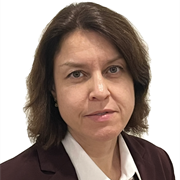
Anastasia Semykina is a Professor of Economics and Deputy Dean (Research and Innovation) at RMIT University's School of Economics, Finance & Marketing. She holds a PhD from Michigan State University (2006) and previously served as Charles and Joan Haworth Professor of Economics at Florida State University. Her expertise spans theoretical and applied econometrics, with a focus on panel data models, missing data estimation, and their application in labor economics, education economics, transition economies, and economic psychology. She teaches advanced econometrics and microeconomics courses at both undergraduate and graduate levels. Research Interests: Theoretical and Applied Econometrics Labor Economics Economics of Education Transition Economies Economics and Psychology Health Economics Her recent publications address topics such as panel data methodologies, healthcare cost-effectiveness analysis, and educational policy evaluation. She is actively involved in supervising PhD and Master's research students in econometrics and applied economics.
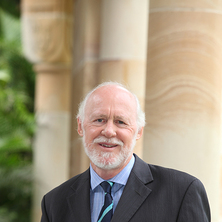
Professor Gene Bawden is a communication designer and Head of the Department of Design at Monash University’s Faculty of Art, Design and Architecture (MADA). He holds a PhD in Design focusing on Australian domestic spaces and cultural identity. His work bridges design practice and research, emphasizing gender equity in urban environments through collaborative projects like the XYX Lab. Key contributions include developing design thinking curricula, leading the D-Lab’s material tools for spatial inquiry, and co-designing safety initiatives for public transport and urban spaces. Education: PhD in Design (2015), Monash University, specializing in 'Comfort and Judgement: Nineteenth Century Advice Manuals and the Scripting of Australian Identity'. Research Interests: Gendered spatial practices, design thinking methodologies, material and visual narratives of belonging, and co-design strategies for mitigating urban gender inequity. His projects include the 'Safer Cities Crowd Mapping' initiative and the WHO-guided 'Design for Impact' toolkit. Awards: Recipient of the 2018 Dean’s Award for Research Impact, 2020 Good Design Award for 'Yours, Mine, Ours', and multiple recognitions for urban design projects addressing gender safety. Advising: Graduate supervisor for design research students. Grants: Principal investigator on projects totaling over AUD 2M, including the 'Gender-sensitive training for safe communities' and 'Co-designing health futures' initiatives. Labs/Teams: Founding director of D-Lab and core member of XYX Lab, which focus on design-driven solutions for gender equity in urban environments. Notable collaborations include the 'HyperSext City' exhibition and 'Keep Running' public safety campaigns.
Dr. Farzana Aman Tanima is a Senior Lecturer at the University of Sydney Business School’s Accounting, Governance, and Regulation department. She previously held roles at the University of Wollongong (2017–2023). Her research focuses on critical and dialogic accounting, social justice, and challenging neoliberal frameworks through participatory approaches. Born in Bangladesh, she earned her PhD in 2015 from Victoria University of Wellington, New Zealand, with a thesis on dialogic accounting practices for marginalized women. Education: PhD in Accounting, Victoria University of Wellington, 2015 Undergraduate Honours Degree, Victoria University of Wellington Research Interests: Dr. Tanima’s work centers on dialogic accounting to democratize accounting practices, with focus on NGOs, microfinance, Indigenous education, and race. She employs participatory action research and autoethnography to address systemic inequalities. Key areas include: Accounting’s role in empowerment and development Decolonizing accounting education through Jindaola Critical race theory and counter-accounting Awards: 2024 Mary Parker Follet Award (AAAJ Journal) 2020 VC OCTAL Teaching Award 2015 AFAANZ Best PhD Award Teaching & Mentorship: She leads pedagogical initiatives embedding Indigenous perspectives into curricula and fosters dialogic learning. Supervised two completed PhDs, with co-authored publications. Active in mentoring early-career researchers through invited talks and workshops. Labs/Teams: Part of the Alternative Accounting Research Network and editorial boards for CPA Journal and Financial Accountability & Management . Co-leads special issues on critical dialogics and publicness in accounting.
Professor Susan Goodwin is a leading academic at the University of Sydney, specializing in social policy, gender studies, and social justice. She holds a BA(Hons) from ANU and a PhD from the University of Sydney. Her work focuses on collaborative research projects with government and civil society organizations, emphasizing participatory methodologies to address poverty and inequality. Educations: PhD, University of Sydney BA(Hons), Australian National University Her research interests span social structures, gender relations, and community development, with a focus on policy analysis methodologies. Notable projects include participatory approaches to community revitalization in Australia and Hong Kong, and interrogating constructions of motherhood in Australia. Professor Goodwin is affiliated with the Sydney Policy Lab, Sydney Southeast Asia Centre, and the Charles Perkins Centre. Her awards include the 2016 Vice-Chancellor’s Award for Outstanding Research Supervision and a 2014 residency at Hong Kong Baptist University. Key Grants & Projects: ARC Linkage Project on participatory community development in public housing neighborhoods NSW Refugee Youth Policy Initiative Research on gender, social policy, and adolescent girls' sexuality in Indonesia She actively contributes to policy networks like the Social Policy Research Network and co-convenes the Sydney Social Justice Network. Her work bridges academic research with practical policy impact, emphasizing grassroots engagement and equity.
Jocelyn Davies is a University Fellow at the Faculty of Arts and Society, Northern Institute, Charles Darwin University. She lives and works in Alice Springs and has specialized in arid rangeland environments. As a geographer and predominantly qualitative researcher, she is skilled in participatory action research methods with extensive experience in Aboriginal land management initiatives across Australia. Her research profile demonstrates significant engagement with: Climate change adaptation in arid environments (70% research focus) Land management practices (66% research focus) Protected area management (61% research focus) Rangeland systems (59% research focus) Dr. Davies' scholarly work shows a strong international dimension, with research conducted in sub-Saharan Africa, Vietnam, and Inner Mongolia. Her fingerprint analysis reveals significant contributions to Environmental Impact Assessment (52%) and Ecosystem Function studies (52%). Her publications demonstrate consistent scholarly output with significant impact, particularly her 2020 article on Indigenous adaptation pathways which has received 117 Scopus citations and influenced policy development. Her research has been widely disseminated through platforms like Mendeley with hundreds of readers across multiple publications. Dr. Davies' work contributes substantially to UN Sustainable Development Goals related to climate action, life on land, and reduced inequalities through her focus on indigenous knowledge systems and sustainable land management practices. She maintains active research collaborations across multiple countries and has documented 16 research outputs with significant policy engagement, including references in multiple policy documents and news outlets. Her current work focuses on documenting the 50-year history of the Central Australian Aboriginal Congress through participatory methods.
Dr. Valerie Cooms is a Research Fellow at the ANU College of Law, Governance and Policy within the Australian National University. Her work primarily focuses on quantitative social policy research with specialization in longitudinal studies and Indigenous affairs. She holds leadership roles in major national research initiatives evaluating policy effectiveness. Research Interests: Dr. Cooms' research spans longitudinal data analysis, statistical methodology, Indigenous policy evaluation, criminal justice reform, and social inequality measurement. Her work frequently examines the intersection of evidence-based policy and marginalized communities. Research Trends: Recent outputs demonstrate consistent focus on Indigenous policy assessment, criminal justice system reform, and political analysis of constitutional changes affecting First Nations communities. Her publications blend academic research with public engagement through multimedia formats. Research Projects: Principal Investigator for 'Review of methods for assessing progress towards Closing the Gap' (2023-2026) Co-Investigator for 'Footprints in Time: Longitudinal Study of Indigenous Children' (2023-2024) Lead researcher for 'Longitudinal Studies of Indigenous Children Wave 13 Summary Report' (2022-2024) Contributor to 'Monitoring and Accountability Framework' project (2023-2024) Co-Investigator for literature review on women in court systems (2023-2024)
Lisa Magnani is a Professor in the Department of Economics at Macquarie University, with active research in labor economics, finance, and development studies. She is affiliated with both the Innovation, Strategy and Entrepreneurship Research Centre and the Health at Work Research Centre at Macquarie University. Professor Magnani's research focuses on critical areas including labor markets, financial systems, and their intersection with social issues. Her work examines: Unionization and workers' rights across different economic contexts The relationship between finance and labor in capitalist societies Small and Medium-sized Enterprises (SMEs) and their financing challenges Worker mobility and technological diffusion HIV/AIDS and economic deprivation in Southeast Asia Social finance and inequality Her recent publications demonstrate a consistent focus on the interplay between financial systems and labor dynamics, with increasing attention to social issues like HIV/AIDS and women's agency. Magnani's work spans both developed and developing economies, with particular emphasis on post-socialist contexts and Southeast Asia. Professor Magnani has been actively involved in research projects including: "The Impact of Capital Account on Small and Medium Enterprises" (ongoing) "Understanding deprivation and HIV/AIDS in Southeast Asia: A new multidimensional model for research and economic planning" (2018-2022) "Small firms' finances: effects on employment, wages and growth" (2016-2021) She regularly presents her research at international conferences and has organized academic events such as "Sino-Australia Economies Towards a New Globalization: A Mutual Learning Curve" in 2018.
Associate Professor Samantha Schulz is a sociologist of education at The University of Adelaide's School of Education, within the Faculty of Arts, Business, Law and Economics. She specializes in educational justice, focusing on First Nations education, race critical theory, affect studies, and gender equity. Her work spans international contexts including Kenya, India, China, and Australia's APY Lands. She is co-convenor of the Pedagogies for Justice Research Group, affiliated with CRESI and the Fay Gale Centre for Research on Gender. As Program Director for the Master of Teaching program, she emphasizes socially engaged pedagogies. Recent research includes the ARC-funded 'Culturally Responsive Schooling' project (2022-24) and studies on gender-based violence in educational settings. Her publications explore decolonial methodologies, critical race theory, and the intersection of affect and pedagogy. Her grants include leadership roles in projects addressing Indigenous sovereignty in education, culturally responsive curriculum design, and restorative practices. Notable collaborations involve UniSA and Open University of Cyprus. She co-edits the Routledge 'Local Global Issues in Education' series and actively publishes on topics ranging from toxic masculinity in academia to anti-racist policy frameworks. Her advising focuses on fostering critical scholarship in Masters and PhD candidates, with research supervision emphasizing justice-oriented educational practices. She leads initiatives like 'Teaching in an era of digital influence' and has contributed to policy discussions on preventing violent extremism in schools. Her work bridges theoretical rigor with practical advocacy for marginalized communities in education systems globally.
Professor Victor Callan AM is Professor of Leadership and Organisational Change at the University of Queensland Business School within the Faculty of Business, Economics and Law. With over 300 publications to his name, including 179 journal articles, 60 conference publications, and 17 books, he is one of Australia's most recognized researchers in organizational change, leadership performance, and employee training. His influential work has shaped public policy in workforce development, vocational education, and organizational change management. Education: Bachelor (Honours) of Arts, University of New South Wales Doctor of Philosophy, Australian National University Professor Callan's research focuses on two primary areas: organizational change and leadership, with special interest in employees' and leaders' experiences with large-scale change; and employee skills, capabilities and training, examining effective responses to skills development and shortages. His work explores adaptation levels, personal capabilities, communication dynamics, and team processes during organizational transitions. He has pioneered research on maverickism in organizations, investigating how positively deviant change agents drive radical organizational transformations. His recent publications reveal a strong trend toward gender equality research, Indigenous knowledge integration, and maverick leadership. These works span multiple disciplines including organizational behavior, human resource management, vocational education, and leadership studies. His research on workplace gender inequality employs wicked problems frameworks, while his work on Indigenous knowledge holders emphasizes co-creation and positioning as expert researchers. Major Awards and Recognition: Fellow of the Academy of Social Sciences in Australia Fellow of the Queensland Academy of Arts and Sciences Fellow of the Australian Institute of Company Directors Member (AM) of the Order of Australia for significant service to higher education University's Award for Excellence in Higher Degree Research Supervision Two UQ Excellence in Leadership Awards Professor Callan has supervised numerous PhD students across diverse topics including leadership ascension, maverickism, CEO appointments, and organizational change. He has secured substantial research funding, including his 14th Australian Research Council project in 2025 focusing on Indigenous women environmental rangers. His advisory work spans over 100 projects for government departments and international organizations across South Africa, Ghana, Tanzania, Indonesia, Bhutan, Brunei, New Zealand, PNG, and South Pacific countries, addressing employee skills, vocational education, industry closures, and workforce development. He actively contributes to executive education for senior managers globally and has developed strong research, consulting, and industry partnerships. His current teaching focuses on MBA programs and the Bachelor of Advanced Business Honours program at UQ.
Ingebjorg Kristoffersen is a Lecturer in the Department of Economics at the UWA Business School, The University of Western Australia. She holds a PhD in Economics from UWA and a Master of Business (Finance) from Edith Cowan University. A Fellow of the Higher Education Academy since 2021, she specializes in applied microeconomics focusing on economic psychology, wellbeing, and gender issues. Her research explores how values, perceptions, and emotions influence economic behavior, particularly in areas like health, financial literacy, and gender roles. She has published in journals such as Journal of Economic Psychology and Health Promotion International . Currently, she teaches Microeconomics and research methods courses and serves as Undergraduate Coordinator for Economics. Dr. Kristoffersen contributes to initiatives like the National Indigenous Business Summer School and actively reviews for top academic journals. Her work aligns with UN Sustainable Development Goals related to education and gender equality.
Associate Professor Helen Adam is a leading academic in the School of Education at Edith Cowan University (ECU), specializing in culturally responsive pedagogy and the role of children’s literature in fostering equity and inclusion. She holds a PhD in Early Years Education (2019) and has extensive experience in primary education and literacy research. Her career includes roles as a teacher, researcher, and leader in teacher education, particularly in addressing systemic inequities through literature. She is Board President of the Primary English Teaching Association of Australia (PETAA) and actively contributes to national and international educational initiatives. Research interests focus on diverse children’s literature, social-emotional development, and dismantling prejudice through books. Notable projects include a Churchill Fellowship (2022) exploring global practices in children’s literature and equity-driven education. Her work has been recognized with awards such as the 2023 Churchill Fellowship and multiple ECU research accolades. Helen supervises postgraduate research in literacy and diversity, including projects on postmodern picturebooks and culturally diverse family representation. She collaborates with institutions like ECU’s Kurongkurl Katitjin Centre for Indigenous Education, emphasizing allyship and support for marginalized groups.
Professor Marinella Marmo is a leading academic in criminology, human rights, and gendered migration studies at Flinders University's College of Business, Government and Law . She serves as a Professor and contributes to institutions like the Centre for Social Impact and the Jeff Bleich Centre for Democracy and Disruptive Technologies . Education: PhD in Applied Social Science (University of Lancaster, UK), LLB (Honours) (Università di Salerno, Italy). Her research spans international criminal justice , transnational crime , modern slavery , and gendered border control , with work influencing national policies and documentaries. She has secured funding from the Australian Research Council and EU-Australian Government initiatives . Recent publications focus on state-corporate harm and migrant deportation regimes , reflecting her commitment to human rights centred criminology . Awards include the 2023 BGL Team Teaching Award and the 2018 ANZ Society of Criminology Excellence in Teaching Award . She supervises projects on modern slavery , gig economy exploitation , and state crime , aligning with UN Sustainable Development Goals like SDG 5 (Gender Equality) and SDG 8 (Decent Work).
Professor Barbara Pini is a faculty member at Griffith University's School of Humanities, Languages and Social Science , with a focus on rural sociology, gender studies, and media analysis. She holds a PhD from Queensland University of Technology (2001) and an MBA from the University of New England (1997). Research Interests: Pini's work examines rural identities, gender representation in media, disability studies, and affective geographies. Her projects often intersect with Sustainable Development Goals like Gender Equality and Reduced Inequalities , using interdisciplinary approaches to analyze visual culture, policy, and social narratives. Funded Research: She has received grants from the PA Research Foundation (2021-2022) and the Australian Research Council (2011-2017) for studies on emergency care and rural disability experiences. Scientific Awards: Notable grants include the ARC Discovery Projects DP110102719 and PA Research Foundation's 'Rethinking Emergency Medicine' grant. Teaching & Supervision: Pini has supervised over 14 doctoral and master's students at Griffith University, including Hannah Ruth Adler, Marnie Cruickshank, and Laura Rodriguez Castro, across topics like medicinal cannabis, gendered financialization, and decolonial research.
Overview Professor Mile Terziovski is a Professor of Entrepreneurship and Innovation at Swinburne University of Technology's School of Business, Law and Entrepreneurship. He previously held leadership roles including Dean of Curtin Graduate School of Business, Head of UniSA's International Graduate School of Business, and Director of the Masters of Entrepreneurship and Innovation program at Swinburne. His academic journey spans over 25 years across multiple Australian universities, alongside a 17-year industrial career at Rio Tinto Group. Education PhD in Quality and Innovation Management (Melbourne Business School, University of Melbourne) MBA (RMIT University) BEng and MEng (University of Wollongong) GAICD (Australian Institute of Company Directors) Research Focus Terziovski's research focuses on innovation strategy, SME innovation practices, quality management systems, and sustainable business practices. His work bridges theory and practice, addressing challenges in manufacturing, healthcare, and energy sectors. He has published 60+ peer-reviewed articles, including in Strategic Management Journal and Journal of Operations Management , and authored books on innovation capability development. Grants & Awards He has secured $3M+ in research grants, including ARC Discovery and Linkage grants. Recognitions include the 2023 Stanford Top 2% Cited Scientists award, two Best Paper Awards from the Academy of Management, and multiple teaching excellence awards. His leadership extends to advisory roles with ACEM, SEAANZ, and Macedonian community organizations. Professional Contributions Terziovski advises global corporations like Motorola, Dow Chemical, and Eurocopter. His visiting professorship at the University of Versailles highlights international academic engagement. He currently supervises doctoral research on AI in entrepreneurship education, leadership in emergency medicine, and cross-border entrepreneurial ecosystems.
Dr. Laura Rodriguez Castro is a Vice-Chancellor Senior Research Fellow at Southern Cross University's Faculty of Education, specializing in Feminist Geography and Decolonial Studies. She leads the Sustainability, Environment and the Arts in Education Research Cluster and serves as Secretary for the Association of Iberian and Latin America Studies of Australasia. Her work bridges critical pedagogies, memory studies, and rural studies through arts-based and participatory methodologies. Her research focuses on Southern knowledges, decolonial feminisms, and the intersections of memory and place. Notable contributions include her 2021 Palgrave monograph exploring rural women's decolonial feminist praxis in Colombia. She also critiques settler colonial representations in Australian rural media and examines Latin American migrant memory practices in Australia. Research Interests: Decolonial methodologies, feminist geographies, rural social movements, memory politics, participatory research Awards: 2024 Southern Cross University Outstanding Contribution to Research Impact Editorial Roles: Associate Editor, Journal of Intercultural Studies