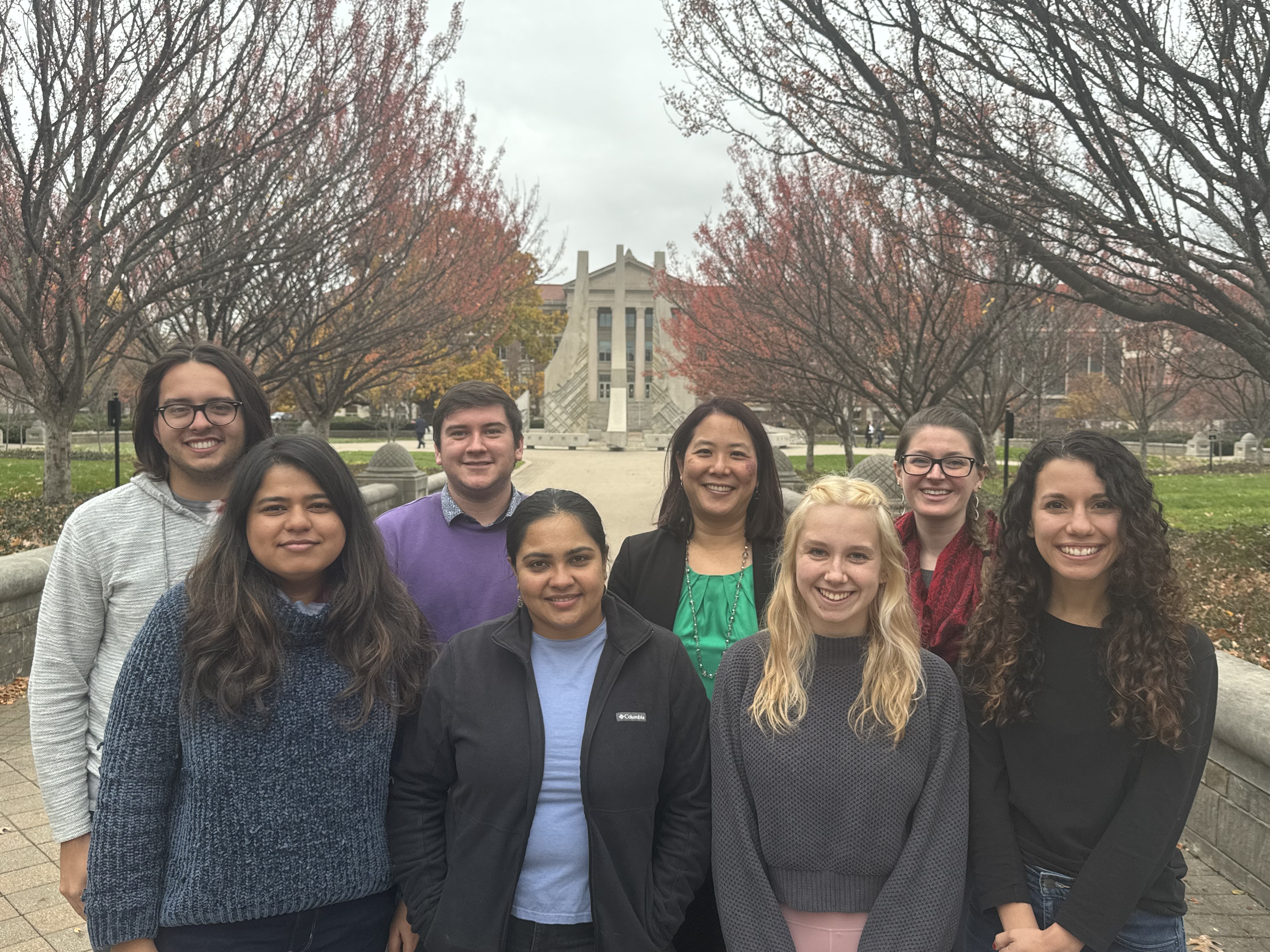
Julie C. Liu is an Associate Professor of Chemical Engineering at Purdue University, with a courtesy appointment in Biomedical Engineering. She joined Purdue in 2008 and holds a B.S.E. from Princeton University, M.S. and Ph.D. from Caltech, and completed a postdoc at the University of Massachusetts Medical School. Her research focuses on protein-based biomaterials for tissue engineering, regenerative medicine, and surgical adhesives, with a particular emphasis on recombinant proteins and natural matrix molecules like collagen and hyaluronic acid. Key awards include the Purdue Faculty Scholar (2019-2024), ELATES Fellowship (2019), and Outstanding Mentor Award (2018). Her work has been funded by NSF, NIH, and industry grants. She advises multiple graduate and undergraduate students, mentoring over 20 researchers. Her lab collaborates on outreach, including Introduce a Girl to Engineering Day, reaching 500+ students since 2014. Liu’s lab designs biomaterials with tailored properties for cartilage repair, drug testing models, and adhesives. Recent advances include mussel-inspired adhesives and redox-responsive hydrogels. She leads a team focused on translational biomedical innovations, bridging engineering and clinical applications.
Yasmin B. Kafai is the Lori and Michael Milken President's Distinguished Professor at the University of Pennsylvania's Graduate School of Education. Her work focuses on empowering students through computational tools such as Scratch, electronic textiles, and biomaking, aiming to broaden participation in computing and promote equity in STEM education. Affiliations: Editor of the Journal of the Learning Sciences Former President of the International Society of the Learning Sciences Recipient of NSF Early Career Award and Rosenfield Community Prize Her research explores youth engagement with digital media, including gaming, coding, and creative technologies. She co-developed Scratch, a foundational platform for youth programming, and pioneered curricula integrating electronic textiles and biodesign in K-12 education. Key contributions include analyzing the societal impacts of virtual worlds, algorithmic literacy, and culturally responsive pedagogy. Publications & Awards: Author of award-winning books like Connected Gaming and Makeology Contributed to national policy reports, including the 2010 U.S. Department of Education's National Educational Technology Plan Recognized as a Fellow of the American Educational Research Association Her outreach initiatives include mentoring partnerships with the City of Los Angeles and collaborations with community tech centers like the Computer Clubhouse network. Current projects emphasize algorithmic justice, AI literacy, and equity-focused maker education.
Laura Albert is a Professor of Industrial & Systems Engineering at the University of Wisconsin-Madison and former David H. Gustafson Department Chair (2021-24). She serves as a Fellow of AAAS and IISE, and previously held the INFORMS presidency. Her research focuses on optimizing public-sector systems, with applications in critical infrastructure protection, emergency response, and cybersecurity. She advocates for public engagement through op-eds and blogs like 'Punk Rock Operations Research.' Education: PhD in Industrial Engineering, University of Illinois at Urbana-Champaign (2006) MS in Industrial Engineering, University of Illinois at Urbana-Champaign (2001) BS in Industrial Engineering, University of Illinois at Urbana-Champaign (2000) Research Interests: Dr. Albert’s work bridges operations research and public policy, addressing challenges in emergency medical services, voting system security, law enforcement strategies, and opioid treatment diversion programs. She employs mathematical optimization, game theory, and stochastic modeling to design resilient systems. Awards: INFORMS Impact Prize (2018) NSF CAREER Award (2011) Fulbright Award (2020) AAAS Fellow (2020) Advising & Grants: While explicit student names aren’t listed, her research has been supported by grants from the NSF, Army Research Office, and other agencies. She advises on interdisciplinary projects involving public health, cybersecurity, and disaster management. Labs/Teams: Engaged in collaborative efforts across the College of Engineering, including affiliations with the Electrical & Computer Engineering department. Leads initiatives on resilient infrastructure and emergency response systems.
Dr. Sarah Young is an Associate Professor at the School of Slavonic and East European Studies (SSEES), University College London. Her academic journey includes a BA (Honours) in Russian and French from Trinity College, Cambridge, followed by an MA in European Languages and Culture at the University of Manchester and a PhD in Russian Literature from the University of Nottingham. Her research focuses on Russian literature, particularly Dostoevsky’s narrative structures, prison narratives, and the history of penal systems in Russia. She has held a Leverhulme Fellowship and previously taught at the University of Leeds and the University of Toronto. Her work explores themes like Siberian exile, political imprisonment, and revolutionary memoirs, as seen in her book Writing Resistance: Revolutionary Memoirs of Shlissel’burg Prison, 1884-1906 . She also investigates Gulag literature, societal impacts of quantum technologies, and inclusive STEM education for neurodivergent students. Her blogs ( www.sarahjyoung.com ) and websites ( Mapping Petersburg , Shlisselburg ) further her interdisciplinary research. Her scholarly contributions span literary criticism, historical analysis, and policy studies. Awards include the Leverhulme Special Research Fellowship (2001-2003). She actively engages in academic mentoring and has published on research practices across disciplines like environmental engineering and marine conservation.
Caryn J. Block is a Professor of Psychology and Education at Teachers College, Columbia University. Her affiliations include the Organization & Leadership and Social-Organizational Psychology programs. She holds a Ph.D. in Industrial/Organizational Psychology from New York University (NYU), an M.A. in Psychology from NYU, and a B.S. in Psychology from the University of Illinois at Urbana-Champaign. Her research focuses on the long-term effects of stereotype threat in workplaces, the influence of race and gender stereotypes on leadership perceptions, microaggressions, and strategies for creating inclusive climates. Notably, her work explores how systemic stereotypes affect marginalized groups in STEM fields and the psychological dynamics of workplace diversity challenges. Block’s publications span topics including racial dynamics in employment, gender disparities in academic evaluations, and the psychological impact of microaggressions. Her collaborative research with colleagues examines organizational citizenship behavior, diversity trainer effectiveness, and leadership stereotype assessment. Despite no explicitly listed awards, her contributions to organizational psychology and diversity studies are widely recognized through her extensive publication record. Her advising and grant activities are not detailed here, though her research collaborations suggest active engagement in academic networks and institutional change initiatives. Block is affiliated with the Teachers College community and contributes to its mission of advancing education and psychological research in diverse organizational contexts.
Ann Rivet is an Associate Professor of Science Education at Teachers College, Columbia University, and serves as the Associate Director of the Center for Sustainable Futures. She previously held the role of Program Officer in the Directorate for STEM Education at the National Science Foundation from 2016 to 2019. Her expertise lies in science education, particularly in Earth and environmental science, curriculum design, and urban school reform. Education: Ph.D. in Science Education, University of Michigan M.S. in Science Education (Earth Science), University of Michigan Sc.B. in Physics, Brown University Research Interests: Dr. Rivet's research focuses on how students develop deep understandings of Earth and environmental science concepts. She examines the intersections of scientific reasoning, instructional design, and assessment, primarily at the middle and secondary school levels. Her current work investigates how crosscutting scientific concepts influence students’ understanding of core disciplinary ideas, and how phenomena-based instructional approaches can support learning about large-scale Earth systems. She is actively involved in supporting the adoption and implementation of the Next Generation Science Standards (NGSS) through policy and practitioner-level initiatives, including the development of free, open-source curriculum materials for middle and high school science. Publications & Trends: Her work has been published in leading journals such as Science , the Journal of Research in Science Teaching , and the American Educational Research Journal . Her publications span topics from learning progressions in science to contextualizing instruction for urban students, reflecting a deep commitment to both theoretical and applied aspects of science education. Grants & Funding: Principal Investigator, NSF: "Collaborative Research: Bridging the Gap Between Tabletop Models and the Earth System" ($982,080) Science Team Member, GE Foundation: "Harlem Schools Partnership for Science and Math Education" ($5,000,000) Co-Principal Investigator, Carnegie Foundation: "Enhancing Teacher Preparation for Adolescent Literacy" ($100,000) Co-Principal Investigator, NSF: "GSE/RES Girls’ Science Practices in Urban High Poverty Communities" ($499,334) Principal Investigator, NSF (subaward): "Developing the Next Generation of Middle School Science Materials" ($137,198) Leadership & Outreach: Dr. Rivet has led multiple federally funded projects aimed at improving science education in urban schools. She has also contributed to national policy discussions through her role at the NSF and continues to shape science education standards and practices through her research and curriculum development efforts.
Barbara A. Knuth is a Professor Emerita at Cornell University's College of Agriculture and Life Sciences, Department of Natural Resources and the Environment. She previously served as Dean of Cornell's Graduate School (over 10 years), Vice Provost/Senior Vice Provost (8 years), and Senior Associate Dean in CALS (3 years). Her academic career began with a PhD in Fisheries and Wildlife Sciences from Virginia Tech (1987), making her the first woman in tenure-track faculty at Cornell's Department of Natural Resources. Education: Ph.D., Fisheries and Wildlife Sciences (Virginia Tech) M.En., Environmental Science (Miami University) B. Phil. & A.B., Zoology/Environmental Studies (Miami University, Phi Beta Kappa) Research Interests: Focuses on ecosystem-based management in Great Lakes/marine systems, risk communication around chemical contaminants in fish, and environmental stewardship. Also studies equity/inclusion in graduate education. Key themes include: Social science integration in natural resource policy Health benefits/risk trade-offs in fish consumption Community-based conservation strategies Outreach: Advises state/tribal agencies on fishery management and public health. Led initiatives improving graduate education through professional development, mental health support, and faculty mentoring programs. Awards: Debra W. Stewart Award (2019) Fellow, American Fisheries Society (2015-) Council of Graduate Schools Recognition Multiple teaching/research awards (1999-2006) Grants & Funding: Supported by NSF, Sea Grant, EPA, Sloan Foundation, and others for projects on Great Lakes management, educational equity, and contaminant risk communication. Labs/Teams: Affiliated with Cornell's Center for Conservation Social Sciences. Collaborated with Ecologists Without Borders, Great Lakes Fishery Commission, and National Academies Ocean Studies Board.
Dr. Adriana Kugler is a Full Professor at Georgetown University’s McCourt School of Public Policy and Economics. She currently serves as Governor of the Federal Reserve Board, on leave from Georgetown since 2023. Previously, she was U.S. Executive Director at the World Bank (2022–2023), Chief Economist at the U.S. Department of Labor (2011–2013), and Vice Provost for Faculty at Georgetown (2013–2016). Her research focuses on labor markets, policy evaluation, and development economics, with notable work on unemployment insurance, immigration, and vocational training. She holds a Ph.D. from UC Berkeley (1997) and a BA from McGill University (1991). Education : Ph.D. in Economics, University of California, Berkeley (1997) B.A. in Economics and Political Science (First Class Honors), McGill University (1991) Research Interests : Dr. Kugler examines the impact of public policies on labor markets, including payroll taxes, employment protections, and unemployment insurance. Her work bridges academia and policy, addressing issues like occupational licensing, immigration, and global development. She has published in top journals such as the American Economic Review and the Journal of Labor Economics. Awards : Chase Award (U.S. Treasury, 2023) 100 Most Influential Women in U.S. Finance (Barrons, 2024–2025) John T. Dunlop Outstanding Scholar Award (2007) Global Development Network First Prize (2010) Grants and Service : She secured NSF grants supporting women in STEM and advised Congress on economic policies. She chairs committees at the National Academies of Science and served on the Bureau of Labor Statistics’ Technical Advisory Committee. Labs/Teams : Founder of the International Summer Institute on Policy Evaluation (2010–2013) and affiliated with multiple research institutes, including NBER and CEPR.
London School of Economics and Political Science (LSE)United Kingdom
Dr Raquel Campos is an Assistant Professor (Education) of Management at the Department of Management, London School of Economics and Political Science (LSE). Her work focuses on the impact of information technologies on institutional performance across firms and universities. She holds dual expertise in economics (PhD, MSc from Universidad Rey Juan Carlos) and engineering (BSc in Electrical Engineering and Computer Science). Prior to academia, she worked in IT project management and consulting in Spain and the US. Key qualifications include a PhD in Economics (2013) and MSc in Economics (2009), both from Universidad Rey Juan Carlos. She also completed the University of London’s BSc in Economics and Management via its external program. Her multidisciplinary background spans electrical engineering, computer science, and law. Research interests center on organizational economics, personnel economics, and ICT applications in labor markets. Notable works include studies on hurricane impacts on academic collaborations, internet recruitment strategies in Spain, and gender disparities in engineering careers. She has presented at major labor economics workshops and serves as a referee for Economics of Innovation and New Technology . Teaching responsibilities include leading the Strategy module (MG301) at LSE, where she received top teaching awards including the 2019 Excellence in Education Award. Her professional experience includes roles as Visiting Researcher at University of Kent (2015-2017), and prior IT project management roles in sectors like banking and real estate. Awards highlight her educational contributions: Top 10% performer in LSE Management Department teaching evaluations (2018-19) and Excellence in Education recognition. Current research explores missing skills for EU entrepreneurs/managers using PIAAC data in collaboration with M. Arrazola and J. de Hevia.
Nichole Bauer is an Associate Professor of Political Communication at Louisiana State University (LSU), jointly affiliated with the Manship School of Mass Communication and the Department of Political Science. Her research focuses on gender and politics, particularly how strategic communication influences voter perceptions of women in political roles. Bauer’s work has been published in top journals like the Journal of Politics and Political Psychology, and she authored The Qualifications Gap: Why Women Must be Better than Men to Win Political Office , exploring the challenges women face in political elections. She also co-edited Politicking While Female , a collection examining barriers for women in politics, stemming from the Reilly Center’s 2019 Breaux Symposium. Her research interests include gendered stereotypes in political messaging, voter responses to female candidates, and the intersection of race and gender in campaigns. Bauer’s work frequently addresses how candidates navigate societal expectations and stereotypes to gain electoral support. She has also investigated media coverage of female candidates, fundraising strategies in congressional races, and the evolving abortion policy landscape post-Dobbs. Bauer’s interdisciplinary approach bridges political science, communication studies, and gender studies. Her recent publications analyze topics such as emotional appeals by women of color, gendered differences in judicial elections, and the structural ambivalence voters exhibit toward female candidates. Bauer’s contributions highlight systemic biases and the nuanced strategies women must employ to succeed in male-dominated political spheres. She is a sought-after scholar in gendered electoral dynamics and has advised on policy and communication strategies for political organizations.
Dr. Martha Sidury Christiansen is a Professor of Applied Linguistics/TESOL at the University of Texas at San Antonio , where she serves in the College of Education and Human Development . She is the Principal Investigator of Project RESPETO , a NSF-funded initiative exploring racial equity in engineering education. Her work spans sociolinguistics, digital literacies, and raciolinguistic analysis, with a focus on transnational multilingual communities. Born in Veracruz, Mexico Ph.D. in Foreign/Second Language Education (Ohio State University, 2013) M.A. in English Composition (Indiana University, 2007) B.A. in English Language Teaching (Universidad Veracruzana, 2002) Her research examines how transnational youth navigate digital spaces through multiliteracies , challenges Western academic writing norms via Mexican decolonial methodologies , and investigates raciolinguistic intersections in identity formation. The 15 most recent publications reveal a strong focus on digital communication , transnationalism , and critical pedagogy across journals like TESOL Quarterly and Language@Internet . 2023-2025: Expanding raciolinguistic frameworks in digital contexts 2021-2022: Analyzing multimodal identity construction 2019-2020: Exploring Mexican bilinguals' online language use She has received multiple honors including ACUE Fellow (2023), Fulbright Scholar (2017), and Faculty Leadership Fellow (2021-2022). Her presentations at conferences like ICOLLITE and DDVM Lab highlight her expertise in critical sociolinguistic awareness and digital discourse analysis . Dr. Christiansen actively consults for nonprofits on linguistic equity and multilingual education .
University of California, Los AngelesUnited States
Alison Louise Bailey is a Professor and Division Head in Human Development & Psychology at UCLA's Graduate School of Education and Information Studies. She specializes in developmental psycholinguistics, focusing on multilingual education, academic language pedagogy, and assessment practices for English learners. Education: Ed.D. and Ed.M. from Harvard University; B.A. (Hons) in Linguistics with a minor in American Literature from The University of Hull, England Her research explores language learning progressions, equity in educational assessment, and the intersection of language with STEM disciplines. She leads two U.S. Department of Education-funded ExcEL Peer Network projects and collaborates on NSF and W.T. Grant Foundation grants. Recent publications emphasize translanguaging, automated language assessment, and bias mitigation in educational technologies. Her work integrates Bayesian modeling for dual-language immersion outcomes and examines racial injustices in assessment systems. Awards: Bobbie and Mark Greenfield Distinguished Faculty Award, Haynes Foundation Faculty Fellow, Harold and Lois Haytin Award, Ann C. Rosenfield Distinguished Community Partnership Prize She contributes to national assessment policy as a NAEP Reading Standing Committee member and NCME Classroom Assessment Task Force Co-Chair, advocating for culturally responsive assessment frameworks.
Allison Godwin is a Professor in the Department of Chemical Engineering at Cornell University, joining the faculty in 2023. She holds a B.S. (2011) and Ph.D. (2014) in Chemical Engineering and Science Education from Clemson University. At Purdue University, she was a tenured member of the School of Engineering Education and held a joint appointment in the Davidson School of Chemical Engineering (2020). Research Interests: Engineering identity development, particularly for underrepresented groups Inclusive pedagogies to reduce equity gaps in STEM Engineering workforce diversity and retention strategies Mixed-methods research on belonging and motivation Scientific Awards: 2023 American Institute of Chemical Engineers Award for Excellence in Engineering Education Research 2022 AERA Division I Outstanding Research Publication Award 2021 CEE William H. Corcoran Award 2017-Present NSF CAREER Award 2016 NARST Outstanding Doctoral Dissertation Award Leadership Roles: Past Chair of ASEE Educational Research Methods Division (2021-2023) Associate Editor for Chemical Engineering Education (2020-Present) Co-led Purdue’s Faculty Learning Community for inclusive teaching
Catherine White Berheide is the Tisch Family Distinguished Professor and Professor of Sociology at Skidmore College , focusing on work and occupations, organizations, and women's studies. She holds a Ph.D. and M.A. from Northwestern University and a B.A. from Beloit College . Education Ph.D., M.A. – Northwestern University B.A. – Beloit College Her research explores faculty work-life balance, gender disparities in academia, pandemic impacts on academic productivity, and household labor dynamics. Key themes include: Faculty well-being during crises Gendered division of labor Family-friendly institutional policies Academic career barriers for women Intersectional analysis of race and gender in teaching Recent work analyzes: Emotional labor disparities during remote teaching Career trajectory obstacles in liberal arts colleges Gendered work-life conflict patterns She has contributed to curriculum development through Senior Seminar in Sociology and studies institutional diversity initiatives.
Stacey Garrett (she/her/hers) is an Associate Professor in the Counseling, Family Therapy, and Higher Education Department at Appalachian State University’s Reich College of Education. Her research focuses on diversifying higher education through qualitative exploration of faculty, staff, and students of color’s experiences. She advises graduate students across certificate, master’s, and doctoral programs delivered both online and in-person. Member of the Reich College of Education Mentoring Guild Advocate for faculty professional and personal growth Emphasizes institutional leadership strategies for recruitment/retention of diverse faculty Her work highlights challenges like pandemic-era community disruption and burnout prevention through mentorship. Key research themes include Black women faculty navigation, culturally responsive teaching, and systemic barriers faced by marginalized groups in academia.