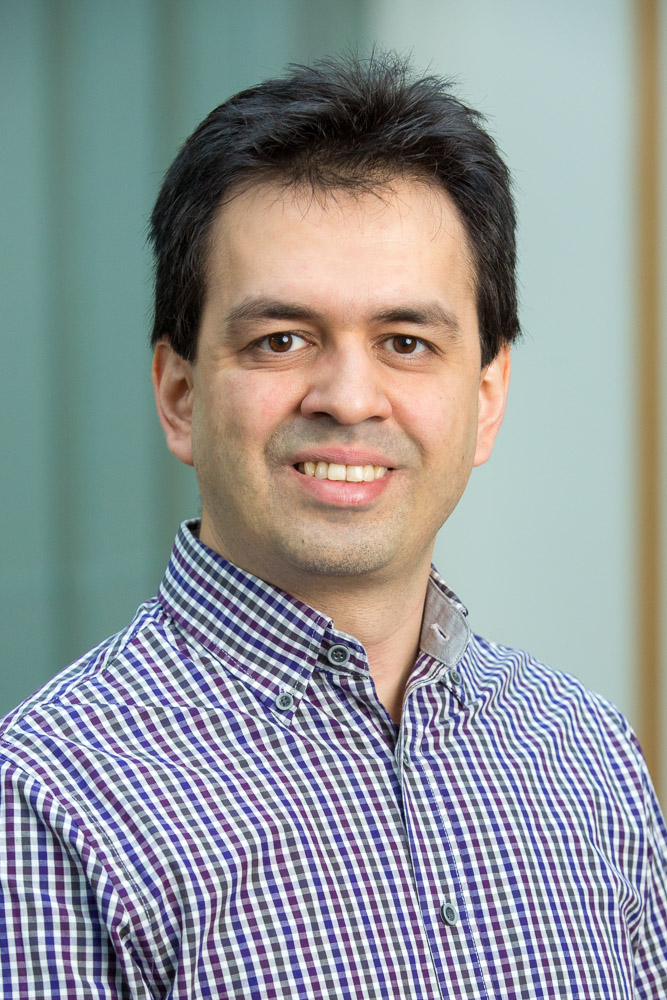
Per Lauvås is an Associate Professor at the Department of Computer Science, Faculty of Technology, Art and Design, Oslo Metropolitan University. His research and teaching focus on IT education, software engineering, and e-learning technologies. Key research areas include Software testing pedagogy Gamification in data modeling education Interactive web development tools Cloud computing and cybersecurity Assessment innovations in database courses Work-integrated learning for IT students Recent publications explore AI chatbots in education, employer prioritization of IT graduates, and gamified learning tools. His work emphasizes student-centered approaches and practical skill development. Contact: pelau8806@oslomet.no
Attila Bekkvik Szentirmai is an Assistant Professor and Ph.D. research fellow at the Department of Design, Norwegian University of Science and Technology (NTNU), focusing on Universal Design of ICT, Human-Computer Interaction, and Augmented Reality (AR) development. With prior academic roles at the University of Agder and Oslo Metropolitan University, his interdisciplinary background bridges Social Science, Art, Software Engineering, and Digital Health. He teaches Web of Things (IDG3006) and leads innovative AR projects like AReader (AR screen reader), ARachnoAID (phobia treatment), and guARdian (daily decision support). Current role: Assistant Professor at NTNU Research focus: Universal Design, AR/VR accessibility, e-Learning/e-Health Teaching: Web of Things (IDG3006) course coordinator Previous roles: Assistant Professor at University of Agder and OsloMet His recent publications emphasize accessible AR/VR design, including humor/ethics in technology, sustainable AR solutions, and critical analysis of accessibility paradoxes. Projects span education (SlidAR classroom presentations), health (CybAR sickness, ARachnoAID), and sustainability (HoloWatch, E-Waste gaming). All work aligns with universal design principles to ensure inclusivity across diverse user needs. Scientific contributions include developing new accessibility heuristics for AR, analyzing AI-AR integration for decision-making, and creating prototypes for banknote recognition and indoor navigation. His publications bridge theoretical research with practical implementations, often using Unity/Vuforia for development and cross-disciplinary collaboration. His XR Research & Development timeline highlights innovations such as Deadliest Animals (2017, first universally designed WebVR), UndARtheSkull (2019, brain anatomy education), and 2023 projects like Jedi fARt Pro (humorous AR), Meta IntARaction (Quest3 AR), and XR Portal (AR-VR integration). Current Ph.D. work focuses on evidence-based accessibility guidelines for AR, aiming to impact social inclusion, academic research, and industry UX practices.
Demetrio Arturo Ovalle Carranza is a Professor in the Department of Computer Science at the National University of Colombia's School of Engineering. With an academic career spanning over three decades since earning his PhD from Joseph Fourier University in Grenoble, France in 1991, he has established himself as a prominent researcher in multi-agent systems and educational technology. His research focuses on developing intelligent systems for education, particularly in the areas of multi-agent architectures, adaptive learning environments, context-aware educational applications, and learning object recommendation systems. His work bridges artificial intelligence with practical educational applications, creating systems that adapt to individual learner needs and contexts. Analysis of his recent publications (2015-2020) reveals a strong trend toward developing sophisticated multi-agent systems for educational applications, with increasing emphasis on context-awareness, personalization, and adaptive learning techniques. His research demonstrates consistent evolution from foundational multi-agent work to sophisticated educational applications integrating fuzzy logic, ontologies, and collaborative filtering. Ovalle Carranza has mentored numerous researchers who have become active contributors in the field, including Oscar M. Salazar, Néstor D. Duque, Valentina Tabares Morales, and others who frequently appear as co-authors on his publications. His collaborative network extends across Colombian institutions and international research groups. His laboratory work centers around developing and testing multi-agent educational systems, with particular emphasis on creating adaptive learning environments that can respond to individual student needs and group dynamics. Current projects appear to focus on serious games, health-care applications of intelligent agents, and advanced recommendation systems for educational resources.
Tomasz Pełech-Pilichowski serves as a Lecturer at the Institute of Computer Science within the Faculty of Computer Science at AGH University of Science and Technology in Kraków. He concurrently holds dual administrative leadership positions as Director of the AGH Recruitment Center and Rector's Representative for Recruitment, demonstrating significant institutional impact beyond his academic role. His research expertise spans artificial intelligence, natural language processing, and legal informatics with methodological foundations in deep learning and time series analysis. Recent work focuses on AI-driven solutions for legal text processing (text segmentation, hypertext law), educational technology (gamification, recruitment systems), and security applications (facial-age detection, anomaly identification). His interdisciplinary approach consistently bridges computer science with law, education, and environmental science through practical implementations. Analysis of his 2023-2025 publications reveals three dominant research trajectories: legal tech innovation (68% of output featuring text segmentation and regulatory automation), educational transformation (22% including gamified AI skill development), and security/environmental systems (10% covering IoT integration and pollution prediction). This progression shows increasing specialization in AI-NLP fusion techniques applied to domain-specific challenges, particularly within legal informatics where he has developed novel text recovery and visualization frameworks.
Dr. José Miguel Rojas is a Lecturer in Software Testing at the University of Sheffield's Department of Computer Science. He holds a PhD from the Technical University of Madrid and has held roles including Research Associate at the University of Sheffield and Lecturer at the University of Leicester. His research focuses on automated software testing, search-based techniques, and education in software engineering. Education: PhD in Software and Systems (Technical University of Madrid, 2013). Research Interests: Automated test generation, mutation testing, empirical software engineering, and teaching methodologies for testing. He leads the development of tools like EvoSuite and Code Defenders , which advance unit test generation and education through gamification. Key Publications include work on test suite generation effectiveness, mutation testing games, and accessibility testing for mobile apps. Awards include ACM Distinguished Paper Awards for contributions to testing methodologies. Grants: PI on EPSRC-funded projects like 'Accelerating Software Development using Gamification' and Co-PI on the UKRI Trustworthy Autonomous Systems Node. Labs/Teams: Active in the Testing Research Group and contributes to the Code Defenders educational platform.
Miloš Mravik is an academic affiliated with Singidunum University's Faculty of Informatics and Computing, specializing in research involving artificial intelligence, cybersecurity, and data science. He holds a doctoral degree in 'Advanced Protection Systems' from Singidunum University (2020–2023), preceded by a Master’s in 'Contemporary Information Technologies' (2018–2019) and a Bachelor’s in 'Informatics and Computing' (2014–2018). His work emphasizes applying machine learning techniques to real-world challenges like healthcare diagnostics, cybersecurity frameworks, and pandemic-era education systems. Research Interests: AI-driven cybersecurity solutions for IoT and blockchain Machine learning applications in health informatics Optimization of predictive algorithms using metaheuristics E-learning strategies during crises Recent articles focus on explainable AI for metaverse security, sentiment analysis using BERT models, and blockchain node detection via XGBoost. His work bridges theoretical computer science with practical applications in emergency education and pandemic response. No scientific awards listed. Advised no formally registered students. Active in conference organizing and software prototyping, as seen in projects like a scheduling web application and network management systems.
Mark Lindquist is an Associate Professor of Landscape Architecture at the University of Michigan’s School for Environment and Sustainability (SEAS), currently on sabbatical for Fall 2024. His research focuses on high-performance landscapes, integrating computation, data, and virtual/augmented reality to enhance urban green infrastructure planning and stakeholder decision-making. PhD, University of Sheffield (Landscape) MA, University of Toronto (Landscape Architecture) BS, University of Manitoba (Environmental Design) Lindquist’s work emphasizes urban sustainability through empirical studies on sensory simulation (e.g., audio fidelity in VR greenspaces), gamification of community design (Land.Info software), and multisensory evaluation of urban environments. His projects span Detroit, New Orleans, and Alberta, focusing on climate resilience and equitable community engagement. Key trends in his research include leveraging crowdsourcing for urban planning, using 3D visualization tools to democratize design processes, and quantifying ecosystem service tradeoffs through digital platforms. Collaborations with data scientists and software developers highlight his interdisciplinary approach. EAGER award, National Science Foundation McIntire Stennis Cooperative Forestry Research Program, USDA MCubed Grant, University of Michigan MakeCalgary Seed Grant URGC Seed Grant In Detroit’s Mack Ave Chandler Park community, Lindquist co-developed Land.Info, a Unity3D-based tool enabling residents to design vacant spaces with real-time cost and environmental impact feedback. The software was later expanded with NSF funding to gamify climate-resilient landscape design in underserved regions, partnering with local planning departments and landscape architecture firms.
Rosa Lanzilotti is a Full Professor in the Department of Computer Science at the University of Bari Aldo Moro, Italy, where she has established herself as a leading researcher in Human-Computer Interaction (HCI) and Usability Engineering. As a core member of the IVU (Interaction Visualization Usability and UX) Laboratory, she coordinates research on Usability Engineering and UX practices, and Human-Centered Artificial Intelligence. With over 90 publications in top-tier journals and conferences, her work bridges academic research with practical applications in industry and public institutions. Dr. Lanzilotti earned her PhD in Computer Science from the University of Bari in May 2006. Her doctoral research developed the ELSE (e-Learning Systematic Evaluation) methodology, which combines inspection and usability testing to achieve more reliable results for evaluating e-learning systems. She also pioneered Pattern-Based inspection techniques that guide evaluators through detailed evaluation patterns. Her research spans multiple domains including educational technology, cultural heritage, healthcare, and smart environments. She has designed and evaluated numerous educational games for mobile devices and large multi-touch displays, resulting in a patent (n. 1401512, 2013) for a multimedia framework supporting site visits. Her work in End-User Development (EUD) explores how non-technical users can customize systems in healthcare and cultural heritage contexts through participatory design with domain experts. Recent publications (2019-2024) show increasing focus on integrating AI with human-centered design, privacy considerations in UX, and cybersecurity applications of HCI principles, particularly for public administration systems. As an active member of the Italian Working Group on Usability (GLU), she works to improve public administration websites and advocate for explicit usability requirements in ICT procurement. Her conference service includes Technical Program Co-Chair for INTERACT 2021 and various leadership roles in AVI, IEEE SMC, and womENcourage conferences. She teaches courses including 'Interacting with Intelligent Systems' (Master's level), 'Human-Computer Interaction for AI' (PhD level), and various undergraduate courses on Human-Machine Interaction at the University of Bari.
Dr. Loutfouz Zaman is an Associate Professor in the Game Development and Interactive Media department at Ontario Tech University , part of the Faculty of Business and Information Technology . He holds a PhD in Computer Science with a focus on Human-Computer Interaction from York University. His research explores visual programming interfaces, game analytics, and extended reality technologies, with a focus on practical applications such as automated bug detection and user experience optimization. Dr. Zaman has collaborated on projects funded by MITACS, NSERC, and industry partners, addressing challenges in healthcare incident management, language learning gamification, and air traffic control simulation training. He teaches courses ranging from introductory game math to graduate-level topics in human-computer interaction and machine learning for game analytics. Education: Bachelor of Science in Computer Science (Software Systems) – Concordia University Master of Science in Computer Science (Human-Computer Interaction) – York University PhD in Computer Science (Human-Computer Interaction) – York University Research Interests: Dr. Zaman’s work spans user research in gaming, game evaluation methodologies, and emerging technologies like AR/VR. His team focuses on developing tools for visual game analytics and automated testing, with recent projects including mixed reality fitness gaming interfaces and deep learning-based bug detection systems. Grants & Collaborations: His industry partnerships include projects on healthcare incident management during pandemics, CRM gamification, and pet identification systems using computer vision. He actively seeks doctoral candidates to expand research in visual analytics, XR technologies, and automated bug detection. Labs & Affiliations: Dr. Zaman is affiliated with the Software and Informatics Research Centre (SIRC) and contributes to the university’s efforts in bridging academic research with real-world applications.
Antonio García Cabot is an Associate Professor in the Department of Computer Science at the University of Alcalá. His research focuses on artificial intelligence, educational technology, natural language processing, and mobile computing. He leads the INTELIA research group (Interaction Technologies and Artificial Intelligence Lab) and previously contributed to the PMI group (Intelligent Mobile Platforms). He earned his Doctorate in Computer Science from the University of Alcalá in 2013 with a thesis titled *Propuesta de un sistema multi-agente para la adaptación de contenidos docentes a las competencias, contexto y dispositivo del usuario*. His work emphasizes accessibility in digital education, gamification in MOOCs, and software engineering innovations like automated code repair using LLMs. Research trends in his 2024-2025 publications include: Advancing AI applications in educational assessment (e.g., automated question generation, distractor design) Improving mobile app usability through gesture-based interfaces and sensor integration Developing large language model-based tools for vulnerability repair and teacher simulation analysis Systematic reviews on digital competence ecosystems and multilingual AI systems His contributions to open educational resources (OER) and accessible virtual campuses have been widely adopted in Latin America. Current research extends into embedded systems education and olfactory stimuli impacts on mobile app performance.
Dominique Jaccard is a Professor at the Haute école d'Ingénierie et de Gestion du Canton de Vaud (HEIG-VD) , specifically within the Institut d'ingénierie des Médias (MEI) . He leads the Serious Games and Edtech Competency Group , focusing on digital pedagogy, learning analytics, and project management education through game-based approaches. Developed HUMAn real-time patient simulation model for emergency triage training Created the co.LAB collaborative framework for serious game development Secured major grants from Innosuisse and Swiss National Science Foundation Collaborated with institutions like University of Agder, Université de Genève, and Université de Fribourg Research Interests: His work bridges educational sciences and computer science , emphasizing: Digital games for emergency medicine and oncology training Systemic approaches to collaborative design processes Holistic learning analytics systems Overcoming development barriers for non-programmers Scientific Contributions: Through 15+ years of research, he has: Validated serious games as educational tools Developed adaptive simulation frameworks for healthcare Explored NLP integration in educational games Published in International Journal of Serious Games and JMIR Serious Games Implementation: His projects have created: WEGAS authoring system for rapid simulation game development PRITS software prototype for patient rights education co.LAB digital platform for cross-disciplinary collaboration
Haoqi Zhang is an Associate Professor at Northwestern University in Computer Science and Design, with offices at 2133 Sheridan Rd., Evanston, IL. He directs the Design, Technology, and Research (DTR) program and co-directs the Delta Lab with interdisciplinary collaborators. His work bridges Social Computing , Human-Computer Interaction , Artificial Intelligence , and Learning Science to create socio-technical systems advancing human values. Education: PhD in Computer Science from Harvard University (2012) BA in Computer Science and Economics from Harvard University (2007) Research interests focus on Computational Ecosystems that interweave community processes, social structures, and intelligent systems to promote values like self-direction , metacognition , and belonging . His projects include agile research studios for training researchers, opportunistic collective experiences for remote collaboration, and flexible coordination in crowdsourcing systems. Recent publications examine metacognitive learning in CS education, dialectical activities in HCI, and trust dynamics in crowdfunding. Supported by National Science Foundation grants in Cyber-Human Systems and Cyberlearning, plus Microsoft FUSE Labs and Northwestern institutional awards. Awards include Microsoft FUSE Labs Research Award Northwestern Office of the Provost Award for Digital Learning Notable Paper Award at HCOMP 2013 Best Paper Honorable Mention at CHI 2018 Mentors PhD students Kapil Garg and Gobi Dasu , while fostering over 100 students through DTR. Runs a Junior Faculty Support Group since 2022, providing emotional and professional support for early-career academics.
Derek Lomas is a researcher at Delft University of Technology’s Faculty of Industrial Design Engineering, specializing in Human-Centered Design and Human Technology Relations. He holds a PhD in Human-Computer Interaction from Carnegie Mellon University, an MFA in Social Design from UC San Diego, and a BA in Cognitive Science from Yale University. His research focuses on AI-driven wellbeing solutions, neurodesign, and educational technology. He leads projects like NeuroUX (mobile cognitive assessment software) and Zensus (patient wellness tracking), and has developed over 40 learning/assessment games. Key areas include music perception via EEG, AI alignment with human emotions, and design methodologies for positive AI. Education: B.A. Cognitive Science, Yale University, 2003 MFA Social Design, UC San Diego, 2009 PhD Human-Computer Interaction, Carnegie Mellon University, 2014 Research Interests: AI for wellbeing and mental health Neuroscience-driven design (EEG, brain-computer interfaces) AI ethics and human-AI interaction Game-based learning and assessment Key Projects: NeuroUX : Cognitive assessment software used in psychiatric research Zensus : AI-driven patient wellness monitoring system FactFlow : AI math fluency tool for children Vibe Research Labs : Exploring AI and positive human experiences Awards: Social Innovation Fellowship (PopTech) MacArthur Foundation Digital Media Learning Grant White House National STEM Game Competition McGinnis Business Plan Competition Winner Grants & Collaborations: Consultancy: Playpower Labs (UX, data science, software) Partnerships with UC San Diego, Brown University, and UT Austin
Dr. Gursimran Walia serves as Professor and Associate Dean for Academic Affairs in the School of Computer and Cyber Sciences at the University of Georgia. Their academic background includes a Ph.D. and Master of Science in Computer Science from Mississippi State University (2009 and 2006). They hold administrative roles in both the Department of Computer & Cyber Sciences and The Graduate School. Dr. Walia's academic contributions span multiple institutions and interdisciplinary initiatives. Educational Background Ph.D., Computer Science, Mississippi State University (2009) M.S.C., Computer Science, Mississippi State University (2006) Research Focus Dr. Walia's work centers on software engineering education, programming pedagogy, and human factors in software development. They develop novel tools like the Testing Tutor platform and Non-intrusive Classroom Attention Tracking System (NiCATS) . Their research emphasizes improving student learning outcomes through active learning strategies, gamification, and AI-driven education technologies. Key themes include: Software requirements engineering and error taxonomy development Classroom attention tracking using machine learning and eye-tracking Curriculum design for software testing and database systems Addressing industry-education gaps in CS graduate preparedness Professional Service Dr. Walia actively contributes to academic service through: Curriculum development initiatives Educational research funding proposals Reviewing for conferences and journals in software engineering education Innovation & Labs Their work involves: Designing cyberlearning environments for CS education Developing the WReSTT (Web-based Repository of Software Testing Tutorials) Advancing NiCATS classroom monitoring systems
Dr. Gergely Vakulya is an Associate Professor and Research Fellow at Óbuda University. He specializes in interdisciplinary research spanning cybersecurity, agricultural technology, sensor networks, and image processing. His work integrates hardware design, algorithm development, and real-world applications. Dr. Vakulya’s recent focus includes developing rumen bolus sensors for dairy cattle health monitoring, gamification of cybersecurity training, and innovative methods in camera exposure time measurement. He is affiliated with Óbuda University’s Budai Road and Pirosalma Street campuses, with an office at building F room 316. His research frequently addresses challenges in data collection, sensor fusion, and embedded systems. Research Interests: Dr. Vakulya’s expertise includes cybersecurity frameworks (e.g., CTF challenges), agricultural IoT systems (e.g., rumen bolus sensors for livestock monitoring), and image processing techniques (e.g., genetic algorithms for shape approximation). His work on visible light communication (VLC) and wireless sensor networks highlights his contributions to communication protocols and energy-efficient systems. Recent trends in his publications emphasize cross-disciplinary approaches, such as applying AI methods to agricultural sensor data and optimizing sensor networks for real-time applications. Advising & Grants: No specific advising relationships or grants are listed in available materials. His research infrastructure is likely supported through institutional and collaborative projects. Labs/Teams: While not explicitly stated, his research likely involves collaborations within Óbuda University’s engineering and computer science departments. His work on rumen sensors and VLC systems suggests potential affiliations with robotics, biomedical engineering, or smart agriculture research groups.