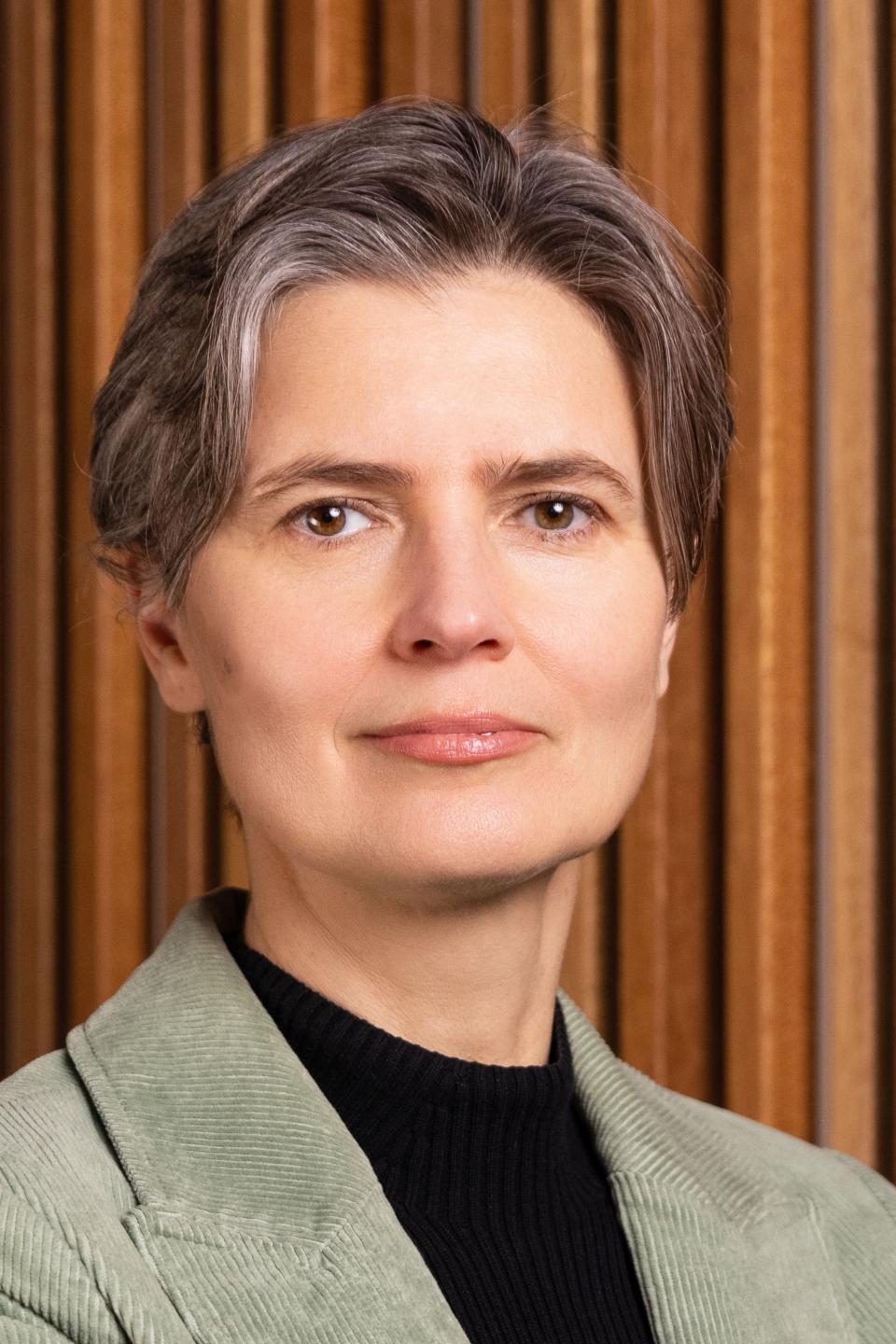
Elly Konijn is a Full Professor at the Faculty of Social Sciences and Humanities and Network Institute of Vrije Universiteit Amsterdam, holding the Fenna Diemer-Lindeboom Endowed Chair. As chair of the Media Psychology Amsterdam program, her work bridges media psychology, social robots, affective processing, and adolescent media use . Research Pillars : Relating to media figures, virtual humans, and social robots Media-based reality perceptions and moral standards Adolescent media effects (cyberbullying, video games, body image) Recent Publications explore emotional bonding with robots, narrative complexity in film, and media's impact on adolescent cognition. Her 2025 Communication Theory article introduces a framework for human-artificial others relationships. Scientific Recognition : KNAW/NWO Eurekaprijs (2015) Computable Award (2021) Network Institute Competitive Research Funding (2025) She supervises 16 PhD students and leads projects like ROBOT-BOND (ERC Advanced Grant 2025-2029) and Communicating with Social Robots (2020-2025). Her documentaries (e.g., Alice Cares ) translate research into public discourse.
Anna Grigolon is an Assistant Professor at the University of Twente , Netherlands, affiliated with the Transport Engineering and Management Research Group . Her research focuses on sustainable urban mobility , user-centric transport solutions , and travel behavior analysis using tools like discrete choice modeling , spatial analysis , and social psychology theories . Research Interests : Sustainable Urban Mobility Accessibility Modeling Travel Behavior Discrete Choice and Latent Class Modeling Spatial Analysis and GIS Shared Micromobility and Mobility Hubs Equity in Transport Planning Article Trends : Anna’s recent work (2025–2024) emphasizes mobility justice , 15-minute city transitions, and equity in transport access , particularly for marginalized communities like São Paulo favelas. She integrates digital tools (e.g., serious games, kiosks) and space-time metrics to evaluate mobility solutions. Projects : She currently leads the SmartHubs project and contributes to DREAMS and R-map , focusing on smart, equitable mobility systems in Europe and Saudi Arabia.
Justin Jansen is a Professor of Corporate Entrepreneurship at Rotterdam School of Management (RSM) within Erasmus University Rotterdam. Affiliated since 2001, his academic career spans over two decades. He holds a PhD in Management (2005) from Erasmus University. His research focuses on organizational growth, strategic renewal, and leadership dynamics in fast-growing firms. He co-founded the Erasmus Centre for Entrepreneurship (ECE) and pioneered the European ScaleUp Institute, fostering scale-up ecosystems across Europe. His work bridges academia and practice, addressing how organizations navigate paradoxes between exploration and exploitation. He has advised companies and governments on innovation strategies and entrepreneurial ecosystems. Editorships include Journal of Management Studies , and he’s an editorial board member of leading journals like Academy of Management Journal . Notable awards include the ERIM Best Paper Award and being named one of the world’s top entrepreneurship scholars. Research highlights include frameworks for scale-up DNA, leadership roles in ambidextrous organizations, and the role of social networks in corporate-startup collaborations. He co-developed BuildtoGrow, a venture applying research-based game-based learning tools for scaling organizations. Key collaborations include work with the European ScaleUp Institute and advisory roles for governmental agencies on entrepreneurial climate improvement. His 50+ publications span topics like absorptive capacity, strategic agility, and middle management roles in strategy implementation.
Hannah van Zanten is a Full Professor in Earth Systems and Global Change at Wageningen University & Research, specializing in sustainable food systems, regenerative agriculture, and biodiversity conservation. Her work emphasizes circular food systems, livestock production optimization, and environmental impact mitigation. She has received multiple awards, including the Storm-van der Chijs award (2015) and several Best Oral Presentation accolades at academic conferences. Her research spans topics like protein upcycling, soil biodiversity, and the environmental implications of livestock feed. She supervises PhD projects on regenerative agriculture, circular food transitions, and ecosystem services in South American grasslands. Recent projects include redesigning European food systems to enhance food security under climate change and modeling circularity impacts. Key research interests include: sustainable diets, land-use efficiency, and the integration of biodiversity conservation with agricultural practices. She has published extensively on topics like earthworm farming, circular protein systems, and the compatibility of animal-sourced foods with circular principles. Awards: 5 major prizes for academic contributions, including innovation in animal sciences and sustainability. Grants/Projects: Leading 19 active projects, including EU-funded initiatives on sustainable livestock and circular food system modeling. Labs/Teams: Collaborates with interdisciplinary teams on projects like SUSFANS (Sustainable Food Systems) and Re-Livestock (resilient livestock systems).
Dr. Debraj Roy is a Visiting Professor at the University of Amsterdam (UvA), affiliated with the Faculty of Science, Mathematics and Computer Science and the Informatics Institute. His research focuses on agent-based modeling, socio-economic dynamics, environmental resilience, and blockchain technology. He investigates complex systems such as urban slums, disaster recovery, and climate adaptation using computational methods like remote sensing and machine learning. His work bridges theory and practice, offering insights into policy design for sustainable development and social equity. Key research interests include slum dynamics, poverty traps, and the application of blockchain oracles for decentralized systems. He employs advanced techniques such as global sensitivity analysis and manifold learning to explore multi-scale socio-environmental challenges. His recent articles highlight trends in carbon pricing, flood risk valuation, and multi-agent systems. Earlier work concentrated on urban inequality in cities like Bangalore and Mexico City, leveraging geospatial and statistical tools. No scientific awards or grants are explicitly listed. His advising and team collaborations are unspecified in the provided text.
Dr. Joyce Delnoij is an Assistant Professor in the Department of Economics within the Faculty of Law, Economics and Governance at Utrecht University. She is affiliated with the Utrecht University School of Economics and conducts research under the university's Institutions for Open Societies (IOS) and Pathways to Sustainability (PtS) research themes. Her research focuses on experimental economics and behavioral game theory, with particular expertise in online marketplaces (including auctions and the sharing economy), sustainable decision making (particularly regarding protein and energy transitions), and interpersonal preferences (such as honesty, trust, and social norms). Her work combines theoretical game theory with empirical experimental methods to understand economic behavior in real-world contexts. Dr. Delnoij's publication record shows consistent high-quality output across leading economics and interdisciplinary journals. Her recent work demonstrates a clear trajectory from foundational auction theory toward more applied research on sustainability and social behavior. She has published in top journals including Proceedings of the National Academy of Sciences, Journal of Economic Behavior and Organization, and Economic Theory, with her research gaining significant attention as evidenced by citation metrics and media coverage. Her scholarly contributions span several interconnected domains: auction theory and market design, behavioral aspects of sharing economy platforms like Airbnb, sustainable consumption patterns, and social norm formation. This interdisciplinary approach positions her work at the intersection of economics, psychology, and policy-relevant research. Dr. Delnoij teaches courses in experimental economics and microeconomics, contributing to both undergraduate and graduate education at Utrecht University. Her research has been supported through various academic channels, though specific grant details are not provided in the available information.
Dr. Michiel Kamp is Assistant Professor of Musicology at Utrecht University's Department of Media and Culture Studies within the Faculty of Humanities. He holds a PhD from the University of Cambridge (2015) and co-founded the Ludomusicology research group. His research employs hermeneutic and semiotic approaches to analyze video game music and related audiovisual media. Key interests include musical transmediality, ubiquitous music, phenomenologies of listening, participatory culture, sound synchronization, ecological psychology, musical affordances, ludomusicality, and the aesthetics of background music. Publications focus on phenomenological approaches to game music, hermeneutic analyses of interactive soundtracks, and theoretical frameworks for understanding musical meaning across media platforms. Recent work explores VR audio experiences and historical perspectives on musical interfaces. Dr. Kamp has organized numerous international conferences on video game music and edited foundational publications in ludomusicology. His monograph Four Ways of Hearing Video Game Music presents a comprehensive theoretical framework for game music analysis.
Nicolas Cambier is a Visiting Professor at Vrije Universiteit Amsterdam, affiliated with the Faculty of Science's Artificial Intelligence department and the Network Institute. His research focuses on swarm robotics, collective behavior, and evolutionary systems. He explores topics like emergent communication, modular robotics, and prosociality in robotic swarms. Key areas include task-driven language evolution, adaptive decision-making, and environmental interaction in constrained environments. His work bridges theoretical models with practical implementations, emphasizing self-organization and cultural evolution in synthetic systems. Recent contributions address challenges in heterogeneous swarms, skill acquisition in modular robots, and decision-making without prior knowledge. He collaborates widely, with publications in IEEE Robotics and Automation Letters, Nature Communications, and top conferences like GECCO and Distributed Autonomous Robotic Systems. Research interests span robotics, artificial intelligence, and evolutionary computation, with applications to both theoretical frameworks and real-world robotic systems. His studies often involve agent-based simulations and embodied evolution approaches to understand complex collective phenomena.
Dr. Froukje Sleeswijk Visser is an Associate Professor in Service Design at Delft University of Technology's Industrial Design Engineering department, part of the Human-Centered Design group. She works part-time and focuses on public service design, empathy-driven methodologies, and co-design approaches. Her research emphasizes societal challenges, user participation, and empathic design practices. She advises ContextQueen, a consultancy firm, and collaborates on projects like MyFutures Lab (winner of the 2018 Hans Sauer Award). Education: PhD in Design Engineering (2009, TU Delft), Master’s in Industrial Design Engineering (Delft). Key roles include teaching courses like 'Contextmapping Skills' and 'Human-Centered Design and Beyond'. Research projects involve Innovation in Services, Empathic Future Visions, and Bubble Games exploring empathy design. Publications span over 50 peer-reviewed works since 2003, focusing on empathic design frameworks, service design deliverables, and collaborative research impacts. She advocates for bridging design research and industry practice, with notable contributions to contextmapping and empathic method taxonomies. Labs/Studios: Active in StudioLab (cross-pollination of research/education) and MyFutures (tools for personal future planning). Current projects explore VR for empathy-building and interdisciplinary design labels.
Joost Raessens is Professor of Media Theory at Utrecht University's Faculty of Humanities, Department of Media and Culture Studies, where he leads research in Media and Performance Studies. He coordinates the Horizon Europe-funded project STRATEGIES: Sustainable transition for Europe's game industries (2024-2028), focusing on how games, AI, and extended reality impact the climate crisis. His research spans several interconnected areas focused on the intersection of digital media, gaming, and environmental sustainability. Raessens explores how immersive experiences like Games and XR for Change contribute to advancing UN Sustainable Development Goals through his Green Media Studies framework. His work examines the environmental impact of the gaming industry while investigating how games can foster ecological citizenship and climate awareness. He has pioneered research on "ecogames" - games designed to engage players with climate crisis issues through playful perspectives. Raessens' recent publications reveal a clear trend toward examining gaming's dual role in the climate crisis - as both a contributor to environmental problems and a potential solution. His work analyzes how games like Collapsus, SpaceBuzz, and Symbiosis create meaningful engagement with ecological issues, while also addressing the carbon footprint of the gaming industry itself. This research sits at the intersection of game studies, environmental humanities, and digital media theory. His notable recognition includes: Incentive for the development of an International Master Degree Game Studies (2011) Raessens actively supervises multiple PhD projects including 'The becoming-playful of warfare in the Netherlands' (2021-2025) and 'Experiencing the past: Bridging art, history, and young people's media environment through multisensory XR engagement' (2022-2026). He leads significant research initiatives including the NWO-funded project on "Long-term consumer and community empowerment in energy applications through inclusive Game design, Artificial Intelligence and system Modelling" (2022-2026) and previously directed the Utrecht University Graduate Programme "Game Research" (2015-2021). He co-founded and directed the Utrecht Center for Game Research (2014-2024), creating a hub for interdisciplinary game studies that connected humanities scholars with computer scientists. This center facilitated numerous collaborative projects examining the societal impact of games, from persuasive gaming to citizen science applications.
Valentijn Visch is a researcher and academic at Delft University of Technology's Faculty of Industrial Design Engineering, specializing in Human-Centered Design and Society, Culture, and Critique. His work focuses on eHealth interventions, gamification in healthcare, and reducing health-related stigmas through innovative design solutions. He teaches courses such as 'eHealth Design for a Healthy Society' and 'Understanding Humans,' emphasizing interdisciplinary approaches to healthcare challenges. His research projects include developing embodied coaches for stroke rehabilitation, AI-driven healthcare decision-making frameworks, and inclusive eHealth tools for low socioeconomic populations. He has been recognized with awards like the Rehabilitation Year Award 2024 for his work on cardiac rehabilitation interventions and a CHI 2024 Best Paper Honourable Mention for studies on patient preferences in AI autonomy. Visch collaborates on initiatives like the 'Emotion Aware Car Seat' project, exploring human-technology interaction. His work bridges academic research with real-world applications, addressing gaps in healthcare accessibility and patient empowerment through technology.
Dr. Rick Dolphijn is an Associate Professor in Media and Performance Studies at Utrecht University's Faculty of Humanities. He holds concurrent roles as Honorary Professor at the University of Hong Kong (2017-2026) and Visiting Professor at the University of Barcelona (2019/2020). His research bridges continental philosophy (Deleuze, Serres), new materialism, posthumanism, and environmental humanities. He coordinates Utrecht’s Humanities Honours Program and leads international initiatives like the 'More-Than-Human City' exchange with HKU and the EU-funded CONVIVIUM project. Key projects include Food2Gather (HERA-funded food discourse analysis), IMAGINE (NORWAY-funded creative industries research), and the More-Than-Human Studies Lab co-founded with Gdańsk University. His work appears in journals like Continental Philosophy Review and books such as New Materialism: Interviews and Cartographies . Awards include the Vice Chancellor’s Visiting Professorship at Gdańsk (2024) and over 90 scholarly outputs. Research focuses on material culture, ecological thought, and interdisciplinary collaboration. Notable collaborations include editing works with Rosi Braidotti and organizing transnational academic exchanges. Current initiatives address sustainability, urban studies, and postcolonial critique through artistic and philosophical lenses.
Sal Hagen is a postdoctoral researcher at the Institute for Logic, Language and Computation (ILLC) at the University of Amsterdam, working within the Natural Language Processing & Digital Humanities group. His research focuses on the intersection of computational methods and cultural analysis, particularly examining online communities, political discourse, and meme culture. His educational background includes a Research Master's in Media Studies from the University of Amsterdam, for which he received the prestigious 2018 Internet Thesis Prize in the Internet & Social Sciences or Humanities category for his work "Here I Am, Praying to an Egyptian Frog: Exploring Political Fluidity on 4chan/pol/". He also won the Audience Award for his presentation at the ceremony. Hagen's research interests center on understanding the dynamics of online communities, with particular expertise in 4chan and related platforms. His work combines qualitative and quantitative approaches to analyze political discourse, far-right movements, and the evolution of memes across digital spaces. He examines how anonymity, platform architecture, and cultural context shape online interactions and political expression. His publication record demonstrates a consistent focus on tracing political movements through digital footprints, with particular attention to the interplay between platform-specific cultures and broader political trends. Hagen's work often bridges computational social science with cultural studies, creating methodologies that capture both the quantitative patterns and qualitative meanings of online discourse. Scientific Awards: 2018 Internet Thesis Prize (Internet & Social Sciences or Humanities category) Audience Award for presentation at Internet Thesis Prize ceremony Hagen has secured significant research funding, including an NWO PhD grant for humanities research running from 2019-2024. He has been involved in multiple research projects including the CAT4SMR project (2024), OILab (2017-present), and the ERC-funded ODYCCEUS project (2018-2019). As part of OILab (Online Intelligence Lab), Hagen contributes to research on online political subcultures, while his work on the CAT4SMR project focuses on stabilizing and developing tools for social media data collection and analysis. He is also the developer of the 4CAT Capture and Analysis Toolkit, which provides transparent and traceable methods for social media research.
National Research Institute for Mathematics and Computer ScienceNetherlands
Dr. Jie Li is a dual-career academic and creative professional with a PhD in Industrial Design Engineering from Delft University of Technology. As an HCI/UX researcher in industry and Adjunct Professor at multiple institutions, she bridges academia and practice through work on Extended Reality (XR) , Human-AI interactions , and user experience evaluation . Her ACM Interactions column 'Bits to Bites' explores interdisciplinary research methodologies. Education: MSc in Industrial Design Engineering, Delft University of Technology PhD in Industrial Design Engineering, Delft University of Technology (2019) Her research spans social VR platforms , AI-augmented cognition , and privacy-preserving emotion detection , with recent publications analyzing LLM-assisted game design , harassment detection in VR , and XR's impact on remote collaboration . She has received Best Demo Awards (2020, 2022) and the ACM Best Paper Award (2018). Notable trends in her work include emerging immersive technologies (XR, 6DoF displays), human-AI collaboration frameworks , and cross-domain applications from medical VR clinics to cultural heritage experiences . Her advocacy for synthetic UX research and asynchronous co-creation tools reflects industry-academia hybrid innovation. Scientific Awards: Best Demo Award (2020, ACM TVX/IMX 2020) Best Demo Award (2022, ACM Multimedia) ACM Best Paper Award (2018, ACM TVX) While maintaining active roles in CHI conference committees and guest lecturing , Jie also operates a Delft-based creative cake design business , demonstrating her commitment to interdisciplinary exploration and 'slash career' balance between technical research and artistic practice.
Adriana Iamnitchi is a Full Professor and Key Domain Chair for Computational Science at Maastricht University's Faculty of Science and Engineering, affiliated with the Department of Advanced Computing Sciences. Her research focuses on computational social science, social media dynamics, and misinformation detection. Her primary research interests include: Analysis of coordinated information campaigns across social platforms Development of LLM-based synthetic data generation for social media research Polarization quantification in multi-community networks Policy compliance frameworks for digital regulation (e.g., EU's Digital Services Act) Ethical AI applications for content moderation and transparency Her recent publications (2023-2025) demonstrate strong focus on: Cross-platform disinformation detection using multimodal embeddings Generative AI for synthetic social media datasets Quantitative analysis of toxicity monetization in creator economies Regulatory compliance automation for content transparency