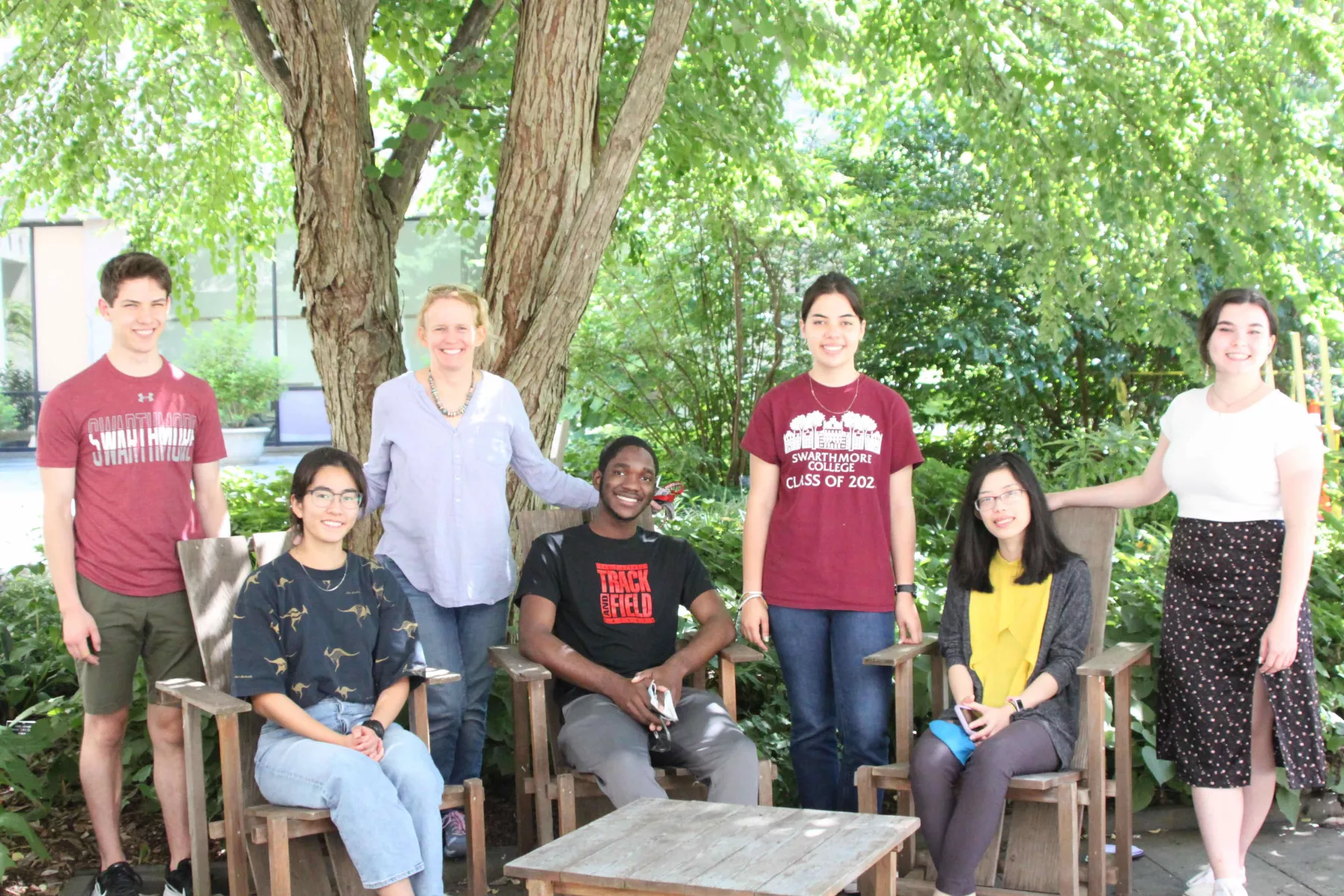
Kathleen Howard is a Professor of Physical Chemistry at Swarthmore College, specializing in biophysical chemistry and magnetic resonance spectroscopy. She holds the Edward Hicks Magill Professorship in Mathematics & Natural Sciences and operates the Howard Lab within the Chemistry and Biochemistry department. Education: A.B. in Chemistry, Princeton University Ph.D. in Chemistry, Yale University Postdoctoral Fellow in Chemistry, University of Pennsylvania Her research focuses on membrane-bound protein dynamics, particularly the influenza A M2 protein, using EPR and NMR spectroscopy. Publications highlight structural characterization, cholesterol interactions, and functional implications of protein domains. Scientific Awards & Funding: NSF-CAREER grant NIH funding Camille and Henry Dreyfus Foundation Merck/AAAS USRP HHMI support Lab members include undergraduate researchers (asterisked in publications) and alumni. The lab is located in Science Center 283, named after biochemist Maxine Frank Singer (Swarthmore Class of 1952).
Mirko Salewski is a Professor in the Department of Physics at the Technical University of Denmark (DTU), specializing in Plasma Physics and Fusion Energy. He is actively involved in international fusion research, working with major tokamaks and stellarators such as JET, ASDEX Upgrade, DIII-D, EAST, MAST, TCV, Wendelstein 7-X, and LHD. He serves as an ITER Scientist Fellow and chairs the ITPA Topical Group on Energetic Particle Physics, coordinating global research efforts to support ITER. Education: Dr. techn. in Plasma Physics, Technical University of Denmark (2020) PhD in Fluid Mechanics, Lund University (2007) MSc in Aerospace Engineering, Technical University of Berlin (2002) BSc in Mechanical Engineering, RWTH Aachen University (1998) Additional studies at University of Washington (2000–2001) and Moscow Aviation Institute (2000) His research focuses on developing advanced diagnostics for energetic particles in fusion plasmas using tomography in velocity- and phase-space. He integrates physics-informed models and neural networks to improve reconstruction accuracy. His work spans experimental diagnostics including fast-ion D-alpha spectroscopy, collective Thomson scattering, neutron and gamma-ray spectroscopy, neutral particle analyzers, fast-ion loss detectors, and ion cyclotron emission. Recent publications emphasize synthetic diagnostics, phase-space tomography, and AI-enhanced modeling, reflecting a strong trend toward data-driven and physics-integrated approaches in fusion research. His work is central to understanding fast-ion behavior in burning plasmas. Scientific Awards: ITER Scientist Fellow Professor Salewski supervises multiple PhD students and leads significant research projects funded by EU and national programs. His projects include fast-ion phase-space tomography in D-T plasmas at JET, AI applications in fusion tomography, and orbit-space sensitivity studies. He teaches courses in Electromagnetism, Plasma Physics, and the Physics of Sports at BSc, MSc, and PhD levels. He is affiliated with key fusion research networks and collaborates extensively with institutions across Europe, the US, and Asia, contributing to the global effort to realize fusion energy.
Vera Pfanzagl is a Research Fellow at the Institute of Biochemistry within the Department of Natural Sciences and Sustainable Resources at the University of Natural Resources and Life Sciences, Vienna (BOKU). She currently holds an Elise-Richter Fellowship and has been actively conducting research on heme peroxidases since completing her PhD through the BioToP program at BOKU. Her work bridges biochemistry, structural biology, and molecular biology with a focus on human enzymes involved in immune response and thyroid function. Dr. Pfanzagl's research centers on the structure-function relationship of human heme peroxidases, with particular emphasis on Myeloperoxidase (MPO), eosinophil peroxidase (EPO), and Thyroid peroxidase (TPO). Her laboratory employs a multidisciplinary approach combining biochemical analysis , X-ray crystallography , and molecular biology techniques to unravel the fine structural differences between these enzymes. A significant portion of her work focuses on understanding TPO's role in thyroid hormone production and its involvement in Hashimoto's disease, where it serves as a primary auto-antigen. Analysis of her recent publications reveals a strong focus on structural characterization of peroxidases , enzyme mechanism studies , and inhibitor design . Her research spans fundamental enzymology to potential therapeutic applications, particularly in understanding autoimmune disorders related to peroxidase function. The consistent use of X-ray crystallography alongside biochemical and spectroscopic methods demonstrates her commitment to obtaining atomic-level understanding of these enzymes. Principal Investigator for FWF project 'biochemistry and structure of thyroid peroxidase' (2024-2027) Project Staff for FWF project 'SPIN – a novel scaffold for the design of inhibitors for human peroxidases' (2020-2025) Reviewer for Journal of Biological Chemistry (2024) and Journal of Molecular Recognition (2021) Member of organization committee for 11th Human Peroxidase Meeting (2019) Dr. Pfanzagl has successfully supervised six Master's theses on related topics, demonstrating her commitment to research mentoring. Her students have investigated areas including unnatural amino acid integration, peroxidase inhibition mechanisms, and heme reconstitution in thyroid peroxidase. Her research program is supported by competitive funding from the Austrian Science Fund (FWF), indicating the high quality and significance of her work in the field of peroxidase biochemistry.
Kristoffer Hougaard Madsen is a Professor at the Department of Applied Mathematics and Computer Science , Technical University of Denmark (DTU), specializing in Visual Computing and Cognitive Systems . His work focuses on brain function mapping using functional MRI (fMRI), with expertise in fMRI data analysis, study design, and noise reduction techniques. Education: Civil Engineer (Bioinformatics & Complex Systems) from DTU (2004) External Position: Danish Research Centre for Magnetic Resonance, Copenhagen University Hospital Hvidovre (since 2008) His research spans neuroimaging , brain network modeling , and neuromodulation techniques like transcranial magnetic stimulation (TMS) and deep brain stimulation (DBS). He supervises PhD projects on topics such as individual brain circuit modeling , cerebellum organization in schizophrenia , and cooperation behavior in children . Recent publications highlight his contributions to electric field optimization , time-dependent diffusion imaging for tumors, and high-resolution mapping of brain structures . His work aligns with UN Sustainable Development Goals related to health and well-being. He collaborates extensively with institutions like Copenhagen University Hospital and contributes to interdisciplinary research in neurodegenerative diseases (e.g., Parkinson’s, Multiple Sclerosis) and psychiatric disorders .
Eric Majzoub is a Professor in the Department of Physics and Astronomy at the University of Missouri–St. Louis (UMSL), with a joint appointment in the Department of Chemistry and Biochemistry. He has been a faculty member since 2007, advancing to Full Professor in 2015, and served as Associate Director of the Center for Nanoscience from 2011 to 2016. Education: Ph.D., Physics, Washington University (2000) B.S., Physics, Washington University (1993) His research lies at the intersection of computational and experimental materials physics, focusing on energy storage materials such as complex hydrides for hydrogen storage and novel anode materials for Li-ion batteries. He employs advanced computational techniques including density functional theory (DFT) , Monte Carlo simulations for crystal structure prediction, and first-principles quantum chemistry . Experimentally, his group uses NMR , neutron scattering , and Raman spectroscopy to characterize material behavior. Recently, his interests have expanded into theoretical areas such as large-N matrix quantum mechanics , non-commutative geometry , and AdS/CFT correspondence . His most recent publications (2022–2014) reflect a strong trend in hydrogen storage materials , particularly in complex hydrides (e.g., NaAlH 4 , LiBH 4 , Ca(BH 4 ) 2 ) and intermetallic alloys (e.g., Mg-Ni, V-Ti-Cr systems). A key theme is the use of nanoporous confinement to control decomposition pathways, suppress unwanted byproducts like diborane, and enhance kinetics. Several studies combine experimental validation with computational modeling to understand thermodynamics and diffusion mechanisms. While no scientific awards are listed in the provided text, his extensive publication record in high-impact journals such as Acta Materialia , Journal of Physical Chemistry C , and Physical Review B underscores his significant contributions to the field. Dr. Majzoub teaches a range of courses including Quantum Mechanics I & II , Introduction to Quantum Mechanics , Computational Physics , and Solid State Physics . He also leads a graduate Journal Club. He advises students in both experimental and computational projects, though specific advisees are not named. His group specializes in developing novel crystal structure prediction methods using Monte Carlo techniques. There is no mention of current grants, but his research has clearly involved collaboration with national labs and experimental teams. He is actively involved in research and teaching, with no indication of retirement or part-time status.
Claudia Gusenbauer (Dipl.-Ing.Dr.) is a Senior Scientist and University Assistant at the Institut für Holztechnologie und Nachwachsende Rohstoffe of the University of Natural Resources and Life Sciences (BOKU), Vienna. Her research focuses on biobased material design , particularly through nanostructural analysis of wood components using atomic force microscopy (AFM) and chemical force microscopy . She has held research positions at the University of Cambridge (2022) and Lehigh University (2019). Research Highlights: Biobased wood coatings using cellulose nanocrystals High-resolution nanoscale characterization of wood surfaces Surface chemistry of lignocellulosic materials Applications of AFM in renewable resource analysis Scientific Recognition: Danubius Young Scientist Award (2021) Knowledge creates the future Prize (2021) BOKU Best Talent Award (2018) Academic Contributions: She has published extensively on wood nanotechnology, presented at international conferences (e.g., EPNOE, ISWFPC), and supervised master's theses on topics like reaction wood characterization and chemical force titration methods.
Cristina Ramona Cudalbu Moldovan is a Senior Lecturer and Researcher at École Polytechnique Fédérale de Lausanne (EPFL), where she serves as Head of Unit at the Center for Biomedical Imaging (CIBM), Animal Imaging and Technology (AIT) section. She is affiliated with the School of Basic Sciences and contributes to teaching in the Doctoral Program in Physics (EDPY) and the School of Physics (SPH). Her work integrates advanced MRI and MRS techniques to study brain metabolism and neurological complications of liver disease. Institution: École Polytechnique Fédérale de Lausanne (EPFL) School: School of Basic Sciences Department: CIBM - MRI Technologies Research Section Roles: Head of Unit, Senior Lecturer, Researcher Her research focuses on in vivo magnetic resonance spectroscopy (MRS) and imaging at ultra-high magnetic fields (up to 14.1T), with applications in hepatic encephalopathy, glioma, brain energy metabolism, and neurochemical profiling. She investigates metabolic alterations in animal models of liver disease, brain tumors, and neurodegenerative conditions, often employing multimodal imaging approaches such as 1 H, 31 P, and 13 C MRS, as well as PET and DTI. Her work emphasizes translational neuroscience and methodological innovation in spectral quantification and data acquisition. The most recent publications demonstrate a strong trend toward understanding metabolic dysregulation in hepatic encephalopathy, particularly focusing on ammonia toxicity, oxidative stress, and therapeutic interventions like urease inhibition and creatine supplementation. She also contributes significantly to methodological consensus in MRS, promoting standardization across research centers. Her articles span high-impact journals in neuroscience, radiology, and metabolism, reflecting interdisciplinary collaboration and technical rigor. She has supervised several PhD students, including Jessie Julie Mosso, Veronika Rackayová, and Dunja Simicic, whose theses reflect the lab’s focus on brain metabolism in liver disease and glioma. She is actively involved in expert task forces and collaborative networks such as ENIGMA, shaping best practices in neuroimaging. While no specific scientific awards are listed in the provided text, her leadership in consensus guidelines and high-impact publications underscores her recognition in the field. Her academic background includes a PhD from University Claude-Bernard Lyon 1, France, and a Master of Science in Biophysics and Medical Physics from University Babes-Bolyai, Romania. She has been continuously active at EPFL since 2007, progressing from postdoctoral researcher to senior leadership in imaging research. She leads a research unit at CIBM-AIT, which provides translational MR neuroimaging and spectroscopy services and training, emphasizing preclinical ultra-high-field MRI systems.
Melissa Catanese is a Visiting Critic in the Department of Art at Cornell University’s College of Architecture, Art, and Planning, and a full-time lecturer in studio arts at the University of Pittsburgh. She also holds visiting faculty positions at Image Text Ithaca MFA (Ithaca College), Hartford Art School Photography MFA, and the International Center for Photography. Her educational and professional background centers on photography, image-making, and artist’s books. She has contributed to major publications such as The Photographer's Playbook (Aperture, 2014), Words Without Pictures (Aperture, 2010), Photographers Looking At Photographs (Pier 24, 2020), and Photo No-Nos (Aperture, 2021), reflecting her deep engagement with photographic theory and pedagogy. Melissa Catanese’s research and artistic practice explore the psychological and narrative potential of photographs, particularly found and vernacular imagery. Her work investigates themes of alienation, memory, authorship, and ecological change through carefully sequenced visual constellations. She transforms individual images into immersive, poetic experiences that evoke speculative fiction, surrealism, and emotional resonance. Her recent publications and exhibitions, including The Lottery (2023), Fever Field (2023–2025), and inclusion in Widening the Lens at Carnegie Museum of Art, demonstrate a consistent trajectory toward examining the intersection of personal and collective trauma, environmental fragility, and the regenerative power of image-making. Her work bridges intuitive editing with conceptual depth, creating nonlinear narratives that challenge linear time and fixed meaning. Scientific and Artistic Recognition: Recipient of the Heinz Endowment Creative Development Award Shortlisted for the Paris Photo-Aperture Foundation PhotoBook Awards Shortlisted for the Foam Paul Huf Award Advising and Grants: While no formal PhD or Master’s students are listed, Catanese actively mentors through her teaching roles at multiple institutions and through her leadership at Spaces Corners, an artist-run project space. She has likely guided numerous emerging artists through workshops, critiques, and collaborative projects. Her work has been supported by institutional exhibitions and print editions, including a special release through Light Work, indicating grant or funding support for production and dissemination. Labs and Creative Teams: She is the founder and co-organizer of Spaces Corners , an artist-run photography bookshop and project space in Pittsburgh, Pennsylvania. This initiative serves as a hub for experimental publishing, community engagement, and curatorial experimentation, functioning as a de facto lab for photographic innovation and discourse.
Bernard Lanz is a Researcher at the CIBM-AIT (Animal Imaging and Technology) unit within École Polytechnique Fédérale de Lausanne (EPFL) , with concurrent Lecturer roles in the EDPY-ENS and SB-SPH-ENS teaching programs. His work integrates Magnetic Resonance Spectroscopy (MRS) , Positron Emission Tomography (PET) , and mathematical modeling to study brain energy metabolism , neuroglial interactions , and metabolic flux dynamics in health and disease. Research Interests : Neuroenergetics : Quantifying glucose and lactate metabolism in rodent models of liver disease and cancer. Metabolic Imaging : Developing hyperpolarized C-13 glucose techniques for real-time metabolic tracking. Brain-Liver Axis : Investigating metabolic disruptions in hepatic encephalopathy via in vivo PET-MRS. Publication Trends : Recent work focuses on ultrahigh-field MRI , FLASH radiotherapy effects , and cross-disease metabolic comparisons (Alzheimer’s, glioblastoma, depressive disorders). Collaborative studies emphasize methodological innovation in MRS quantification and neurochemical modeling . Teaching & Supervision : Co-teaches MRI Practicals and Translational MR Neuroimaging courses. Advises PhD student Siviglia Alessio . Labs & Teams : Affiliated with the CIBM center and EPFL’s Swiss School of Physics units, contributing to interdisciplinary research in biomedical imaging .
Professor Liviu Chioncel leads the Theoretical Physics III group at the Institute of Physics, University of Augsburg, affiliated with the Faculty of Mathematics, Natural Sciences, and Materials Engineering. His research focuses on strongly correlated electronic systems, combining theoretical frameworks like Dynamical Mean-Field Theory (DMFT) with computational methods to study quantum materials, spintronics, and transport phenomena. Research Interests: Key areas include electronic structure calculations of correlated materials, momentum density analysis via Compton scattering and positron annihilation, non-equilibrium transport in nanodevices, half-metallic magnetism, and cluster-based quantum many-body approaches. His work bridges fundamental theory with applications in next-generation electronic and spintronic devices. Publication Trends: Recent articles (2021–2025) emphasize kagome magnets, high-entropy alloys, and correlated electron transport. Predominant themes include topological magnetism, Fermi surface engineering, and advanced computational techniques (e.g., DFT+DMFT). This reflects a focus on quantum materials design and electron correlation effects in solids. Team & Advising: Dr. Chioncel supervises PhD candidates (Dylan Jones, Shreyas Nadiger) and collaborates with postdoctoral researchers. His group investigates condensed matter systems using analytical and numerical tools, with projects spanning from ab initio methods to experimental spectroscopy validation.
Jan Klärs is an Associate Professor at the MESA+ Institute, University of Twente, specializing in Adaptive Quantum Optics. His work bridges quantum mechanics and photonics, with a focus on Bose-Einstein condensates and optical resonator systems. Research interests include Photon Bose-Einstein condensation Quantum particle dynamics Non-Hermitian phase transitions Thermodynamics of quantum systems Waveguide and microcavity engineering Article trends reveal a focus on quantum thermodynamics, computational methods (e.g., Schrödinger equation inversion), and synchronization phenomena in photon condensates. His work spans theoretical and experimental approaches, with applications in energy-efficient computing and quantum fluid dynamics. Scientific awards include 1st Prize, University Competition 'Patente Erfinder' (2010) Dissertation Prize in Physics (2012) Klärs leads the Adaptive Quantum Optics group at MESA+ Institute, conducting experiments on photon gases and developing novel cooling and alignment techniques for optical systems. His research has been featured in media outlets discussing quantum-inspired energy efficiency.
Miao-Jung Yvonne Ou is a Professor in the Department of Mathematical Sciences at the University of Delaware, with affiliated faculty status in the Department of Biomedical Engineering. She is based in 508 Ewing Hall, Newark, DE, and actively contributes to research and graduate education in applied mathematics. Research Interests: Her work centers on inverse and direct scattering in composite and poroelastic materials, partial and integral differential equations, homogenization theory, and the application of Herglotz-Nevanlinna functions in systems with memory. She applies these to material sciences, particularly in modeling wave propagation and effective properties in complex media such as bones and porous composites. Her recent publications (2023–2015) show a strong trend in numerical methods (e.g., discontinuous Galerkin, RKHS regularization), wave modeling in poroelastic and dispersive media, and inverse problems in biomedical and geophysical contexts. She frequently employs advanced mathematical tools like fractional calculus, spectral analysis, and integral representations to address real-world physical systems. Scientific Engagement: She is currently part of the EU RISE EXPOWER project (2021–2025), promoting international research exchange in mathematics. She teaches graduate courses such as Math 508: Introduction to Complex Variables and Applications. Advising and Grants: She supervises graduate student research projects in areas like efficient quadrature for fractional derivatives, RKHS frameworks, spectral analysis of poroelastic waves, and NMR imaging. Funding includes the EU RISE grant, supporting collaborative research and student involvement. Laboratories and Teams: She collaborates with interdisciplinary teams in applied mathematics, biomedical engineering, and computational science. Her work with the MADNESS project and poroelastic wave modeling indicates active participation in high-performance scientific computing and modeling environments.
Janne Kananen is a Clinical Researcher at the University of Oulu , affiliated with the Faculty of Medicine and the Clinical Neurophysiology department. Holding dual expertise in medicine and technology, he investigates neurological disorders through interdisciplinary approaches, supported by the Research Council of Finland. His work bridges clinical neurophysiology with computational methods, focusing on physiological brain activity across various states. Education: Ph.D., M.D., and M.Sc.(Tech.) from University of Oulu Research Focus: Epilepsy, Narcolepsy, Sleep Disorders, Dementia Techniques: Magnetic Resonance Encephalography (MREG), EEG, NIRS Harnessing fast functional MRI and multimodal scanning environments, his research aims to establish baseline brain activity patterns for improved disease markers and treatments. Key topics span brain physiology, glymphatic system dynamics, and neurovascular coupling mechanisms. Scientific publications demonstrate consistent contributions to journals like Scientific Reports and Frontiers in Neuroscience , addressing physiological brain pulsations, their interactions with BOLD signals, and implications for neurological conditions.
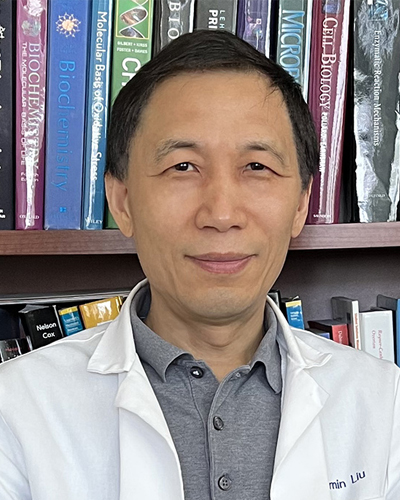
Aimin Liu is a Professor of Chemistry and Lutcher Brown Distinguished Chair in Biochemistry at the University of Texas at San Antonio (UTSA) College of Sciences. His research focuses on metalloprotein chemistry, enzymology, and redox regulation. Education: Ph.D. in Biochemistry and Biophysics, Stockholm University B.S. in Chemistry, University of Science and Technology of China Research interests include: Metal-driven cofactor biosynthesis and protein-derived cofactor formation Mechanistic enzymology of oxygen activation and C–H/C–C/C–X bond transformations Redox regulation in cellular signaling and metabolism Amino acid metabolism (tryptophan, tyrosine, cysteine) and natural product pathways Structural and spectroscopic analysis of enzyme intermediates Key article trends show expertise in metalloenzyme mechanisms, with emphasis on: Heme and non-heme iron chemistry Free radical and diradical intermediates Crystallographic and spectroscopic methods Biological charge resonance phenomena Redox sensing and signal transduction Enzyme engineering and mechanistic probes Scientific awards include: AAAS Fellow (2021) Royal Society of Chemistry Fellow (2021) NSF Accomplishment-Based Renewal award (2022) Georgia Research Alliance Distinguished Cancer Scholar (2009) Current grants include NIH R01GM152982 (2024-2028), NSF CHE-2204225 (2022-2025), and Welch Foundation AX-2110-20250403 (2025-2028). He leads the Metalloprotein Research Laboratory, integrating advanced spectroscopies, mass spectrometry, and structural biology to study metal-enzyme interactions.
Narek Hovsepyan is a Hill Assistant Professor in the Department of Mathematics at Rutgers University within the School of Arts and Sciences. His research spans applied mathematics, mathematical physics, and computational analysis, focusing on wave propagation, inverse problems, and analytic continuation techniques. Education: PhD from Temple University (advisor: Yury Grabovsky), MSc from University of Bonn (advisor: Juan J. L. Velázquez), BSc from Yerevan State University (advisor: Hakop Hakopian) Research: Scattering theory, nonlinear optical phenomena, quasiconvex analysis, and spectral methods Activities: Co-organizer of the Applied and Computational Mathematics Seminar since 2023, visiting researcher at Institut Fourier (Université Grenoble Alpes) in 2024 Contact: nh507@rutgers.edu, narek.hovsepyan@rutgers.edu